
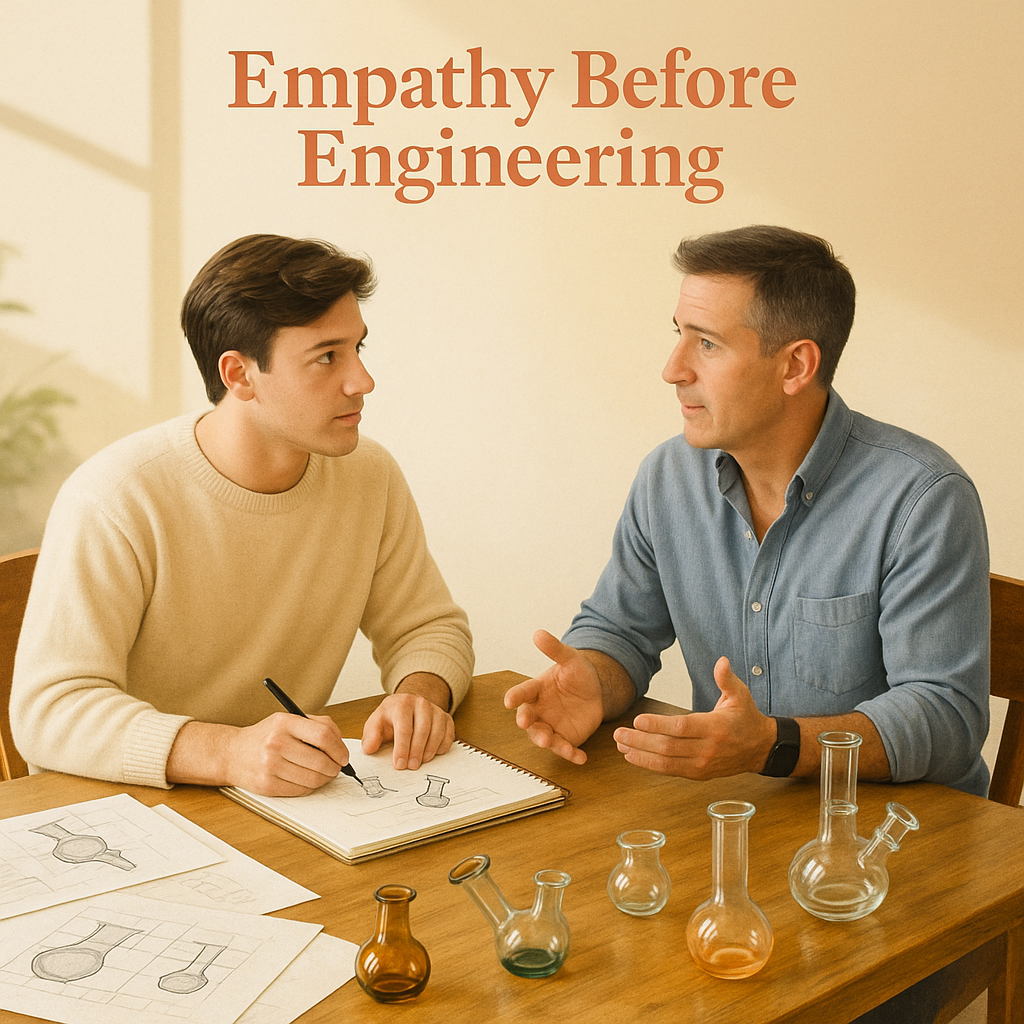
In the glass pipes industry, our core design philosophy is “Empathy Before Engineering.”
We’ve found that many brand founders, product designers, and CEOs care deeply about the “why” behind their products, not just the “how.”
They need more than an order processor; they need a partner who thinks like a brand creator.
This is where our commitment to empathy before engineering truly shines.
The Disconnect: Beyond Blueprints and Specifications
Most products fail not from poor engineering, but because they solve problems no one has or create experiences no one wants.
When manufacturers rely solely on technical files, the customer’s true voice—their frustrations and aspirations—gets lost.
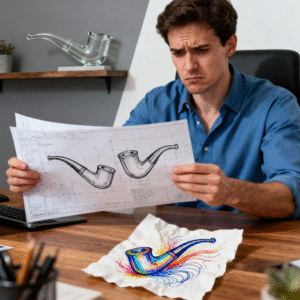
A client provides detailed CAD files, but nowhere in that data is the answer to the most critical question: How should this product make someone feel?
This oversight is the root of the disconnect. I’ve seen it happen too many times—a brilliant idea, full of soul on the napkin sketch, ending up as just another lifeless product on the shelf.
Believe me, watching a great vision get compromised by a process that doesn’t care is a hard lesson.
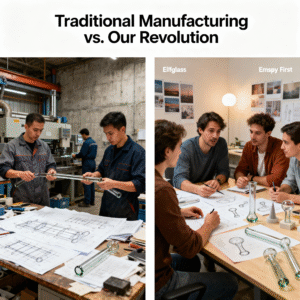
Traditional Manufacturing vs. Our Revolution
The conventional manufacturing process is fundamentally flawed because it starts with the how instead of the why.
It treats creation as a simple, transactional task, leading to predictable failures in user connection.
We started a revolution by reversing the process.
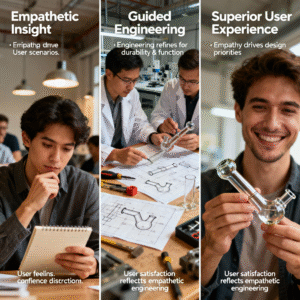
The Bridge: How Empathy Translates to Superior Engineering
Our philosophy isn’t just talk; it’s a practical framework that creates better products.
By prioritizing empathy, we gather critical data that directly informs our engineering decisions.
This approach, central to disciplines like Human-Centered Design, ensures that function serves feeling.
Here’s how our “Empathy-First” process works:
Empathetic Insight → Guided Engineering → Superior User Experience
- Scenario 1: The Goal is a “Solid, Reliable” Feeling
- Empathetic Insight: The user needs to feel confidence and trust in the product’s durability.
- Engineering Decisions: We select thicker glass walls. We strategically adjust the center of gravity to create a substantial, balanced weight in the hand.
- Result: A product that feels premium and trustworthy, a quality a spec sheet could never define.
- Scenario 2: The Goal is a “Private, Quiet Moment”
- Empathetic Insight: The user experience must be discreet and unobtrusive.
- Engineering Decisions: We optimize airflow geometry. We design internal pathways to minimize turbulence and noise.
- Result: A product that delivers its function with an elegance and quietness that respects the user’s context.
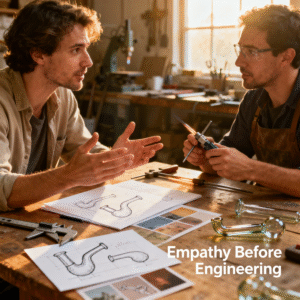
Demand a Better Partnership
You should not be forced to separate your creative vision from the realities of production.
A true partner must be fluent in both languages—seamlessly translating the emotional landscape of your dream into the precise requirements of manufacturing.
“Empathy Before Engineering” is our promise.
It is our commitment to being the most fluent interpreter of your vision, ensuring that the final product not only works perfectly but feels exactly right.
Frequently Asked Questions (FAQ)
Q: How will “Empathy Before Engineering” affect the cost of a project?
A: Our philosophy is about investing in certainty to prevent the most expensive problems: market failure or late-stage redesigns.
By understanding the desired experience from day one, we make smarter engineering decisions that eliminate costly sampling rounds and ensure the final product resonates with customers, delivering a much higher return on your investment.
Q: Can you give an example of this philosophy applied in a real project?
A: A client came to us with a design for a new hand pipe wanting to evoke “sturdy, traditional craftsmanship.
This single insight became our guide.
Instead of just meeting specs, we adjusted the glass thickness and center of gravity to give it a more substantial, balanced weight.
This decision, born from empathy, transformed a correct item into a product that feels intuitively reliable and premium.
Q: What if your team’s suggestions conflict with my original design?
A: We view it as the start of a crucial conversation, not a conflict. Our role is to be your technical partner.
We will transparently present our findings, explaining why we’re making a recommendation, and work collaboratively with you to find the best solution that honors your original intent.
The final decision always rests with you.
