

There’s an old saying in business: “Revenue is vanity, profit is sanity.”
Many brands celebrate impressive sales figures while struggling with paper-thin margins.
The difference between a struggling business and a thriving one often lies in using smart sourcing strategies to unlock hidden opportunities within the supply chain.
Thinking strategically about how you source products can transform your bottom line.
It’s about shifting your mindset from simply buying inventory to building an efficient, profit-driven supply ecosystem.
This guide will reveal five smart sourcing strategies that will help you think like a CFO and unlock the hidden profit in your business.

Strategy #1: A Smart Sourcing Strategy for Negotiations
Amateurs negotiate the unit price; professionals negotiate the entire partnership.
While shaving a few cents off a product is a small win, one of the most effective smart sourcing strategies involves negotiating better terms that can fundamentally improve your business’s financial health and cash flow.
Think of it this way: a good unit price saves you money, but great terms make you money by freeing up capital you can reinvest for growth.
| The Amateur Negotiator (Leaves Money on the Table) | The Pro Negotiator (Maximizes Profit Margins) |
| Focus: Argues only for the lowest unit price. | Focus: Discusses the entire value package. |
| Payment: Accepts a 50% down payment as standard. | Payment: Negotiates for Net 30 or Net 60 terms to improve cash flow. |
| Volume: Places orders without future incentives. | Volume: Secures tiered pricing that rewards growth with automatic discounts. |
| Shipping: Accepts whatever freight cost is quoted. | Shipping: Negotiates FOB terms or freight cost sharing for large orders. |
| Partnership: Views the relationship as purely transactional. | Partnership: Discusses co-op marketing support and exclusive territory rights. |
Actionable Tip: Before your next negotiation, create a list of non-price terms that would benefit your business and present them as part of a total partnership package.

Strategy #2: Optimize Your Product Portfolio with the 80/20 Rule
The Pareto Principle states that roughly 80% of your profit likely comes from just 20% of your products.
A core component of smart sourcing strategies is to stop spreading your purchasing power thin and instead focus it on these “profit powerhouses.”
Here’s a simple, three-step guide to applying this principle:
- Step 1: Analyze Your Data Go through your sales data for the last 6-12 months. For each product (SKU), calculate its gross profit margin and its sales velocity. If you need help, you can find excellent guides on calculating profit margins from resources like Entrepreneur magazine.
- Step 2: Identify Your Winners and Losers Categorize your products into four groups:
- High Margin, High Velocity: Your superstars.
- High Margin, Low Velocity: Good products that may need better marketing.
- Low Margin, High Velocity: Necessary traffic drivers, but don’t over-invest.
- Low Margin, Low Velocity: Your “shelf warmers.” These tie up cash and space.
- Step 3: Focus Your Sourcing Budget Shift your purchasing power heavily toward your “superstar” products. Look for ways to supplement them with high-margin accessories. This portfolio analysis is one of the most impactful smart sourcing strategies you can implement.

Strategy #3: Strategically Consolidate Your Freight
Shipping is one of the biggest and most volatile costs for any wholesaler.
Strategic freight consolidation—combining multiple smaller orders into fewer, larger shipments—is a powerful way to reduce your per-unit shipping costs by 20-40%.
Instead of placing small, reactive orders, a proactive approach saves thousands.
Planning ahead allows you to take advantage of economies of scale, like using Less-than-Container Load (LCL) shipping.
This is especially crucial when dealing with the <a href=”https://glasspipessourcing.com/the-hidden-costs-of-cheap-shipping-and-how-a-true-partner-mitigates-them/“>hidden costs of “cheap” shipping.
Key Consolidation Tactics:
- Develop a Forecast: Create a predictable ordering schedule based on sales forecasts.
- Batch Your Orders: Group orders from the same supplier or geographic region together.
- Communicate with Your Partner: Work with your supplier to align orders for maximum efficiency. This communication is key to all smart sourcing strategies.
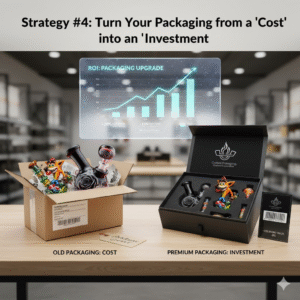
Strategy #4: Turn Your Packaging from a “Cost” into an “Investment”
Many businesses see packaging as a pure cost to be minimized.
This is a critical mistake.
Smart wholesalers understand that a modest investment in quality packaging delivers an exponential return by preventing the much higher costs of product damage.
This approach is one of the most overlooked smart sourcing strategies.
Let’s do the math. The financial argument is undeniable:
- The Scenario: A business ships $500,000 in fragile products annually with an average damage rate of 3%.
- The Hidden Cost: That 3% rate equals $15,000 in direct losses from broken merchandise, return shipping, and lost customer trust.
- The Smart Investment: Spending an extra $0.75 per shipment on better protective materials might cost $3,000 annually.
- The Return: If that investment reduces the damage rate to just 1%, you save $10,000 in direct losses for a net gain of **$7,000** to your bottom line.
Beyond damage prevention, a premium unboxing experience is a powerful marketing tool that turns a cost center into a profit-generating asset.
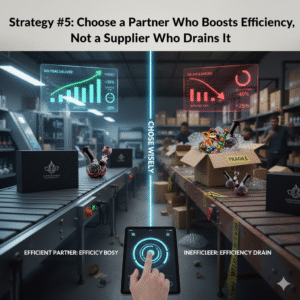
Strategy #5: Choose a Partner Who Boosts Efficiency, Not a Supplier Who Drains It
The final, and most crucial, of our smart sourcing strategies is to understand the immense difference between a transactional “supplier” and a strategic “partner.”
A bad supplier costs you far more than the price on an invoice; they cost you your most valuable asset—time.
Believe me, I have seen founders lose weeks of their year managing crises that a good partner would have prevented.
Every hour spent chasing a late shipment or arguing about quality is an hour you didn’t spend growing your business.
The True Cost of a Bad Supplier
- Time Wasted: Chasing emails, tracking orders, and managing crises.
- Money Lost: Paying for rush shipping, replacing defective goods, and losing sales from stockouts.
- Energy Drained: Constant stress prevents you from focusing on strategy.
A true partner saves you that time.
They communicate proactively, maintain rigorous quality control, and solve problems before they reach you.
That reclaimed time is money you can invest to maximize your profit margins.
Conclusion: Start Implementing These Smart Sourcing Strategies
You now have the framework to build a more efficient and collaborative supply chain.
Maximizing margins isn’t about squeezing a supplier; it’s about implementing smart sourcing strategies that create value for everyone.
The right manufacturing partner is the cornerstone of this approach.
They provide not just a product, but a partnership that frees your time and capital to focus on what matters most: building a profitable, sustainable brand.
Building a profitable brand starts with a smart sourcing strategy.
Let’s build a smarter supply chain together.
Frequently Asked Questions (FAQ)
Q: Is consolidating shipments with one supplier always the best way to save money?
A: Not always.
While consolidation is one of the most powerful smart sourcing strategies, it’s a trade-off. It can sometimes lead to longer wait times.
The best approach is to consolidate when possible without creating stockouts of high-demand items.
Q: How often should I renegotiate terms with my supplier?
A: Look for key trigger points.
The best times to renegotiate are: 1) When you are significantly increasing your order volume, 2)Before renewing a long-term contract, or 3) When market conditions have changed significantly in your favor.
Q: What is a good gross margin for a smoke shop?
A: It varies, but a healthy gross margin is typically in the 50% to 70% range.
Core products like high-end glass often have higher margins.
The key is to manage your product portfolio to achieve a strong average margin.
