

You’re holding a beautiful design sketch, a concept that is perfectly clear in your mind.
But how do you ensure a factory thousands of miles away sees the exact same picture?
This guide will show you what is a tech pack and why it’s the most important document for protecting your design.
The fear of being misunderstood is real.
A single undefined measurement can lead to costly errors and a final sample that looks nothing like your vision.
Fortunately, there is a universal language in manufacturing designed to solve this: the “Tech Pack.”
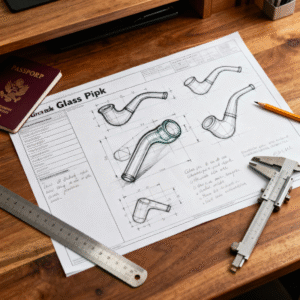
What is a Tech Pack? Your Design’s Official Passport
Think of a tech pack as your product’s passport.
It’s a comprehensive instruction manual containing every technical detail a manufacturer needs to bring your design to life exactly as you intended.
This document bridges the gap between creative concept and physical reality, ensuring that from Shenzhen to Los Angeles, everyone is working from the same script.
At its core, a tech pack transforms subjective ideas into objective, measurable instructions that eliminate guesswork.

Why a Good Tech Pack is Your Brand’s Best Insurance
Investing time in creating a clear tech pack is one of the smartest decisions a founder can make.
It protects you from common pitfalls and sets your project up for success from day one.
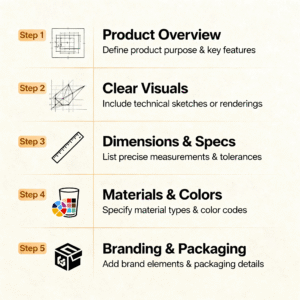
How to Create Your First Basic Tech Pack: The 5 Core Elements
Creating a tech pack doesn’t require an engineering degree; it requires clarity.
Your goal is to create a document so clear that, as the saying goes, “a three-year-old could understand it.”
This ensures that even with language barriers, your instructions are unmistakable.
Here are the five essential steps to follow.
Step 1: Product Overview
This is the cover page of your blueprint. It provides the fundamental identity of your product.
Product Name: A clear, descriptive name.
SKU: A unique code for your product if you have multiple designs.
Brief Description: A single sentence explaining the product’s main function.
For example: “Borosilicate Glass Water Pipe – Premium smoking accessory with dual-chamber filtration system.
Company Info: Include your company name, logo, and contact information.
Step 2: Clear Visuals
This is the heart of your tech pack. Your visuals must be precise and easy to read.
Provide Multiple Views: Include drawings from the front, back, side, and top.
Label Everything: Clearly point out and name each component of your design.
Use Clear Lines: While professional tools like Adobe Illustrator are the industry standard, a clean, well-lit photo of a precise hand-drawn sketch is far better than a vague digital illustration.
Remember, clarity is more important than artistic skill.
Step 3: Dimensions & Specs
Precision is everything in this section. Avoid vague terms and provide exact numbers.
Label All Critical Dimensions: Include height, width, diameter, wall thickness, and joint sizes.
Use Consistent Units: Millimeters (mm) are the standard for most manufacturing. Stick to one unit to avoid confusion.
Be Specific: Instead of “make it a bit thicker,” write “Glass Wall Thickness: 4mm.”
Believe me, I learned this the hard way—a single undefined measurement on my first project led to a sample that was completely wrong, wasting weeks of time and a lot of money.
Step 4: Materials & Colors
This section defines the physical substance of your product.
Specify Exact Materials: Don’t just write “glass.” Write “High-Grade Borosilicate Glass 3.3.”
Use Color Codes: For any colored elements, provide universal Pantone (PMS) color codes to ensure perfect matching.
Detail Finishes: Specify any textures or finishes, such as “matte finish” or “electroplated.”
Step 5: Branding & Packaging
Define how your brand will be represented on the final product.
Logo Placement: Show the exact position and size of your logo on the visual diagrams.
Application Method: Specify how the logo should be applied (e.g., etched, screen-printed, decal).
Packaging Requirements: Detail your basic needs for the box, protective materials, or any included accessories.
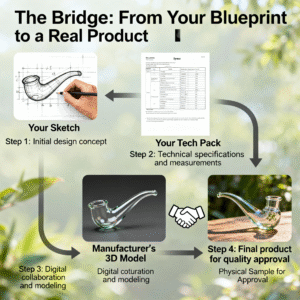
The Bridge: From Your Blueprint to a Real Product
Remember, your first tech pack doesn’t need to be perfect.
Its goal is to be as clear as possible.
A true manufacturing partner won’t just passively receive this document; they will collaborate with you to refine it.
The process transforms your initial vision into a production-ready reality.
The Manufacturing Journey
Your Sketch → Your Tech Pack → Manufacturer’s 3D Model → Physical Sample for Approval
When you submit your design to a team like ours at Elfglass, our engineers will review it and help you optimize the details for manufacturability.
This collaborative step is what bridges the gap between a great idea and a great product.
Conclusion: You Are Ready to Build
You are no longer just a dreamer with a sketch.
You now have the power to translate your vision into the professional language of manufacturing.
The tech pack is the tool that will protect your idea on its journey across the globe, ensuring it is never misinterpreted or compromised.
With these five core elements, you are ready to take the most important and solid step toward turning your idea into a reality.
Feeling more confident? Download our free Tech Pack template to get started, or submit your basic design to our team and we’ll help you build it together.
Frequently Asked Questions (FAQ)
Q: Do I need to be a professional designer to create a tech pack?
A: Absolutely not! The goal of a basic tech pack is clarity, not artistic perfection.
A clear, hand-drawn sketch with multiple views and precise measurements is far more valuable to a manufacturer than a beautiful but vague illustration.
As long as you can clearly communicate the core elements, you can create an effective tech pack.
Q: What is the most common mistake people make when creating a tech pack?
A: The single most common and costly mistake is ambiguity.
This often shows up as vague measurements (like “make it bigger”), missing views (only showing the front), or unspecified materials (just “glass” instead of “Borosilicate Glass”).
Every ambiguity is a potential production error, so be as specific as possible.
Q: How detailed does my first tech pack need to be?
A: It doesn’t need to be a 50-page engineering document. Your first tech pack simply needs to be complete enough to get an accurate quote and a correct first sample.
Focus on covering the five core elements: Product Overview, Clear Visuals, Dimensions & Specs, Materials & Colors, and Branding & Packaging.
A good manufacturing partner will review it and help you fill in any technical gaps.
