
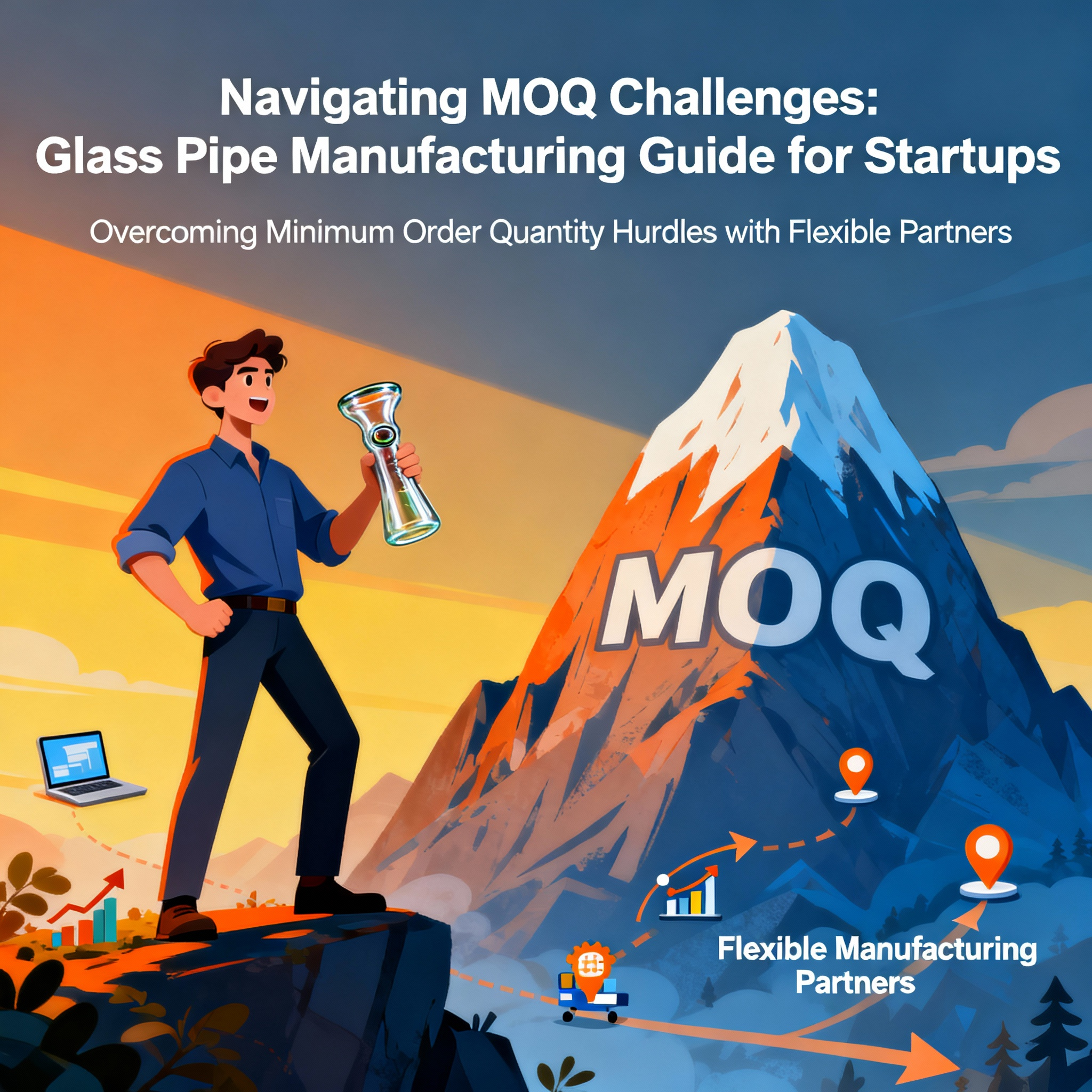
You’ve spent months perfecting your product.
Your passion is undeniable, and you’re ready to bring your vision to the world.
Then, reality hits: MOQ.
For a new brand, a factory’s Minimum Order Quantity can feel like an insurmountable mountain.
But what if you knew how to navigate it?
This guide explains what the minimum order quantity for glass pipes is and provides a practical guide for start-ups to find flexible partners.
What is MOQ? (And Why Do Factories Need It?)
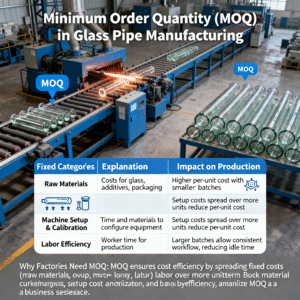
First, let’s demystify the term. An MOQ, or Minimum Order Quantity, is the smallest number of units a manufacturer is willing to produce in a single production run.
While it can feel like a personal rejection, it’s actually rooted in the fundamental economics of manufacturing.
Think of it as a matter of shared efficiency.
Every production run has significant fixed costs that exist whether you’re making 50 pieces or 5,000.
A Look Inside the Factory: Why MOQs are a Business Necessity
Understanding this logic is the first step: an MOQ isn’t a wall designed to keep you out; it’s a baseline for a sustainable business partnership.
The “Big Factory” Problem: When High MOQs Kill Startup Dreams
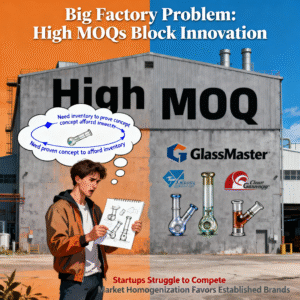
While MOQs are a business reality, inflexible MOQ policies have become one of the biggest barriers to innovation.
When a factory rigidly enforces a high minimum, they don’t just reject an order; they potentially eliminate the next breakthrough product.
This institutional bias towards established brands creates a frustrating paradox: you need inventory to prove your concept, but you need a proven concept to afford the inventory.
This mismatch doesn’t just hurt individual entrepreneurs; it homogenizes the entire market, ensuring only the most well-funded and conventional ideas survive.
It’s a loss for everyone when a brilliant, visionary product never sees the light of day.
The Bridge: A Partnership Approach to MOQs
A true partner sees your potential, not just your first order size.
At Elfglass, we believe an MOQ should be a starting point for a conversation, not an ending.
Believe me, as someone who has seen countless brilliant ideas stall at this exact hurdle, I know that the right partner invests in your future, not just your first transaction.
Our flexible approach is built on creative problem-solving and a shared belief in your vision.
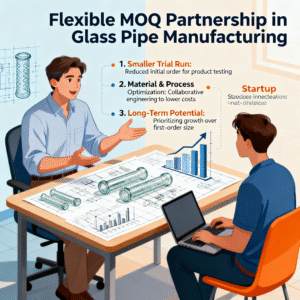
Three Strategic Pathways for Startups:
- The Smaller Trial Run: We can support a smaller, initial production run designed specifically for you to test the market.This allows you to gather crucial customer feedback and validate demand before committing to a larger investment.
- Material & Process Optimization: Our engineering experts will collaborate with you.Together, we can analyze your design to see if alternative materials or slight process adjustments could lower the production minimum without compromising your product’s quality or integrity.
- Long-Term Potential over First-Order Size: We look at the whole picture.If you have a clear vision, a solid plan, and a commitment to growth, we’re ready to invest in that potential.We build relationships, not just process orders.
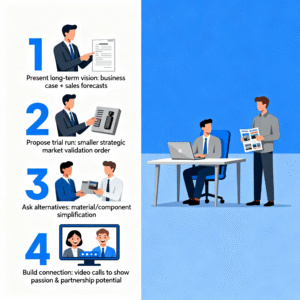
As a Founder, How Should You Discuss the MOQ Issue?
Empower yourself by approaching the MOQ conversation not as a plea for an exception, but as a strategic negotiation between business partners.
Here is a step-by-step guide to framing the discussion for success.
Your 4-Step Guide to Negotiating MOQs:
Step 1: Present Your Long-Term Vision Don’t just send a design file; send a business case.
Share your marketing plan, sales forecasts, and future product roadmap.
When a manufacturer sees your potential for long-term, repeat business, they are far more likely to be flexible on the first order.
Step 2: Propose a Smaller, Strategic Trial Run Frame your request as a “market validation order.”
Explain that this smaller batch is a crucial step in your data-driven process and that its success will unlock larger, full-MOQ orders in the near future.
Step 3: Ask About Creative Alternatives Show you understand their constraints by asking collaborative questions. ”
Is there an alternative material that has a lower purchasing minimum?” or “If we simplify this one component, could it help us meet the MOQ for the other parts?”
Step 4: Build a Human Connection Move beyond price-focused emails.
Get on a video call. Let them see your passion.
A supplier who sees genuine partnership potential is far more willing to find a creative solution that helps you both succeed in the long run.
Your Vision, Not Your Order Size, Defines Your Success
Your breakthrough product, your clever market strategy, and your commitment to solving a real customer problem—that’s what truly matters.
The most successful brands in history didn’t start with unlimited capital; they started with unlimited determination and found partners who believed in them.
Elfglass was founded to bridge this exact gap between startup ambition and manufacturing reality.
We are here to ensure that MOQ barriers become collaborative stepping stones toward your brand’s growth.
Don’t let a number stand in the way of your dream. Talk to our team about your project, and let’s find a flexible path forward, together.
Frequently Asked Questions (FAQ)
Q: Is a larger order quantity always cheaper per unit?
A: Generally, yes, due to economies of scale. The fixed costs of a production run (like machine setup and tooling) get spread across more units, lowering the cost for each item.
However, this isn’t an infinite rule.
After a certain volume, the price reduction may become very small.
It’s always best to discuss specific price tiers with your manufacturing partner.
Q: Can I negotiate the MOQ with a manufacturer?
A: Absolutely. You should view the stated MOQ not as a rigid wall, but as the start of a conversation.
A true manufacturing partner is willing to listen and explore flexible solutions.
You can negotiate by being transparent about your long-term vision, asking for a smaller trial run, or exploring if alternative materials could lower the production requirement.
Q: What is the difference between MOQ (Minimum Order Quantity) and MOV (Minimum Order Value)?
A: It’s a great question.
- MOQ (Minimum Order Quantity) refers to the minimum number of units of a specific product a factory will produce (e.g., 500 pieces of one design).
- MOV (Minimum Order Value) refers to the minimum total price of an order a supplier will accept (e.g., a $3,000 order). You could meet an MOV by ordering a mix of different products, as long as the total value hits that threshold.
