
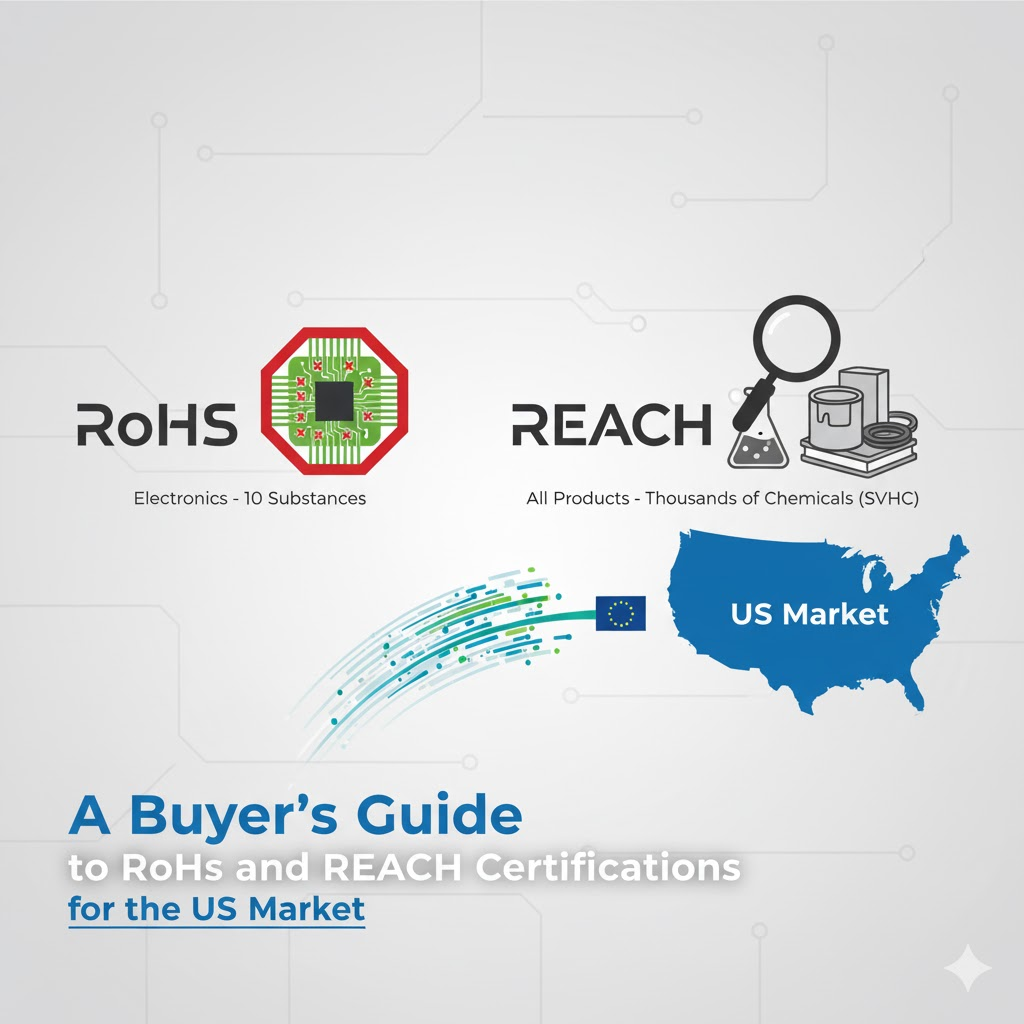
As a US buyer, you might not think you need to ask “what is rohs certification?”
Your focus is naturally on domestic regulations like the TSCA or California’s Prop 65. So, why should you care about two EU-based regulations, RoHS and REACH?
The answer is simple: global markets and supply chain integrity.
If you ever plan to sell your products internationally, these EU standards are non-negotiable for accessing one of the world’s largest markets.
More importantly, even if you only sell in the US, RoHS and REACH have become the de facto global standards for high-quality, safe manufacturing.
Understanding them is the best way to vet a supplier’s quality.
This guide is written for you, the US buyer. We’ll answer “what is rohs certification” and how it impacts your business.
What is RoHS Certification? — The Global “Electronics Safety” Standard
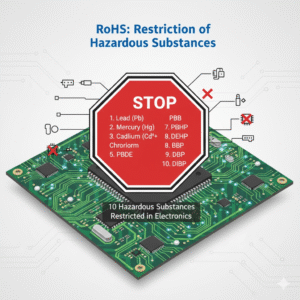
RoHS (Restriction of Hazardous Substances) is an EU directive that acts as a protective barrier, limiting specific hazardous materials in electrical and electronic equipment (EEE).
Its primary goal is to prevent the health and environmental risks from electronic waste.
The directive specifically restricts ten substances, but the most well-known are:
- Lead (Pb)
- Mercury (Hg)
- Cadmium (Cd)
- Hexavalent Chromium (Cr6+)
For official details, you can always refer to the EU’s official RoHS Directive page.
Its Relation to Your Products (Even in the US)
A basic borosilicate glass pipe isn’t electronic.
However, the modern accessory market is full of hybrid products.
This is where what is RoHS certification becomes critical.
If your brand sells any of the following, compliance is mandatory for EU sales and a strong quality signal in the US:
- Electronic nails (E-nails)
- Vaporizers
- Grinders with LED lights
- Any device with a battery or charging port
Believe me, I’ve seen US brands get this wrong.
They assume US-only sales protect them, only to find their supply chain is using non-compliant components that could pose a risk, or they are completely blocked when they try to expand.
What is REACH? — The “Great Encyclopedia” of Chemical Safety
If RoHS is a focused rulebook, REACH (Registration, Evaluation, Authorisation and Restriction of Chemicals) is the entire library.
It is a sweeping EU regulation governing tens of thousands of chemical substances.
Unlike RoHS, REACH applies to chemical substances in almost all products imported into the EU.
Its core principle is simple: the burden of proof is on companies to demonstrate that the chemicals they use are safe.
REACH is not a one-time certificate; it’s an ongoing regulatory process. The European Chemicals Agency (ECHA) updates its list of “Substances of Very High Concern” (SVHCs) twice a year. You can follow these updates directly on the ECHA’s official website.
Its Relation to Your Products
REACH compliance applies to every non-glass component of your product, including:
- Coatings, paints, or decorative finishes
- Metal alloys
- Rubber or silicone O-rings and seals
- Adhesives
A supplier who is REACH-compliant is actively monitoring their entire supply chain, which is a powerful indicator of their overall quality control—a critical factor for any US buyer.
RoHS vs. REACH: Understanding the Core Differences at a Glance
For a US buyer, it’s easy to confuse these two.
Both are about safety, but they operate very differently.
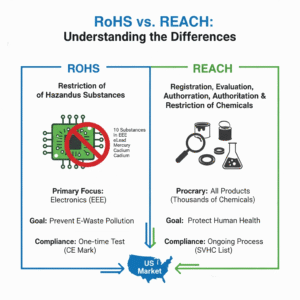
Confusing what is RoHS certification (a focused rule for electronics) with REACH (a broad rule for all chemicals) is a common mistake.
Here is a simple breakdown:
The Bridge: Why Your Manufacturing Partner Must Be Fluent in These Standards
A good partner doesn’t just make your product; they ensure it’s market-ready globally.
When your manufacturer is fluent in RoHS and REACH, it’s your first line of defense.
They are what stands between you and costly mistakes.
A partner who shrugs off compliance or doesn’t understand these rules is a major red flag.
They aren’t just saving costs; they are transferring a massive legal and financial risk directly to your brand.
Conclusion (Empowerment)
Compliance isn’t a scary hurdle; it’s the hallmark of a high-quality, responsible brand.
By understanding these basics from a US buyer’s perspective, you can now have more intelligent conversations with suppliers, ask for the right documentation (even if you’re not selling in the EU yet), and confidently choose a partner who will help you build a global, future-proof brand.
Don’t let compliance issues become a barrier to your brand’s growth.
Partner with a manufacturer who prioritizes global standards.
Contact Elfglass to build a product that’s ready for any market.
Frequently Asked Questions (FAQs)
Q: Do glass pipes need to be RoHS compliant?
A: A basic glass pipe itself generally does not, as it isn’t classified as an “electrical or electronic product.”
However, if the product includes any electronic components—such as LED lights, e-nails, or attached vaporizers—then those specific components must be RoHS compliant to be sold in the EU and are a strong quality indicator for the US market.
Q: Is REACH a one-time certification?
A: No, REACH is an ongoing regulatory process, not a one-time certificate.
Compliance must be continuous because the SVHC (Substances of Very High Concern) list is updated by the European Chemicals Agency (ECHA) twice a year.
A good supplier must constantly monitor these updates.
Q: How can I verify a supplier’s certificate is real?
A: This is a critical step.
First, ask for the full, detailed test report, not just the summary certificate.
Check the issuing laboratory; it should be an accredited, internationally recognized body (like SGS, TÜV Rheinland, Intertek, or Eurofins).
Most legitimate reports have a unique certificate number or QR code that you can use to verify its authenticity on the laboratory’s official website.
