
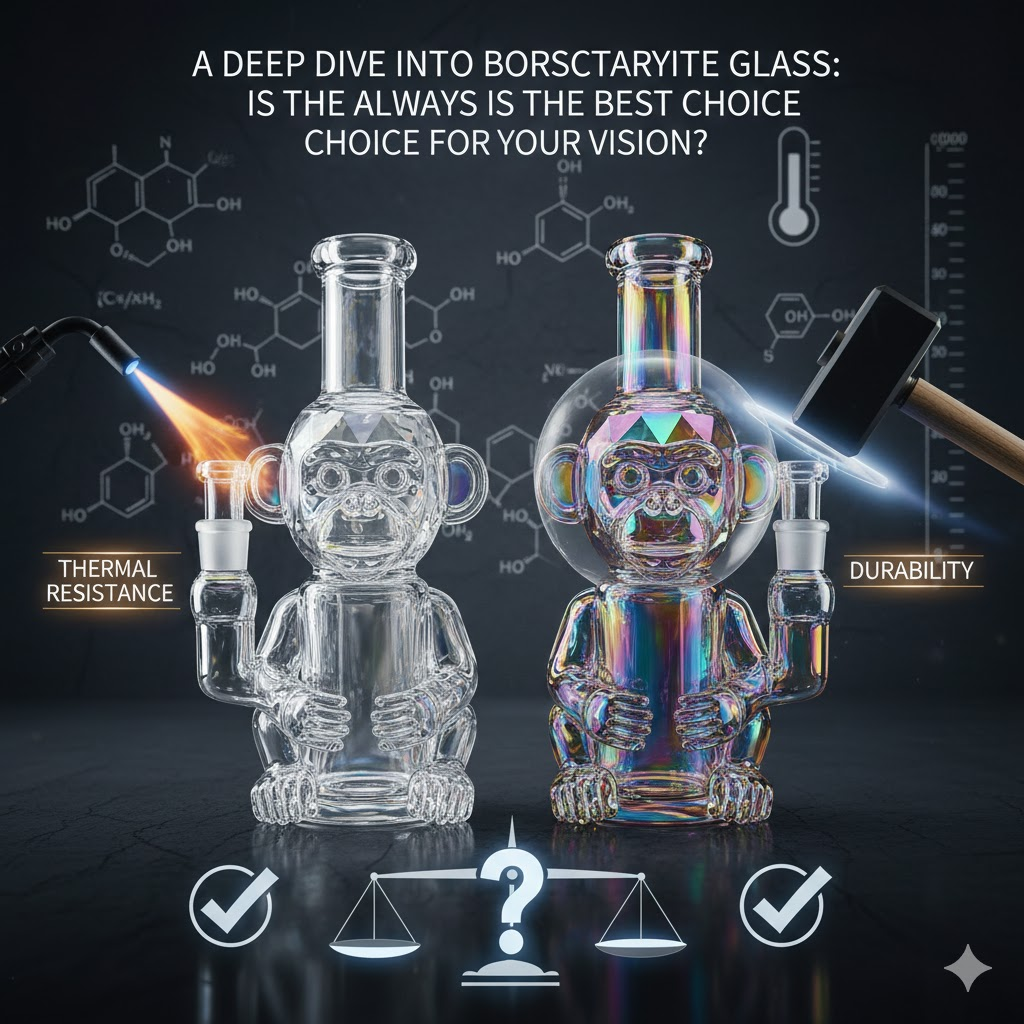
1. Executive Summary: The Alchemy of Material Choice
In the vast universe of functional glass manufacturing, choosing the right material is never just a cold technical setting; it is the cornerstone of translating abstract ideas into tangible reality.
For a brand like Elfglass, which aspires to be a “creative confidant and midwife,” we know that when a visionary designer hands us a blueprint, they are delivering a dream.
This white paper goes beyond the binary debate of “Borosilicate vs. Soda-Lime.”
We analyze molecular structures, manufacturing physics, aesthetics, and user rituals.
At Elfglass, we believe in Empathetic Forging—using material science to protect the “soul” of your brand.
While soda-lime glass occupies the low-end mass market due to cost, borosilicate glass for pipes (specifically COE 33) has become the undisputed “Golden Standard” for the connoisseur.
2. The Molecular Battlefield: Silicon, Boron, and the Lattice of Trust
To understand why we advocate for borosilicate, we must dive into the angstrom-level world of atomic bonds.
All glass starts with sand—Silicon Dioxide ($SiO_2$). But the “flux” we add defines the material’s destiny.
2.1 The Conflict of Ions: Boron vs. Calcium
Soda-lime glass is a compromise of chaos.
It consists of roughly 70-74% $SiO_2$, 12-16% Sodium Oxide ($Na_2O$), and 10-14% Calcium Oxide ($CaO$).
The Sodium acts as a “network modifier,” breaking the tight covalent bonds of the silica tetrahedra to lower the melting point.
This creates a loose, disorganized structure.
In contrast, borosilicate glass for pipes contains 12-13% Boron Trioxide ($B_2O_3$).
Boron does not break the network; it acts as a “network former.”
It weaves itself into the silica structure, creating a highly cross-linked, dense, and rigid three-dimensional lattice.
This rigidity is the physical manifestation of brand reliability.
3. The Science of Confidence: COE 33 and Thermal Shock
The Coefficient of Expansion (COE) measures how much glass stretches when heated. It represents the material’s “flexibility” under stress.
-
COE 33 (Borosilicate): Known as “Hard Glass.” It barely expands when heated.
-
COE 104 (Soda-Lime): Known as “Soft Glass.” It expands three times more than borosilicate under the same heat.
Why does this constant matter for your vision?
Imagine a user heating a Dab Rig joint with a torch.
The local temperature spikes to $500^\circ\text{C}$ while the rest of the pipe remains at room temperature.
In soda-lime glass, the heated area expands violently, pushing against the cold glass.
This internal “shoving” creates tensile stress that exceeds the glass’s strength, leading to a catastrophic crack.
Borosilicate stays still.
The stress is negligible.
For Elfglass, choosing COE 33 is an act of design liberation. It allows us to weld a 5mm thick base to a 2mm tube—a feat that would tear soda-lime glass apart during cooling.
Borosilicate glass for pipes grants designers the privilege to ignore the “laws of thermal stress” and create complex structures like double recyclers.
4. Aesthetic Realities: The Alchemy of Color
There was a time when borosilicate was criticized for its limited palette.
Today, an American-led “color revolution” has changed the game, providing Elfglass with an infinite spectrum for custom glass pipe projects.
4.1 Striking Colors and Fuming
The color chemistry of borosilicate is mesmerizing.
Many color rods, such as those from Northstar or Glass Alchemy, are translucent in their cold state.
Only after being heated in a specific flame atmosphere and “struck” in a kiln do they reveal deep purples, blues, or ambers through the growth of silver and gold nanocrystals.
“I still remember buying my first pound of ‘Slyme’ green glass rods years ago.
The price was a shock—it felt like I was buying gold dust, not glass.
But when I saw it emerge from the kiln, glowing with that electric, exotic hue, I knew every cent was worth the ‘wow factor’ it brought to the brand.”
4.2 Slyme and Crayon: The Currency of Subculture
Colors like Slyme (a semi-translucent, milky green) or Crayon (opaque, high-saturation yellow/orange) are the “totems” of high-end pipe culture.
They offer a tactile, waxy texture that soda-lime glass simply cannot replicate.
For a brand founder like “Smart” or “Max,” using these expensive imported rods for accents like mouthpieces or percolators creates instant premium positioning.
5. Weight Perception: The Density Dilemma
A common myth in the industry is: “Heavy equals quality.”
-
Borosilicate Density: $\approx 2.23\text{ g/cm}^3$.
-
Soda-Lime Density: $\approx 2.50\text{ g/cm}^3$.
Borosilicate is naturally lighter because the atomic weight of Boron is much lower than the Calcium it replaces.
A slender borosilicate pipe may feel “light as a feather,” which some customers mistake for being “cheap.”
Our engineering solution follows our Decoding Design Language philosophy.
If you want that “premium heft,” we don’t switch to inferior glass; we increase the wall thickness to 7mm or 9mm.
This gives the user the satisfying weight they crave without sacrificing the “scientific grade” strength of COE 33.
6. Manufacturing as “Forging”: Accuracy as a Form of Respect
Borosilicate’s high melting point requires an oxygen-propane torch, a process called Lampworking.
This is where Elfglass excels compared to traditional furnace-work factories.
In furnace work (soda-lime), the glass is like honey—too fluid for sharp, internal structures.
If you try to build a complex “Tree Perc,” the branches will sag. Borosilicate, however, hardens quickly.
We can weld it like metal, heating only a single point while the glass two centimeters away remains rigid.
This precision is what allows us to fulfill our promise of 24-hour 3D modeling and rapid prototyping.
We don’t need expensive metal molds; we build directly from high-quality tubing.
7. Business Strategy: The Long-Term Logic
Why choose the more expensive path? For a distributor like “Jack,” borosilicate is a risk-management tool.
-
Lower Breakage: Borosilicate’s thermal resistance ($Delta T approx 165text{ K}$ vs. soda-lime’s $40text{ K}$) means it survives boiling water cleaning and shipping accidents.
-
Flavor Purity: Borosilicate is Class 1 Hydrolytic Resistance. It is chemically inert and won’t leach alkaline ions into the water, preserving the pure taste of the flower.
-
Brand Image: High-quality borosilicate provides a flatter surface for precision decals and sandblasting, ensuring your logo never looks distorted.
FAQ: Navigating the Boro-Decision
Q1: Can I get neon colors in borosilicate like I see in soft glass vases?
A1: It is difficult and expensive.
Borosilicate colors (like those from Northstar Glass) are stunning but lean towards “natural” or “scientific” aesthetics.
We can mimic neon looks with specific rods, but it will impact the BOM cost.
Q2: Why does my borosilicate pipe feel lighter than my old cheap one?
A2: It’s physics—borosilicate is less dense.
To regain that “luxury feel,” we recommend increasing the wall thickness.
A 9mm Boro piece feels indestructible because, physically, it nearly is.
Q3: Is COE 33 the only type of borosilicate?
A3: COE 33 is the gold standard for borosilicate glass for pipes.
While other coefficients exist, 33 provides the perfect balance of “workability” for the flame and durability for the user.
8. Conclusion: A Commitment to the Vision
So, is borosilicate glass for pipes the only choice for your vision?
If your goal is a disposable product for a gas station counter, then no.
Soda-lime is your friend.
But if your goal is to build a brand that lasts, to create an heirloom that a user cherishes, then the answer is a resounding yes.
Borosilicate is the physical extension of Elfglass’s values:
-
It represents Precision, as it carries the most complex structures.
-
It represents Empathy, as it protects the user from cracks and off-flavors.
-
It represents Timelessness, as it resists the erosion of time.
At Elfglass, we don’t just buy glass tubes; we curate the skeleton of your dreams.
We invite you to follow our Technical Pack Guide to specify the exact grade of borosilicate for your next masterpiece.
