
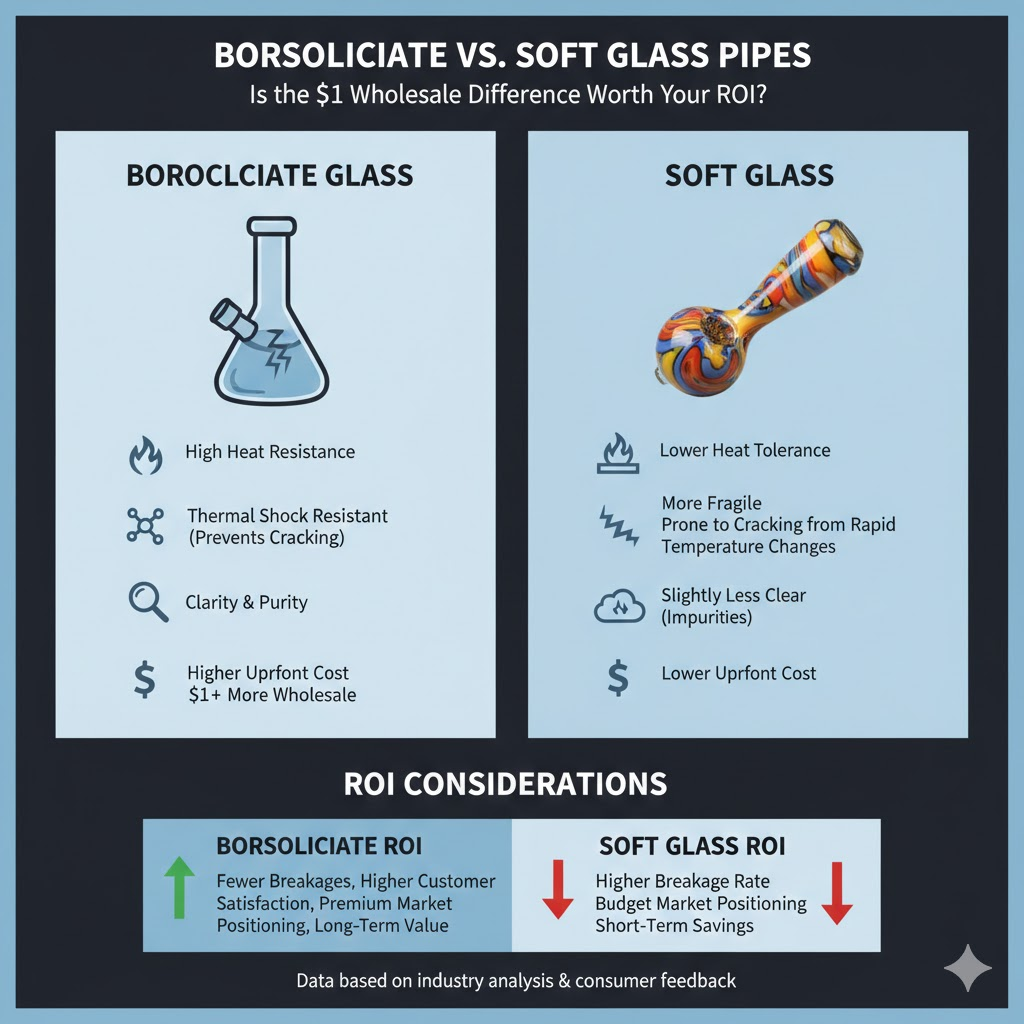
The Great Debate: Borosilicate vs Soft Glass Pipes
In the competitive landscape of the smoking accessory industry, procurement officers face a recurring dilemma: Borosilicate vs Soft Glass Pipes.
On the surface, a “soft glass” (soda-lime) spoon might look identical to a high-borosilicate 3.3 version, but the wholesale price differs by roughly $1.
Is that $1 a wasted expense or a strategic investment?
This 1,600-word deep dive explores why the Borosilicate vs Soft Glass Pipes debate is the most critical factor in your retail inventory liability and long-term brand health.
1. Material Science: The Molecular War
When evaluating Borosilicate vs Soft Glass Pipes, you are essentially choosing between two different chemical structures.
What is Soft Glass (Soda-Lime)?
Soft glass is the most common form of glass, used for windows and bottles.
In the context of Borosilicate vs Soft Glass Pipes, soda-lime glass has a high Coefficient of Thermal Expansion (COE).
It is “soft” because it melts at lower temperatures, which makes it faster and cheaper to produce in mass quantities in regions like India or Mexico.
What is Borosilicate 3.3?
Borosilicate glass (often branded as Pyrex) includes at least 5% boric oxide.
When comparing Borosilicate vs Soft Glass Pipes, the boron trioxide acts as a “glue” that allows the glass to resist expanding when heated.
This material is the laboratory standard for a reason: it does not break under extreme temperature shifts.
2. Thermal Shock: Why Your Customers Care
The primary functional difference in the Borosilicate vs Soft Glass Pipes comparison is thermal shock resistance.
The “Snap” Factor
A standard lighter flame reaches temperatures that can cause immediate stress in soda-lime glass.
Because soft glass cannot dissipate heat efficiently, the area under the flame expands while the rest of the pipe remains cold. This creates a “thermal fracture.”
If you choose Borosilicate vs Soft Glass Pipes, you are choosing a product that can handle a $150^{\circ}C$ ($302^{\circ}F$) temperature change in seconds.
For a retail customer, this is the difference between a pipe that lasts for years and one that cracks during the very first session.
As a wholesaler, every “thermal snap” return eats into your profit margin, quickly negating that $1 initial saving.
3. The 50x Standard: Heavy-Wall Engineering
In the B2B sector, the Borosilicate vs Soft Glass Pipes discussion often centers on “50x” tubing.
Wall Thickness and “Double Blowing”
-
Soft Glass Pipes: Usually single-blown with a wall thickness of 1mm to 2mm. They feel light, fragile, and “plastic-like” in the hand.
-
Borosilicate Pipes: Often utilize 50mm diameter heavy-wall tubing, resulting in “double-blown” pieces with 5mm to 9mm thickness.
When a customer holds both, the weight of the borosilicate pipe conveys “premium quality.”
In the Borosilicate vs Soft Glass Pipes retail battle, the heavier pipe always commands a higher MSRP, often allowing a retailer to charge $20 for a piece that cost them only $1 more than a $10 soft glass alternative.
4. The “Golden 4” Inventory Strategy
To maximize ROI, wholesalers must understand how Borosilicate vs Soft Glass Pipes perform across different styles.
Style 1: The Spoon (The Daily Driver)
Spoons make up 90% of sales. We recommend Borosilicate vs Soft Glass Pipes comparisons for spoons specifically because they are the most abused items. Our borosilicate spoons feature:
-
Flat Bottoms: To prevent rolling off glass counters.
-
Precision Draft Holes: 3mm-4mm holes that prevent clogging—a feat difficult to achieve consistently with volatile soft glass.
Style 2: The Chillum (The Impulse Buy)
Chillums are high-velocity items. While some shops buy cheap soft glass chillums, the savvy owner knows that a broken chillum in a customer’s pocket is a liability.
Choosing Borosilicate vs Soft Glass Pipes for your “Point of Sale” (POS) items ensures that even your cheapest products represent your brand’s quality.
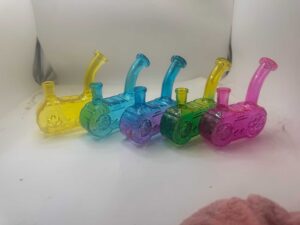
5. Industrial Annealing: The Invisible Insurance
A major hidden factor in the Borosilicate vs Soft Glass Pipes debate is the annealing process.
Removing Internal Stress
Annealing is the process of slowly cooling glass in a kiln to remove internal molecular tension.
-
Soft Glass Factories: Often skip or rush annealing to save on electricity and time. This leaves the pipe in a “high-tension” state.
-
Borosilicate Production: Requires a strict $1050^{\circ}F$ ($565^{\circ}C$) soak.
A poorly annealed soft glass pipe can explode in a display case without ever being touched, simply due to a change in room temperature.
When you analyze Borosilicate vs Soft Glass Pipes from a warehouse perspective, the “spontaneous breakage” of soft glass can result in a 15% loss of inventory before it even reaches the customer.
6. Thermodynamics of the Sherlock Pipe
The Sherlock pipe is defined by its “S” curve.
This curve is a structural nightmare for low-quality glass.
Cooling the Smoke
The “S” shape increases the distance smoke travels, allowing it to cool.
However, the bend is a natural weak point.
In the Borosilicate vs Soft Glass Pipes comparison, the borosilicate version is significantly safer because the material can handle the tension of the curve.
Soft glass Sherlocks frequently “snap” at the neck during shipping or minor drops.
7. Aesthetics: Fuming and Color Depth
Many wholesalers worry that choosing borosilicate means sacrificing the “pretty colors” of soft glass. This is a misconception.
Silver and Gold Fuming
High-grade Borosilicate vs Soft Glass Pipes use .999 silver and 24k gold fuming.
Because borosilicate is more “optically clear” than soda-lime (which often has a green or blue tint from iron impurities), the color-changing effects are more vivid.
-
Blue/Purple Hues: From Silver fuming.
-
Pink/Orange Hues: From Gold fuming.
The result is a pipe that looks better on the shelf and “evolves” more beautifully as the user smokes, a feature that soft glass simply cannot replicate with the same clarity.
8. Procurement Economics: Landed Cost vs. Purchase Price
Let’s look at the math of Borosilicate vs Soft Glass Pipes.
The Soft Glass “Hidden Costs”
Suppose you order 1,000 pipes:
-
Soft Glass Cost: $3.50/unit ($3,500 total)
-
Shipping Breakage (15%): -$525 value
-
Retail Returns (5%): -$175 value
-
Landed Cost per Salable Unit: $4.37
The Borosilicate ROI
-
Boro Cost: $4.50/unit ($4,500 total)
-
Shipping Breakage (<2%): -$90 value
-
Retail Returns (<1%): -$45 value
-
Landed Cost per Salable Unit: $4.63
For a difference of only $0.26 per salable unit, you gain a product that can be sold for $10.00 more at retail.
The Borosilicate vs Soft Glass Pipes choice is the easiest way to increase your net profit.
9. Cleaning and Maintenance
Hygiene is a growing concern for modern consumers.
ISO-Alcohol and Boiling Water
Borosilicate 3.3 is non-porous and chemically resistant. Users can boil their pipes or soak them in 91% Isopropyl alcohol without worrying about the glass clouding or cracking.
In the Borosilicate vs Soft Glass Pipes comparison, soft glass often develops “leaching” or micro-cracks over time when exposed to harsh cleaning chemicals, making them less sanitary in the long run.
10. Conclusion: Securing Your Supply Chain
The debate of Borosilicate vs Soft Glass Pipes is not just about the material; it’s about the integrity of your business model.
Opting for the $1 cheaper soft glass import creates a ripple effect of liability—from shipping breakage to customer dissatisfaction.
Investing in high-borosilicate 3.3 ensures:
-
Lower Breakage Rates: Saving you thousands in logistics.
-
Higher Perceived Value: Allowing for better retail margins.
-
Brand Longevity: Building trust with a product that doesn’t break under a lighter.
Final Comparison Summary
| Feature | Soft Glass Pipes | Borosilicate Pipes |
| Material | Soda-Lime (COE 90+) | Borosilicate 3.3 (COE 33) |
| Thermal Shock | High Risk of Cracking | High Resistance |
| Durability | Fragile (1-2mm) | Heavy-Wall (5-9mm) |
| Annealing | Often Rushed/Skipped | Industrial Standard ($1050^{\circ}F$) |
| Best For | Low-end gas stations | Professional Smoke Shops |
Ready to see the difference for yourself?
Don’t take our word for the Borosilicate vs Soft Glass Pipes difference.
Order an assorted testing kit today to evaluate our “50x” wall thickness and precision draft engineering.
Would you like me to prepare a wholesale quote for our Borosilicate 3.3 Spoon Pipes, or would you prefer a sample pack to test the thermal shock resistance yourself?
Turn Your Vision Into Profitable Reality

Frequently Asked Questions
Why use Borosilicate glass instead of cheaper soft glass?
Soft glass (Soda-Lime) creates liability for retailers because it fractures under thermal shock.
We strictly use High Borosilicate 3.3, the same material used in laboratory beakers.
This glass withstands lighter heat and physical impact far better than soft glass alternatives from India or Mexico.
Your customers get a pipe that lasts for years rather than one that cracks after a few uses.
What are the essential pipe styles to stock for a new shop?
You do not need dozens of shapes to start.
The “Golden 4” styles cover roughly 90% of consumer demand and form the backbone of a profitable inventory:
- Spoon Pipe: The standard daily driver. We use flat bottoms to prevent rolling.
- Chillum: An affordable one-hitter. Keep these at the register for impulse buys.
- Sherlock: The aesthetic choice. The curved shape cools smoke and appeals to collectors.
- Hammer Bubbler: A high-margin hybrid offering portable water filtration.
What is the Minimum Order Quantity (MOQ) for wholesale?
We structure MOQs to support both testing market waters and scaling established brands.
The requirements depend on customization levels:
- In-Stock Assorted: 100 pieces (Mixed colors).
- Custom Branding: 200 pieces (Sandblasted or decal logos).
- Custom Shapes: 500 pieces (Requires new mold production).
How do you handle shipping breakage?
We package every pipe in individual bubble bags inside white boxes to minimize impact risk.
Our standard breakage allowance is under 3%.
If damage exceeds this threshold, we issue credit or provide replacements with your next shipment. This ensures your inventory costs remain predictable.
Do you offer custom logos or colors?
Yes. We place logos on the stem or the bottom of the bowl using sandblasting or high-fire decals.
For premium lines, we also offer access to American color rods from Northstar and Trautman Art Glass (TAG).
These materials create unique visual effects like color-changing fuming that standard factory glass cannot replicate.
