
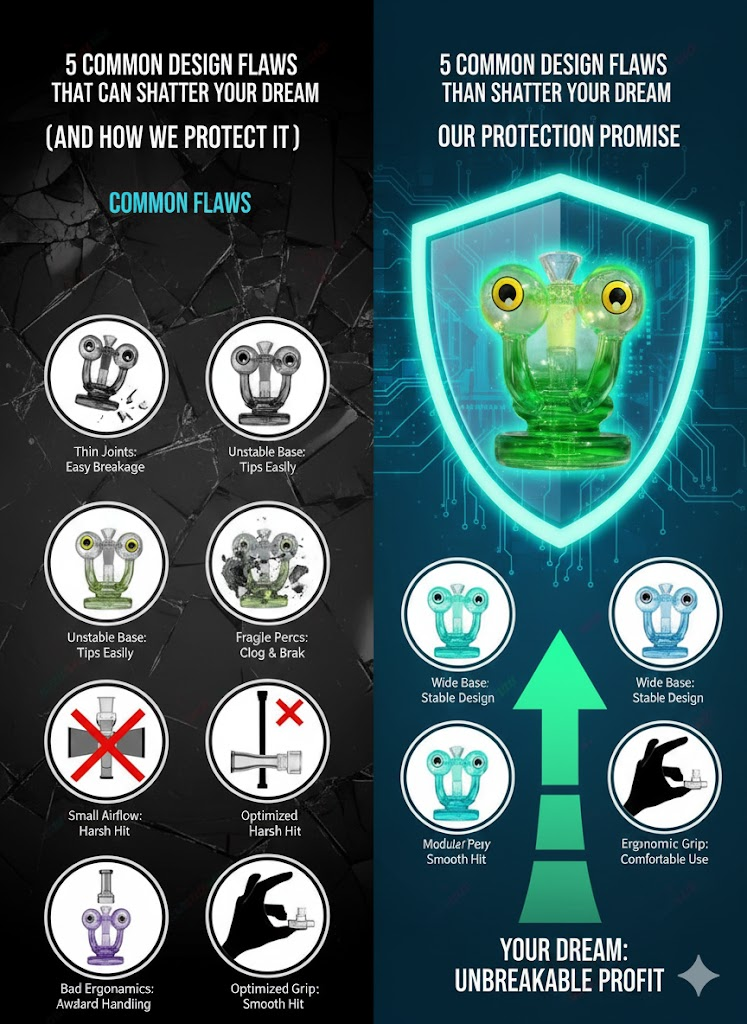
There is no sound more heartbreaking in our industry than the sharp crack of a beautifully designed glass piece shattering the moment it touches a table.
It is not just the sound of broken glass; it is the sound of a broken dream.
Many talented founders and designers can sketch breathtaking lines on paper.
But borosilicate glass has its own rigid physical language—a language of thermodynamics, stress vectors, and fluid dynamics.
If your design does not speak this language, reality will teach you a very expensive lesson.
At Elfglass, we are bilingual. We speak “Art,” and we speak “Physics.”
Before we ever light a torch to produce your custom order, we act as your Technical Partner, scanning your vision to eliminate the five most common glass pipe design flaws that kill brands.
This is not criticism; this is guardianship.
Here is how we protect your dream from the harsh realities of the physical world.
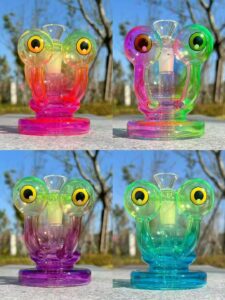
Flaw #1:”The Stress Concentration Trap” (Fatal Sharp Corners)
The Problem: In the pursuit of modern minimalism, many designers draw sharp, 90-degree internal angles where tubes connect.
On a CAD screen, this looks clean and precise.
In the physical world of glass, a sharp internal corner is a “stress riser.”
When glass cools, tension naturally migrates to these sharp points.
Even if the piece survives the kiln, it becomes a ticking time bomb.
A minor temperature change (like rinsing with cold water) or a small bump weeks later can cause the stress to release, resulting in a spontaneous, catastrophic crack.
The Elfglass Solution: The “Fillet Mandate” We refuse to manufacture failure.
When we see a sharp internal junction, we introduce a microscopic “fillet” or radius transition.
-
What we do: Instead of a hard angle, we create a curved transition between the two glass walls.
-
The Result: This simple geometric tweak distributes mechanical stress over a wider area rather than focusing it on a single point. It is often invisible to the naked eye but can increase the impact resistance of the joint by 300%.
Flaw #2:”The Top-Heavy Titan” (Gravity’s Victim)
The Problem: Ambition often leads to height.
Designers love towering recyclers with intricate percolation chambers stacked near the top, or massive, heavy mouthpieces that look aggressive and bold.
While these designs look stunning on a computer monitor, they suffer from a fatal flaw: a high center of gravity.
A “top-heavy” bong is unstable.
Once you add water (which adds weight) and perhaps an ash catcher (which shifts the balance point forward), the piece becomes a hair-trigger trap, ready to tip over with the slightest nudge.
The Elfglass Solution: Center of Mass Simulation We don’t guess; we calculate. During our 24-hour design review, we simulate the center of mass.
-
Optimization: If a design is unstable, we don’t demand you shrink the top. Instead, we counterbalance it. We might suggest using a “heavy wall” glass puck for the base (increasing thickness from 5mm to 12mm) or widening the footprint diameter by just 10%.
-
The Result: A piece that retains your visual grandeur but sits on the table with the stability of a pyramid.
Flaw #3:”The Choke Point” (Breathless Airflow)
The Problem: We often see designs that are obsessed with filtration.
The logic seems sound: “More percolators = smoother hit.”
Designers will stack honeycomb discs on top of matrix percs on top of spiral coils.
However, they forget the human element: The user needs to breathe.
Every restriction adds “drag.”
If the airflow resistance is too high, the user has to strain their lungs to clear the chamber.
The experience shifts from relaxing to exhausting. It feels like trying to suck a milkshake through a coffee stirrer.
The Elfglass Solution: Fluid Dynamic Balancing We practice “Empathy Before Engineering.”
We calculate the Total Cross-Sectional Area (TCSA) of the airflow path.
-
Optimization: We ensure the total open area of the percolator slits is roughly 1.2x to 1.5x the area of the downstem intake. If your design is too “tight,” we will advise reducing the number of complex chambers or widening the slit geometry.
-
The Result: A “chug” that feels effortless and substantial, ensuring the function matches the form.
Flaw #4:”The Unreachable Corner” (A Cleaning Nightmare)
The Problem: A pipe that cannot be cleaned is a disposable product. Period.
Designers often create beautiful, twisting chambers or “blind pockets” where water circulates but mechanical cleaning is impossible.
Once resin builds up in these dead zones, no amount of shaking with salt and alcohol will remove it.
The piece becomes permanently yellowed and gross. Your customer eventually throws it away—and blames your brand for the short lifespan.
The Elfglass Solution: Maintenance Modeling We mentally simulate the cleaning process for every design.
-
Optimization: We look for “dead zones” where fluid velocity drops to zero. We might suggest slightly altering the angle of a drain tube or enlarging a passage to ensure that standard coarse salt grains (typically 1-2mm) can actually flow into every chamber to scrub the glass.
-
The Result: A product that stays pristine for years, turning your customers into long-term brand advocates.
Flaw #5:”The Fragile Joint” (Weak Structural Links)
The Problem: Recyclers are popular because of their looping water function.
However, these designs rely on thin glass tubes to connect heavy main chambers.
In a bad design, these connecting tubes act as structural load-bearers.
If these arms are too long or unsupported, the vibration from shipping or simply setting the rig down creates torque.
The connecting points snap because they are carrying weight they were never designed to hold.
The Elfglass Solution: Structural Bridging We approach glass like civil engineers building a bridge.
-
Optimization: We use the “Dewar Joint” reinforcement technique for internal connections. For external arms, we suggest adding discreet glass “bridges” or trusses between long tubes. These tiny, clear connections are aesthetically subtle but structurally massive, locking the floating parts into a rigid, unified frame.
-
The Result: A complex recycler that is robust enough to survive FedEx shipping and daily use.

The Bridge: We Don’t Just Flag Problems; We Solve Them
If a factory simply looks at your drawing and says, “No, we can’t do this,” that is arrogance.
If a factory sees a flaw, stays silent, and takes your money anyway, that is greed.
At Elfglass, we choose a third option. Partnership.
We will never ask you to sacrifice your vision.
We will never tell you to make your design “boring” just to make it easier for us. Instead, we offer creative engineering solutions.
We say: “To keep this beautiful sharp aesthetic you want, while ensuring it doesn’t crack, let’s increase the wall thickness here by 2mm and fire-polish the inner joint.”
We use engineering as a tool not just to make the product manufacturable, but to make it survivable.
Conclusion: Let Your Dream Land Safely
A beautiful rendering might get likes on Instagram, but only a flawless physical product builds a business.
Don’t let your first production run be an expensive experiment in physics.
Glass pipe design flaws are avoidable if you have the right guide.
Your dream deserves protection.
Let us troubleshoot the hidden dangers before the first tube is cut.
Unsure if your design is production-ready? Submit your sketch for a [Free Design Risk Assessment], and let our engineers safeguard your investment before you spend a dime on molds.
Frequently Asked Questions (FAQ)
Q1: Will you help me fix these flaws before production?
A1: Absolutely.
That is part of our standard onboarding process.
We review every design for structural integrity and provide a “Feasibility Report” with specific suggestions for improvement.
Q2: Do I have to sacrifice my aesthetic to fix structural issues?
A2: Rarely.
90% of the time, we can preserve the “look” of your design by making subtle, invisible changes—like thickening a wall, radiusing a hidden corner, or adding a clear support bridge that blends in.
Q3: What is “annealing,” and does it fix design flaws?
A3: Annealing is a heat treatment process that removes internal stress from the glass manufacturing process.
While it is critical (and we follow strict annealing schedules), it cannot fix bad geometry.
A sharp corner is still a weak point, even if perfectly annealed.
That is why design optimization must happen before manufacturing.
Q4: Does using Borosilicate glass fix these issues?
A4: High-quality Borosilicate 3.3 glass is much stronger than soft glass, but it is not invincible.
It still obeys the laws of physics. Good material cannot save a bad design, but a good design made with Borosilicate is world-class.
