
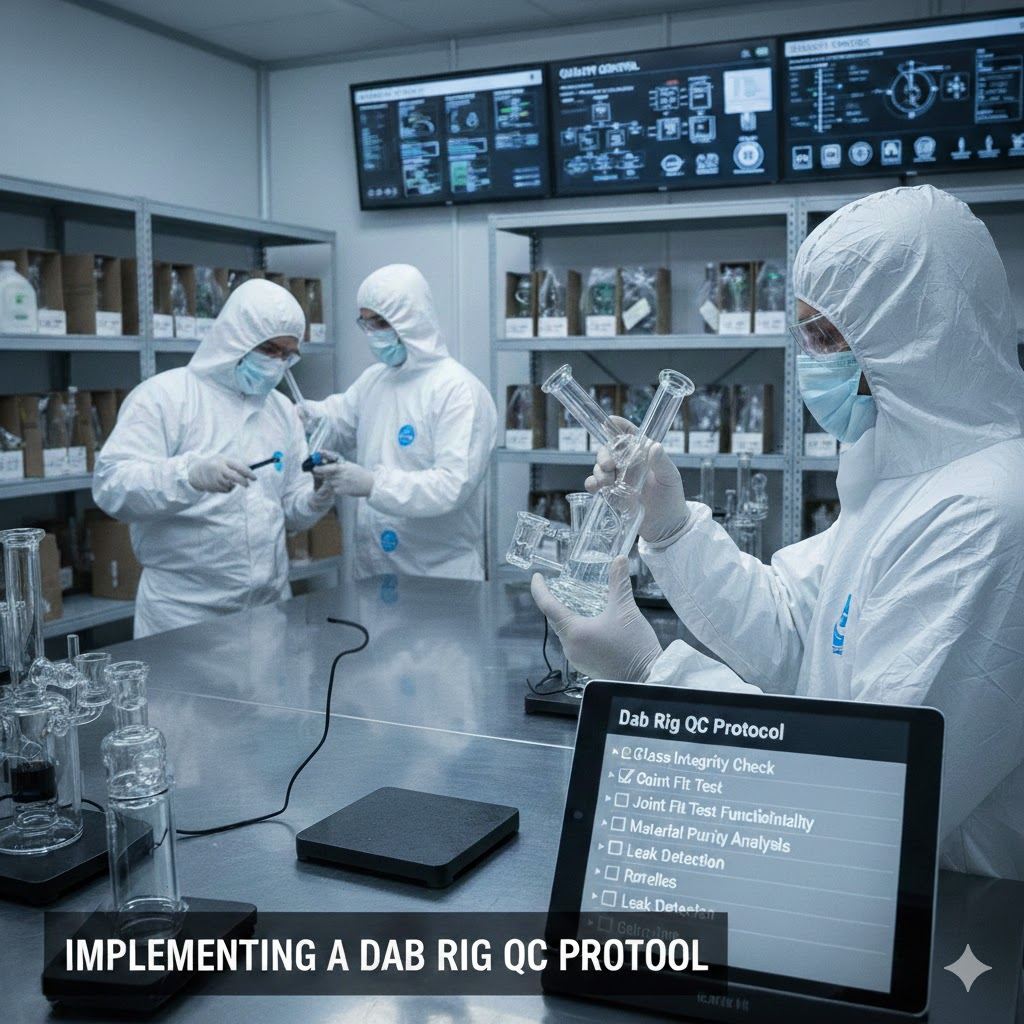
Enforcing a rigid dab rig QC protocol is the only defense against the profit-killing liability of “self-shattering” inventory.
Visual checks fail to detect internal stress in borosilicate glass, leaving brands vulnerable to returns when rigs crack under thermal shock.
Sourcing without validation subjects your cash flow to inevitable breakage claims.
This guide benchmarks production standards against the ASTM C336 annealing specification and Lab-Grade Borosilicate 3.3 material requirements.
We analyze critical inspection points of a proper dab rig QC protocol—from the “Wobble Test” to AQL 2.5 Level II compliance.
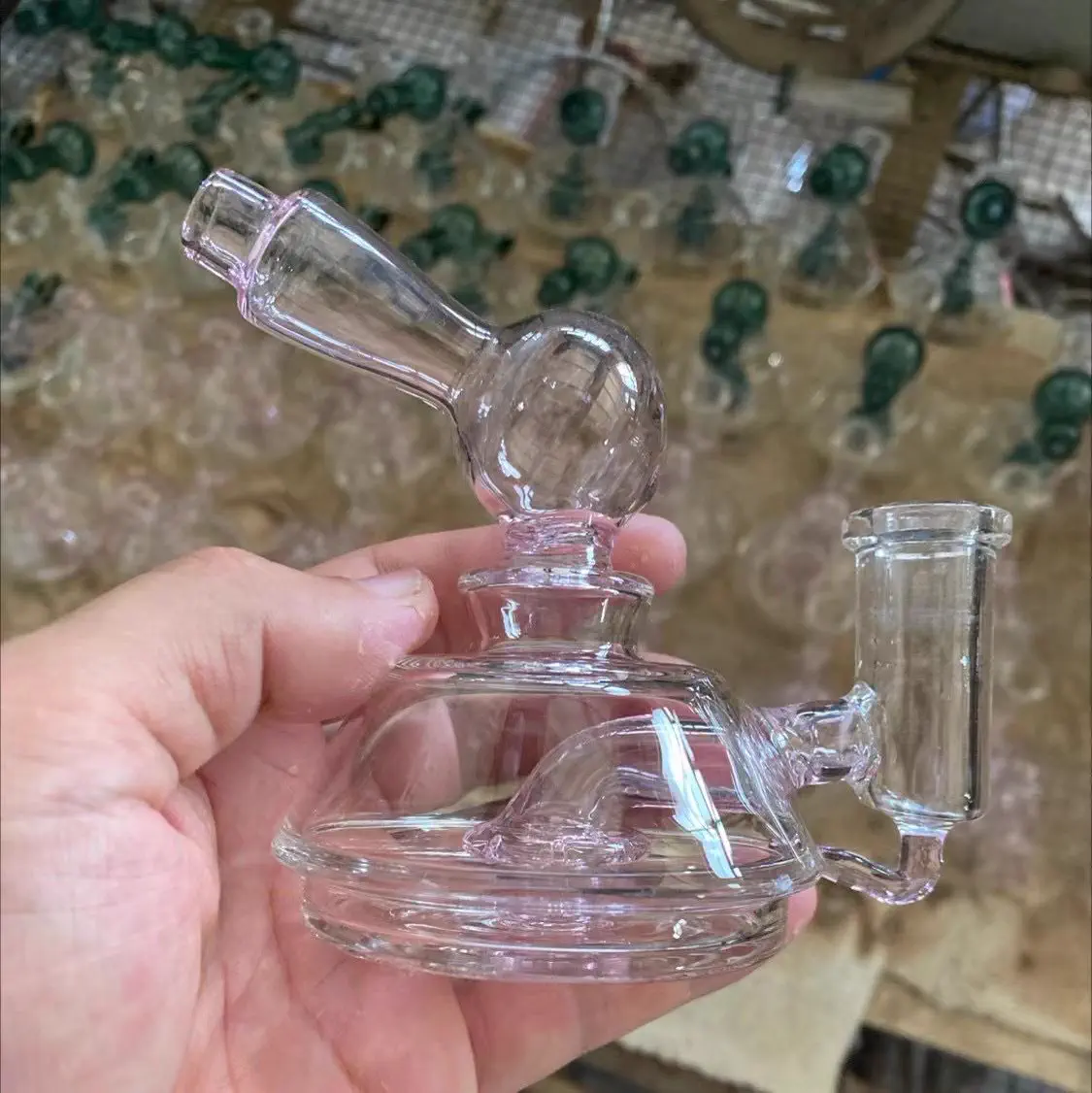
The “Wobble Test” (Base Stability)
A rig that rocks on a flat surface is a safety hazard.
When a user heats the banger with a torch, instability can cause the rig to tip over, creating a fire risk.
-
The Test: Every unit is placed on a calibrated granite surface plate.
-
The Check: We tap the top of the mouthpiece. If the base lifts or “wobbles” more than 1mm, it fails our dab rig QC protocol.
-
Why It Matters: Stability is the first indicator of mold precision and glassblower skill.
Bottom-Up Lighting
Bottom-up lighting reveals internal inclusions and stress fractures in borosilicate glass that standard overhead factory lighting misses, ensuring compliance with AQL 2.5 Level II standards.
Standard overhead factory lighting creates glare on the surface of glass, effectively hiding internal defects.
To counter this, we place borosilicate rigs on illuminated acrylic tables for inspection.
By directing high-intensity light upwards through the material, the light path is reversed. This instantly exposes refractive differences within the glass structure that are invisible to the naked eye under normal conditions.
| Inspection Method | Primary Function | Defects Detected |
|---|---|---|
| Overhead Lighting | General Assembly | Surface scratches, dust, external cracks |
| Bottom-Up Lighting | Internal Structural QC | Air bubbles, uneven wall thickness, internal fissures |
| Polarized Bottom Light | Stress Analysis | Improper annealing, residual thermal stress bands |
Enhancing Contrast for Structural Analysis
Visual audits of clear Lab-Grade Borosilicate 3.3 depend on contrast.
When light passes through the bottom of the rig, defects interrupt the beam.
Air bubbles appear as dark voids, while hairline fractures create bright refractive flares.
This method also highlights uneven wall thickness, particularly at the joints.
If the wall thickness deviates from our standard 4mm—or the Heavy Duty 5-7mm spec—the light intensity shifts, signaling a potential weak point to the inspector.
Verifying the ASTM C336 Annealing Standard
We use polarized bottom-up lighting to verify the success of the annealing process.
Glass that cools too quickly retains internal stress, which leads to “self-shattering” later.
Under polarized light, these stress points appear as rainbow-colored bands.
- Annealing Target: Verifies the 8-12 hour cycle at 1050°F (565°C).
- Thermal Shock: Confirms resistance >170°C.
- Outcome: Any unit showing stress bands is immediately rejected before packing.
Joint Fitting & Airflow Verification
A dab rig is a vacuum system. If the joint isn’t airtight, the function fails.
A robust dab rig QC protocol must include mechanical testing.
-
The “Wiggle” Check: We insert a standard 10mm quartz banger. If it wiggles inside the joint, the grind is poor.
-
The Vacuum Test: We plug the joint and inhale. If air leaks through, the seal is defective. This ensures the vacuum pressure needed for low-temp dabbing.
The “Function Video” Verification
Photos prove aesthetics; only video proves engineering.
We record batch-specific stress-test videos demonstrating proper vortex function before you release the final 70% payment.
-
Vortex Drain Action: Confirms the water cycles continuously without stalling.
-
Zero Splashback: Proves the drain system works fast enough to protect the user.
The Pre-Payment Protocol We strictly connect the “Function Video” to payment terms. You verify the function of your batch before capital leaves your account.
Turn Sketches into Best-Selling Borosilicate Rigs Eliminate breakage with scientific-annealed Borosilicate 3.3 glass that maximizes your ROI. Our 24-hour rapid modeling ensures your custom designs hit the market faster.
Inspect Real Production Glass Before You Commit
We ship COE 3.3 borosilicate samples in 1 to 3 days and back every order with a documented QC process and inspection report. Request a sample kit and judge the wall thickness, color, and finish yourself.
MOQ from 100 pieces | BSCI / WRAP / ISO 9001 | NDA before every project
Turn Sketches into Best-Selling Borosilicate Rigs

Where QC Happens: Annealing, Joint Fitting, and the Pre-Seal Check
QC is not a single inspection at the end of the line; it is a sequence of gates. Annealing at 1050°F with a 12-hour soak comes first, because a rig with internal stress will fail the wobble test and every test after it. Joint fitting comes second, with the 10mm connection ground and checked against a gauge. The pre-seal check comes third: the piece is dry-fit, water-tested, and only then does it move to the function video that documents the finished hydraulics.
When you audit a factory, ask where these gates sit in the production order, not just whether they exist. A factory that inspects only at the end is telling you it discovers defects after the work is done. The QC questions to ask suppliers list covers this conversation in full.
Your Dock-Side Inspection: A 10-Minute Batch Protocol
Your own inspection should start the moment the carton opens. Check the joint on every piece you unpack, run the wobble test on a sample of the batch, and photograph anything that fails before you file a claim. Match the carton contents against the packing list and keep the QC documents the factory shipped, because a batch that passes your dock check today is a batch you can reorder with confidence next quarter.
This mirrors the checklist you would use for any glass category. The arrival inspection checklist walks through the steps in order, and the same discipline applies whether the carton holds mini rigs or full water pipes.
The QC Station: Equipment, Reference Standard, and Pass Criterion
The tests above name the checks; this table names the equipment that runs them, the standard each is measured against, and the exact pass criterion. It is the spec sheet for what a real dab rig inspection station must have — and the list to audit a factory against when they claim “full QC.”
| Equipment | What It Verifies | Pass Criterion | Reference |
|---|---|---|---|
| Granite surface plate | Base stability (the wobble test) | Base lifts no more than 1mm when the mouthpiece is tapped | Mold precision and blower skill |
| Illuminated acrylic table (bottom-up light) | Internal inclusions and wall uniformity | No air-bubble voids; even wall at the joints | AQL 2.5 Level II |
| Polarized bottom light | Residual annealing stress | No rainbow stress bands visible | ASTM C336 (8–12 hr at 1050°F / 565°C) |
| Caliper | Wall thickness | 4mm standard, or the 5–7mm heavy-duty spec | Stated wall tolerance |
| 10mm joint gauge and quartz banger | Joint fit (the wiggle check) | Banger does not wiggle in the ground joint | Vacuum integrity for low-temp dabbing |
| Plug-and-inhale vacuum test | Airtightness of the joint seal | No air leak through the seal | Restriction needed to vaporize at lower temp |
| Function-video rig | Vortex drain, zero splashback, drain efficacy on your batch | Water cycles continuously, no splashback, fast drain | Pre-payment verification before the 70% balance |
| Thermal-shock reference | Resistance to rapid temperature change | Withstands a shift greater than 170°C | Lab-Grade Borosilicate 3.3 spec |
Reject Disposition: Repair, Downgrade, or Destroy
Detecting a defect is only half of QC; deciding what to do with the failed unit is the other half, and it is where a sloppy factory lets rejects leak back into prime stock. These are the disposition rules by defect type — and the segregation discipline that makes the recorded defect rate honest.
- Stress bands under polarized light → destroy. Once glass is worked and cooled with locked-in stress, re-annealing will not reliably save it; it is a self-shatter time bomb. Segregate it to the red bin immediately.
- Wobble over 1mm → destroy, or re-grind the base only if enough glass remains within tolerance. A rig that rocks is a fire hazard next to a torch, not a cosmetic flaw.
- Joint wiggle or vacuum leak → re-grind the joint once; if it still fails, downgrade to seconds. Never ship a leaky joint as prime — it defeats the whole vacuum system.
- Cosmetic surface scratch with no structural impact → downgrade to B-stock for discount sale, never into the prime carton.
- Function-video failure (stalled vortex, splashback, slow drain) → destroy. The hydraulic geometry is wrong and cannot be corrected after the piece is finished.
- Keep rejects physically segregated at every gate. An unsegregated reject bin is exactly how “passed” units get shipped — the no-reject-bin red flag in reverse.
- Document the disposition per unit. A real defect rate is recorded, not optical; a factory with no logged rejects is hiding them somewhere in your carton.
Final Thoughts on QC Standards
Sourcing non-annealed imports creates a liability time bomb.
Investing in verified Lab-Grade Borosilicate 3.3 insures your inventory against thermal shock.
Spec sheets mean nothing without visual proof.
We validate these mechanics with batch-specific videos as part of our standard dab rig QC protocol. The same thermal-shock checks apply to the quartz bangers you stock.
Frequently Asked Questions
Why are your rigs more expensive than standard imports?
We strictly commission Lab-Grade Borosilicate 3.3 tubing and run a mandatory 12-hour annealing cycle at 1050°F.
Cheap imports often rely on recycled “soft glass” or skip the annealing process to cut costs.
While those units might look identical on the shelf, they hold high internal stress and act as time bombs that crack under the heat of a torch.
We prioritize your reputation; a slightly higher upfront cost eliminates the headache of returns and shattered inventory.
Why use 10mm joints instead of the industry standard 14mm?
14mm joints are the standard for smoking flower because you need airflow.
Dabbing concentrates requires the exact opposite. A 10mm joint creates necessary restriction, forming a tighter vacuum that vaporizes oil efficiently at lower temperatures.
If you use a 14mm joint on a mini rig, the excess air dilutes the vapor and degrades the terpene profile.
We engineer our rigs for flavor, not just volume.
What is your policy on shipping breakage?
We utilize our internal “Elf-Guard” packaging protocol, which combines air column bags with individual inner boxes to keep breakage rates consistently under 2%.
If any damage occurs during transit, simply provide a photo and we will issue a direct credit or free replacement in your next order.
We absorb the risk so you don’t have to.
Do you sell to retail customers?
No. We operate strictly as an OEM/ODM manufacturer for Wholesalers, Brands, and Head Shop Chains.
We do not compete with our own clients for end-user sales.
Why should I choose a Recycler over a standard bong?
Standard bongs rely on high water volume for filtration, which strips away vapor flavor (terpenes).
A Recycler uses the *movement* of water—specifically a vortex drain—to cool the vapor without letting it sit stale.
This mechanical cycling prevents splashback and preserves the integrity of expensive concentrates, making it a critical tool for the high-end dabbing market.
Get a Quote for Your Next Order
Building a QC protocol for dab rig orders? Send us your product spec and target quantity — contact our factory team or message us on WhatsApp, and we will reply with pricing and lead times within 24 hours.
About the Author
Ava Zeng is the founder of Elfglass, a Shenzhen-based borosilicate glass pipe manufacturer serving B2B brands worldwide. Every guide on this site is grounded in her production-floor experience— the annealing lines, QC checkpoints, and export orders behind each claim.
Before you commit to a supplier, read her founder’s story and trust promise, and the guide to vetting a reliable glass pipe manufacturer— the same red-flag checklist Elfglass applies to its own suppliers.
Ready to Source Custom Glass Pipes?
Get a free quote within 24 hours. MOQ from 100 pieces. NDA-protected design consultation.
