
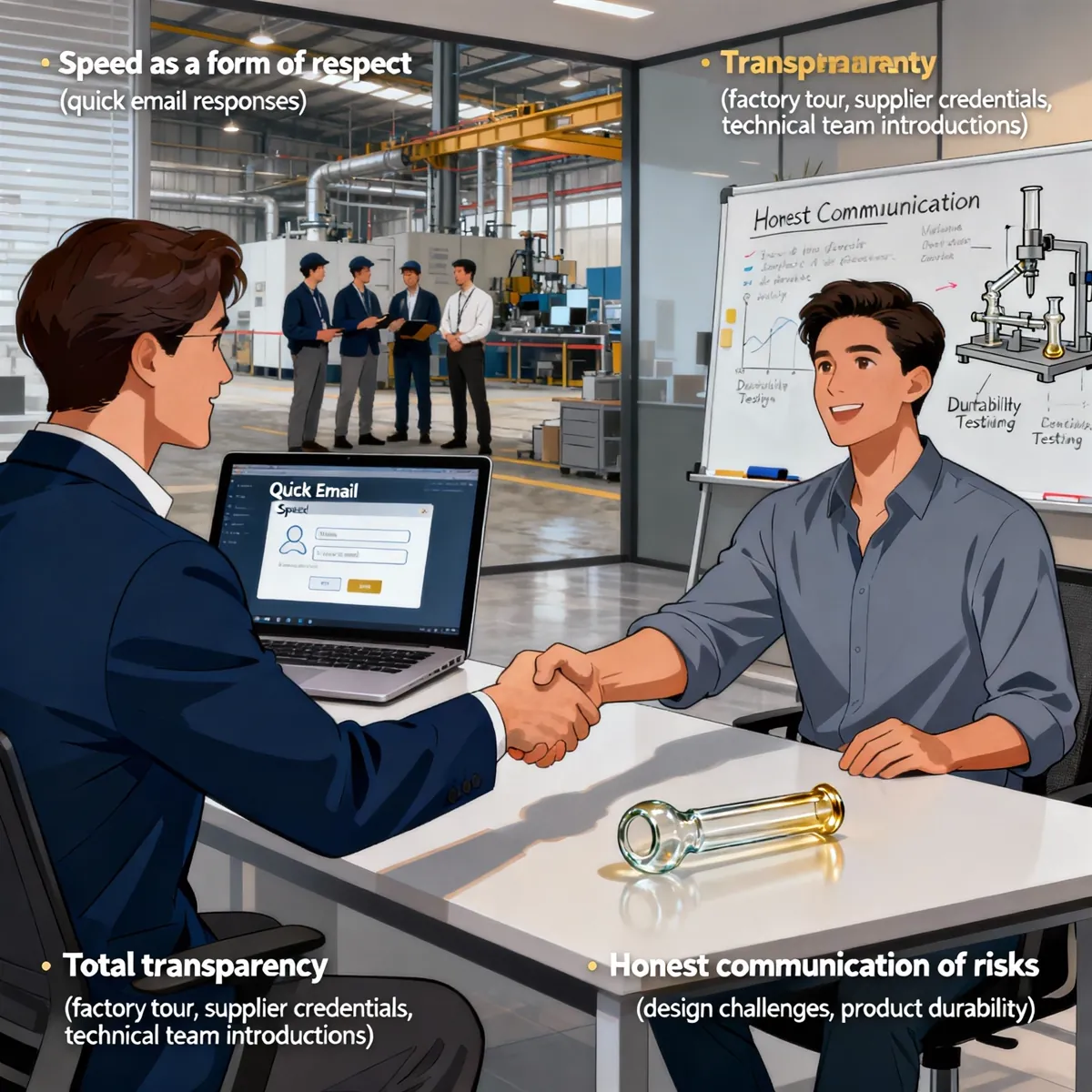
Every buyer who has been burned by a glass pipe supplier shares the same origin story: the factory looked perfect on paper. Clean website, responsive sales rep, certificates framed on the wall. Then the first container arrived and nothing matched the samples. The wall thickness was off, the annealing was botched, and those “certifications” turned out to be expired or borrowed from a sister company. A rigorous factory audit would have caught every one of those problems before a dollar changed hands.
Key Takeaways
- A proper glass factory audit checklist covers six zones: legal credentials, social compliance, QC infrastructure, production capacity, floor conditions, and packaging standards.
- BSCI and WRAP certifications can be independently verified through the amfori member portal — never accept a PDF at face value.
- A factory without a dedicated QC lab and a documented annealing lehr is a coin flip, regardless of how low the price sits.
- Response time during the sampling phase predicts production-phase communication more accurately than any contract clause.
- A supplier who deflects on NDA signing or refuses video floor tours before order confirmation should be crossed off the list immediately.
Why Factory Audits Fail Glass Pipe Buyers
Most importers treat supplier audits as a paperwork exercise. They collect a business license, a few certificate PDFs, and a price list, then ship the order. That approach works until it does not — and when it fails, the cost is not just the defective product. It is the customs delay, the chargeback from your retail buyer, and the three months spent finding a replacement factory while your shelf sits empty.
The glass pipe industry has a specific risk profile that generic supplier audit templates miss. Borosilicate glass requires precise annealing control. Hand-blown pieces vary in wall thickness by operator skill, not by machine tolerance. And the compliance environment — BSCI social audits, WRAP certification, state-level paraphernalia rules — adds layers that a standard “factory inspection checklist” does not address.
If you are sourcing from China for the first time, or switching from a trading company to a direct factory partner, the audit becomes your single most important risk mitigation tool. The suppliers who pass a thorough audit consistently outperform those who merely look good on Alibaba.
Pre-Audit Document Research Before You Visit
Before you schedule a factory visit or request a video tour, do your homework from a desk. The documents a supplier provides before the audit reveal as much as the factory floor itself.
Business License and Export History
Request the factory’s business license and verify three things: the registered company name matches the name on every other document, the registered address matches the physical factory location, and the business scope explicitly includes glass products manufacturing — not just “general trade.” A mismatch between the license name and the invoice name is one of the most common red flags when sourcing wholesale water pipes, and it often signals a middleman posing as a manufacturer.
Cross-check the company on China’s National Enterprise Credit Information Publicity System. This free government database shows registered capital, legal representative, operating status, and any administrative penalties. A factory with multiple penalties or an abnormally low registered capital relative to its claimed output is worth a deeper look — or a wider berth.
Export Records and Market Presence
Ask for the supplier’s customs export records for the past 12 months. Legitimate factories with active export operations can provide these without hesitation. The records confirm export volume, destination countries, and product descriptions. A factory that claims to export 10,000 pieces per month but has no customs history in the relevant HS codes is inflating its numbers.
Certification and Social Compliance Verification
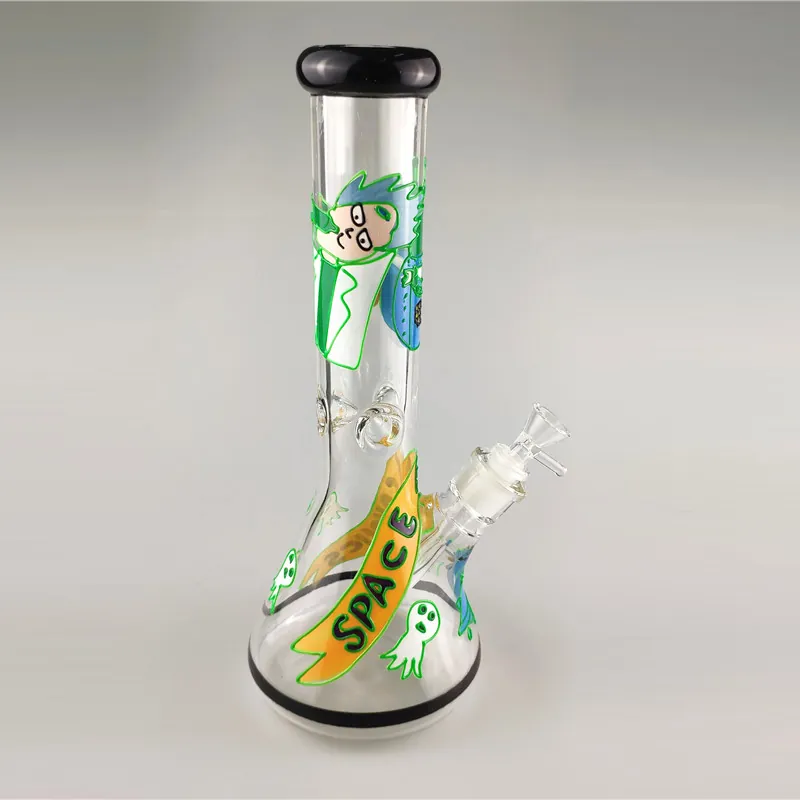
Certificates on a factory wall mean nothing if they are expired, borrowed, or fabricated. The quality control guide for wholesale glass pipes covers product-level QC in depth, but factory-level compliance is a separate audit dimension that requires its own verification protocol.
Social Compliance: BSCI and WRAP
BSCI (Business Social Compliance Initiative) and WRAP (Worldwide Responsible Accredited Production) are the two social compliance certifications that matter for Western buyers. Both can be independently verified. BSCI results are accessible through the amfori BSCI online platform — you or your third-party auditor can request access to view a factory’s current rating and audit date. WRAP maintains a public database of certified facilities on its website.
When auditing a glass pipe manufacturer, check that the certificate covers the specific factory address you are dealing with, not a parent company or a different facility. The certificate scope should include glass manufacturing, and the expiry date should extend beyond your planned production timeline.
| Certification | What It Covers | Verification Method | Validity Period |
|---|---|---|---|
| BSCI | Labor rights, safety, environmental practices | amfori BSCI platform (member access) | Typically 2 years, annual surveillance |
| WRAP | Workplace conditions, legal compliance, environmental rules | WRAP public certified facility database | 1 year, requires renewal audit |
| ISO 9001 | Quality management systems, process consistency | Issuing body’s online certificate register (e.g., SGS, TÜV) | 3 years with annual surveillance audits |
Quality Management: ISO 9001
ISO 9001 certifies that a factory has documented quality management processes — not that its products are inherently superior. During the audit, verify which certification body issued the ISO certificate. Reputable bodies include SGS, TÜV, Bureau Veritas, and Intertek. Certificates from unknown domestic bodies with no international recognition carry minimal weight.
Ask to see the factory’s actual quality manual and inspection records. A factory that maintains ISO 9001 in practice will produce internal audit reports, non-conformance logs, and corrective action records on demand. One that maintains it only for the certificate will stall or produce generic templates.
QC Infrastructure and Production Capacity Audit
A factory’s quality claims are only as credible as the infrastructure backing them. During the audit, walk through the QC area and verify that the equipment exists, is calibrated, and is actually used — not staged for visitors.
On-Site QC Lab and Testing Equipment
A competent glass pipe factory maintains an in-house QC station with specific tools: wall thickness gauges, dimensional calipers, leak testers for water pipes, and thermal shock testing equipment for borosilicate pieces. Ask the QC manager to demonstrate a live inspection using your product specifications. If the team cannot walk through a complete inspection protocol with calibrated tools in hand, the factory’s quality system exists on paper only.
Request to see the most recent batch inspection reports. Cross-reference the report data with the actual products in the warehouse. If the report says “wall thickness 3.5mm ±0.2mm” but the pieces on the shelf measure 2.8mm, the inspection records are fabricated.
Production Capacity Reality Check
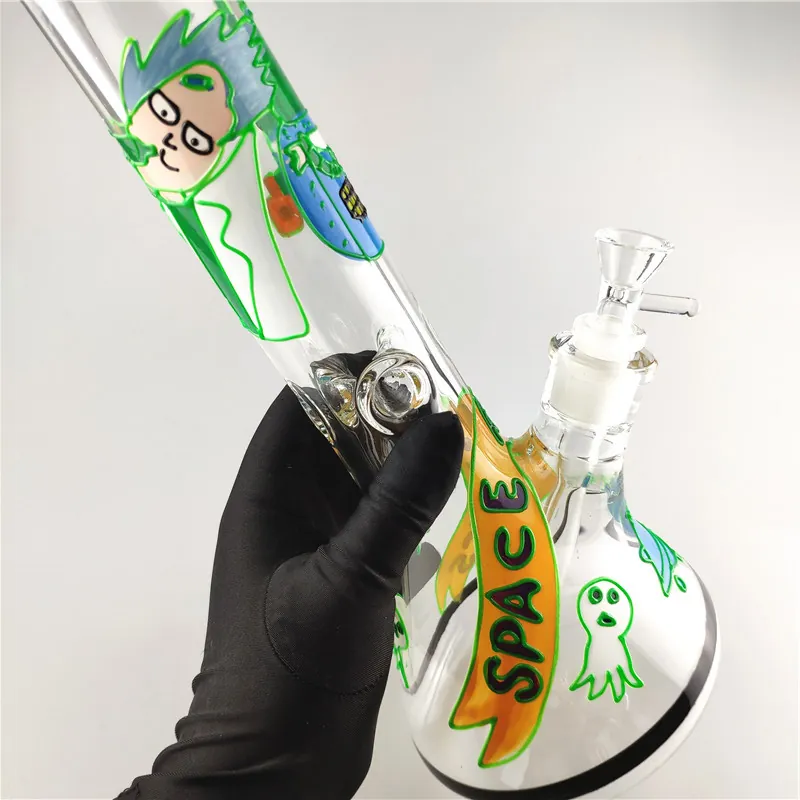
Factories routinely overstate capacity. A supplier claiming 50,000 pieces per month from a 500-square-meter facility is either lying or counting the output of subcontractors as its own. During the audit, count the production stations, observe the number of active blowers, and calculate realistic daily output based on what you see.
A realistic benchmark: a 1,000-square-meter glass pipe factory with 20 skilled workers produces approximately 10,000 pieces per month across mixed SKUs. Claims significantly above this figure without proportional floor space or headcount warrant skepticism. Ask about subcontracting policies — some factories quietly outsource overflow to smaller workshops with no quality oversight.
Conducting the Factory Floor Walk Assessment
The floor walk is the irreplaceable core of any glass factory audit checklist. No document review substitutes for seeing the production environment with your own eyes — or through a live video call with a trusted third-party auditor on the ground.
Workshop Organization and Annealing Process
A well-run glass workshop is organized by workflow: raw material storage near the torch stations, semi-finished pieces moving toward annealing, and finished products in a separate packing area. Cross-contamination between zones — raw glass dust near finished products, or unpacked pieces stacked near the shipping area — signals poor process control.
The annealing lehr (controlled cooling oven) is the single most critical piece of equipment in a glass pipe factory. Pieces that cool too fast develop internal stress and crack in transit or under normal use. Ask to see the lehr temperature profile settings for your product type. A factory that cannot articulate its annealing parameters — or that has the lehr turned off to save electricity during your visit — should fail the audit.
Worker Conditions and Safety
BSCI and WRAP exist because buyer markets increasingly require proof of ethical manufacturing. During the floor walk, observe whether workers have protective equipment (heat-resistant gloves, safety glasses, ventilation at torch stations), whether emergency exits are unblocked, and whether the facility has functioning fire suppression systems. These are not just compliance checkboxes — they directly affect product consistency. An understaffed, overworked shop floor produces more defects.
Vet Your Next Glass Pipe Factory With Confidence
Elfglass is a BSCI/WRAP/ISO 9001 audited manufacturer with 16 years and 800+ wholesale orders behind every quote. Send us your target products and we will show you exactly how we source, inspect, and ship.
MOQ from 100 pieces | BSCI / WRAP / ISO 9001 | NDA before every project
Packaging and Shipping Readiness Check
Glass pipe breakage during transit is not an accident — it is a packaging failure. The audit must verify that the factory’s packaging methods meet export standards for fragile goods.
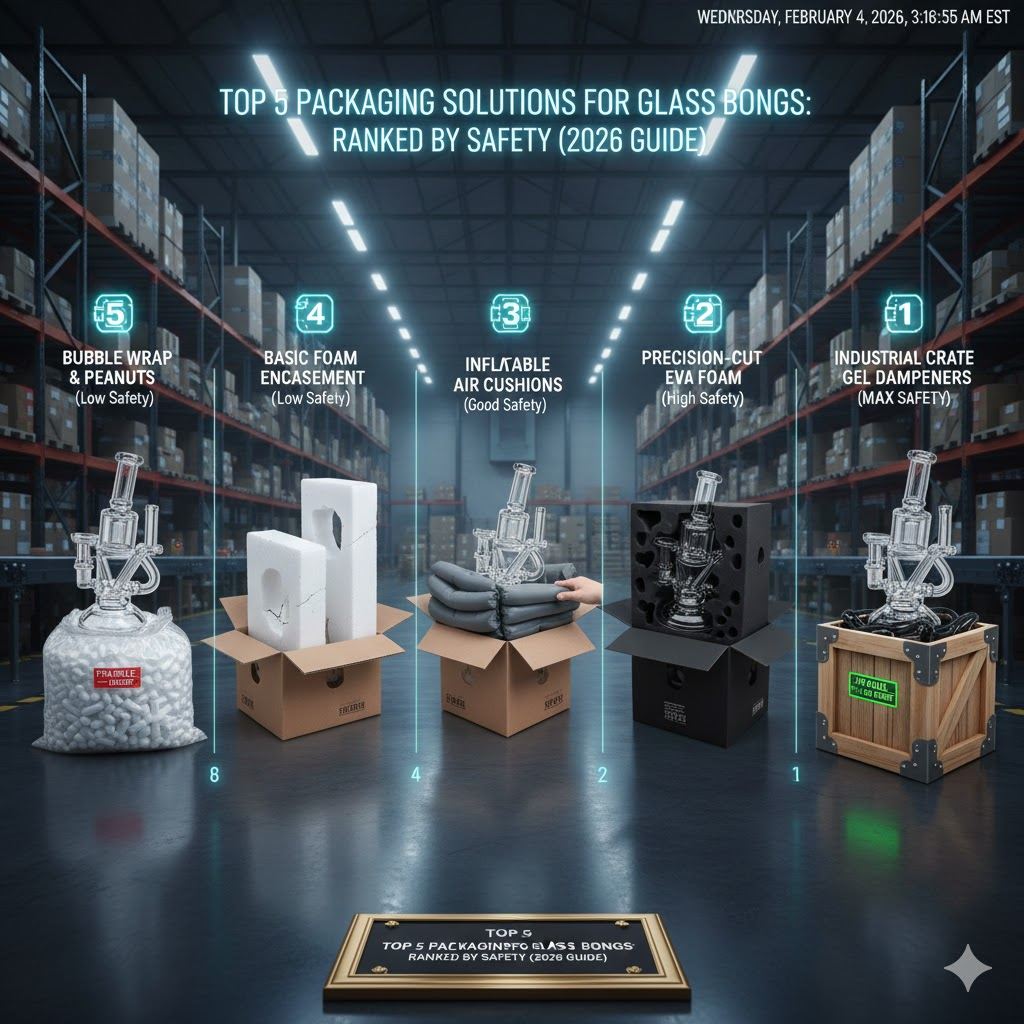
Request to see the factory’s standard export packaging setup: individual bubble wrap or foam sleeves for each piece, dividers in inner cartons, and double-walled outer cartons with appropriate weight ratings. Ask about drop test protocols — a factory that packages for domestic shipping (single-wall boxes, minimal padding) but labels it “export ready” is a breakage claim waiting to happen.
Sampling and Communication Evaluation Phase
The audit is not just about the factory — it is about the working relationship. How the supplier handles the sampling phase before the audit predicts how they will handle production issues after you place an order.
Sample Quality and Turnaround
Request samples before the audit and evaluate three dimensions: dimensional accuracy against your specifications, surface finish quality (no bubbles, devitrification, or tool marks), and packaging of the samples themselves. A factory that ships samples wrapped in newspaper inside a shoebox will not pack your production order any better.
Typical sampling turnaround for a glass pipe factory is 1 to 3 days for standard designs and up to 7 days for complex custom pieces. A supplier who quotes 1-day turnaround on a complex OEM design is either rushing or lying — and both scenarios produce poor samples.
Communication Responsiveness
Track response times from first contact through the audit process. A factory that takes 5 days to reply to an initial inquiry will not respond faster once you are a customer with a problem. The best manufacturers respond to RFQs within one business day and treat the sampling phase as a mutual evaluation — they ask detailed questions about your specifications, target market, and compliance requirements rather than just quoting a price.
During the audit, ask who your day-to-day contact will be after ordering. If the sales rep who has been courting you disappears post-order and a different team handles production updates, communication will break down at the worst moments.
Red Flags That Should Disqualify a Supplier
Some audit findings are fixable — a dirty workshop can be cleaned, a missing sign can be hung. Others are structural dealbreakers that indicate fundamental dishonesty or incapability. Walk away immediately if you encounter any of these:
| Red Flag | What It Signals | Risk If Ignored |
|---|---|---|
| Cannot produce original certification documents (only photocopies or “the office has them”) | Certificates may be forged or borrowed | Customs rejection, buyer chargebacks |
| Refuses NDA signing before discussing custom designs | Will share your designs with competitors | Design IP theft, market saturation with your own product |
| Annealing lehr is off or cold during visit | Equipment is decorative or used inconsistently | Batch-wide cracking failures in transit |
| Business license name does not match invoice or bank account name | Middleman or identity mismatch | Payment fraud, no legal recourse |
| Quotes production capacity far above what floor space and headcount support | Inflated claims, possible unauthorized subcontracting | Quality inconsistency, missed delivery dates |
Any one of these findings should halt the audit and remove the supplier from your shortlist. The cost of switching suppliers before production is always lower than the cost of recovering from a failed shipment.
Conclusion
A glass factory audit is not a formality — it is the difference between a reliable supply chain and an expensive lesson. The six audit zones covered in this checklist — legal credentials, certifications, QC infrastructure, floor conditions, packaging readiness, and communication quality — form a complete framework for evaluating any glass pipe manufacturer before you commit capital.
The factories that pass this level of scrutiny consistently deliver better product, fewer surprises, and longer partnership value. The ones that fail it — or that you skip auditing entirely — are the ones that end up as cautionary tales in import forums.
Key Takeaways
- Always verify certifications through the issuing body’s database, never from PDFs alone.
- The annealing lehr is the heartbeat of a glass factory — if it is off, walk out.
- Sampling-phase responsiveness predicts production-phase reliability more than any contract term.
- Red flags like identity mismatches or NDA refusal are structural — do not rationalize them away.
Building a vetted supplier shortlist takes effort upfront but eliminates the most costly sourcing mistakes downstream. If you are ready to evaluate a manufacturer that maintains BSCI, WRAP, and ISO 9001 certifications with transparent production processes, explore the wholesale water pipes collection to see how a factory audit framework translates into consistent product quality.
How long does a proper glass factory audit take?
A comprehensive on-site audit of a glass pipe factory typically requires one full day for the floor walk, document review, and staff interviews. Pre-audit document research typically requires 2-3 days of remote verification before the visit.
Can I audit a glass factory remotely?
Partial audits work remotely — document verification, certification checks, and live video floor tours cover the majority of the checklist. For the remainder (physical equipment inspection, random carton opening, worker interviews), an on-site visit or a trusted third-party auditor is necessary.
What is the most common reason glass pipe shipments arrive damaged?
Inadequate export packaging is the leading cause — specifically, single-wall cartons without internal dividers and insufficient individual wrapping. Annealing failures rank second, causing pieces that pass factory inspection but crack in transit due to internal stress.
How do I verify a supplier’s BSCI certification?
BSCI audit results are managed through the amfori BSCI online platform. As a buyer, you can request access to view a factory’s BSCI rating, audit date, and scope. Always confirm the certificate covers the specific factory address, not just a parent company.
Should I hire a third-party inspection company for the factory audit?
For first-time sourcing or high-value orders, a third-party inspector adds objectivity. Firms like SGS, Bureau Veritas, and Intertek offer factory audit services in China. While a third-party audit represents a meaningful investment, the cost is minor compared to the risk of a failed container shipment.
Frequently Asked Questions
How long does a proper glass factory audit take?
A comprehensive on-site audit of a glass pipe factory typically requires one full day for the floor walk, document review, and staff interviews. Pre-audit document research adds 2 to 3 days of remote verification before the visit.
Can I audit a glass factory remotely?
Partial audits work remotely — document verification, certification checks, and live video floor tours cover the majority of the checklist. For the remainder (physical equipment inspection, random carton opening, worker interviews), an on-site visit or a trusted third-party auditor is necessary.
What is the most common reason glass pipe shipments arrive damaged?
Inadequate export packaging is the leading cause — specifically, single-wall cartons without internal dividers and insufficient individual wrapping. Annealing failures rank second, causing pieces that pass factory inspection but crack in transit due to internal stress.
How do I verify a supplier’s BSCI certification?
BSCI audit results are managed through the amfori BSCI online platform. As a buyer, you can request access to view a factory’s current BSCI rating, audit date, and scope. Always confirm the certificate covers the specific factory address, not just a parent company.
Should I hire a third-party inspection company for the factory audit?
For first-time sourcing or high-value orders, a third-party inspector adds objectivity. Firms like SGS, Bureau Veritas, and Intertek offer factory audit services in China. The investment is minor compared to the risk of a failed container shipment.
Get a Quote for Your Next Order
Need documentation you can verify? ready for your factory audit checklist? Explore our wholesale water pipe ranges — or send your product spec and target quantity to our factory team or message us on WhatsApp, and we will reply with pricing and lead times within 24 hours.
If you want a reference for what a verified production line looks like, our OEM process overview documents every stage from design review to final dispatch.
About the Author
Ava Zeng is the founder of Elfglass, a Shenzhen-based borosilicate glass pipe manufacturer serving B2B brands worldwide. Every guide on this site is grounded in her production-floor experience— the annealing lines, QC checkpoints, and export orders behind each claim.
Before you commit to a supplier, read her founder’s story and trust promise, and the guide to vetting a reliable glass pipe manufacturer— the same red-flag checklist Elfglass applies to its own suppliers.
Audit scope is defined in audit standards, where independence, evidence sampling, and corrective-action tracking determine whether findings are actionable.
Ready to Source Custom Glass Pipes?
Get a free quote within 24 hours. MOQ from 100 pieces. NDA-protected design consultation.
