
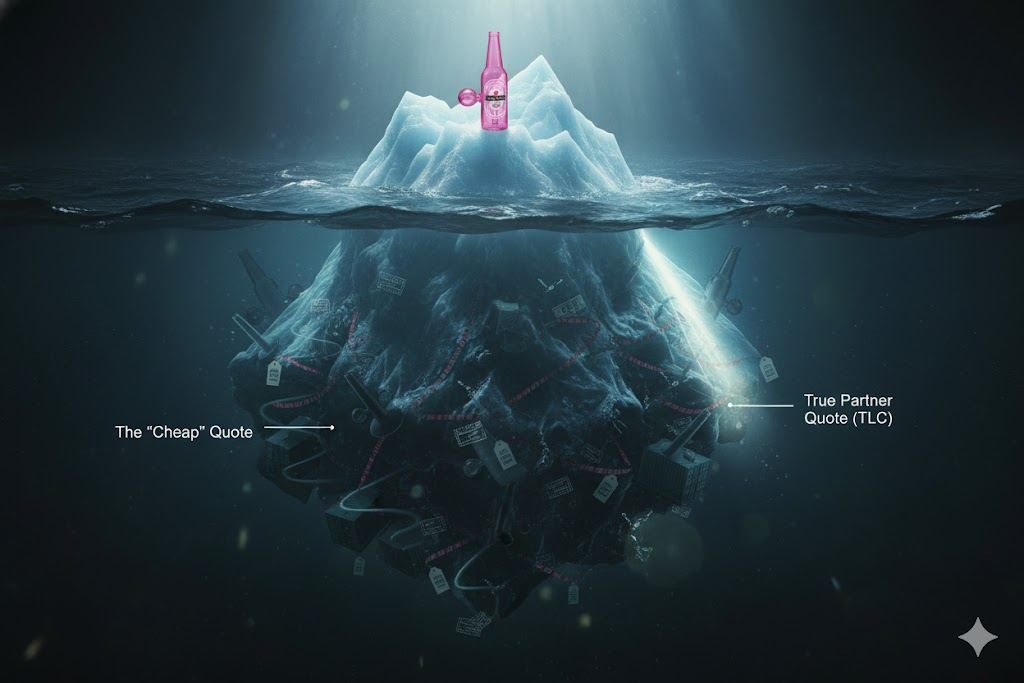
Glass pipe breakage during shipping costs retailers 5â15% of every order â but the right packaging method can reduce that rate to under 2%. The difference between a 12% breakage rate and a 1.5% rate comes down to three factors: inner wrapping material, box compression strength, and whether the supplier actually tests their packaging before shipping.
This guide shows you the four packaging methods used for glass pipes, breaks down the real cost of breakage (including hidden fees most buyers overlook), and explains why some factories charge $0.50 per unit for premium packaging while others include it at no extra cost.
Four Packaging Methods for Glass Pipes
Bubble Wrap + Standard Box â The budget option. Each pipe is wrapped in 2â3 layers of bubble wrap and placed in a standard corrugated box. Typical cost: $0.20â$0.40 per unit. Breakage rate: 8â12% for domestic shipping, 12â18% for international. Best for low-value items where replacement cost is less than premium packaging cost.
Foam Insert + Reinforced Box â The mid-tier option. Custom-cut foam inserts hold each pipe securely in place, preventing movement during transit. Box uses double-wall corrugated cardboard. Typical cost: $0.50â$0.80 per unit. Breakage rate: 3â5% for domestic, 5â8% for international. Best for mid-range products where customer experience matters.
Individual Gift Box + Foam + Master Carton â The premium option. Each pipe ships in its own printed gift box with foam insert, then multiple gift boxes are packed into a reinforced master carton. Typical cost: $1.00â$1.50 per unit. Breakage rate: 1â2% for domestic, 2â3% for international. Best for high-value items and retail-ready products.
Drop-Tested Custom Packaging â The enterprise option. Packaging is engineered and drop-tested to ISTA standards (International Safe Transit Association). Uses custom foam density, optimized box dimensions, and reinforced corners. Typical cost: $1.50â$2.50 per unit. Breakage rate: under 1% for all shipping methods. Best for high-volume orders (5,000+ units) where packaging cost amortization makes engineering worthwhile.

The Real Cost of Breakage (Including Hidden Fees)
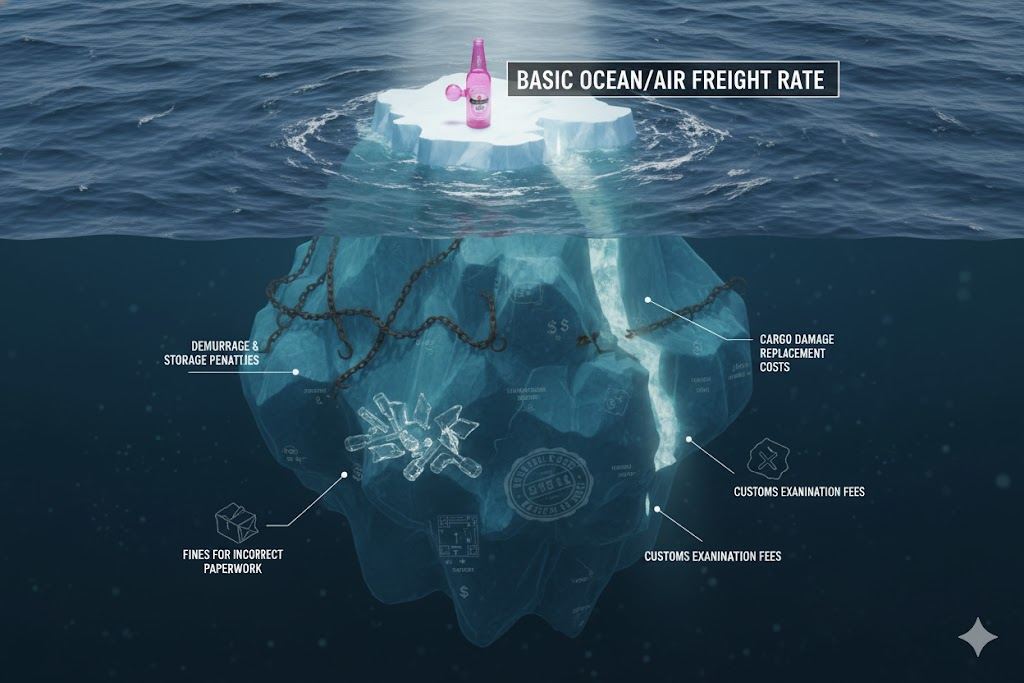
Most buyers calculate breakage cost as: (replacement cost à breakage rate). This misses four hidden costs:
1. Customer service time. Each broken item generates 2â3 emails (notification, replacement request, tracking update). At $5/hour for customer service labor, processing one breakage claim takes 15â20 minutes = $1.25â$1.67 in labor cost.
2. Replacement shipping. Sending a replacement item costs $5â$15 in shipping fees, depending on destination and speed. This cost is rarely recovered from the original supplier unless explicitly negotiated.
3. Lost customer lifetime value. A customer who receives a broken item is 40% less likely to reorder. For a customer with $200/year lifetime value, this represents an $80 opportunity cost.
4. Administrative overhead. Processing breakage claims, filing insurance requests, and reconciling inventory discrepancies takes 30â60 minutes per incident. At $10/hour for administrative labor, this adds $5â$10 per claim.
Quick answer: The true cost of breakage is 3â5Ã the replacement cost when you factor in customer service labor, replacement shipping, lost customer lifetime value, and administrative overhead. For a $10 glass pipe with 10% breakage rate, the real cost is $5â$8 per broken unit, not $1. Investing $0.50/unit in better packaging reduces breakage from 10% to 2%, saving $3â$6 per unit sold.
How to Calculate Your True Breakage Cost
Use this formula to calculate the true cost of breakage for your business:
| Cost component | Per-unit cost | Notes |
|---|---|---|
| Replacement product cost | $10.00 | Wholesale price of the pipe |
| Customer service labor | $1.50 | 15 min à $6/hour |
| Replacement shipping | $8.00 | Average domestic shipping cost |
| Administrative overhead | $7.50 | 45 min à $10/hour ÷ 60 min |
| Lost LTV (40% Ã $200) | $80.00 | Amortized over expected order volume |
| Total per breakage | $107.00 | Before LTV amortization |
For a business shipping 1,000 units/month with 10% breakage rate (100 broken units):
- Direct replacement cost: 100 Ã $10 = $1,000/month
- Customer service labor: 100 Ã $1.50 = $150/month
- Replacement shipping: 100 Ã $8 = $800/month
- Administrative overhead: 100 Ã $7.50 = $750/month
- Total monthly breakage cost: $2,700 (excluding LTV impact)
Investing $0.50/unit in better packaging (adding $500/month) reduces breakage from 10% to 2% (20 broken units):
- New monthly breakage cost: $540 (20 units à $27 direct cost)
- Packaging investment: $500
- Net monthly savings: $1,660 ($2,700 â $540 â $500)
Packaging Engineered to Cut Breakage
We offer foam-insert, double-wall, and drop-tested packaging options so your glass pipes arrive intact. Ask us which packaging tier fits your route and value before you ship.
MOQ from 100 pieces | BSCI / WRAP / ISO 9001 | NDA before every project
How to Evaluate Packaging Quality from Samples
Never approve packaging based on photos alone. Request physical samples and conduct these three tests:
1. Drop test. Drop the packaged product from 1.5 meters onto concrete, once on each face and each corner (6 faces + 8 corners = 14 drops). Count broken items. Acceptable breakage rate: 0% for premium packaging, under 5% for budget packaging.
2. Compression test. Stack 10 packaged units and place 50kg weight on top for 24 hours. Check for box deformation or product damage. Boxes should show minimal compression (under 5mm) and products should remain undamaged.
3. Vibration test. If you have access to a vibration testing machine, simulate truck/rail transport conditions (ISTA Procedure 1A). Without equipment, shake the package vigorously for 2 minutes and check for internal movement or damage.
Need Help Reducing Your Breakage Rate?
Elfglass provides free packaging consultation and drop-testing services. Send us your current packaging specs and we will recommend improvements to reduce breakage below 2%. Request a quote today.
Four Common Packaging Mistakes
1. Using undersized boxes. Boxes that are too small force pipes against walls, increasing breakage risk. Boxes that are too large allow movement during transit. Ideal fit: 20â30mm clearance on all sides for cushioning material.
2. Skipping corner reinforcement. Corners are the most vulnerable points during drops. Adding cardboard corner protectors or foam corner inserts reduces corner breakage by 60â80%.
3. Not accounting for humidity. Corrugated cardboard loses 30â50% of its compression strength in high-humidity environments. For tropical destinations, use wax-coated boxes or add desiccant packets.
4. Ignoring stacking limits. Standard corrugated boxes support 4â6 layers of stacking. Double-wall boxes support 8â10 layers. Exceeding these limits causes bottom-layer box collapse and product damage.
| Mistake | Result | Prevention |
|---|---|---|
| Undersized boxes | Pipes pressed against walls, increased breakage | Allow 20â30mm clearance for cushioning |
| No corner reinforcement | Corner breakage during drops | Add cardboard or foam corner protectors |
| Not accounting for humidity | Box softening, collapse during transit | Use wax-coated boxes or add desiccants for tropical destinations |
| Exceeding stacking limits | Bottom-layer box collapse | Standard boxes: 4â6 layers max; double-wall: 8â10 layers |
Reducing Breakage at Each Handling Stage
Breakage is treated above as a packaging choice, but a package only protects against the forces it actually meets. Glass changes hands several times between the factory and your shelf, and each stage applies a different stress. Mapping the controls to the stage — not just to the box — is what takes a rate from acceptable to under 2%.
| Handling Stage | Primary Risk | Control Measure |
|---|---|---|
| Factory packing | Glass pressed against box walls; movement inside the carton | Correct box sizing (20–30mm clearance), corner reinforcement, individual foam or gift-box insert |
| Master carton consolidation | Bottom-layer collapse under stacking weight | Respect stacking limits (standard 4–6 layers, double-wall 8–10); reinforced master carton |
| Line-haul transit (sea/air) | Sustained vibration and compression; humidity softening corrugate | Double-wall corrugated, wax-coated boxes or desiccants for tropical routes, drop-tested to ISTA |
| Customs and deconsolidation | Rough handling when cartons are opened and repalletized | Keep units in their inner protection until final leg; document carton condition on arrival |
| Last mile and in-store | Drops on hard floors; handling of small parts | Retail-ready inner packaging that survives being opened; stock small parts in padded bins |
Building a Breakage Claim File That Gets Honored
A claim is only as good as its documentation, and both suppliers and cargo insurers reject most disputes on evidence, not on merit. Insurers in particular require proof of adequate packaging before paying. Assemble this file the moment a shipment arrives damaged — not weeks later when the carton is gone.
- Photograph the outer carton before opening it. Timestamped shots of any crush, puncture, or corner damage establish that the force arrived in transit, not in your store.
- Retain every box and all cushioning material. Do not discard the packaging — the supplier and the insurer may ask to inspect the very foam, inserts, and corrugate that failed.
- Count broken versus intact units, per SKU. A precise count, not an estimate, is what converts a complaint into a quantified claim.
- Record which packaging method was used. Note whether it was bubble wrap, foam insert, gift box, or drop-tested custom — this ties the failure to a specific protection level and its expected breakage rate.
- Attach the drop-test records if you have them. Most cargo policies require proof of adequate packaging before paying a claim; the supplier’s ISTA or drop-test documentation is that proof.
- Submit within the claim window with PO and tracking. Include the purchase-order number, tracking number, and a detailed loss breakdown, and file within the stated window (commonly 7 days of delivery) so the claim is not time-barred.
- Keep a per-shipment breakage log. Tracking the rate by shipment and method turns one-off claims into a pattern you can take back to the supplier — and the evidence to renegotiate packaging or terms.
Frequently Asked Questions
What is an acceptable breakage rate for glass pipes?
Industry average is 5â10% for standard packaging. Premium packaging (foam inserts, reinforced boxes) should achieve under 2% breakage. Drop-tested custom packaging can achieve under 1%. If your breakage rate exceeds 10%, your packaging method needs immediate improvement.
How much should I spend on packaging per unit?
Budget packaging: $0.20â$0.40/unit. Mid-tier packaging: $0.50â$0.80/unit. Premium packaging: $1.00â$1.50/unit. Enterprise drop-tested packaging: $1.50â$2.50/unit. The optimal spend depends on your product value â for $10+ pipes, invest at least $0.50/unit to keep breakage under 3%.
Can I negotiate packaging costs with my supplier?
Yes. Packaging costs decrease with volume. At 100 units, expect quoted prices. At 1,000 units, negotiate 10â15% discount. At 5,000+ units, negotiate 20â30% discount or request free packaging upgrades. Some suppliers absorb packaging costs for orders above 10,000 units.
Should I insure my glass pipe shipments?
For orders under $5,000, self-insuring (absorbing breakage costs) is usually cheaper than insurance premiums. For orders over $5,000, consider cargo insurance at 0.3â0.5% of shipment value. Note: most insurance policies require proof of adequate packaging (drop test records) before paying claims.
How do I file a breakage claim with my supplier?
Document everything: photograph damaged items and packaging, retain all boxes and cushioning materials, count broken vs. intact units, and submit a claim within 7 days of delivery. Include your purchase order number, tracking number, and a detailed breakdown of losses. Reputable suppliers respond within 3â5 business days.
Ready to Start Your Custom Glass Pipe Project?
Get a free quote within 24 hours. MOQ from 100 pieces. NDA-protected design consultation.
About the Author

Ava Zeng is the founder of Elfglass and has spent 16 years managing B2B glass pipe sourcing, production oversight, and international trade compliance. She has processed over 800 wholesale orders and works directly with packaging suppliers in Guangdong to ensure breakage rates stay under 2% for all Elfglass shipments. Every order includes drop-test documentation and packaging specifications.
Ready to Reduce Your Glass Pipe Breakage Rate?
Elfglass offers free packaging consultation and drop-testing services. Request a quote and see our current packaging options with guaranteed breakage rates under 2%.
