
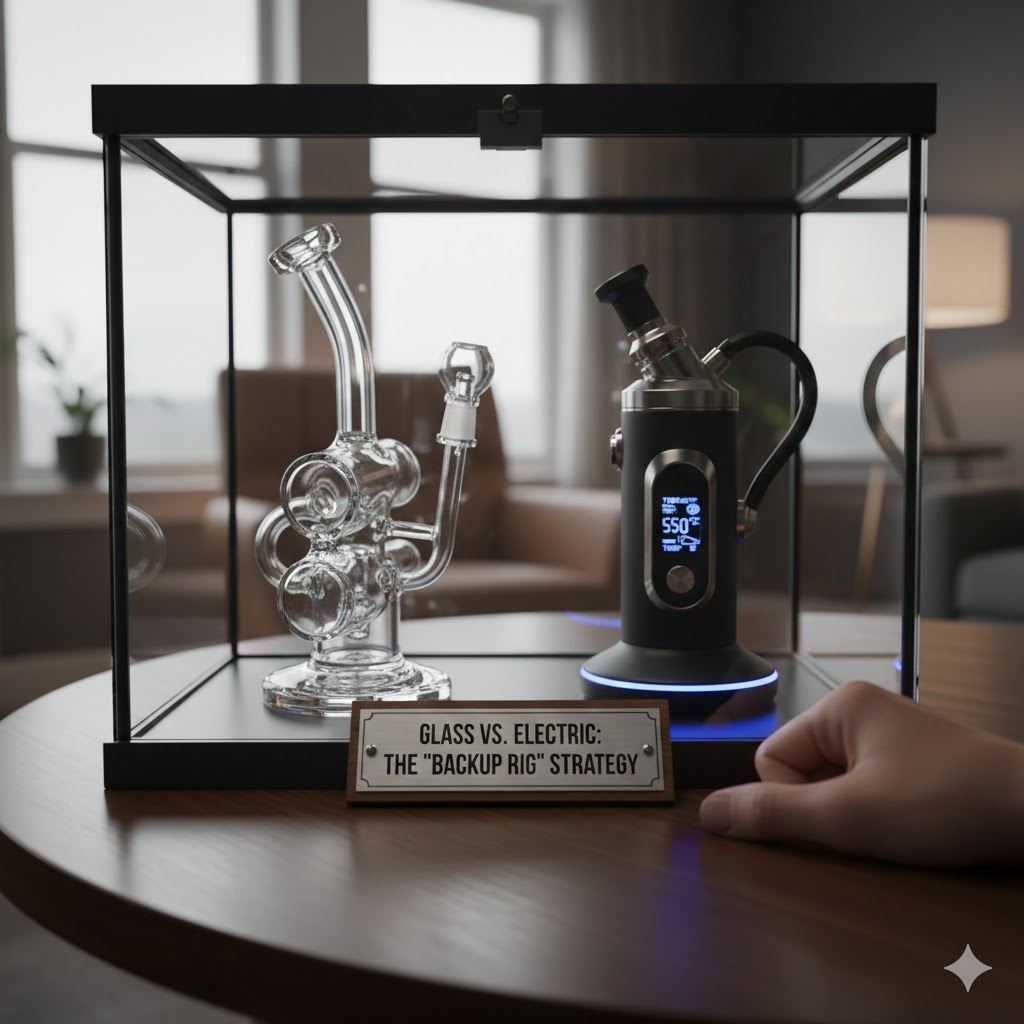
E-Rig Defense is the only strategy that protects user experience when high-tech vaporizers succumb to battery failure. The glass vs electric decision is not either-or: the backup rig strategy runs both.
While digital devices drive initial traffic, their susceptibility to sensor drift creates a critical reliability gap that leads to frustrated customers.
We sell both categories, and the reliability gap below is not theoretical — it comes from watching which units come back and which stay on shelves for years. This analysis positions the analog “Backup Rig” as essential infrastructure.
In the glass vs electric dab rigs debate, we contrast the fragility of OLED screens against the permanence of Lab-Grade Borosilicate 3.3.
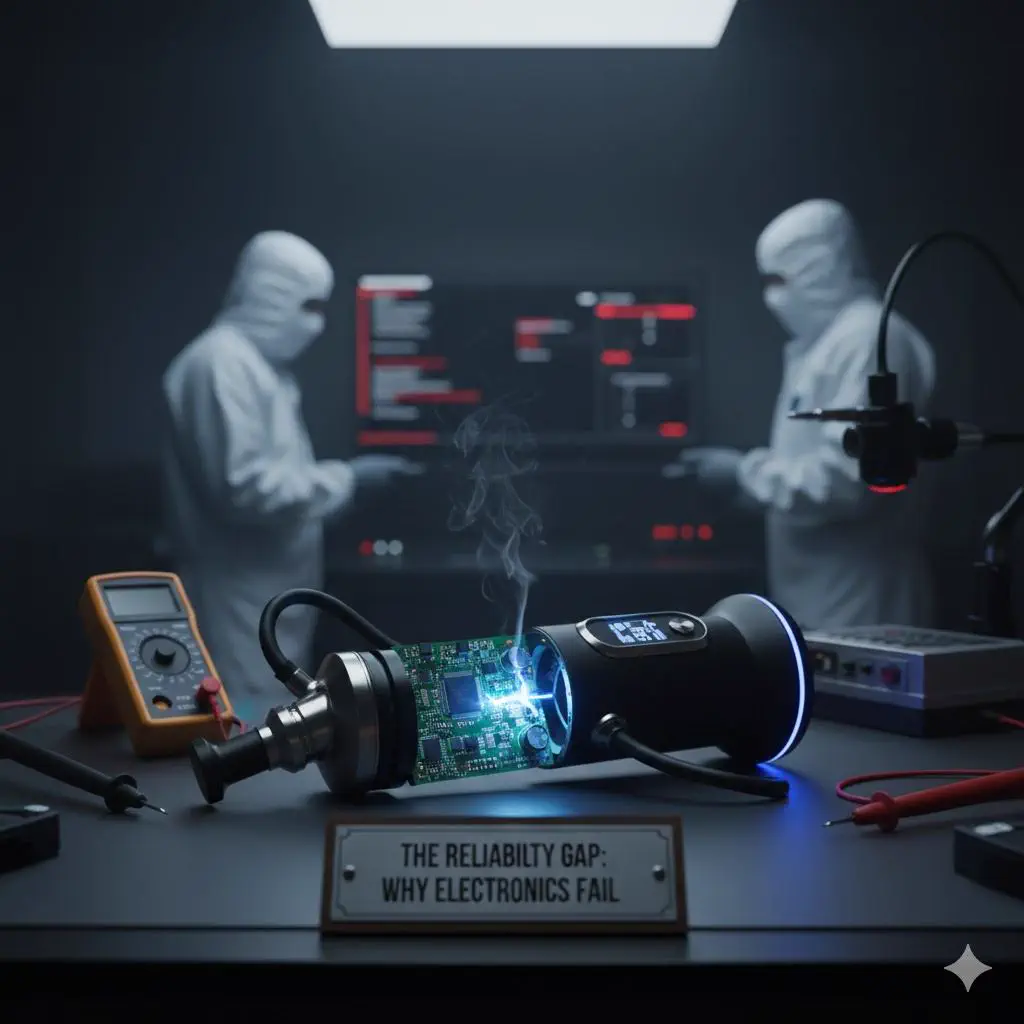
The Reliability Gap: Why Electronics Fail
While E-Rigs offer convenience, they suffer from a fatal flaw: planned obsolescence.
1. Battery Degradation (The 2-Year Wall) According to Battery University, standard Lithium-ion batteries lose about 20% of their capacity after 500 cycles. An expensive E-Rig eventually becomes a paperweight.
-
The Glass Advantage: Borosilicate glass has an infinite shelf life. It never needs charging.
2. The “Sunlight Blindness” Failure Most consumer E-Rigs rely on dim LED screens. In bright environments like festivals, these screens wash out, making temperature control impossible.
-
The Glass Advantage: A glass rig provides mechanical feedback. If the water spins in the Recycler, it works. No screen required.
The “Backup Rig” Upsell Strategy
Smart retailers don’t view glass vs electric dab rigs as a binary choice; they sell them as a bundle.
-
The Pitch: “You have your daily driver E-Rig, but what happens when you’re camping or the battery dies?”
-
The Solution: Sell a 10mm Mini Rig as the “fail-safe” option.
-
The Margin: While E-Rigs have slim margins (often MAP controlled), the add-on glass rig can command 200%+ margins.
Technical Specs: 10mm Vacuum vs. Electronic Pumps
E-Rigs use electronic pumps to force air. Glass rigs use physics.
-
10mm Vacuum Restriction: We engineer our Mini Rigs with 10mm joints to create natural restriction. This allows for low-temp vaporization without a motor.
-
Vortex Mechanics: A Recycler uses water movement to cool vapor. Unlike electronic airways which clog with reclaim and are hard to clean, a glass rig can be soaked in ISO alcohol for a brand-new hit every time.
Turn Creative Visions Into Profitable Reality

Stock the Glass Pipes Your Customers Actually Buy
Elfglass produces the full wholesale catalog, from hand pipes and sherlocks to dab rigs, percolator bongs, and accessories, in proven best-selling specs. Tell us your market and we will recommend a catalog mix with pricing.
MOQ from 100 pieces | BSCI / WRAP / ISO 9001 | NDA before every project
The Wholesale Return Profile: E-Rig vs. Glass
Electronic rigs fail in patterns that create predictable warranty claims. A lithium battery hits its capacity wall within roughly two years, and once that happens, the device is a paperweight. Glass, by contrast, fails only from impact, and impact damage is visible and photographable. For a wholesale buyer, that difference shows up in your dispute queue: battery and circuit complaints require teardowns, firmware logs, and charge-cycle testing, while a broken joint is proven by two photos.
That asymmetry matters when you negotiate terms. Factory-standard transactions run on a 30% T/T deposit with the balance against shipping documents, and MOQ starts at 100 units. Before you commit, request samples and validate the glass grade, because annealed Borosilicate 3.3 tolerates torch heat and soft glass does not. This is exactly the kind of detail to cover when you run through the questions to ask a glass pipe supplier list before ordering.
Ordering the Backup: MOQ 100 and Mixed-SKU Flexibility
A backup-rig strategy only works if the order structure lets you stock both categories without doubling inventory risk. A 100-unit MOQ can cover a mixed basket: 40 mini rigs as the glass backup line, 30 recyclers as the mid-tier option, and 30 fab eggs for the high end. That single order gives your catalog the three price points customers already expect from 2026 dab rig styles, without committing a container to any single design.
Elfglass quotes mixed-SKU baskets within 24 hours and confirms lead times against factory annealing and QC capacity. Every unit is annealed and inspected before it ships, so backup inventory arrives ready to sell rather than ready to break.
Warranty Math: Two Failure Modes, Two Cost Profiles
Stock a category long enough and you will process both failure types, and they cost differently. A dead e-rig leaves you with a warranty claim: the customer expects a replacement or refund, the manufacturer wants the unit back for diagnosis, and the round trip can take weeks. A broken glass joint is settled with a photo and a replacement piece. The e-rig failure also ages your inventory, since electronics lose value on the shelf while annealed glass does not.
That is why established smoke-shop buyers split their spend: electronics for the front of the display, glass for the repeat margin. The 7 glass pipe types guide maps the full glass range so you can decide which shapes deserve the shelf space next to your e-rig wall.
Glass vs E-Rig: Reliability and Cost Comparison
The reliability gap and the warranty math above describe the same asymmetry from two angles. Put into one table, it becomes the reference sheet a buyer can use to justify splitting spend between the two categories. Every figure restates a point already made in this guide — the value is in seeing the two failure economics side by side.
| Factor | Electric Rig (E-Rig) | Annealed Glass Rig |
|---|---|---|
| Primary failure mode | Battery decay (~20% capacity after ~500 cycles), sensor drift | Impact only — visible and photographable |
| How failure is proven | Teardown, firmware logs, charge-cycle testing | Two photos of a broken joint |
| Warranty turnaround | Weeks; unit often returned for diagnosis | Replacement piece settled on the photo |
| Shelf aging | Electronics lose value sitting on the shelf | Annealed glass holds value indefinitely |
| Margin profile | Slim, often MAP-controlled | 200%+ on the add-on backup rig |
| Cleaning | Electronic airways clog with reclaim, hard to clear | ISO soak returns a brand-new hit |
Positioning the Backup Rig In-Store
Knowing the reliability gap is half the job; merchandising it is the other half. The backup-rig strategy only pays if the glass is placed and pitched where the customer actually makes the decision. These are the in-store tactics that turn the comparison table into an attach sale.
- Lead with electronics, attach with glass. Put the E-Rig wall at the front to pull traffic, then position the 10mm mini rigs directly beside it as the fail-safe — close enough that the comparison happens in one glance.
- Script the attach. Train staff on one line: “This is your daily driver — but what happens when you are camping, or the battery dies?” The question sells the backup without disparaging the device they just chose.
- Build a seasonal endcap. Festival and camping seasons are when battery failure hurts most. A “take a backup” endcap timed to those windows catches the customer at the moment the pitch is most believable.
- Keep the margin MAP-safe. The E-Rig may be price-controlled; the glass add-on is not. That is where the 200%+ margin lives, so let the glass carry the profit on the transaction.
- Merchandise the cleaning contrast. A small display showing an ISO-soaked glass rig next to a clogged electronic airway makes the reliability argument physical instead of verbal.
Final Thoughts on Inventory Strategy
Electronic devices inevitably face battery decay, but a Borosilicate 3.3 rig remains functional forever.
Stocking lab-grade, fully annealed glass positions your inventory as the ultimate reliability insurance.
Secure the add-on sale today while eliminating the return liability caused by cheap, thermal-sensitive alternatives.
Turn Creative Visions Into Profitable Reality Eliminate breakage risks with our scientifically annealed borosilicate glass.
We bridge the gap between complex sketches and mass production.
Frequently Asked Questions
Why use 10mm joints for dab rigs instead of the standard 14mm?
While 14mm joints provide the open airflow needed for smoking flower, dabbing requires restriction.
A 10mm joint creates a tight vacuum that helps vaporize oil efficiently at lower temperatures.
This restriction preserves terpenes and flavor profiles without requiring massive lung capacity from the user.
What is the difference between Lab-Grade Borosilicate and standard glass?
We strictly use High Borosilicate 3.3 (COE 3.3), the same material used in scientific laboratory beakers.
Unlike cheap “soft glass” (Soda-Lime) which creates liability issues by shattering under a torch, our glass withstands thermal shock variations greater than 170°C.
This ensures safety during the repeated heating cycles inherent to dabbing.
How does the annealing process affect durability?
Every Elfglass rig undergoes an 8-12 hour slow-cooling cycle at 1050°F (565°C).
This process eliminates microscopic internal stress caused by shaping.
Proper annealing prevents the glass from “self-shattering” or cracking unexpectedly months after your customer buys it.
Why choose a Recycler over a standard bong for concentrates?
Standard bongs use high water volume, which strips away flavor (terpenes) along with impurities.
Recyclers use the continuous movement of water (Vortex function) to cool vapor without trapping flavor.
Mechanically, they also prevent water from splashing into the mouthpiece, solving a common complaint with small rigs.
What happens if breakage occurs during shipping?
We use “Elf-Guard” packaging, consisting of Air Column Bags and individual inner boxes, keeping our breakage rate below 2%.
If any damage occurs, we provide immediate credit or free replacements in your next order.
Get a Quote for Your Next Order
Choosing between glass and electric dab rigs? Send us your product spec and target quantity — contact our factory team or message us on WhatsApp, and we will reply with pricing and lead times within 24 hours.
About the Author
Ava Zeng is the founder of Elfglass, a Shenzhen-based borosilicate glass pipe manufacturer serving B2B brands worldwide. She built Elfglass’s product line watching which categories actually get reordered — and the analog rigs she manufactures are the same ones retailers position as the fail-safe next to every E-Rig sale.
Before you plan your next inventory mix, read her founder’s story and trust promise, and the guide to vetting a reliable glass pipe manufacturer — the same red-flag checklist Elfglass applies to its own suppliers.
Ready to Source Custom Glass Pipes?
Get a free quote within 24 hours. MOQ from 100 pieces. NDA-protected design consultation.
