
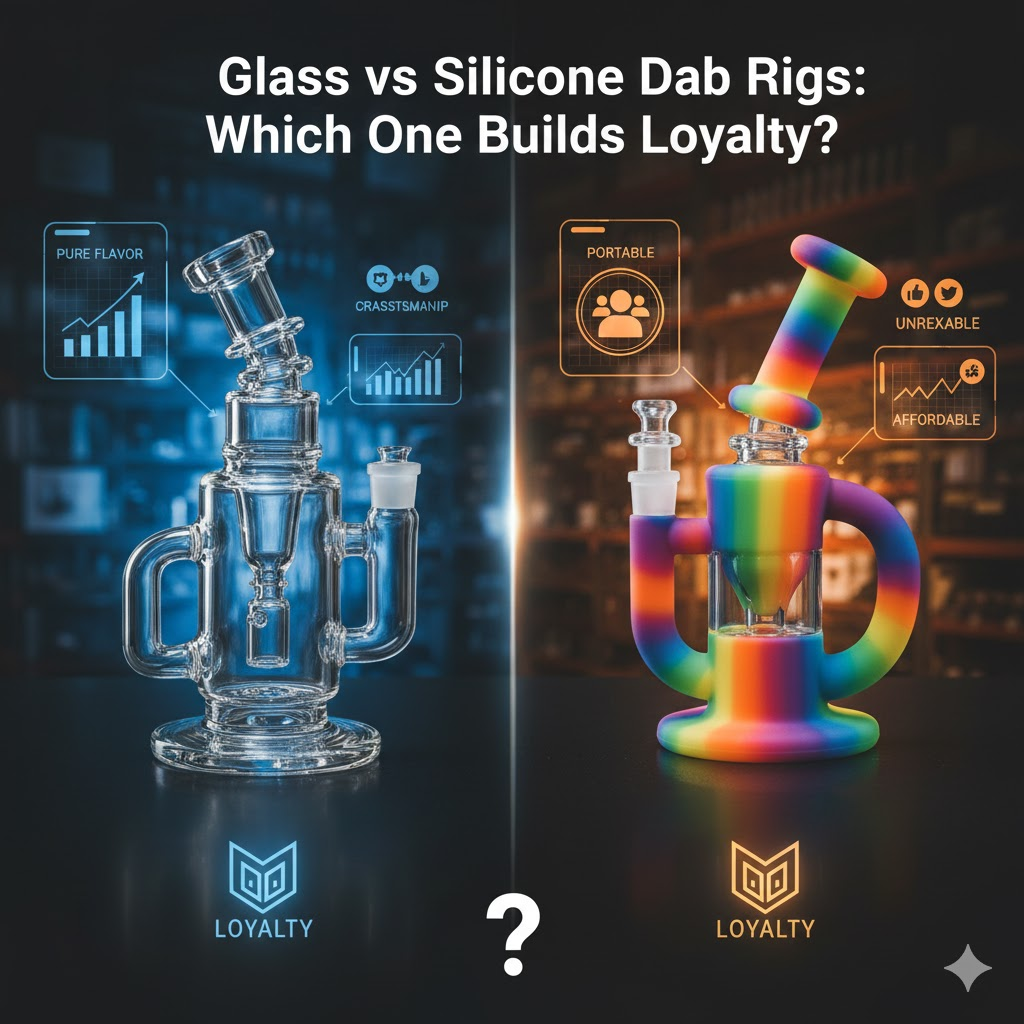
The glass vs silicone dab rigs inventory mix determines whether you secure temporary festival sales or long-term brand loyalty.
While silicone offers unbreakable utility, its porous surface acts as a terpene trap, creating “ghost flavors” that prevent the high-fidelity experience required to upsell premium quartz spacer ecosystems.
According to Harvard Business Review, acquiring a new customer is exponentially more expensive than retaining an existing one.
Selling a product that degrades in quality over time (like silicone) hurts retention.
This guide benchmarks the retention value of Lab-Grade Borosilicate 3.3 against Platinum-Cured Silicone.
We analyze ASTM C336 annealing standards to help you balance durable volume movers with the high-margin glass architecture demanded by hash rosin connoisseurs.
The Essential Shapes: Why Glass Wins on Function
Profitable inventory relies on three core geometries: Mini Rigs for flavor chasing, Recyclers for higher margin tiers, and Fab Eggs for advanced filtration density.
| Architecture | Core Mechanic | B2B Strategy | Target Profile |
|---|---|---|---|
| Mini Rig | Low Air Volume | Volume Mover (Daily Driver) | Hash Rosin Connoisseurs |
| Recycler | Vortex Flow | High Margin ($40+ Wholesale) | Professional/Upgraders |
| Fab Egg | Swiss Diffusion | Visual Premium | Function Enthusiasts |
The Mini Rig (Flavor Purity)
Big glass kills flavor, but porous material kills it faster. In the glass vs silicone dab rigs debate, the Glass Mini Rig is the undisputed leader for flavor chasers.
We engineer these rigs specifically to minimize the contact between air and vapor.
While silicone absorbs terpenes over time, creating a permanent “stale” taste, our Borosilicate 3.3 remains chemically inert.
We strictly fit Mini Rigs with 10mm female joints to create a vacuum, providing the necessary restriction that flexible silicone joints often fail to maintain.
-
Height: Under 6 inches (Standard)
-
Joint Spec: 10mm Female (Precision Grind)
-
Material: Lab-Grade Borosilicate 3.3
The Fab Egg (Advanced Filtration)
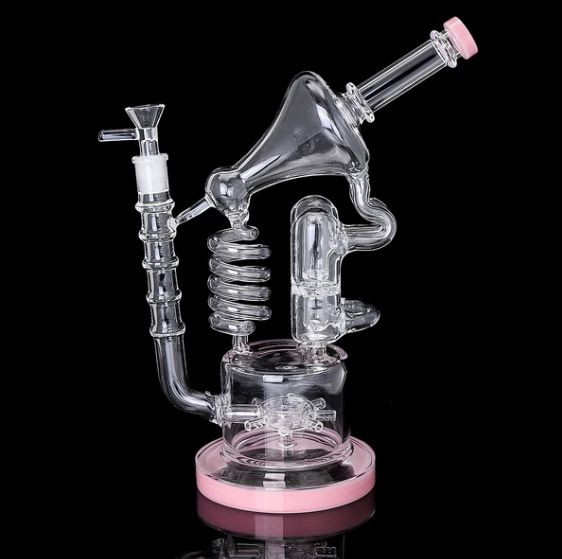
The Fab Egg combines the Swiss Perc’s diffusion with a recycling body.
This design is nearly impossible to replicate effectively in silicone because the internal “egg” structure requires rigid structural integrity to function as a percolator.
We use Grade A Borosilicate tubing and an annealing cycle of 1050°F to ensure these complex internal connections survive daily thermal shock.
Final Thoughts on Glass vs Silicone Dab Rigs
Silicone captures the entry-level sale, but chemically inert Borosilicate 3.3 creates the recurring revenue.
Serious connoisseurs abandon porous materials immediately once they detect the “ghost flavor” of degrading silicone.
Do not risk your shop’s reputation on soft glass import batches.
Request a sample kit today to test our joint precision and thermal shock resistance against your current supply.
Premium Wholesale Rigs: Precision Meets Profitability
Frequently Asked Questions
Is a glass rig better than silicone for dabbing?
Yes, for flavor preservation. Silicone is naturally porous and eventually absorbs terpenes, creating a permanent residu or “ghost flavor” that alters the taste of future dabs.
High Borosilicate 3.3 glass remains chemically inert and non-porous, ensuring the user tastes the extract exactly as intended.
While silicone serves the entry-level or festival market, glass is the standard for connoisseurs.
Why do many high-end dab rigs use 10mm joints instead of 14mm?
While 14mm flows well for flower smoke, 10mm is superior for concentrates because it creates restriction.
This tighter pull generates a vacuum, helping to vaporize oil at lower temperatures.
Low-temp vaporization preserves delicate terpenes that high heat destroys.
For this reason, 10mm is our standard for Mini Rigs and flavor-focused setups.
What is the specific benefit of a Recycler design?
Recyclers use the movement of water rather than the volume of water to cool vapor.
Too much water filtration strips away flavor. By cycling water through external tubes (a vortex function), the rig cools the smoke mechanically without trapping flavor compounds.
It also prevents splashback, keeping water out of the mouthpiece during heavy pulls.
Why is Borosilicate 3.3 glass critical for oil rigs?
Standard “soft glass” (Soda-Lime) cannot withstand the localized heat of a butane torch and often cracks due to thermal shock.
Borosilicate 3.3 is laboratory-grade material used in scientific beakers.
It resists thermal shock greater than 170°C. We also anneal our glass at 1050°F (565°C) for 8-12 hours to remove internal stress, ensuring the rig doesn’t shatter during normal use.
Why are smaller “Mini Rigs” recommended for dabbing?
Less air volume equals better flavor retention.
Large rigs allow vapor to expand and mix with too much air, causing oxidation and stale flavor before it reaches the user.
Mini rigs (typically under 6 inches) keep the vapor path compact, delivering a potent, flavor-rich hit preferred by hash rosin connoisseurs.
