
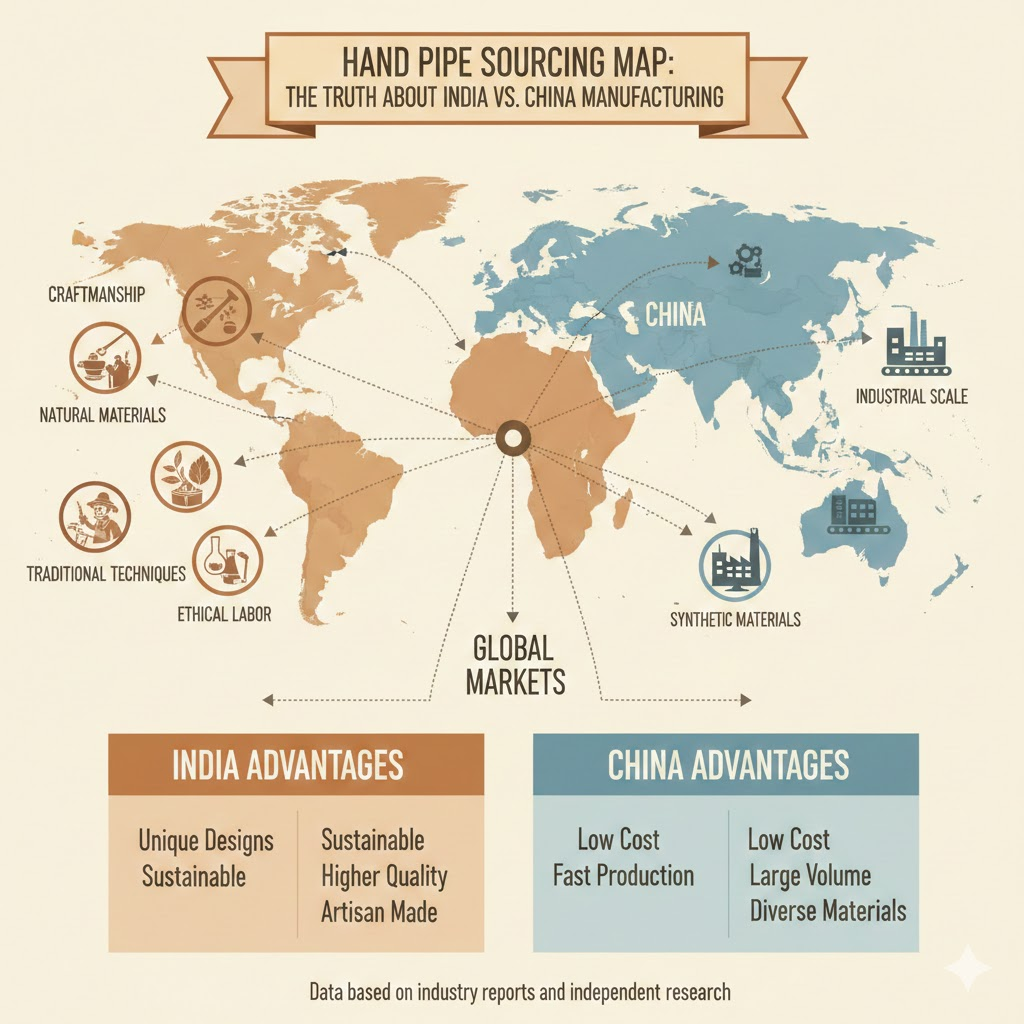
Introduction: Why Your Sourcing Map Defines Your Margin
In the global glass industry, a Hand Pipe Sourcing Map is more than a list of suppliers—it is a strategic blueprint that determines the lifecycle of your inventory.
Wholesalers often face a crossroads: the low-cost lure of Indian manufacturing versus the technical precision of Chinese borosilicate facilities.
Choosing the wrong path on your Hand Pipe Sourcing Map results in a “graveyard” of breakage returns and eroded dealer trust.
This comprehensive report serves as your guide to navigating material science, thermal standards, and the “Golden 4” inventory strategy to ensure your brand scales with durable, high-margin assets.
1. The Foundation of the Sourcing Map: Material Science
When plotting your Hand Pipe Sourcing Map, the first variable to evaluate is the chemical composition of the glass.
The global market is divided into two primary materials: Soda-Lime (Soft Glass) and Borosilicate 3.3.
The India Profile: Soda-Lime (Soft Glass)
Most manufacturing hubs in India specialize in soft glass.
While aesthetically versatile and cheaper to produce due to lower melting points, soft glass has a high Coefficient of Thermal Expansion (COE).
-
The Risk: Soft glass cannot handle rapid temperature shifts. When a consumer applies a lighter to the bowl, the glass expands at a rate that the material cannot structurally support, leading to “Thermal Shock” cracks.
-
The Sourcing Impact: Sourcing soft glass leads to a hidden “fragility tax”—where 10–15% of your inventory may be lost to breakage before it even reaches the end consumer.
The China Profile: High Borosilicate 3.3
Premium Chinese export factories have standardized High Borosilicate 3.3 (ASTM E438 Type I, Class A).
This is the same material used in laboratory beakers and volcanic research tools.
-
The Benefit: It features a very low COE, making it virtually immune to the heat of a standard lighter or even a butane torch.
-
The Sourcing Impact: Borosilicate is the “Gold Standard” on any professional Hand Pipe Sourcing Map, ensuring that your brand is associated with durability and high-end performance.
2. Technical Standards: The Annealing Benchmark
A critical stop on your Hand Pipe Sourcing Map is the factory’s annealing process.
Raw glass holds immense internal stress from the blowing process; if not relieved, the pipe will eventually shatter spontaneously.
ASTM C336 Precision Annealing
We benchmark all suppliers against the ASTM C336 standard. This involves a computer-controlled kiln cycle:
-
Stress Relief: The glass is heated to 1050°F (565°C).
-
Thermal Soak: The temperature is held steady to allow the molecular structure to relax.
-
Controlled Descent: The kiln drops the temperature at a precise, slow rate to prevent new stresses from forming.
Sourcing Insight: Many low-tier factories in India bypass or rush this process to save on electricity and fuel.
On your Hand Pipe Sourcing Map, always prioritize factories that can provide digital kiln logs to prove they adhere to proper annealing curves.
3. The “Double Blown” Wall Thickness Strategy
Durability isn’t just about chemistry; it’s about physics. A vital metric on your Hand Pipe Sourcing Map is wall thickness.
-
Standard Tubing (2mm-3mm): Found in budget-tier imports. These feel light, “cheap,” and break easily during minor drops.
-
Double Blown (5mm-9mm): This technique involves the glassblower gathering extra molten glass to reinforce the piece.
The B2B Advantage: “Double Blown” pipes carry a significant “hand-feel” premium.
When a retailer holds a 7mm thick borosilicate spoon, the perceived value triples compared to a thin soft-glass piece.
Your Hand Pipe Sourcing Map should prioritize heavy-duty specs to reduce shipping damage and increase retail price points.
4. Visual Artistry: Silver Fuming and the “Living Glass”
A high-turnover Hand Pipe Sourcing Map must include color-changing glass.
This is achieved through the technical application of vaporized precious metals.
99.9% Pure Silver Vaporization
True silver fuming is a molecular bond, not a paint. We vaporize 99.9% Pure Silver (ASTM B700 Type 1) within the torch flame.
-
The Technique: Metallic ions are trapped inside the glass layers while it is molten.
-
The Quality Trap: Using Sterling Silver (925) results in a “dirty” gray oxidation. Professional sourcing requires 99.9% purity for that ethereal, ghostly sheen.
The Living Glass Sales Pitch
Fumed glass is the “Living Art” of the industry.
As the pipe is used and resin builds up, the dark background causes the silver ions to reflect light differently, shifting the pipe’s color to a deep, electric blue.
This “evolution” is a powerful psychological selling point that creates customer loyalty—something cheap, painted glass can never replicate.
5. Industrial Slime: Diversifying the Sourcing Map
As you expand your Hand Pipe Sourcing Map, you may encounter the growing “Slime” craze.
This novelty category requires strict chemical engineering to meet export standards.
PVA and Borate Cross-Linking
Industrial slime is a polymer product that relies on Polyvinyl Alcohol (PVA) and precise borate cross-linkers.
-
Viscosity Stability: Unlike DIY mixtures, industrial-grade slime is mixed in automated vats to millisecond tolerances. This prevents the product from becoming “runny” or “brittle” during the 30-day transit in a shipping container.
-
Safety Compliance (EN 71-3): For EU and North American market access, slime must comply with the Toy Safety Directive 2009/48/EC. Your Hand Pipe Sourcing Map must filter for factories that test for chemical migration limits, specifically regarding boron levels.
6. Implementing the “Golden 4” Assortment Strategy
The most common mistake in procurement is “Inventory Bloat”—stocking too many niche shapes that don’t sell.
A lean Hand Pipe Sourcing Map focuses on the “Golden 4” profiles that capture 90% of market demand.
| Profile | Category | Why It Sells | Manufacturing Detail |
| The Spoon | The Volume Leader | Universal appeal; bread & butter. | Flat Bottom design to prevent rolling. |
| The Chillum | The Impulse Buy | Low price point; on-the-go use. | Reinforced tips to prevent chipping. |
| The Sherlock | The Aesthetic Choice | Cools smoke; appeal to collectors. | Deep “S” curve for thermal cooling. |
| The Hammer | The Functional Hybrid | Bridges pipe and bubbler gap. | Water filtration in a handheld form. |
By narrowing your Hand Pipe Sourcing Map to these four categories, you reduce demand uncertainty and increase capital turnover.
7. Logistics and Quality Control: The “Golden Sample”
Navigating a Hand Pipe Sourcing Map across oceans requires a rigorous quality control (QC) protocol to prevent the “bait and switch.”
The Golden Sample Protocol
Before committing to a 5,000-unit run, you must secure a “Golden Sample.” This is the physical benchmark for your order.
-
Modeling: 24-hour rapid 3D modeling for custom shapes.
-
Sampling: A physical prototype made from the exact Borosilicate 3.3 batch.
-
Validation: Test the silver fuming depth and the flat-bottom balance.
-
Production: Once the Golden Sample is approved, the factory is legally and contractually obligated to match that quality for the entire batch.
8. Customization: Building Brand Equity
Your Hand Pipe Sourcing Map should allow for brand scaling.
Modern Chinese manufacturing offers customization levels that Indian cottage industries struggle to match at scale.
-
Custom Logos: Sandblasting or high-heat decals that fuse with the glass.
-
Proprietary Molds: For brands looking to launch unique shapes that cannot be found elsewhere in their region.
-
Packaging: Integrated retail-ready packaging (boxes/tubes) that reduces the retailer’s labor and makes your product “shelf-ready.”
9. The Financial Truth: Net Delivered Margin
Wholesalers often focus on the “Unit Cost” at the factory gate.
However, a professional Hand Pipe Sourcing Map calculates the Net Delivered Margin.
-
Low-Cost India Source: $1.40 per pipe. 12% breakage in transit + 8% customer returns for cracks = 20% inventory loss. Your real cost is $1.68+.
-
Premium China Source: $2.00 per pipe. <1% breakage + <1% returns = ~2% inventory loss. Your real cost is $2.04.
When you factor in the “soft costs”—brand reputation, the labor of processing returns, and lost shipping fees—the premium borosilicate path on your Hand Pipe Sourcing Map is the only one that yields sustainable profit.
Premium Custom Glass Pipes Built To Sell

10. Conclusion: Finalizing Your Sourcing Map
The truth about hand pipe manufacturing is that quality is your best hedge against a volatile market.
Sourcing soft glass imports may save pennies upfront, but the high breakage rate acts as a hidden tax on your net margins.
High Borosilicate 3.3 remains the only viable standard for ensuring thermal shock resistance and long-term durability.
By following this Hand Pipe Sourcing Map, you ensure that your inventory builds dealer trust through resilience rather than crumbling under the heat of a lighter.
Summary Checklist for Your Sourcing Map:
-
[ ] Is the base material Borosilicate 3.3?
-
[ ] Does the factory follow ASTM C336 annealing cycles?
-
[ ] Are the pipes Double Blown (5mm-9mm thickness)?
-
[ ] Is the fuming done with 99.9% Pure Silver?
-
[ ] Does the factory provide a Golden Sample for approval?
Frequently Asked Questions
Why use Borosilicate 3.3 instead of Soft Glass?
Soft glass (soda-lime), common in cheap imports from India or Mexico, cracks under direct lighter heat or minor thermal shock.
We strictly use High Borosilicate 3.3, the same material found in laboratory beakers.
This glass withstands rapid temperature changes and physical impact without shattering.
For a smoke shop, this means selling a product that survives daily use rather than breaking in a week.
How does the annealing process affect durability?
Raw glass holds internal stress that leads to spontaneous cracking, famously known as “checking” in the industry.
We run a precision annealing cycle at 1050°F (565°C) adhering to ASTM C336 standards.
This process targets critical stress points like the bowl and carb hole.
Proper annealing makes the difference between a pipe that bounces when dropped on a table and one that explodes.
What is the standard wall thickness for heavy-duty pipes?
Standard spoons typically use 3mm to 4mm tubing.
For our heavy-duty lines, we use double-blown glass ranging from 5mm to 9mm.
This extra thickness gives the product substantial weight in the hand—a key indicator of quality for end-users—and significantly increases impact resistance.
Do the fumed glass pipes actually change color?
Yes. We fume pure silver and gold into the glass during the blowing process.
Silver produces blue hues, while gold creates pinks and oranges.
These molecules sit inside the glass structure.
As resin builds up inside the pipe, the dark background causes these metallic ions to visually pop and shift colors, turning the pipe into “living art” that evolves with use.
What are the minimums for custom branding?
We structure our MOQs to support growing brands and wholesalers:
- In-Stock Assorted: 100 pieces (Mixed colors).
- Custom Logo: 200 pieces (Sandblast or Decal).
- Custom Shape: 500 pieces (Requires new mold).
We provide “Golden Samples” for approval before mass production to ensure the final batch matches your specifications.
