
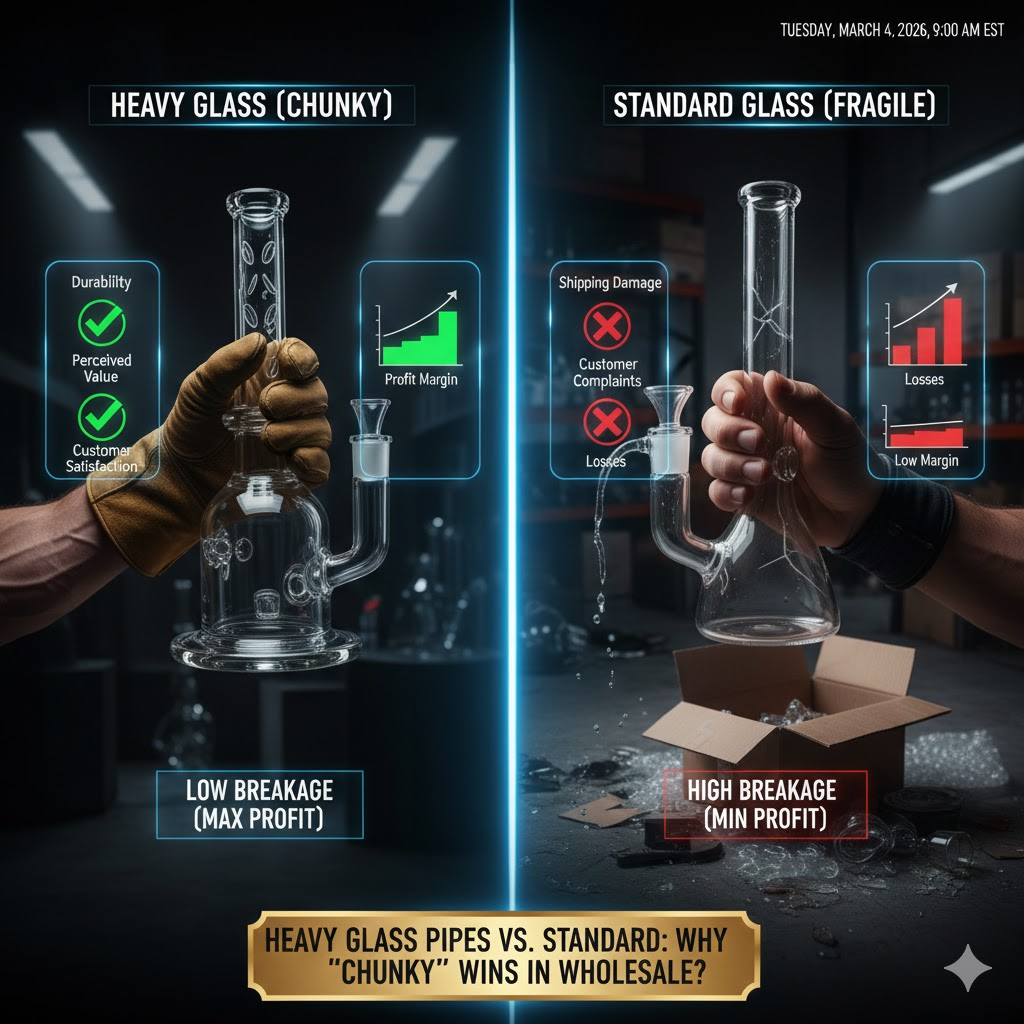
The debate between standard and heavy glass pipes is the ultimate deciding factor in your long-term wholesale margins.
While standard 3mm pipes reduce upfront procurement costs, they expose your inventory to extreme fracture risks during international shipping and everyday retail handling.
In the modern smoke shop industry, consumers equate weight with quality.
Opting for heavy glass pipes (5mm-9mm walls) is the only empirical defense against the inventory bleed caused by fragile imports.
This comprehensive guide analyzes the economics of sourcing heavy glass pipes for your wholesale business.
The Economics of Heavy Glass Pipes: Cost vs. Value
When building a purchase order, B2B buyers often stare at the FOB price difference between a standard 3mm pipe and heavy glass pipes and wonder if the premium is worth it.
The ROI of Heavy Glass Pipes (5mm – 9mm) These chunky units require up to double the raw material.
-
The “Heft” Factor: In retail psychology, weight equals perceived value. When a customer picks up heavy glass pipes, they feel like weapons. That tangible heft allows retailers to comfortably double or triple the MSRP.
-
Survival Rate: Stocking heavy glass pipes drastically reduces the breakage rate to below 2%. You are no longer spending your margin replacing broken inventory.

Technical Deep Dive: Manufacturing Heavy Wall Borosilicate
Sourcing heavy wall glass pipes wholesale requires partnering with a real manufacturer, not a trader.
Thicker glass presents immense engineering challenges that budget factories simply cannot handle.
1. The ASTM C336 Annealing Challenge
Annealing is the controlled cooling cycle that relieves internal stress within the glass.
-
The Physics: The thicker the glass wall, the longer it takes for the core temperature to equalize with the surface temperature.
-
The Bottleneck: A standard 3mm pipe might require a short kiln cycle. A heavy 9mm pipe requires a prolonged soaking cycle at exactly 1050°F (565°C), often taking 8 to 12 hours.
-
The Elfglass Standard: Rushing this process locks internal stress inside the thick glass, turning it into a ticking time bomb that will shatter spontaneously on the shelf. We strictly adhere to ASTM C336 standards, ensuring every heavy wall pipe is structurally neutralized and safe for daily thermal abuse.
2. Weld Integrity: Dewar Seals on Heavy Glass
Joining two thick pieces of glass requires massive heat and precision.
Cheap factories use “Spot Welds,” which fail under pressure.
When working with 5mm-9mm tubing, we utilize Dewar Seals (Bistable Joints), fusing the thick walls together to ensure the joint is actually the strongest part of the pipe.
Heavy Wall vs. Standard Glass: Quick Comparison
| Metric | Standard Glass (3mm) | Heavy Wall / “Tank” (5mm-9mm) | B2B Impact |
| Raw Material Vol. | Baseline | 2x – 3x Higher | Drives upfront FOB cost |
| Drop Resistance | Low (Shatters easily) | Extreme (Bounces/Chips) | Drastically reduces shrinkage |
| Annealing Time | Fast (3-4 Hours) | Slow (8-12 Hours) | Requires longer lead times |
| Retail Perception | Generic / Cheap | Premium / Indestructible | Allows for 2x-3x higher MSRP |
| Thermal Shock | Moderate Risk | High Resistance | Survives butane torches easily |
Applying Heavy Wall Specs to the “Golden 4” Shapes
Stocking the “Golden 4” covers 90% of market demand.
Upgrading these core shapes to heavy wall specifications maximizes turnover and eliminates dead inventory risks.
Here is how thickness impacts each specific shape.
#1 The Spoon (The Volume Leader)
The Spoon pipe accounts for the majority of hand pipe sales due to its universal familiarity.
-
The Heavy Advantage: The bowl of a spoon pipe takes the brunt of direct butane lighter flames. A 3mm bowl can crack from thermal fatigue over time. A “Double Blown” heavy wall spoon (up to 9mm solid) absorbs and dissipates heat effortlessly.
-
Design Spec: We pair this thick wall with a critical Flat Bottom design to prevent the heavy pipe from rolling off display counters.
#2 The Chillum (The P.O.S. Impulse Buy)
Chillums are straight tubes designed for pocket-carry and discretion.
-
The Heavy Advantage: Because they are carried in pockets alongside keys and coins, thin chillums are easily crushed. A heavy wall chillum survives being sat on or dropped on concrete.
-
Design Spec: Quality control focuses on the draft hole. We engineer a precise 3mm-4mm width through the thick glass to ensure perfect airflow without ash pull-through.
#3 The Sherlock (The Aesthetic Choice)
The Sherlock pipe features a curved “S” stem and a deep bowl, appealing to collectors who prioritize a cooler smoke.
-
The Heavy Advantage: The “S” curve is a major structural weak point. Bending thin glass stretches the outer wall dangerously thin. By starting with heavy wall tubing, we ensure the structural integrity of the curve remains intact even after shaping.
-
Design Spec: We often utilize silver and gold fuming on the thick walls, creating deep, multi-layered color-changing effects as resin builds up inside.
#4 The Hammer Bubbler (The High-Value Hybrid)
The Hammer Bubbler offers portable water filtration in a handheld shape, significantly boosting Average Order Value (AOV).
-
The Heavy Advantage: A bubbler must hold water and stand upright. A 5mm+ heavy base provides the necessary low center of gravity so the unit does not tip over and spill dirty water. The thick walls also protect the complex internal downstem from external impacts.
Packaging Heavy Wall Inventory: The Freight Reality
Heavy glass means heavy shipments.
If you are sourcing heavy wall glass pipes wholesale, your packaging strategy must evolve to protect your investment.
Standard egg-crate cardboard will collapse under the sheer weight of 9mm borosilicate.
At Elfglass, we mandate Elf-Guard Air Column Bags for heavy inventory.
This suspension technology ensures that the dense glass is isolated from vibrations during ocean freight, securing your heavy-duty inventory without unnecessarily inflating your CBM (Cubic Meter) freight costs.
Final Thoughts: Selling Durability with Heavy Glass Pipes
Stocking cheap, thin soft glass risks your shop’s reputation due to frequent thermal cracking.
Switching to our inventory of heavy glass pipes drastically reduces breakage rates to below 2% while justifying a premium retail price tag.
Don’t guess on glass quality.
Request a Sample Kit today to physically feel our heavy glass pipes against standard market options.
Transform your vision into market-ready reality with our 9mm solid wall construction.
Turn Your Sketches Into High-Profit Glassware

Frequently Asked Questions
What defines a “Heavy Wall” glass pipe?
In the wholesale glass industry, standard tubing is typically 3mm to 4mm thick.
“Heavy Wall” refers to glass that is 5mm, 7mm, or up to 9mm thick.
This extra thickness requires specialized manufacturing techniques, higher kiln temperatures, and significantly longer annealing times.
Are heavy wall glass pipes indestructible?
While no glass is entirely indestructible, 7mm to 9mm High Borosilicate 3.3 pipes are incredibly resilient.
They can typically survive drops onto hardwood floors or being knocked against tables.
They are highly resistant to the daily wear and tear that quickly shatters standard 3mm pipes.
Does thicker glass cost more to ship?
Slightly, due to the increased actual weight.
However, ocean freight carriers primarily charge by Volume (CBM), not just weight.
Because a heavy pipe occupies the same physical footprint as a thin pipe, the shipping cost per unit remains highly efficient, especially when nested properly in our packaging.
Why do some thick glass pipes still crack?
If a thick pipe cracks without being dropped, it is due to improper annealing.
Thicker glass requires up to 12 hours in a kiln to remove internal stress.
Cheap factories rush this process to save time and electricity, leaving the glass “stressed” and prone to spontaneous thermal shock.
We strictly follow ASTM C336 standards to prevent this.
Can I get custom fuming on heavy wall pipes?
Yes. In fact, heavy wall glass provides an excellent canvas for silver and gold fuming.
The thick walls add optical depth to the color-changing effect (often called “Inside-Out” or ISO fuming), making the aesthetic shift much more dramatic as the pipe is used over time.
