
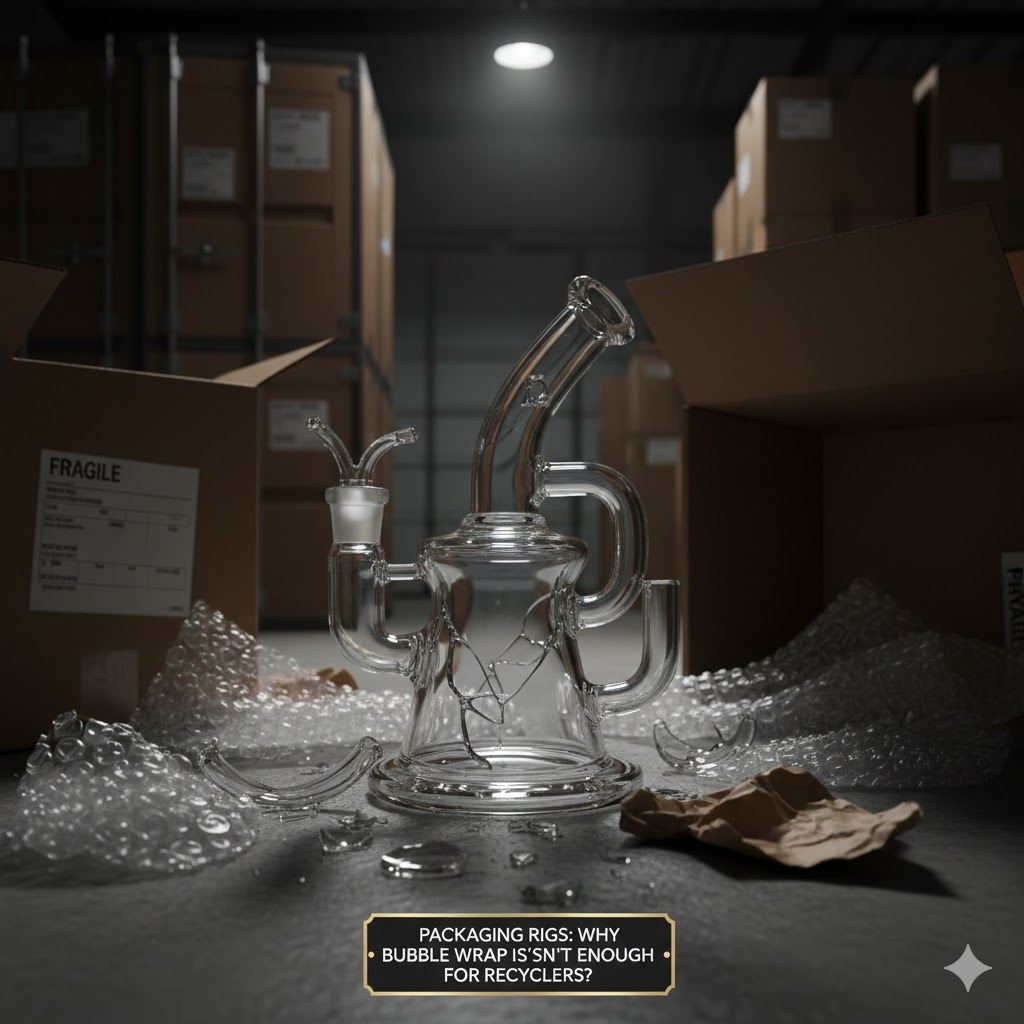
Shipping Safety determines the net margin on every borosilicate shipment, especially since carriers routinely deny liability for glass breakage.
Relying on standard bubble wrap invites “checkerboarding”—fatal compression gaps that allow complex recyclers to shatter against container walls.
These packaging rules are the ones we pack by every day, and the Elf-Guard protocol below is built from what we have seen survive — and fail — inside shipping containers. Every step exists because a cheaper alternative did not make it. This brief details the packaging for glass pipes protocols required to eliminate transit loss.
We analyze the ISTA-grade testing standards and our proprietary Elf-Guard air column suspension system, ensuring your inventory arrives as sellable units rather than unsalvageable shards.
The “Elf-Guard” Air Column System
Bubble wrap is for amateurs. For complex borosilicate geometries, we use Air Column Suspension.
Why Bubble Wrap Fails Standard bubble wrap is static.
Under the weight of other boxes, the bubbles pop or compress, leaving the glass joint directly touching the box wall.
One impact, and it cracks.
How Air Columns Work Our “Elf-Guard” system uses independent, inflatable air chambers that wrap 360 degrees around the rig.
-
Suspension: The glass effectively “floats” in a cushion of air, never touching the cardboard.
-
Isolation: If one column is punctured, the others remain inflated (unlike bubble wrap which loses integrity).
-
Joint Protection: The rigid air pressure locks the 10mm joint in place, preventing vibration stress.
The Outer Defense: 275-lb Burst Strength
Effective packaging for glass pipes isn’t just about the inner wrap; it’s about the crush resistance of the carton.
The “32 ECT” Standard We do not use standard “moving boxes.”
We mandate Double-Wall Corrugated Cardboard with a specific density:
-
32 ECT (Edge Crush Test): Ensures the box can be stacked on a pallet without buckling under vertical weight.
-
275-lb Burst Strength: Prevents punctures from forklifts or other sharp objects in the carrier’s hub.
A recycler packed in a single-wall box is a gamble. A recycler in a 32 ECT double-wall box is an investment.

The “Function Video” QC Audit
Before we even seal the box, we validate that the rig is worth shipping.
A mandatory video audit proving internal hydraulics ensures you aren’t paying shipping costs for defective glass.
The Pre-Balance Payment Protocol Most factories send a few photos and ask for money. We provide high-definition video evidence of your specific production run.
-
Vortex Verification: Confirms the water cycles continuously.
-
Drain Efficiency: Visual proof that the return tubes clear water fast enough to prevent splashback.
Turn Sketches Into Profitable Borosilicate Reality Scale your brand with scientifically annealed glass that maximizes durability.
Turn Sketches Into Profitable Borosilicate Reality
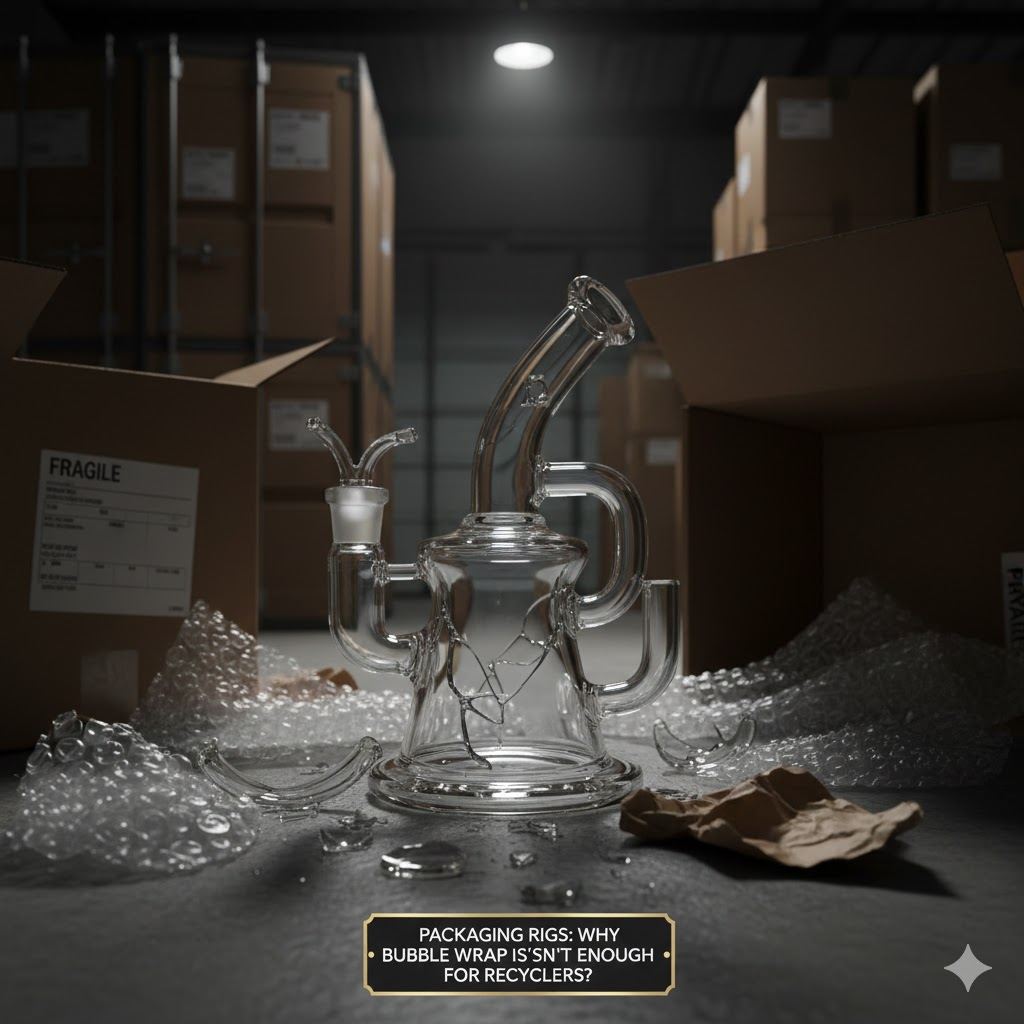
Packaging and Freight Planned Around Your Route
From foam-insert and double-wall cartons to air or sea freight with clear Incoterms, we engineer packaging to cut breakage and quote landed cost honestly. Send us your destination and volume for a packing plan.
MOQ from 100 pieces | BSCI / WRAP / ISO 9001 | NDA before every project
Who Bears the Breakage Cost? Protect Your Margin at the Dock
When a container of rigs arrives with cracked joints, the first question is not how it happened, it is who pays. Factory-standard FOB terms put the risk on your side once goods leave the dock, which means your packaging spec is the only insurance policy you actually control. Two photos of a broken joint are weak evidence; a function video shot before sealing, showing water cycling through the recycler, is proof the piece shipped intact.
That is the logic behind the mandatory function-video QC audit, and it is the same logic to apply when vetting any supplier: ask how breakage disputes are resolved, whether batch photos are archived, and whether the carton spec is contractual. The shipping and liability questions checklist covers exactly what to put in writing before you sign.
Drop-Test the Box Yourself: A 5-Minute Sample Protocol
A spec sheet says “double-wall corrugated”; a drop test proves it. Ask for a packaging sample alongside your product sample, since Elfglass ships 3D models within 24 hours and samples in 1-3 days, so the box arrives with the rig and you can test the combination immediately. Check the corners first, the weakest point on any carton, then press the walls to feel for the second corrugated layer, then drop the packed sample from counter height onto concrete.
If the joint survives, the carton is doing its job; if it does not, that is exactly the information you want before your MOQ of 100 units rather than after. The factory audit checklist walks through the rest of the verification process, annealing records, QC staffing, and audit certificates, so your packaging decision sits inside a complete diligence picture.
Packaging Configuration by Product Type and Freight Mode
There is no single right packaging — there is the right configuration for a specific piece on a specific lane. Use this matrix to write a per-SKU spec instead of applying one blanket rule to the whole order.
| Product | Inner Protection | Carton Grade | Freight Note |
|---|---|---|---|
| Mini rig (10mm) | Air column, joint locked | 32 ECT double-wall | Air-friendly; light and compact |
| Recycler / complex perc | Die-cut foam cradle | 32 ECT double-wall + corner posts | Ocean: immobilize fully; most breakage-prone |
| Beaker / straight tube | Air column or foam sleeve | Double-wall master carton | Nest bowls and downstems inside to cut CBM |
| Hand pipe | Foam insert in retail box | Standard corrugated inner | Retail-ready; low breakage risk |
| Tall water pipe | Fitted foam plus void fill | Heavy-duty double-wall | Ocean: vertical stacking risk; reinforce the base |
Match the carton grade to the lane, not to the product’s value. Air freight rewards lightweight air columns, where every gram is charged twice; ocean freight rewards rigid stacking strength, because the load sits under crushing weight for weeks and gets moved by cranes rather than by careful hands.
Making the Packaging Spec Contractual
A packaging standard only protects you if it is enforceable. A verbal assurance that a factory “packs well” is worth nothing in a breakage dispute three weeks after the container lands. Put these clauses in writing on the purchase order before production starts.
- Carton grade as a spec, not a promise. Name the standard — 32 ECT double-wall, 275-lb burst strength — so a substitution becomes a breach rather than a judgment call.
- Inner immobilization method per SKU. Specify air column or die-cut foam by product, so nothing ever ships loose in an oversized box.
- Function video before balance payment. Tie the balance payment to HD video of your specific run, proving the piece shipped intact and functional.
- Archived batch photos. Require dated packing photos per carton, kept on file, so you can prove condition at origin.
- Written breakage-credit terms. Define the claim window (for example, photos within three days of delivery) and the remedy — credit or free replacement on the next shipment.
- Incoterm and risk transfer stated. Know exactly where FOB risk passes to you, because that is the point your packaging spec becomes your only insurance policy.
None of these clauses costs anything to add to a purchase order, and a supplier who resists putting packaging in writing is telling you, in advance, that they do not intend to be held to it.
Final Thoughts on Shipping Safety
While generic bubble wrap offers lower upfront costs, it fails to protect the complex 10mm joints of a recycler.
Adopting the Elf-Guard protocol is the only reliable way to eliminate breakage and protect your bottom line.
Your dealer reputation depends on delivering intact, sellable inventory.
Don’t guess on survival rates—validate the packaging for glass pipes engineering before you commit capital.
Frequently Asked Questions
How do industry standards mitigate shipping breakage for borosilicate rigs?
“Fragile” stickers are useless in modern logistics hubs.
We rely on physics, not labels. We adhere to ISTA protocols using double-wall corrugated boxes with 275-lb burst strength.
Inside, our proprietary Elf-Guard system (air column bags or custom foam) completely immobilizes the rig.
The glass effectively “floats” in the center of the cartridge, creating a buffer zone that prevents any contact with the outer box walls.
Why is die-cut foam superior to standard bubble wrap?
Bubble wrap settles and compresses during transit, creating gaps where glass can vibrate against heavier components—a failure mode we call “checkerboarding.”
Custom die-cut PE foam or fixed air columns are engineered to the rig’s exact millimeter geometry.
This eliminates vibration and arrests movement specifically at the weak points (joints and mouthpieces), creating a static lock that soft wrap cannot achieve.
Does the annealing process affect shipping safety?
Yes. Glass with high internal stress acts like a ticking time bomb; it can “self-shatter” purely from the temperature drop in an airplane cargo hold.
We anneal every rig at 1050°F (565°C) for 8-12 hours.
This slow-cooling cycle acts as a molecular reset, ensuring the borosilicate structure is stable enough to withstand thermal shock and physical impact during international transport.
What happens if breakage occurs during transit?
Most carriers deny liability for glass, so we manage the risk for you.
Following our AQL 2.5 QC standards, we maintain a breakage rate below 2%.
If an accident happens, we don’t argue with the courier.
We simply issue a credit or include free replacement units in your next shipment to ensure your margin relies on sales, not insurance claims.
Get a Quote for Your Next Order
Choosing packaging for your glass pipe orders? Send us your product spec and target quantity — contact our factory team or message us on WhatsApp, and we will reply with pricing and lead times within 24 hours.
About the Author
Ava Zeng is the founder of Elfglass, a Shenzhen-based borosilicate glass pipe manufacturer serving B2B brands worldwide. She built the Elf-Guard packaging system from the shipping dock up — 32 ECT double-wall cartons, 275-lb burst strength boxes, and air column suspension tested against the failures she has watched in real containers.
Before you sign off on a packaging spec, read her founder’s story and trust promise, and the guide to vetting a reliable glass pipe manufacturer — the same red-flag checklist Elfglass applies to its own suppliers.
Ready to Source Custom Glass Pipes?
Get a free quote within 24 hours. MOQ from 100 pieces. NDA-protected design consultation.
