
Inspiration rarely strikes in a boardroom. But when it does, the race to turn that idea into a product begins.
This is where rapid prototyping glass pipes becomes your competitive advantage, during a conversation in a dimly lit bar, or in the moments just before sleep.
You grab the nearest piece of paper—a receipt, a notebook, or yes, even a cocktail napkin—and you frantically sketch the lines of a glass piece that could redefine your brand.
In that moment, you are electric with possibility.
But almost immediately, the “Founder’s Anxiety” sets in.
You look at that rough drawing and see a long, dark tunnel ahead.
In the traditional manufacturing world, sending this sketch to a factory often results in weeks of silence, followed by a confused email asking for a CAD file you don’t have, or worse, a sample that looks nothing like your vision.
At Elfglass, we believe that the time between inspiration and visualization is sacred.
If that time stretches too long, the passion cools. The idea dies.
We refuse to let your passion cool.
We are not just manufacturers; we are the “Guardians of the Dream.”
This is our promise to you: Give us your napkin sketch, and in 24 hours, we will hand you back a digital reality.
Why We Say “Speed is a Form of Respect”
To the average factory, your sketch is just an inquiry—a potential order number in a queue.
To Elfglass, it is a living thing waiting to be born.
Our core value, “Speed as a Form of Respect,” is not just about efficiency; it is about honoring the emotional energy you have poured into your idea.
Believe me, I’ve been on the other side of that email chain.
Waiting three weeks for a supplier to reply doesn’t just hurt your timeline; it hurts your confidence.
You feel like a small fish in a big pond. We challenge that dynamic.
By delivering a professional 3D model within 24 hours, we are telling you: “We hear you. We understand the urgency of your vision. We are as excited about this as you are.”
This rapid turnaround breaks the “black box” of manufacturing.
It transforms the relationship from a transactional vendor-client exchange into a dynamic Technical Partnership.
Decoding the 24 Hours: Our Process for Rapid Prototyping Glass Pipes
How do we turn a rough 2D drawing into a photorealistic 3D model in one day?
It is not magic; it is a disciplined orchestration of empathy and engineering.
Here is the minute-by-minute breakdown of our rapid prototyping glass pipes process.
Hour 0-2: The Phase of Empathy (Reading the Soul)
When your email lands in our inbox, we do not immediately open our CAD software. First, we practice “Empathy Before Engineering.”
Our product managers—led by Ava and her team—study your sketch to understand the intent behind the lines.
-
The Vibe Check: Is this piece meant to be a heavy, scientific rig for the consumer who values precision? Or is it an artistic, free-flowing piece for the collector?
-
The Functional Audit: We look at the percolator placement. We ask: “What kind of drag does the client want?”
If we see a potential issue—perhaps the base is too narrow for the height, risking a tip-over—we don’t just reject it.
We note it as a “optimization opportunity” to discuss with you. We are reading the subtext of your design.
Hour 2-12: The Engineering Phase (The Physics of Glass)
Once we understand the soul of the piece, our engineers take over to build the body.
This is where art meets the rigid laws of physics.
Using advanced parametric design software, we translate your 2D lines into 3D geometry.
-
Wall Thickness Calibration: We don’t guess. We apply industry standards—typically 5mm for standard durability or 7mm to 9mm for “tank-like” premium pieces.
-
Airflow Simulation: This is the Elfglass difference. A bong is a machine for airflow. We virtually test the “chug.” We ensure the joint size matches the volume of the chamber so the hit isn’t too airy or too restricted.
We are not just drawing a picture; we are building a functional blueprint that can actually be manufactured on our production line.
Hour 12-24: The Visual Reveal (Rendering the Dream)
By the time you wake up, our design team has moved to the final stage: Rendering.
A wireframe model is useful for engineers, but it doesn’t spark joy.
You need to see the glass.
We use high-fidelity rendering engines to apply textures, lighting, and environments to the model.
-
Material Fidelity: We simulate the refractive index of borosilicate glass. You will see how the light bends through the water chamber.
-
Color Accuracy: If you asked for “Slyme Green” accents or a “Fumed” finish, we render those specific chemical colorations.
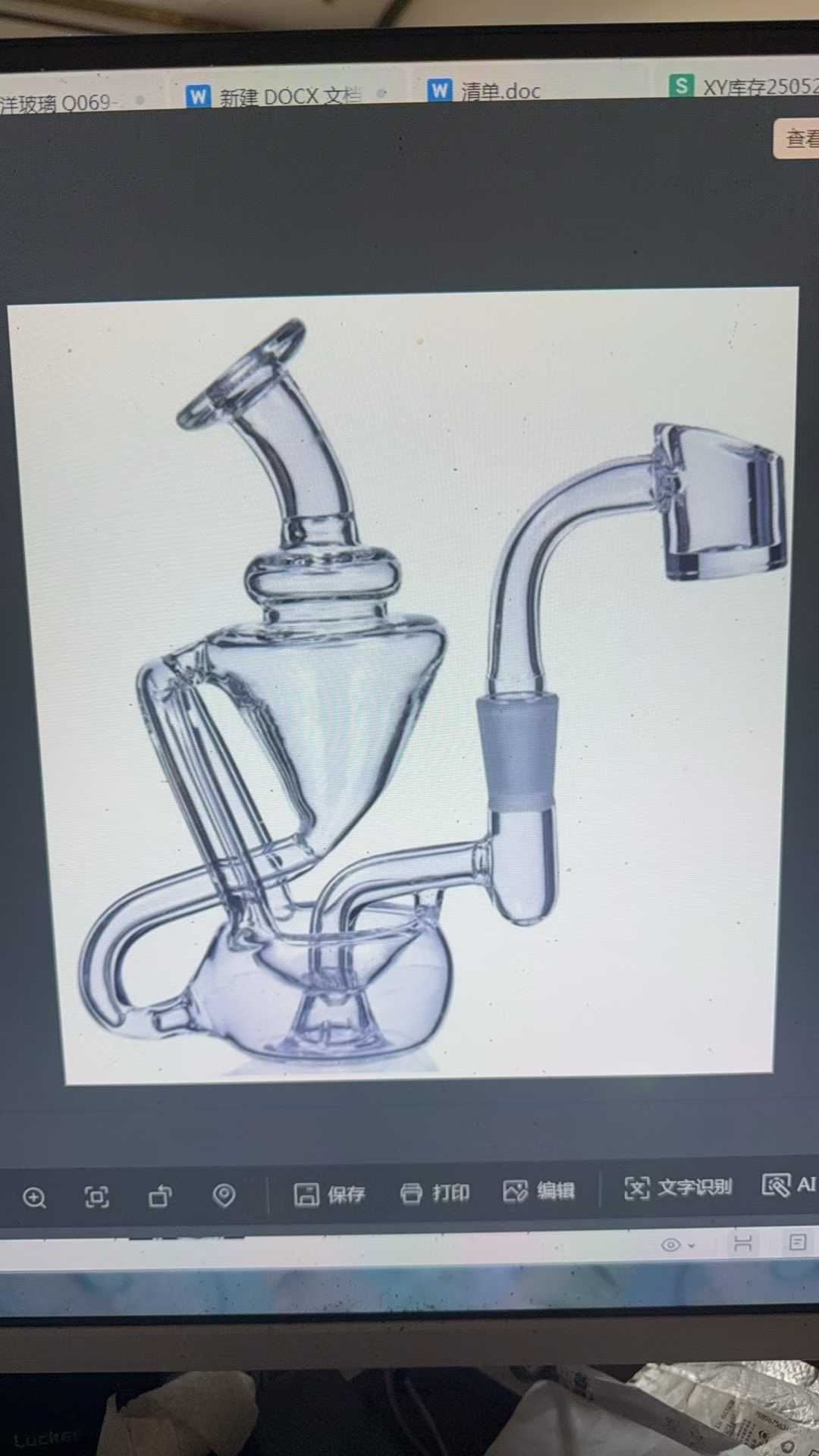
The Deliverable: You receive a comprehensive design packet containing 360-degree views and a photorealistic image that looks like a finished product sitting on a coffee table.
Case Study: The “Impossible” Recycler
To illustrate this, let us share a brief story (names changed for privacy).
A client, let’s call him “Leo,” sent us a photo of a drawing he made on a paper plate at a BBQ.
It was a complex double-recycler concept with a unique “infinity loop” drain.
Two other major factories had rejected him, saying the drain angle was impossible to manufacture without cracking.
-
Leo sent it to Elfglass at 4:00 PM.
-
By 6:00 PM: We identified that the “impossible” angle just needed a 3mm bridge support to distribute the thermal stress during cooling.
-
By 2:00 AM: Our night team had modeled the rig, adding the necessary support bridge so discreetly it looked like part of the design.
-
By 9:00 AM: Leo opened his email to find a spinning 3D GIF of his “Infinity Rig,” fully rendered in amber glass.
He didn’t just get a model; he got a solution.
That rig is now one of his top sellers. That is the power of “Precision is Loyalty.”
Beyond the Screen: From Pixels to Atoms
The 3D model is a triumph, but it is only the first step. What happens next?
Rapid Prototyping (The Physical Draft)
If you need to hold the shape in your hands before cutting steel molds, we offer rapid prototyping services.
Using SLA (Stereolithography) 3D printing technology, we can create a high-resolution resin model of your bong within 48 hours of design approval.
Why SLA?
Unlike cheap filament printers (FDM) that leave rough lines, SLA prints are smooth and precise.
You can test the ergonomics: Does the mouthpiece hit the lips comfortably? Is the handle of the bowl easy to grip?
The Manufacturing Hand-Off
Because our 3D models are built with “Manufacturing Reality” in mind, there is no “translation error” when we move to the production floor.
The same file you approved is used to CNC machine the graphite molds for our glassblowers.
This ensures that the final glass piece is a 100% faithful representation of the digital promise.
Conclusion: Don’t Let Your Idea Cool Down
In this fast-paced industry, a hesitated idea is a lost opportunity.
The market craves novelty, and your unique vision deserves to be seen, touched, and experienced.
Do not lock your creativity in a drawer because you fear the “black box” of the supply chain.
Do not let your napkin sketch end up in the trash.
Elfglass is your co-founder in craftsmanship.
Our rapid prototyping glass pipes service is designed to catch your dream before it falls.
Give us your rough sketches, your mood boards, or your frantic midnight notes.
Give us 24 hours, and we will give you a future you can see.
Your vision is ready. Are you?
(To learn more about how digital prototyping is revolutionizing product development across industries, we recommend reading this insight on rapid prototyping benefits by Autodesk.)
Frequently Asked Questions (FAQ)
Q1: Can you really model ANY design in 24 hours?
A1: For 90% of standard and complex bong designs, yes.
If your design involves entirely new mechanisms or non-glass materials (like integrated electronics), we will provide a feasibility report within 24 hours and a timeline for the full model.
Q2: Do I need to know technical drawing or CAD?
A2: Absolutely not.
That is our job.
We accept hand drawings, reference photos, or even a video description of what you want.
We are the “interpreters” of your vision.
Q3: Does this 24-hour service cost extra?
A3: For serious partners looking to manufacture with us, the initial consultation and preliminary modeling are often credited towards your mold fees or first order.
We invest in you so you can invest in us.
Q4: How long after the 3D model until I get a glass sample?
A4: Once the 3D model is approved, we typically produce a physical glass sample in 7-15 days, depending on the complexity of the mold required.
