
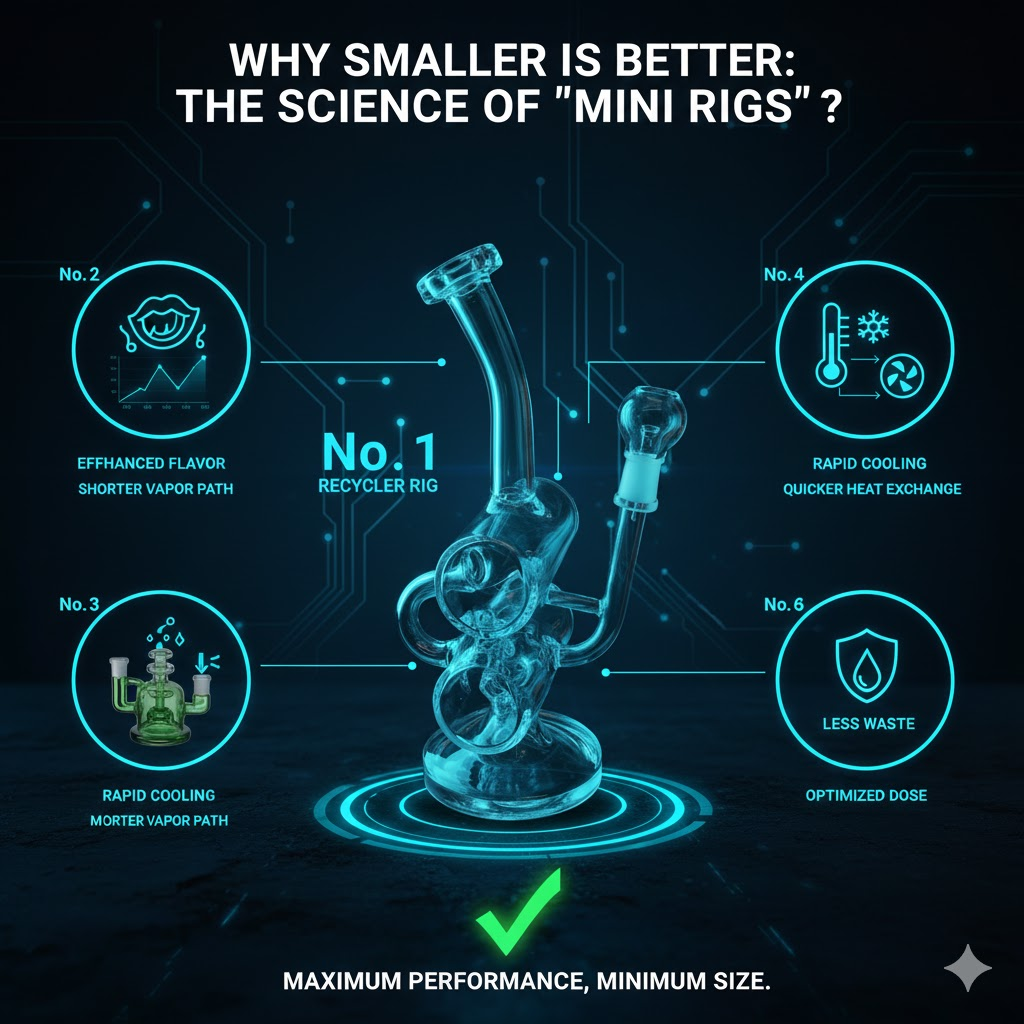
In concentrate glass inventory, size matters—but often in the opposite way traditional head shops expect.
Stocking oversized rigs introduces excess air volume that destroys terpene profiles, alienating high-value hash rosin customers and leaving retailers with stagnant stock.
This analysis benchmarks the physics of the sub-6-inch mini dab rigs against standard flower tubes.
We evaluate the 10mm Joint Standard for vacuum pressure and Lab-Grade Borosilicate 3.3 for durability to help you secure an inventory mix that maximizes both flavor and profit margins.
The Essential Shapes for Mini Dab Rigs
Profitable B2B inventory relies on three core geometries: Mini Rigs for volume, Recyclers for margin, and Fab Eggs for functional complexity.
| Geometry Class | Technical Advantage | Inventory Role |
|---|---|---|
| The Mini Rig | Low Air Volume (Max Flavor) | Volume Driver (High Turnover) |
| The Recycler | Vortex Cooling (Zero Splash) | Margin Builder (High Ticket) |
| The Fab Egg | Swiss Diffusion (Smooth Drag) | Functional Upgrade |
The Mini Dab Rigs Advantage (Volume)
Big glass kills flavor. In the concentrate market, mini dab rigs are the undisputed volume leaders because they solve a specific physics problem: air volume.
According to cannabis science regarding terpenes, volatile compounds degrade quickly when exposed to excess air (oxidation).
Large rigs introduce too much air.
We engineer our mini dab rigs to be under 6 inches tall with restricted airflow, creating a vacuum that vaporizes oil efficiently at lower temperatures.
-
Joint Standard: 10mm Female (Creates necessary restriction).
-
Target Customer: Hash Rosin Connoisseurs.
-
Material: Lab-Grade Borosilicate 3.3 (Never soft glass).
The Recycler (Margin Builder)
Recyclers command higher wholesale costs because the function is visible.
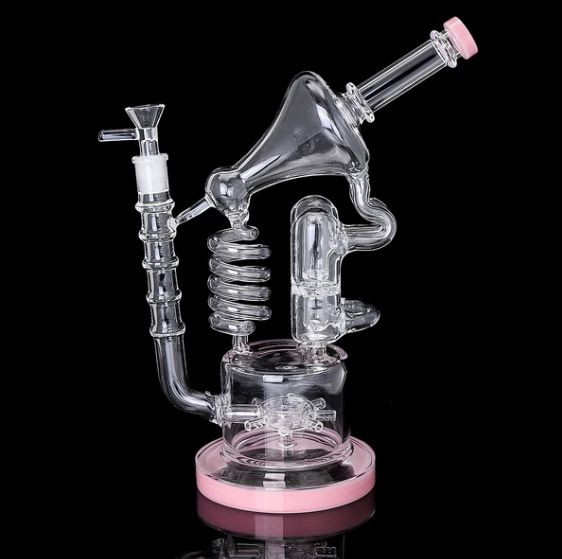
Unlike standard mini dab rigs that just bubble, a Recycler uses external plumbing to cycle water continuously.
This loop mechanically cools the vapor through movement rather than water volume.
-
Key Designs: Klein, Torus, Incycler.
-
QC Standard: AQL 2.5 (Checked for seamless welds).
-
Margin Strategy: Upsell as the “Professional” choice over beaker bongs.
The Fab Egg (Functional Upgrade)
The Fab Egg geometry merges the compactness of mini dab rigs with advanced diffusion.
Its signature “Swiss cheese” holes act as a structural percolator, breaking vapor into fine bubbles for maximum surface area cooling without adding drag.
Final Thoughts: Why Size Matters for ROI
Cheap “soft glass” threatens your business when it shatters under torch heat.
Our Lab-Grade Borosilicate 3.3 warrants the thermal durability pros demand.
We secure your long-term growth by annealing every unit at 1050°F.
Don’t speculate on function; verify the 10mm restriction yourself.
We invite you to request a sample kit of our core mini dab rigs and Recyclers to test the flavor profile firsthand.
Turn Custom Designs Into Reality Fast
Frequently Asked Questions
What is the best size for a dab rig?
For concentrates, air volume is the enemy.
We recommend “Mini Rigs” under 6 inches in height. Large chambers dilute the vapor and oxidize terpenes, killing the flavor profile your customers pay for.
A compact rig keeps the vapor dense and tasty.
This is why our “Golden 4” strategy prioritizes low-air-volume glass for hash rosin connoisseurs.
Why do most dab rigs use 10mm joints instead of the standard 14mm?
14mm is the standard for flower because you need open airflow to clear smoke.
For dabbing, 10mm is superior because you need restriction.
The tighter pull creates a natural vacuum, which helps vaporize oil efficiently at lower temperatures.
This preserves the terpene profile. We design our Mini Rigs specifically with 10mm female joints to optimize this function.
What is the advantage of a Recycler over a standard bong?
Standard bongs rely on water volume for filtration, which strips flavor.
A Recycler uses water movement.
By constantly cycling water between chambers via external tubes, it creates a vortex that mechanically cools the vapor without dilution.
This prevents “stale smoke” buildup and stops water from splashing into the mouthpiece.
Why is Borosilicate 3.3 glass necessary?
Cheap “soft glass” (soda-lime) shatters when exposed to the rapid temperature changes of a butane torch.
We strictly use Lab-Grade High Borosilicate 3.3—the same material used in scientific beakers.
It has high thermal shock resistance (over 170°C), ensuring your customers don’t break the rig during their first session.
What does the annealing process do?
Glass that cools too quickly holds internal stress and can “self-shatter” on the shelf.
We operate a strict annealing cycle: baking the rigs at 1050°F (565°C) for 8 to 12 hours.
This slow-cooling removes stress and aligns with ASTM C336 standards, ensuring the glass is durable enough for international shipping and daily use.
