
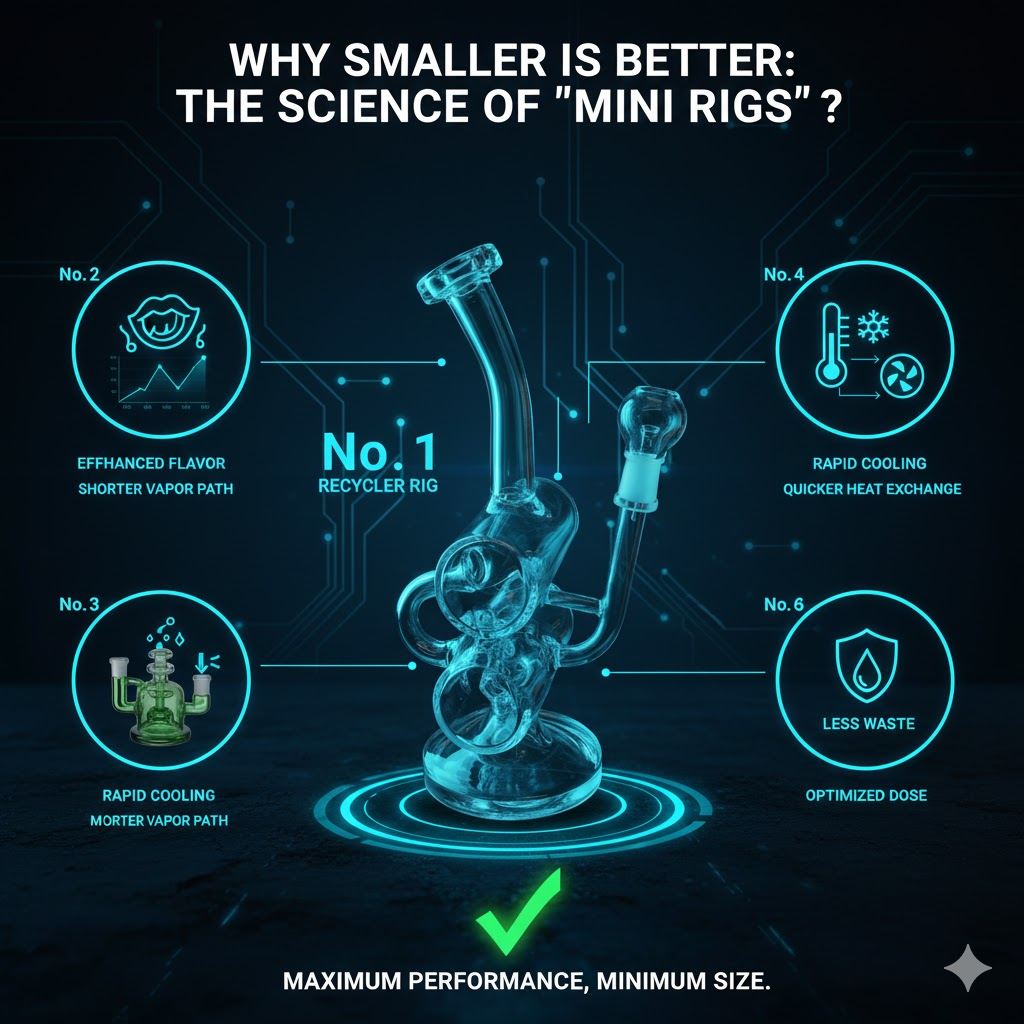
In concentrate glass inventory, size matters—but often in the opposite way traditional head shops expect. Why smaller is better for mini rigs comes down to terpene preservation, price point, and turn rate.
Stocking oversized rigs introduces excess air volume that destroys terpene profiles, alienating high-value hash rosin customers and leaving retailers with stagnant stock.
This analysis benchmarks the physics of the sub-6-inch mini dab rigs against standard flower tubes.
We evaluate the 10mm Joint Standard for vacuum pressure and Lab-Grade Borosilicate 3.3 for durability to help you secure an inventory mix that maximizes both flavor and profit margins.
The Essential Shapes for Mini Dab Rigs
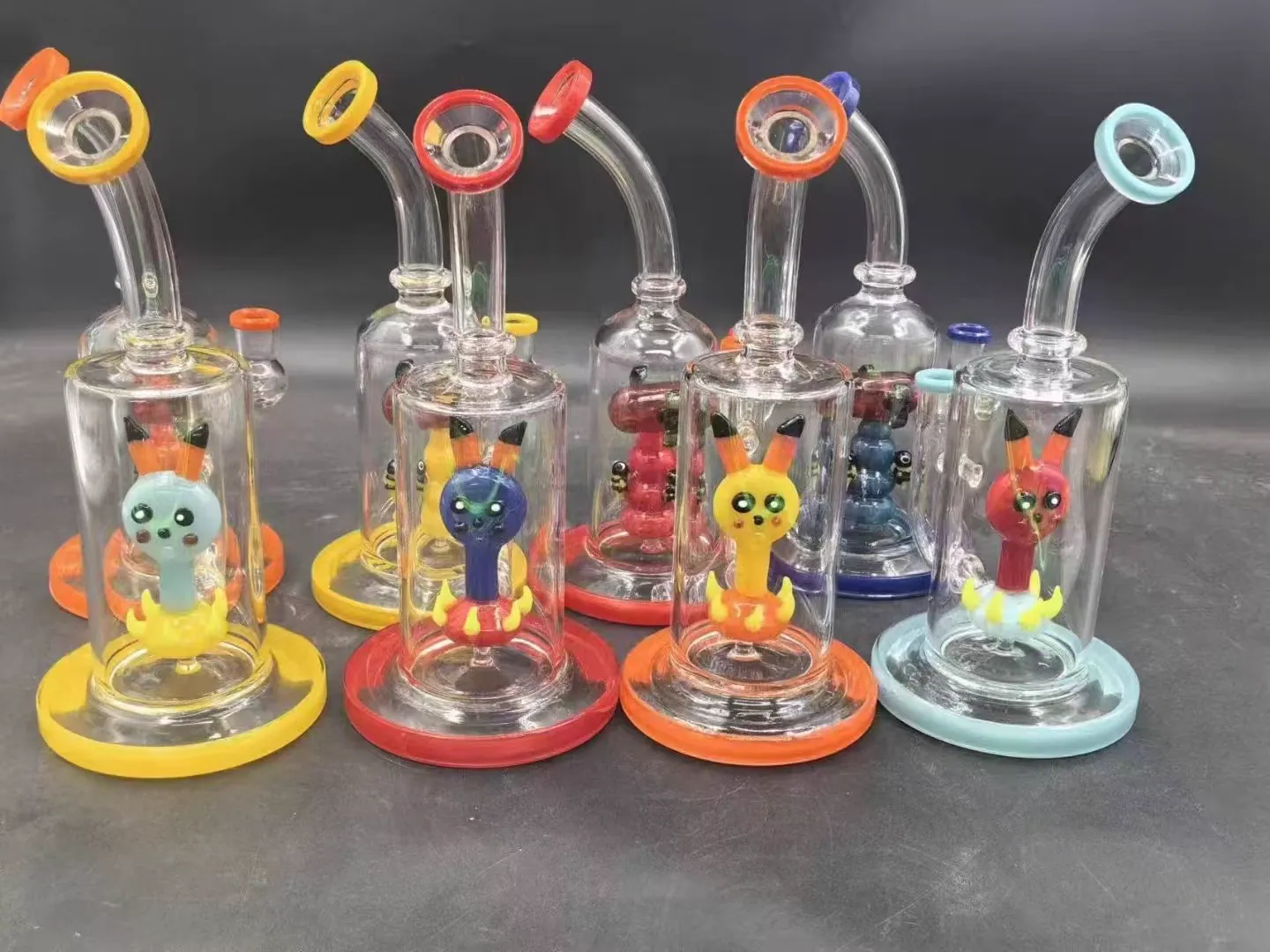
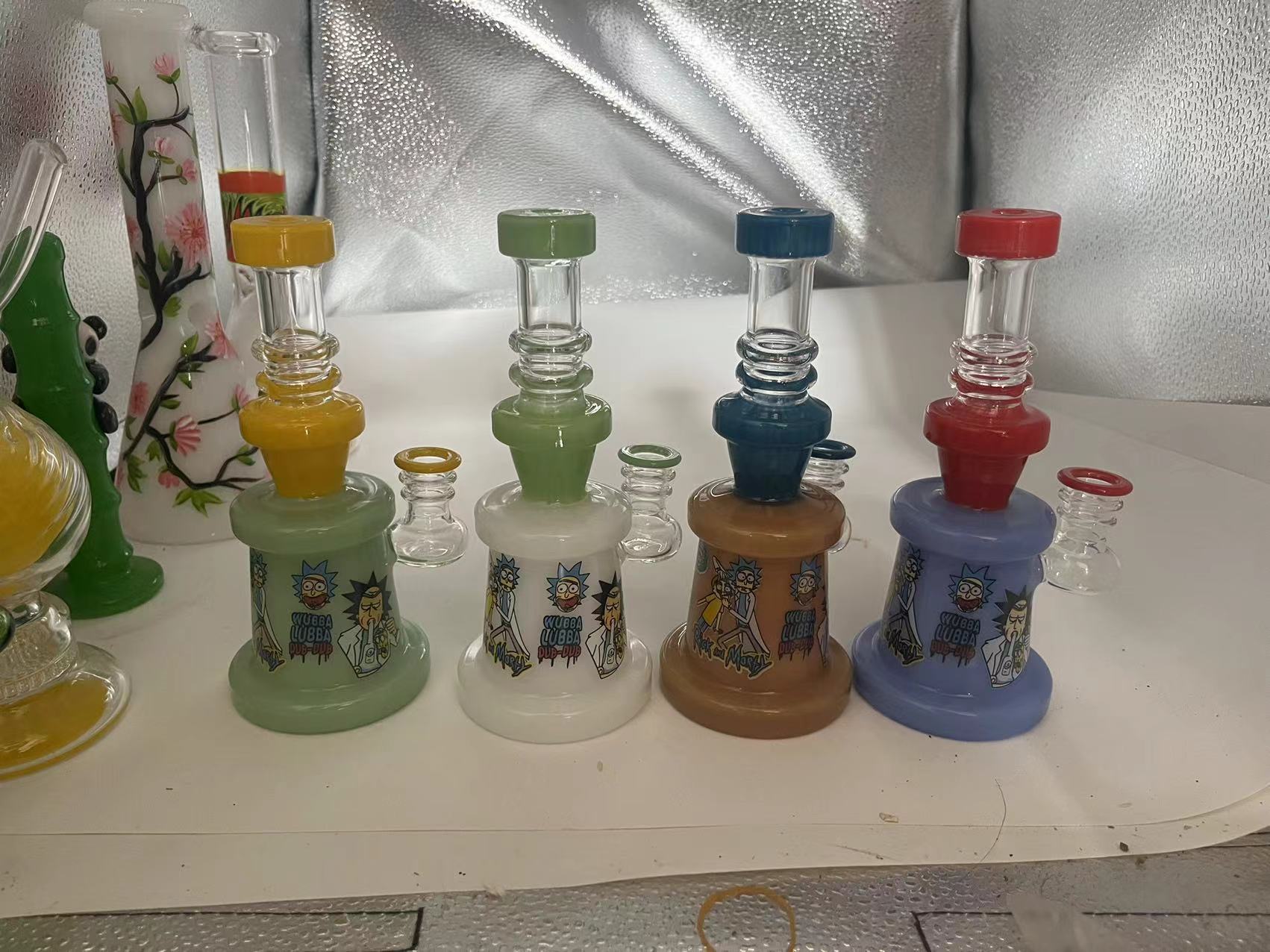
Profitable B2B inventory relies on three core geometries: Mini Rigs for volume, Recyclers for margin, and Fab Eggs for functional complexity.
| Geometry Class | Technical Advantage | Inventory Role |
|---|---|---|
| The Mini Rig | Low Air Volume (Max Flavor) | Volume Driver (High Turnover) |
| The Recycler | Vortex Cooling (Zero Splash) | Margin Builder (High Ticket) |
| The Fab Egg | Swiss Diffusion (Smooth Drag) | Functional Upgrade |
The Mini Dab Rigs Advantage (Volume)
Big glass kills flavor. In the concentrate market, mini dab rigs are the undisputed volume leaders because they solve a specific physics problem: air volume. Pair them with the right wholesale quartz bangers and the setup sells itself.
According to cannabis science regarding terpenes, volatile compounds degrade quickly when exposed to excess air (oxidation).
Large rigs introduce too much air.
We engineer our mini dab rigs to be under 6 inches tall with restricted airflow, creating a vacuum that vaporizes oil efficiently at lower temperatures.
-
Joint Standard: 10mm Female (Creates necessary restriction).
-
Target Customer: Hash Rosin Connoisseurs.
-
Material: Lab-Grade Borosilicate 3.3 (Never soft glass).
The Recycler (Margin Builder)
Recyclers command higher wholesale costs because the function is visible.
Unlike standard mini dab rigs that just bubble, a Recycler uses external plumbing to cycle water continuously.
This loop mechanically cools the vapor through movement rather than water volume.
-
Key Designs: Klein, Torus, Incycler.
-
QC Standard: AQL 2.5 (Checked for seamless welds).
-
Margin Strategy: Upsell as the “Professional” choice over beaker bongs.
The Fab Egg (Functional Upgrade)
The Fab Egg geometry merges the compactness of mini dab rigs with advanced diffusion.
Its signature “Swiss cheese” holes act as a structural percolator, breaking vapor into fine bubbles for maximum surface area cooling without adding drag.
The 6-Inch Rule: Sizing a Lineup Customers Actually Reorder
Under six inches of height, a rig’s internal air volume stays small enough that vapor reaches the lungs concentrated instead of diluted. That single constraint is why mini rigs dominate reorder sheets: they deliver the flavor that keeps concentrate users coming back, and they occupy less shelf space per SKU than any alternative.
A reorder-driven lineup needs the same geometry at different price points: a plain mini for the volume tier, a recycler for the margin tier, and a fab egg for the statement piece. If you are assembling these into packages, the wholesale starter kit bundles guide covers how the three shapes combine into an order that sells as a set rather than as orphan SKUs.
Stock the Glass Pipes Your Customers Actually Buy
Elfglass produces the full wholesale catalog, from hand pipes and sherlocks to dab rigs, percolator bongs, and accessories, in proven best-selling specs. Tell us your market and we will recommend a catalog mix with pricing.
MOQ from 100 pieces | BSCI / WRAP / ISO 9001 | NDA before every project
Anneal Verification: The Spec That Determines Breakage Rates
Mini rigs get used harder than display pieces, torch to joint, cold water to hot glass, repeated in the same session. The anneal is what keeps that abuse from becoming a breakage claim. Elfglass anneals every unit at 1050°F and holds a 12-hour soak cycle so internal stress is fully released; the standard behind the process is ASTM C336, and any factory you shortlist should be able to state its soak time in writing.
Pair that spec with commercial terms before you scale: a 100-unit MOQ, a 1-3 day sample turnaround so you can torch-test a piece yourself, and a deposit structure you are comfortable with. The full 7 glass pipe types guide shows where mini rigs fit in a broader catalog, but for the concentrate category the anneal spec is the single highest-value question you can ask.
From Sample to MOQ: The 100-Unit Step
The science of mini rigs matters most at the moment you actually order. The sequence is standard: request a sample, torch-test the joint and the anneal at home or in the shop, then scale to the 100-unit MOQ once the piece performs. Elfglass turns samples around in 1-3 days and can confirm pricing within 24 hours, so the full validation loop fits inside a working week.
Keep the questions to ask a glass pipe supplier list on hand for that conversation, because sample quality varies from factory to factory even within the same city, and the answers separate a long-term partner from a one-shipment vendor.
Mini Rig Sizing Tiers: A Depth Chart by Price Point
The sub-6-inch rule is a single constraint, but inside it there are distinct tiers that serve different buyers and different shelf roles. Laying them out side by side makes it easier to build a lineup that covers the whole concentrate category instead of repeating one geometry at three price points. Every tier below stays under the 6-inch ceiling and on a 10mm female joint — the two non-negotiables from the physics above.
| Tier | Form & Height | Material | Shelf Role | Who Reorders It |
|---|---|---|---|---|
| Entry volume mini | Plain mini rig, shortest of the range | Lab-grade Borosilicate 3.3 | Volume driver — turns fastest | First-time concentrate buyers |
| Core mini | Standard mini rig, still under 6 inches | Lab-grade Borosilicate 3.3 | Daily-driver staple | Hash rosin regulars |
| Recycler | External-loop recycler (Klein, Torus, Incycler) | Lab-grade Borosilicate 3.3 | Margin builder — higher ticket | Upgraders chasing zero splash |
| Fab egg | Swiss-diffusion egg body | Lab-grade Borosilicate 3.3 | Statement / functional upgrade | Pro dabbers and collectors |
Read the chart as a ladder, not a menu. A healthy concentrate shelf carries one SKU per rung so a customer can enter at the volume tier and trade up on the next visit. That trade-up path is what converts a one-time mini-rig sale into a recurring relationship — the same reorder logic the 6-inch rule describes, expressed as an assortment rather than a single spec.
Torch-Testing a Mini Rig Sample: What to Check
The anneal spec and the 10mm restriction are claims until you verify them on a physical sample. This is the bench test we tell every wholesale buyer to run before scaling from a sample to the 100-unit MOQ. It takes one session and catches the two failure modes that cause returns — a weak anneal and a sloppy joint.
- Inspect the joint grind first. Hold the 10mm female joint to the light and look for an even, continuous ground surface. A wavy or chipped grind will not hold the vacuum restriction the whole design depends on.
- Heat the banger, never the glass. Torch the quartz banger to test function. Then, deliberately, bring a heated banger near the joint on one unit and watch for stress — a properly annealed rig shrugs this off; an unannealed one shows a hairline or pops.
- Look for stress with cross-polarized light. A phone screen behind two polarized filters (or a cheap polariscope) reveals bright bands where internal stress remains. Fully annealed glass at the 1050°F soak reads dark and even.
- Check every weld seam on recyclers. Run a fingertip and a light along each external loop joint. Seams should be smooth and seamless to the eye; a visible ridge or bubble is a future leak point.
- Do a water-fill leak test. Fill to the working line, cap the mouthpiece, and pull. Any drip from a seam or the joint fails the unit regardless of how good the glass looks dry.
- Feel the 10mm pull. The draw should feel tight and restricted, not airy. An easy, open pull on a supposed 10mm rig means the restriction — and the low-temp vaporization it enables — is not really there.
Final Thoughts: Why Size Matters for ROI
Cheap “soft glass” threatens your business when it shatters under torch heat.
Our Lab-Grade Borosilicate 3.3 warrants the thermal durability pros demand.
We secure your long-term growth by annealing every unit at 1050°F.
Don’t speculate on function; verify the 10mm restriction yourself.
We invite you to request a sample kit of our core mini dab rigs and Recyclers to test the flavor profile firsthand.
Turn Custom Designs Into Reality Fast
Frequently Asked Questions
What is the best size for a dab rig?
For concentrates, air volume is the enemy.
We recommend “Mini Rigs” under 6 inches in height. Large chambers dilute the vapor and oxidize terpenes, killing the flavor profile your customers pay for.
A compact rig keeps the vapor dense and tasty.
This is why our “Golden 4” strategy prioritizes low-air-volume glass for hash rosin connoisseurs.
Why do most dab rigs use 10mm joints instead of the standard 14mm?
14mm is the standard for flower because you need open airflow to clear smoke.
For dabbing, 10mm is superior because you need restriction.
The tighter pull creates a natural vacuum, which helps vaporize oil efficiently at lower temperatures.
This preserves the terpene profile. We design our Mini Rigs specifically with 10mm female joints to optimize this function.
What is the advantage of a Recycler over a standard bong?
Standard bongs rely on water volume for filtration, which strips flavor.
A Recycler uses water movement.
By constantly cycling water between chambers via external tubes, it creates a vortex that mechanically cools the vapor without dilution.
This prevents “stale smoke” buildup and stops water from splashing into the mouthpiece.
Why is Borosilicate 3.3 glass necessary?
Cheap “soft glass” (soda-lime) shatters when exposed to the rapid temperature changes of a butane torch.
We strictly use Lab-Grade High Borosilicate 3.3—the same material used in scientific beakers.
It has high thermal shock resistance (over 170°C), ensuring your customers don’t break the rig during their first session.
What does the annealing process do?
Glass that cools too quickly holds internal stress and can “self-shatter” on the shelf.
We operate a strict annealing cycle: baking the rigs at 1050°F (565°C) for 8 to 12 hours.
This slow-cooling removes stress and aligns with ASTM C336 standards, ensuring the glass is durable enough for international shipping and daily use.
Get a Quote for Your Next Order
Adding mini dab rigs to your catalog? Send us your product spec and target quantity — contact our factory team or message us on WhatsApp, and we will reply with pricing and lead times within 24 hours.
About the Author
Ava Zeng is the founder of Elfglass, a Shenzhen-based borosilicate glass pipe manufacturer serving B2B brands worldwide. Every guide on this site is grounded in her production-floor experience— the annealing lines, QC checkpoints, and export orders behind each claim.
Before you commit to a supplier, read her founder’s story and trust promise, and the guide to vetting a reliable glass pipe manufacturer— the same red-flag checklist Elfglass applies to its own suppliers.
Ready to Source Custom Glass Pipes?
Get a free quote within 24 hours. MOQ from 100 pieces. NDA-protected design consultation.
