
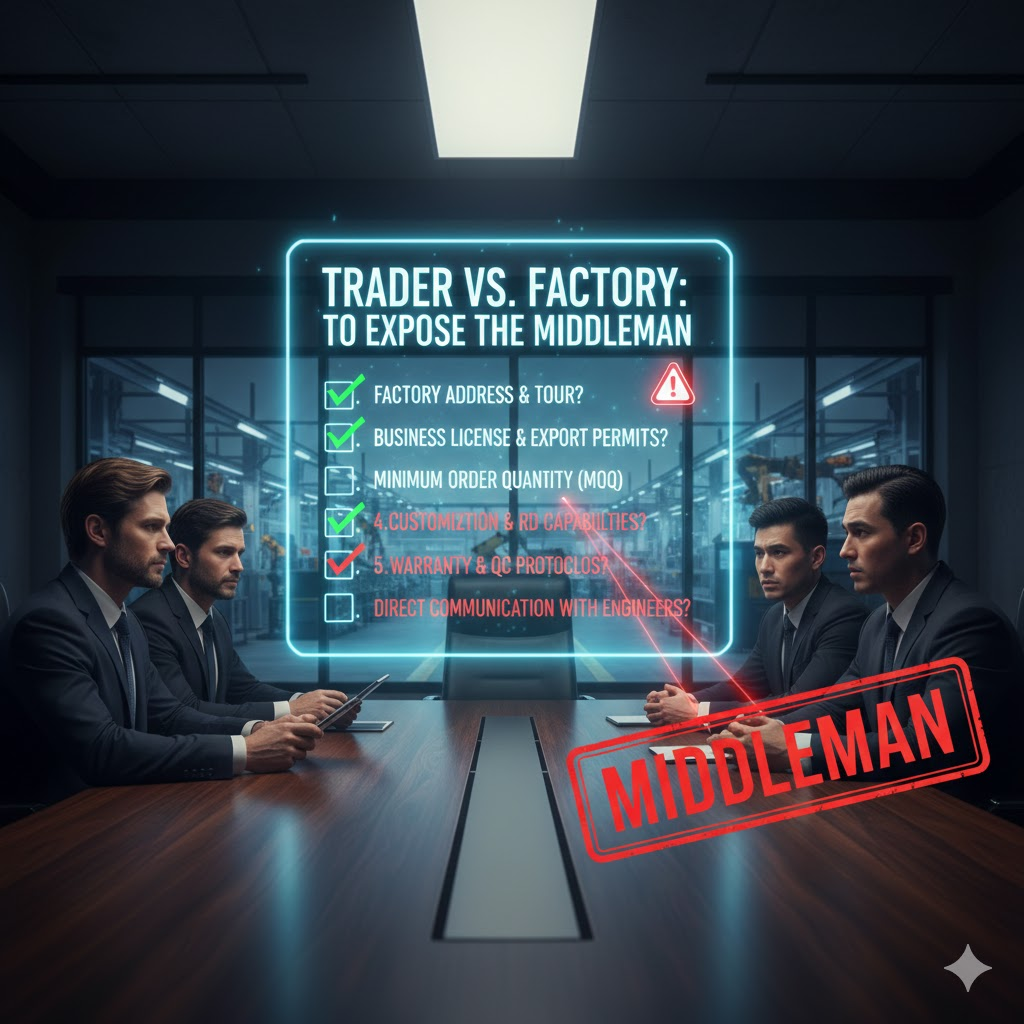
The Trader vs. Factory sourcing decision is the primary firewall between high-margin inventory and invisible “front-running” costs.
While middlemen promise simplified logistics, the hidden tax is frequently paid in “Signal Loss”—where critical BOM specifications like joint reinforcement are downgraded to capture profit spread.
This results in brittle products that shatter your brand reputation.
To secure a sustainable supply chain, you must cut out the broker and audit the engineering reality of direct production.
This analysis benchmarks suppliers against strict ASTM C336 Annealing Standards and Dewar Seal construction protocols.
We identify the 7 specific questions required to validate a 9mm “Tank” series partner capable of delivering true structural integrity.
Part 1: The “Identity” Audit (Who Are They?)
The first step in the trader vs factory battle is establishing identity.
Traders often use polished Alibaba storefronts to mask their lack of assets.
Question 1: “Can I see your Business License and Scope of Business?” A document check is the fastest filter.
-
The Factory: Their license will list “Production” or “Manufacturing” in the Scope of Business.
-
The Trader: Their scope will list “Wholesale,” “Sales,” or “Import/Export.” If they don’t manufacture, they are adding a margin (typically 15-30%) on top of the factory price.
Question 2: “What is your specific proximity to the Kiln?” This question traps “Hybrid Traders” who claim to be factories.
-
The Test: Ask for a live video call and say, “Walk to the annealing kiln right now.”
-
The Reality: A trader in a Shenzhen office cannot walk to a kiln in Hebei. They will make excuses. A real factory will walk you onto the floor in 2 minutes.
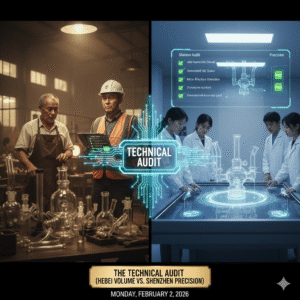
Part 2: The Technical Audit (Hebei Volume vs. Shenzhen Precision)
Understanding regional capabilities is key.
Hebei dominates global industrial volume through sheer scale, but declining margins often drive factories to prioritize speed over stability.
Question 3: “Do you use Spot Welds or Dewar Seals?” This reveals their engineering standard.
-
The Commodity Answer: “Spot Welds” (Single point). This is faster for mass production but creates a weak point that snaps under minor stress (like inserting a banger).
-
The Elfglass Standard: We strictly use Dewar Seals (Double Wall Welds) or reinforced Bistable Joints. This adds 50% more glass to the stress point, ensuring structural integrity.
Question 4: “Can you show me your ASTM C336 Annealing Curve?” The true differentiator between a commodity glass factory and a technical partner is the annealing oven. Manufacturing creates internal stress, particularly in our 9mm “Tank” series.
-
The Risk: Traders cannot monitor kiln residency times. They often unknowingly sell glass that was “rushed” through the cooling cycle to save energy.
-
The Standard: We adhere strictly to ASTM C336 protocols. This requires an 8-12 hour controlled cooling cycle. A hurried 9mm tube is a time bomb; a properly annealed one is a durable commercial asset.
Part 3: The Operational Audit (Capability vs. Promise)
Traders promise everything; factories know their limits.
Question 5: “What is your Reject Rate and where is the Red Bin?” A factory floor without visible broken glass is a lie.
-
The Trap: If a supplier claims “Zero Defects,” run. Glass blowing is organic; scrap is inevitable.
-
The Verification: Ask to see the “Defect Segregation Area” (Red Bin) on video. If they don’t have one, they are likely packing defects into your order.
Question 6: “How do you handle ‘Signal Loss’ in Design?” The “Hybrid” sourcing model creates dangerous blind spots. Design nuances vanish in the chain of “Brand -> Trader -> Factory.”
-
The Elfglass Solution: We eliminate signal loss via our 24-Hour Sketch-to-3D Protocol. Our R&D team works on the factory floor. We convert abstract napkin sketches into technical 3D models within one day, ensuring wall thicknesses are structurally viable before a mold is cut.
Question 7: “Do you offer ‘Nesting’ for Freight Optimization?” Traders often lack the logistical control to repackage goods efficiently.
-
The Strategy: We focus on CBM Optimization. We actively nest smaller accessory boxes (bowls, downstems) inside the hollow voids of master cartons containing large tubes. This ensures you never pay to ship “air,” a logistical flexibility most traders cannot offer.
The Economics of the “Middleman Tax”
Why does this audit matter? Because the “Middleman Tax” isn’t just the 20% markup on the invoice. It is the cost of:
-
Cascading Failures: A minor communication gap at the trader’s desk results in a mass production defect (like the wrong joint angle) you only find when the container lands.
-
Material Substitution: Traders front-running your order may swap Borosilicate 3.3 for cheaper Soda-Lime glass to widen their spread.
-
Warranty Void: When a trader disappears, your warranty disappears. Direct factory partners like Elfglass have asset-heavy reputations to protect.
Bring Your Vision to Life Without Compromise Secure your ROI with our “Zero-Breakage Guarantee” and 100% certified Borosilicate 3.3 glass.
We transform sketches into market-ready products with military-grade IP protection and rapid global delivery.
Bring Your Vision to Life Without Compromise

Final Thoughts on Sourcing Strategy
Sourcing via middlemen creates a dangerous blind spot where “Spot Welds” and rushed annealing cycles hide until the product hits the retail shelf.
True brand protection relies on inventory that survives shipment and daily use, not just artificially low FOB prices.
Direct adherence to ASTM C336 standards with 9mm borosilicate is your only proven defense against thermal shock returns.
Stop gambling on invisible specifications and validate the engineering yourself using these 7 questions.
Frequently Asked Questions
Why do some imported water pipes break easily at the joint?
This failure often stems from factories using weak “Spot Welds” to save production time.
At Elfglass, we strictly use “Dewar Seals” (Double Wall Welds) or reinforced “Bistable Joints.”
This technique adds approximately 50% more glass material to the joint’s stress point, ensuring the connection is the strongest part of the piece rather than a liability.
What creates the price gap between 5mm and 9mm tubes that look similar?
The difference lies in raw material volume and oven time.
A 9mm “Tank” series tube consumes nearly double the borosilicate glass of a 5mm standard beaker.
Thicker glass also requires a significantly longer annealing cycle (following ASTM C336 guidelines) to release internal stress.
You are paying for the tangible “heft” and heavy-duty impact resistance.
Shipping large glass volumes is expensive. How do you handle freight efficiency?
We focus on CBM (Cubic Meter) optimization to ensure you never pay to ship “air.”
We actively nest smaller accessory boxes (like bowls, downstems, or ash catchers) inside the voids of master cartons containing large tubes.
This method reduces the overall shipping volume relative to the dollar value of the order.
What is the policy if products arrive broken?
While we mandate “Elf-Guard” air column bags and 5-layer corrugated cartons, handling accidents occur.
If a unit arrives broken, we provide a Credit or Replacement upon receipt of a photo within 3 days of delivery.
This guarantee aligns with our risk-free supply promise.
Are multi-perc bongs too difficult for customers to keep clean?
Complex percolators (Matrix, Tree, Honeycomb) offer superior diffusion but trap ash if used alone.
We recommend bundling these with “Ash Catchers.”
This upsell captures debris before it enters the main chamber, keeping the complex percs clean for weeks and increasing your average unit retail price.
