
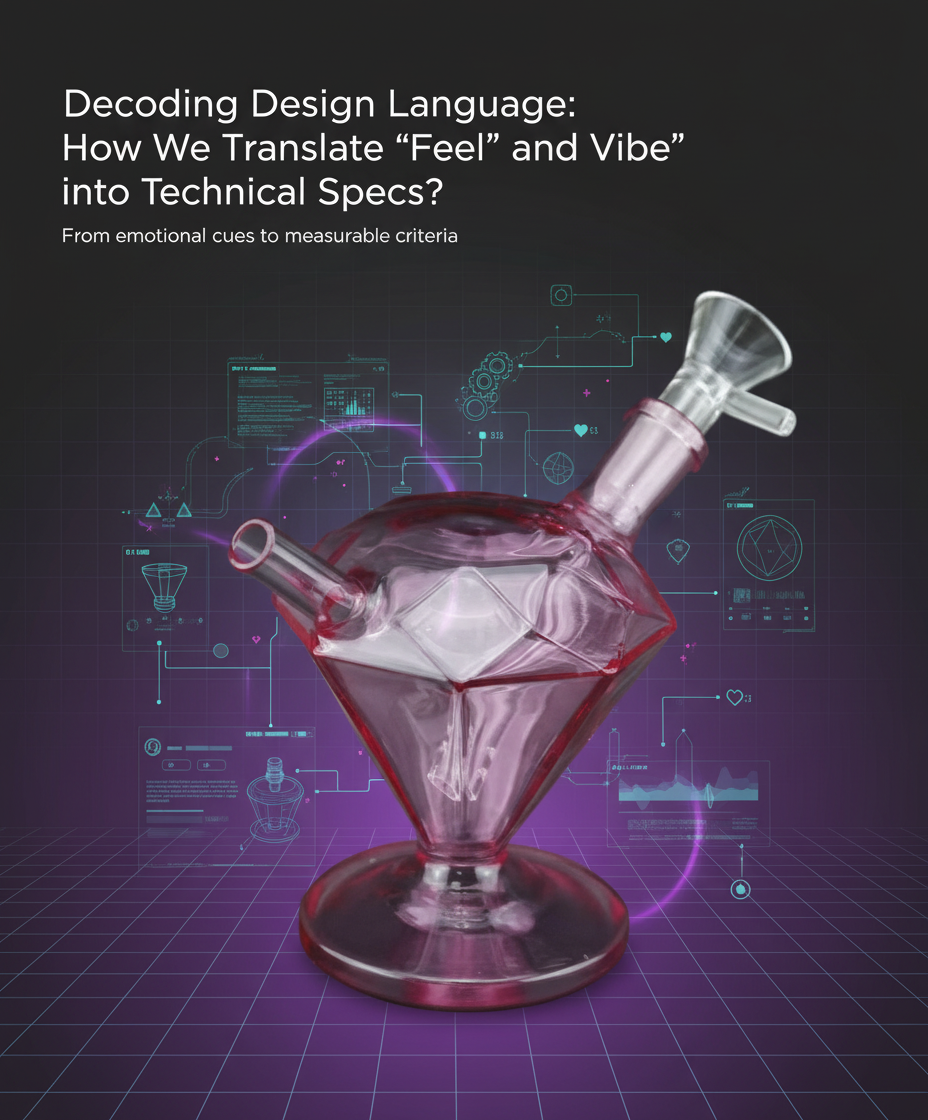
1、Introduction: The Art of Translating Design Concepts
In the grand narrative of product development, translating design concepts into reality is the ultimate challenge for B2B brand founders.
At Elfglass, we understand that a brand’s soul exists in the “vibe,” but a factory’s logic exists in the technical specifications.
For the visionary designer or the boutique owner, a glass pipe is more than a tool; it is an emotional experience.
However, the chasm between a napkin sketch and a physical product can be deep.
Without a clear process for translating design concepts, a “cloud-like” hit can easily become a heavy, industrial disappointment.
To end this “vision loss,” we have redefined the role of the manufacturer.
We position ourselves as Empathetic Forgers—your chief interpreters who turn poetry into production lines.
Our core methodology, Empathy Before Engineering, ensures that we listen to your intent before we touch the raw material.
2、The Physics of “Heft”: Translating Design Concepts into Haptic Value
“Hand-feel” is often dismissed as subjective, but in the realm of industrial design, it is a rigorous science known as Haptics.
When an end-user picks up a piece of glass, their fingertips instantly transmit data about texture, temperature, and weight.
These signals form the user’s perception of your brand.
2.1 The Equation of Stability
In the premium glass market, “weight” is psychologically tethered to “quality.”
When translating design concepts for a high-end brand, we must precisely control the physical properties of Borosilicate 3.3.
Since the material density is a constant (approx. $2.23 \text{ g/cm}^3$), we use wall thickness as our primary variable to engineer psychological value.
| Intended Perception | Technical Specification | Engineering Application |
| Light & Portable | $3\text{mm} – 4\text{mm}$ | Entry-level hand pipes; requires extreme heating uniformity. |
| Refined & Reliable | $5\text{mm}$ | The “Laboratory Standard.” Balanced durability and heat resistance. |
| Heavy & Premium | $7\text{mm}$ | High-end beaker bongs. Provides a strong “anti-break” cue. |
| Indestructible “Tank” | $9\text{mm}+$ | Heavy-duty flagship series. Low-frequency resonance. |
When translating design concepts for a “bulletproof” product, we lock in a $9\text{mm}$ specification and adjust our blowing molds to lower the Center of Gravity (CoG), ensuring the piece feels anchored and secure.
3. The Fluid Dynamics of “The Chug”
If touch determines the first impression, the “Pull” or “Chug” determines the long-term relationship.
This is a complex interplay of aerodynamics and fluid mechanics.
3.1 From “Roar” to “Sizzle”
The percolator is the heart of the piece. Its slit geometry determines the Reynolds Number ($Re$) and the resulting bubble diameter.
-
Creating a “Chuggy” Vibe: For users seeking a visceral experience, we use a single-hole downstem or wide slits (e.g., $4\text{mm}$ openings). This creates large bubbles that burst with a rhythmic “thump.”
-
Creating a “Smooth” Vibe: For brands targeting the connoisseur market, we recommend a Matrix Percolator. By laser-cutting $60+$ holes with a diameter of $1.5\text{mm}$, we shatter the air into thousands of micro-bubbles, maximizing the gas-liquid interface for extreme cooling.
4. Material Science: Translating Design Concepts through COE 33
A great design must be built on a foundation of chemical purity.
We exclusively use Borosilicate 3.3, defined by its low Coefficient of Thermal Expansion (COE):
This isn’t just a number; it is a promise of durability.
While “soft glass” ($COE \approx 104$) feels fragile, our material can withstand the thermal shock of a butane torch without catastrophic failure.
4.1 Annealing: The Invisible Guardian
The shaping process gives the glass its body, but Annealing gives it its soul.
During manufacturing, internal stresses accumulate.
We execute a rigorous annealing schedule to ensure these “timed bombs” are eliminated. We heat the glass to the Annealing Point (approx. $565^\circ\text{C}$), soaking it to allow molecules to realign, then cooling it at a calculated rate to the Strain Point (approx. $525^\circ\text{C}$).
Every batch is inspected under polarized light.
Precision in translating design concepts is our ultimate loyalty to your vision.
5. Connection Architecture: Dewar Joints and Fire Polishing
The joints are often the most vulnerable parts of a glass piece.
To address the fear of breakage, we utilize Dewar Joints—recessed connections that hide the weld point inside the chamber.
This structure transfers impact stress from the fragile weld to the sturdy chamber wall.
Furthermore, we strive for “seamlessness” through Fire Polishing.
By reheating the connection areas, we use surface tension to smooth out weld lines.
This creates an optical-grade transition that isn’t just beautiful—it makes the piece easier to clean, answering a major pain point for B2B distributors.
6. Case Study: The “Floating” Recycler
A creative director once approached us with a concept for a recycler where the water appeared to be “floating in mid-air.”
Other factories claimed it was impossible without thick, ugly support brackets.
By translating design concepts with an engineering mindset, we used ultra-clear structural glass bridges that become invisible when filled with water.
We satisfied the laws of physics without murdering the magic of the design.
When the client held the Golden Sample (which we produced within our signature 24-hour response window), they noted that the product felt “alive” compared to previous industrial failures.
FAQ: Mastering the Process of Translating Design Concepts
Q1: Do I need to provide technical CAD drawings to start?
A1: No. We often start with “Vibe Descriptions.”
Tell us how you want the product to feel (e.g., “heavy,” “smooth”).
It is our job to handle translating design concepts into a technical spec sheet.
Q2: How do you protect my brand’s unique design language?
A2: We treat Intellectual Property (IP) with absolute reverence.
Every project is protected by a strict Non-Disclosure Agreement (NDA).
Your unique “translation” is your trade secret.
Q3: Does a “Premium Feel” always mean a higher price point?
A3: Not necessarily.
Often, premium perception comes from balance and finishing, such as fire-polishing or optimizing the center of gravity, which adds value without the extreme cost of complex percolators.
7. Conclusion: Where Great Ideas are Born, Not Broken
Translating design concepts into specifications is a tightrope walk between art and science.
At Elfglass, we don’t just blow glass; we build emotional containers.
We anchor your fleeting inspirations—”smooth,” “heavy,” “trippy”—into the solid reality of borosilicate engineering.
If you are looking for a partner in sourcing high-quality borosilicate glass pipes, we invite you to experience our “Vision Made Real” process.
