
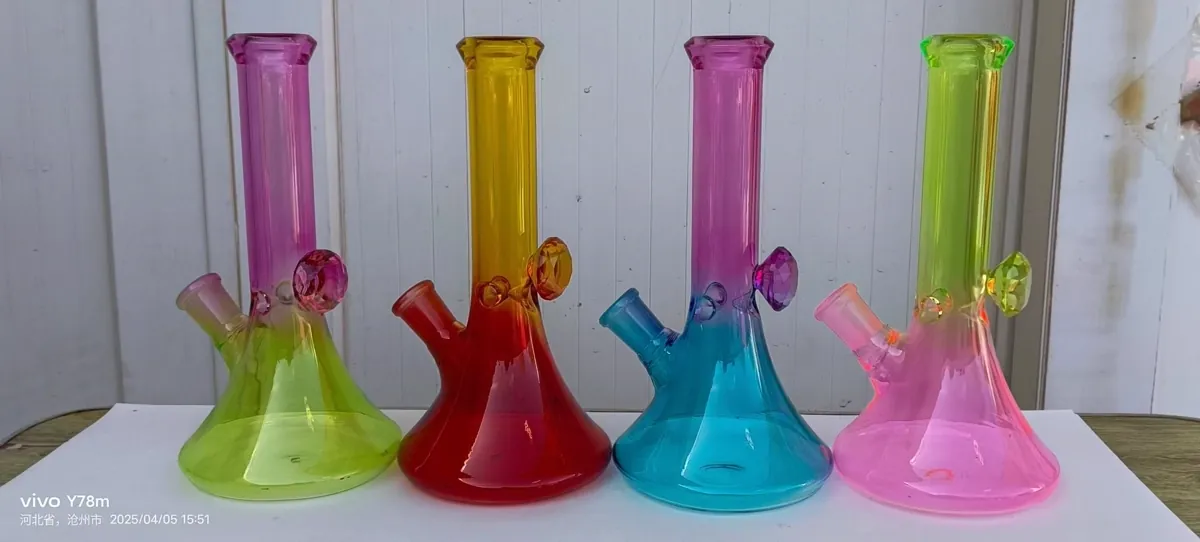
Walk into any smoke shop with a glass pipe display near a window, and you will see the damage within weeks. Colors that were vivid when the piece left the factory—especially greens, blues, and purples—look washed out, yellowed, or uneven. UV-induced color fading is the silent margin killer in retail glass display, and most retailers do not realize it is happening until a customer asks why the pipe on the shelf looks different from the one in the product photo.
This guide explains the science behind glass color fading, which colors are most vulnerable, how display positioning affects the rate of degradation, and what wholesale buyers can specify with their manufacturer to protect color integrity from factory to retail shelf.
Key Takeaways
- UV radiation is the primary cause of glass color fading—visible light and heat play secondary roles
- Green and blue glass colors fade fastest; amber and clear glass are most UV-resistant
- Direct sunlight can fade colored glass by 20–40% within 3 months of continuous exposure
- UV-filtering window film and display positioning away from direct sunlight extend color life by 3–5x
- Wholesale buyers should request UV-stabilized color batches for retail display inventory
How UV Light Fades Glass Color
The Chemistry of Colored Glass
Glass gets its color from metal oxide additives melted into the borosilicate matrix during production. Cobalt produces blue, copper creates green or teal, gold yields red, and manganese generates purple. These metallic ions absorb specific wavelengths of light and reflect others—the reflected wavelengths are what we perceive as color.
UV radiation carries enough energy to alter the electron configuration of these metal ions over time. When UV photons strike the colored glass repeatedly, they gradually change the oxidation state of the metal ions, shifting which wavelengths they absorb and reflect. The result is a visible color shift—usually toward lighter, yellower, or more transparent tones.
Why Some Colors Fade Faster
Not all glass colors are equally vulnerable. The susceptibility depends on the specific metal ion and its bonding environment within the glass matrix:
| Color | Coloring Agent | UV Sensitivity | Fading Pattern |
|---|---|---|---|
| Green / Teal | Copper, iron | High | Shifts toward yellow-green, then pale |
| Blue | Cobalt | High | Loses saturation, becomes washed-out sky blue |
| Purple / Violet | Manganese, nickel | Very High | Fades to pale pink or nearly clear |
| Amber / Brown | Sulfur, carbon, iron | Low | Minimal visible change over years |
| Red (gold-based) | Colloidal gold | Moderate | Gradual darkening rather than fading |
| Clear (uncolored) | None | None | No color change; may develop slight haze from surface damage |
For retailers stocking colored glass pipes, this means green and blue pieces need the most display protection, while amber and clear glass can sit in direct sunlight with minimal visual impact.
Display Conditions That Accelerate Fading
UV fading is cumulative—the total exposure dose determines the damage, not the intensity at any single moment. However, certain display conditions dramatically accelerate the process:
Direct Sunlight Through Windows
Standard retail windows block UVB (280–315 nm) but transmit most UVA (315–400 nm). UVA is sufficient to cause fading in sensitive glass colors. A display shelf near a south-facing window (in the Northern Hemisphere) receives the highest cumulative UVA dose. Pieces in this position can show visible fading within 6–8 weeks.
Halogen and Metal Halide Display Lighting
Many retail display cases use halogen or metal halide spotlights for dramatic product presentation. These light sources emit significant UV radiation alongside visible light. A glass pipe under a halogen spotlight for 10 hours per day accumulates comparable UV exposure to a piece near a window. LED display lighting, by contrast, emits negligible UV and is the preferred choice for colored glass.
Outdoor Markets and Window Displays
Pieces displayed in outdoor market stalls or uncovered window displays receive full-spectrum UV exposure including both UVA and UVB. This is the most aggressive fading environment. Colored glass in these positions can show dramatic color shift within 2–4 weeks during summer months.
Stocking Colored Glass That Stays Vivid?
Elfglass formulates UV-stable colorants and supplies UV-stability data on every colored SKU, so your greens, blues and purples hold their tone on the retail shelf. Send your color list and get a quote within 12 hours.
MOQ from 100 pieces | BSCI / WRAP / ISO 9001 | NDA before every project
Protection Strategies for Retailers
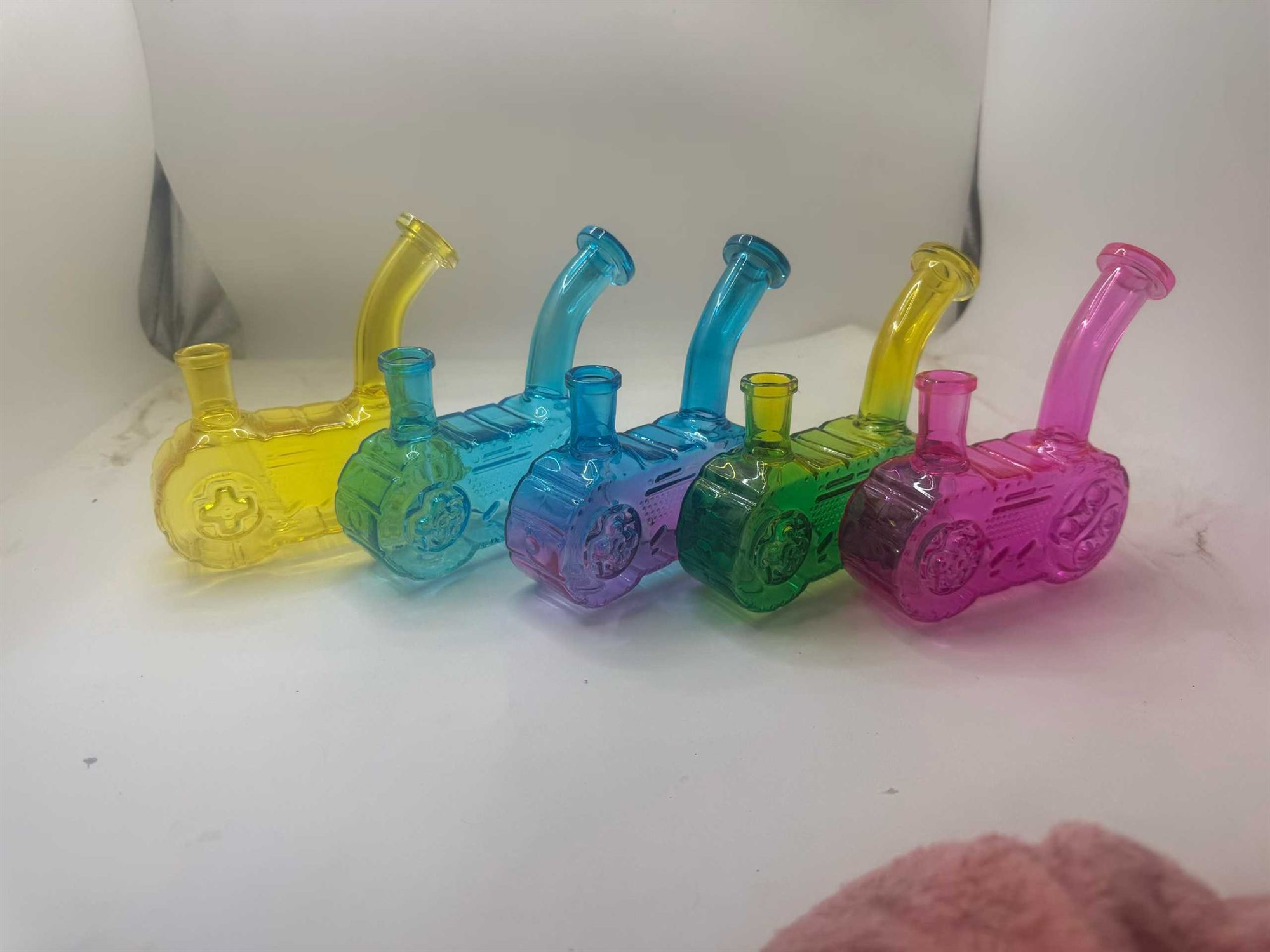
Protecting glass color in retail display does not require expensive equipment. The following strategies, ranked by cost-effectiveness, can extend color life significantly: Contact us for UV-stability data on colored SKUs before you place a wholesale order.
- Reposition displays away from direct sunlight. Moving a colored glass display from a window shelf to an interior wall reduces UV exposure by 80–90%. This is the single most impactful change and costs nothing.
- Switch to LED display lighting. Replace halogen or metal halide spotlights with LED equivalents rated at 3000–4000K color temperature. LEDs emit virtually no UV and produce less heat, which also reduces thermal stress on the glass.
- Apply UV-filtering window film. For displays that must remain near windows, UV-filtering film blocks 95–99% of UVA transmission. Cost is approximately $3–$8 per square foot of window glass, and the film lasts 10–15 years.
- Rotate display inventory. Move colored pieces from high-exposure positions to lower-exposure storage every 4–6 weeks. This distributes cumulative exposure and prevents any single piece from fading noticeably before it sells.
- Request UV-stabilized batches from your manufacturer. Some manufacturers can add UV stabilizers to the color batch during melting. These additives absorb UV energy before it reaches the coloring ions, extending color life by 2–3x. This is especially valuable for wholesale orders destined for retail display.
Communicating Color Expectations to Customers
Even with the best display practices, some color change is inevitable over the lifetime of a colored glass piece. Retailers can reduce customer complaints by setting expectations at the point of sale:
- Include a care card with colored glass purchases noting that natural color shifts may occur with prolonged light exposure—this is normal and does not affect function
- Photograph new inventory under the same lighting conditions each time, so product photos match what customers see in-store
- For online sales, note that colors may appear slightly different from in-person pieces due to monitor calibration and that slight variation is inherent to hand-blown glass
Understanding color behavior also helps with inventory planning. For retailers ordering seasonal color trends, our 2026 color trends guide identifies which trending colors are most and least UV-sensitive—helpful for planning display rotation schedules.
What to Specify When Ordering Colored Glass
When placing wholesale orders for colored glass pipes, include these specifications in your purchase order to protect color integrity:
| Specification | Why It Matters | How to Request |
|---|---|---|
| UV-stabilized color batch | Extends display life 2–3x | “Request UV-stabilized colorants for retail display inventory” |
| Color sample approval before production | Ensures batch matches your expectation | “Send color sample swatch for approval before full production run” |
| Individual poly bag packaging | Prevents scratching and UV exposure during storage and transit | “Each piece individually bagged in opaque or UV-blocking poly bags” |
| Shade tolerance range | Accounts for natural variation between hand-blown batches | “Acceptable color variation: Pantone ±1 step in hue” |
For retailers exploring custom color options, our custom branding guide covers the full process from Pantone matching to production approval, including how to specify UV requirements for branded color lines.
Ready to order colored glass pipes for your retail display? Our wholesale hand pipes collection includes a full color range with UV-stabilized options available on request. MOQ starts at 100 units per design.
UV Dose by Display Position: Where Color Fades Fastest
The fading timelines above are given one situation at a time; pulled into a single table, they become a layout-planning tool. Rank every spot in your shop by cumulative UV dose, then place your most UV-sensitive colors (green, blue, purple) in the lowest-dose positions and reserve the high-dose spots for amber, red, and clear glass that barely shifts.
| Display Position | Relative UV Exposure | Visible Fade in a Sensitive Color | Mitigation |
|---|---|---|---|
| Outdoor market stall / uncovered window | Highest — full-spectrum UVA + UVB | As fast as 2–4 weeks in summer | Avoid for sensitive colors; rotate stock constantly |
| South-facing window shelf (no film) | High — window blocks UVB but passes most UVA | Typically 6–8 weeks | Apply UV-filtering film (blocks 95–99% UVA) or move inward |
| Halogen / metal-halide spotlight | High — lamp emits significant UV | Comparable to a window shelf at ~10 hrs/day | Swap to LED (negligible UV) at 3000–4000K |
| LED-lit enclosed case | Low — LEDs emit virtually no UV | Very slow; years for a noticeable shift | Preferred home for your most sensitive SKUs |
| Interior wall, no direct sun | Low — repositioning cuts exposure 80–90% | Slow | The zero-cost fix: simply move the display inward |
| Closed drawer / opaque storage | Negligible | Effectively none | Use for reserve stock awaiting rotation onto the floor |
A Color-Preservation Routine for Retail Teams
The protection strategies above are one-time fixes; fading is cumulative, so it also needs a recurring routine. Fold these into your store’s operating calendar and color preservation stops depending on anyone remembering to act on it.
- Every day — light check. Confirm display lighting is LED, not halogen or metal halide, and that no sensitive piece sits in a sunbeam at peak hours.
- Every week — position audit. Walk the floor and note which colored pieces are in the highest-dose spots; flag anything that has been static in direct sun or under a spotlight all week.
- Every 4–6 weeks — rotate stock. Move colored pieces from high-exposure positions to interior shelves or opaque storage, and bring fresher stock forward so no single unit accumulates the whole dose.
- Every quarter — re-shoot and re-film. Refresh product photos under consistent lighting so the online image matches the in-store piece, and check any UV window film for peeling or edge lift.
- Every order — specify protection upstream. Request UV-stabilized color batches, approve a color swatch before production, and have each piece individually bagged in opaque or UV-blocking poly bags for storage and transit.
- Continuously — set the customer expectation. Keep a care card with colored purchases noting that a natural, gradual color shift is normal and does not affect function.
Frequently Asked Questions
Does all colored glass fade in sunlight?
All colored glass is susceptible to some degree of UV fading, but the rate varies dramatically by color. Green, blue, and purple glass fade noticeably within months of direct sunlight exposure, while amber and brown glass can withstand years with minimal visible change. Clear glass does not fade because it contains no colorants to alter.
Can faded glass pipe color be restored?
No. Once UV radiation has altered the oxidation state of the metal ions in the glass, the color change is permanent. The glass structure itself has changed at the atomic level. Prevention through UV protection is the only effective strategy—there is no treatment that reverses fading.
Does UV fading affect the structural integrity of the glass?
No. UV fading is purely a cosmetic change. The metal ions that shift color are present in tiny quantities and do not affect the borosilicate glass matrix. A faded glass pipe has the same strength, heat resistance, and durability as one with full color intensity.
Should I use UV-blocking display cases for colored glass?
UV-blocking display cases or acrylic covers are an effective protection method, but they are more expensive than simply repositioning displays away from direct sunlight. For most retailers, repositioning plus switching to LED lighting provides 90% of the protection at a fraction of the cost.
Ready to Start Your Custom Glass Pipe Project?
Get a free quote within 24 hours. MOQ from 100 pieces. NDA-protected design consultation.
About the Author
Ava Zeng is the founder of Elfglass, a Shenzhen-based borosilicate glass pipe manufacturer serving B2B brands worldwide. Every guide on this site is grounded in her production-floor experience— the annealing lines, QC checkpoints, and export orders behind each claim.
Before you commit to a supplier, read her founder’s story and trust promise, and the guide to vetting a reliable glass pipe manufacturer— the same red-flag checklist Elfglass applies to its own suppliers.
