
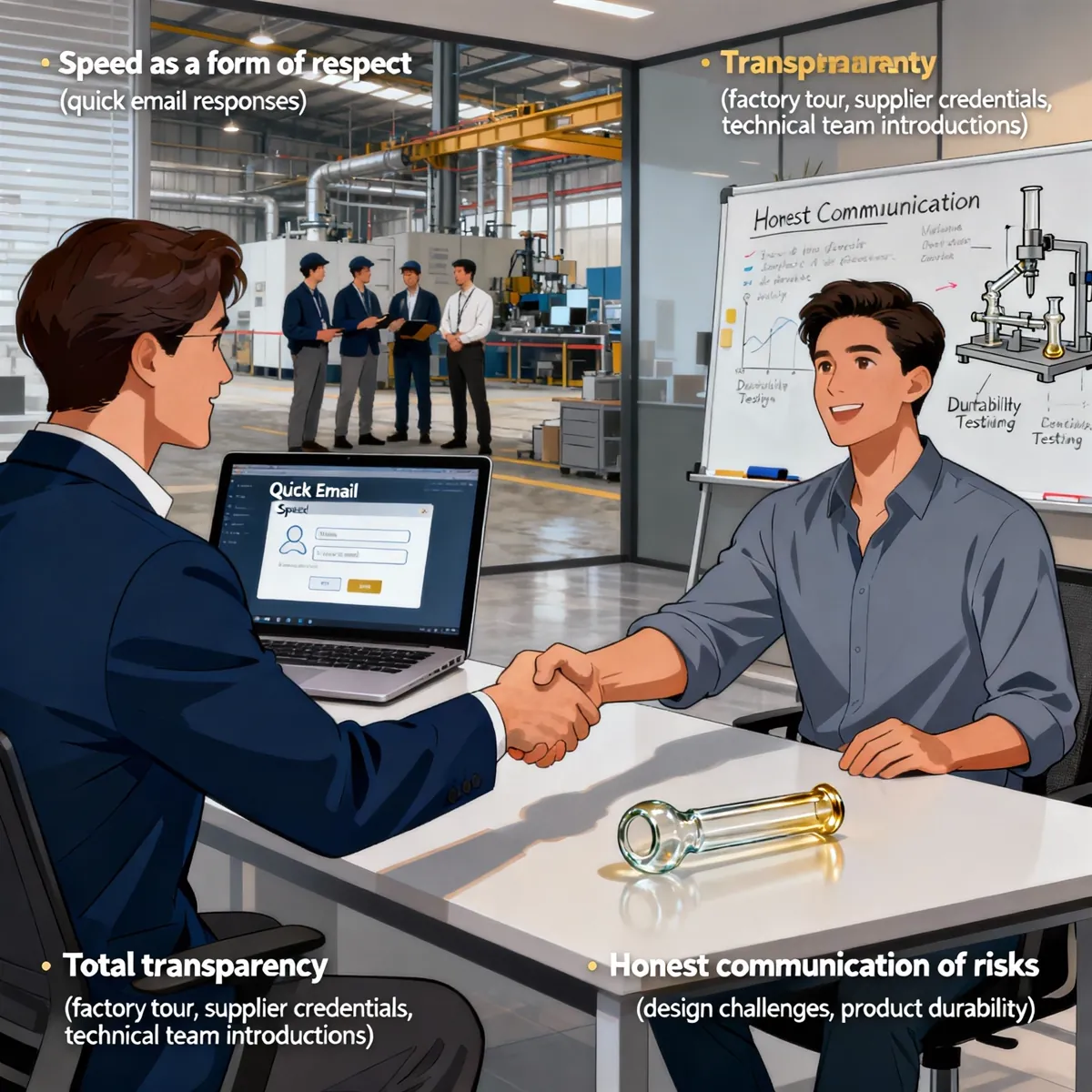
Suppose you sent the same product photo to five suppliers — and the quotes came back spread across a wide range, from a few dollars to more than triple that. Same borosilicate glass hand pipe. Same approximate dimensions. If you are new to sourcing, that spread looks like someone is overcharging. If you have been in the business long enough, you know the truth is more nuanced — and more useful.
The answer is that “identical” is an illusion. Two glass pipes can look indistinguishable in a product photograph yet carry fundamentally different costs beneath the surface. The gap between the cheapest and most expensive quote is not random. It maps to specific, identifiable variables in how each supplier sources materials, runs production, and manages quality.
Understanding those variables is the difference between choosing a supplier based on a number and choosing one based on value. Let us walk through each one.
Factory vs Trading Company — The First Variable
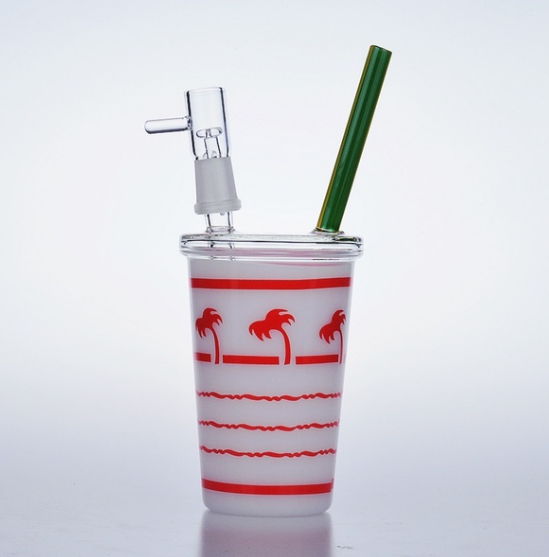
The single largest driver of price divergence is also the simplest: who you are actually buying from.
A direct factory quotes based on production cost plus margin. A trading company quotes based on the factory price plus their own margin — typically 15 to 30 percent on top, in our experience. That markup pays for the trading company’s sourcing team, office overhead, and risk buffer, but it also means you are paying more for the same product without gaining any production capability. The product in your warehouse is identical. The invoice is not.
The difference compounds when customization enters the picture. A factory can adjust a percolator design or modify a joint angle during a production run. A trading company must relay your request to the factory, wait for a response, and often add a coordination fee for the trouble. What took one conversation on the production floor becomes a week of email ping-pong through a middleman.
For buyers sourcing wholesale hand pipes or dab rigs, the practical test is straightforward: ask the supplier to describe their production floor in detail. If they hesitate or pivot to talking about their “partner network,” you are likely speaking with a trading company. A deeper comparison is available in our breakdown of traders vs factories.
The comparison below shows how each variable shifts cost between a budget supplier and a certified direct factory.
| Aspect | Direct Factory | Trading Company |
|---|---|---|
| Pricing basis | Production cost + margin | Factory price + ~15-30% markup |
| Sampling speed | 1-3 days (in-house) | 5-15 days (coordination overhead) |
| Customization | Direct access to makers | Limited by factory relationship |
| Quality control | Direct floor oversight | Relies on factory QC reports |
| Communication | Factory floor to buyer | Middleman relay chain |
| Certifications | Bears own audit costs | May not verify supplier certs |
| Accountability | Single point of responsibility | Blame-shifting risk |
| MOQ flexibility | Negotiable per design | Often fixed, sometimes higher |
Glass Material Grades — Not All Borosilicate Is Equal
Borosilicate glass comes in grades, and the grade determines both raw material cost and how the finished pipe performs under thermal stress.
High borosilicate glass, classified as 3.3, contains roughly 80 percent silica and 13 percent boron oxide. It withstands rapid temperature changes without cracking, which is why it is the standard for both laboratory glassware and premium smoking accessories. Lower grades — sometimes labeled 5.0 or sold without specification at all — contain more soda-lime content. They are cheaper to purchase and easier to blow on the torch, but they are more prone to thermal shock and micro-fractures over time.
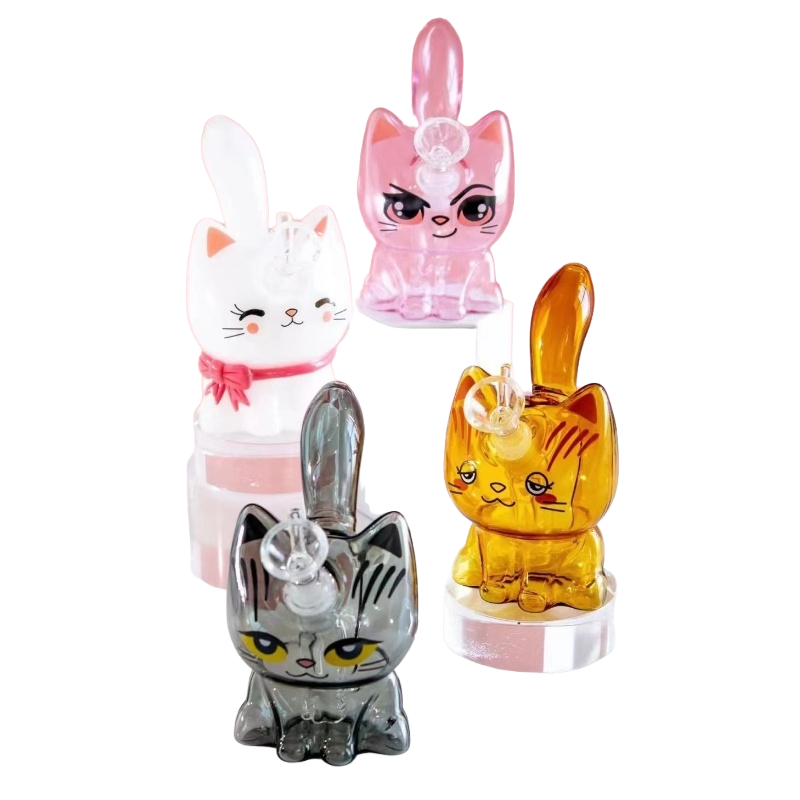
The cost difference between grade 3.3 and grade 5.0 borosilicate is not enormous per kilogram, but it becomes significant across a production run of hundreds or thousands of pieces. A supplier quoting well below market is often absorbing that savings by stepping down to a lower glass grade — one that looks identical in a photograph but behaves differently in the hand and in the flame.
This is particularly relevant for dab rigs, where the glass must endure repeated direct-flame heating cycles. A lower-grade piece may survive the first dozen uses. The stress fractures show up later, long after the order is complete and the review is posted.
Annealing Quality — The Hidden Cost You Cannot See
Here is a variable that never appears in a product photo and rarely makes it into a spec sheet: the annealing process.
After a glass pipe is shaped on the torch, it must be cooled slowly and evenly inside a temperature-controlled annealing oven. This process relieves internal stress created during the blowing and shaping work. Rush the annealing — pull the piece out early, skip the oven entirely, or run the conveyor belt too fast — and the glass retains residual stress. It will look fine on the shelf. It may even pass a basic visual inspection. But over weeks or months of normal use, that stress manifests as cracks, chips, or catastrophic failure at the worst possible moment.
Proper annealing takes time, and time is money. A factory running a 1,000-square-meter production floor with 20 employees, like Elfglass, schedules annealing cycles that match the thickness and geometry of each piece. Thicker walls need longer holds. Complex percolator structures need carefully ramped cooling curves. A supplier cutting corners here can move product faster and cheaper — but the failure rate downstream tells a different story entirely.
This is the single most common reason a “great deal” turns expensive in hindsight: the pipe was cheap because the most important invisible step was skipped.
Finishing and Joint Fit — Where Craftsmanship Shows
Pick up two glass pipes side by side and the finishing quality becomes immediately obvious. Ground glass joints fit snugly with a smooth, airtight rotation. Perc holes are clean and aligned with the water chamber. Edges are fire-polished, not sharp against the lip.
Achieving that finish requires skilled hands and, again, time. A ground joint must be shaped, tested against its mating piece, and re-shaped until the seal is airtight without binding. A percolator must be positioned with precision — even a two-millimeter misalignment changes the diffusion pattern and the draw resistance in ways the end user feels instantly.
These finishing steps add labor cost to every unit. A supplier who skips ground joints in favor of unground connections, or who accepts rough perc cuts to save minutes per piece, can quote lower. But the end user feels the difference in every session, and your brand absorbs the reputational cost. When evaluating samples for your catalog, joint fit is one of the first things to inspect — it tells you more about the maker’s standards than any marketing copy ever will.
Comparing Glass Pipe Quotes That Look Identical?
Elfglass documents its grade 3.3 borosilicate, full annealing cycles and photo-backed QC on every run, so the cheapest quote never costs you more in cracked, rejected pieces. Send your spec sheet and get a quote within 12 hours.
MOQ from 100 pieces | BSCI / WRAP / ISO 9001 | NDA before every project
QC Standards and Inspection Costs
Quality control is not a single checkpoint at the end of the line. It is a system: incoming material inspection when raw glass arrives, in-process checks during blowing and assembly, post-annealing stress testing, and final visual inspection before each piece is wrapped and boxed. Each of those steps represents time, trained personnel, and a willingness to reject product that does not meet the bar.
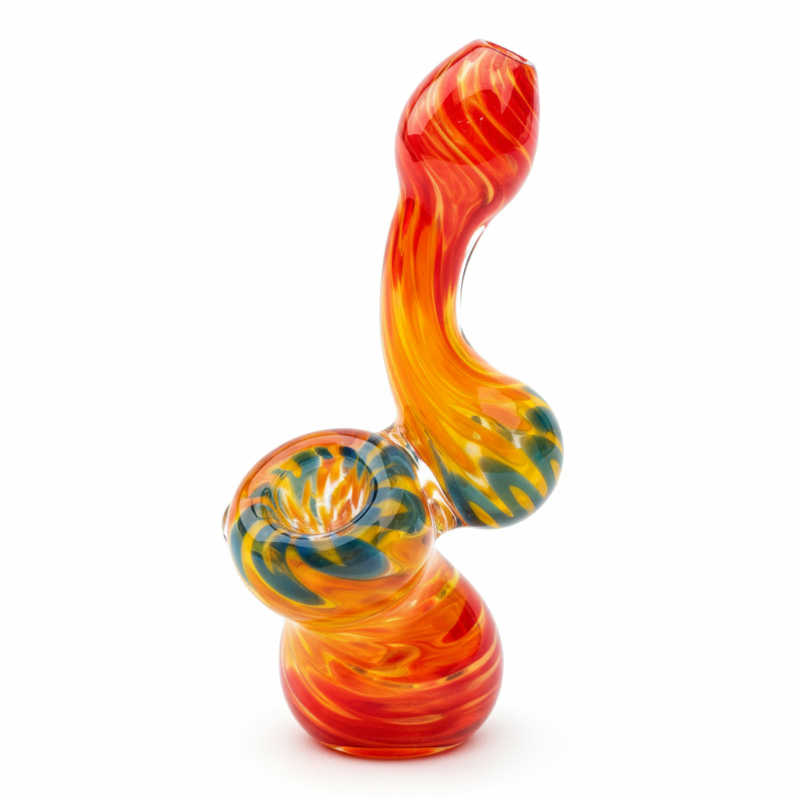
A factory running structured QC rejects pieces that a less rigorous operation would ship. That rejection rate — in our experience, typically 5 to 15 percent depending on design complexity — is built into the unit cost. A supplier with no formal inspection process ships everything that comes off the line. Their per-unit cost is lower, but their defect rate in your warehouse is proportionally higher.
The math favors quality when you run the numbers honestly. Paying a higher unit price for a pipe with approximately a 2 percent defect rate costs less over a 500-piece order than paying a lower unit price for a pipe with approximately a 15 percent defect rate — once you factor in returns, replacements, customer complaints, and the slow erosion of brand trust. Our guide on red flags when sourcing wholesale water pipes covers the warning signs of weak QC in more detail.
Certification Costs — BSCI, WRAP, and ISO 9001
Certifications are not free, and they are not decorative. Maintaining BSCI, WRAP, and ISO 9001 compliance requires regular third-party audits, extensive documentation, facility upgrades, and ongoing staff training. These are real, recurring costs that appear in the unit price of every pipe produced in a certified facility.
A supplier without certifications does not carry those costs, and their quote reflects that advantage. But certifications matter when your brand sells into regulated markets or when your retail partners expect documented supply chain standards. BSCI covers social compliance — fair wages, safe working conditions, no child labor. WRAP addresses workplace safety and ethical manufacturing practices. ISO 9001 certifies that the factory’s quality management system meets international standards for consistency and continuous improvement.
Elfglass holds all three: BSCI, WRAP, and ISO 9001. That decision was not made for marketing purposes. It was made because the brands we work with — the ones building long-term reputations in competitive markets — require documented proof that their supply chain meets recognized standards.
The question is not whether certifications are expensive. They are. The question is whether your market requires them, and whether your buyers will ever ask to see them. If you sell direct to consumers who check labels, or if you wholesale to retailers who audit their supply chains, certifications are not optional. They are table stakes.
Regional Cost Differences — Hebei vs Shenzhen
China’s glass manufacturing is concentrated in two primary regions: Hebei province in the north and the Pearl River Delta around Shenzhen in the south. The cost structures differ meaningfully, and those differences flow directly into the quotes you receive.
Hebei-based manufacturers benefit from lower labor costs and cheaper factory space. Their quotes tend to run lower, particularly for high-volume orders of simpler designs. The region has deep roots in industrial glass production and a large available workforce.
Shenzhen-based factories operate in a higher-cost environment. Rent, wages, and logistics all cost more than in Hebei. But Shenzhen sits within one of the world’s densest supply chains for materials, precision tooling, and surface finishing — everything from custom color frits to laser engraving services is available within a short drive. That ecosystem access matters when a design requires specialized work beyond basic blowing.
The regional difference is not about which location is “better.” It is about which cost structure matches your product requirements. A complex dab rig with color work and precision joints may benefit from Shenzhen’s tooling ecosystem. A simple beaker water pipe in large volume may be more cost-effective from Hebei. Our detailed comparison of Hebei vs Shenzhen water pipe manufacturers explores this trade-off further.
How to Evaluate a Quote Beyond the Bottom Line
The lowest number on a spreadsheet is the easiest thing to compare — and the least informative. A more useful evaluation framework asks five questions before you rank any quote:
First, what glass grade is specified? If the quote does not say, ask directly. A supplier who cannot tell you the borosilicate grade is either unsure of their own supply chain or unwilling to commit to a standard in writing.
Second, what is the annealing process? Ask for cycle times and temperatures. A factory that tracks annealing data can share it. One that gives vague answers about “standard cooling” may not be running a controlled process at all.
Third, what is the defect tolerance? How does the supplier define acceptable versus rejectable? What is their policy when you receive damaged goods? A clear answer signals a factory that has thought about quality as a system, not an afterthought.
Fourth, what certifications does the factory hold? Ask for current audit reports, not just logos on a website. Certifications that have lapsed or were never obtained should change how you weight that quote.
Fifth, what is the communication response time? A factory that responds to inquiries within 12 hours — as Elfglass does — is signaling that they treat pre-sale communication as a production priority. The supplier who asks the most questions before quoting is often the one who delivers the most consistent product, because they are investing in understanding before they invest in manufacturing.
Ava Zeng, founder of Elfglass, frames it this way: “What kills a great idea is never the technology, but the communication gap and a lack of empathy.” That philosophy shapes how Elfglass handles every inquiry — signing an NDA before any project discussion begins, responding to quote requests within 12 hours, and treating each buyer’s specifications as a production commitment rather than a sales lead.
For a comprehensive sourcing checklist that covers these variables and more, see our wholesale glass pipes sourcing guide. And when you are ready to compare specific quotes against a factory-direct baseline, reach out to the Elfglass team — we will give you an honest assessment of where your current quotes sit and why.
Frequently Asked Questions
Why Do Identical Glass Pipes Cost Differently?
The same design can be produced with different glass grades, annealing processes, finishing standards, and QC levels. A factory-direct supplier with certifications will quote higher than a trading company using lower-grade materials and skipping annealing — but the delivered quality and defect rates will differ proportionally. The product photo looks the same. The production reality does not.
Is Higher Price Always Better Quality?
Not automatically. A higher price may reflect genuine quality investments — better glass, proper annealing, certified processes — or it may simply reflect a trading company’s markup on top of the factory price. Always ask what specific variables the price includes before drawing conclusions. The most informative question you can ask is: what glass grade, what annealing cycle, and what defect tolerance does this quote assume?
How to Tell Factory From Trading Company?
Ask about their production floor, request a video call during working hours, and check whether they can describe their annealing process and QC checkpoints without hesitation. A real factory answers these questions immediately and specifically. A trading company deflects, delays, or offers only generalities. You can also read our detailed guide on how to distinguish traders from factories.
Does Factory Region Affect Glass Pipe Pricing?
Yes. Hebei province generally offers lower labor and overhead costs, which translates to lower quotes for simpler, high-volume designs. Shenzhen carries higher operating expenses but provides access to a denser supply chain for specialized tooling, color work, and precision finishing. The right choice depends on your product complexity and volume requirements, not on a blanket assumption about either region.
What Is the Minimum Order for Custom Pipes?
Most direct factories, including Elfglass, set MOQ at 100 pieces per design or SKU. This balances production efficiency with the flexibility brands need to test new designs before committing to larger runs. Sampling typically takes 1 to 3 days, and full production for 100-plus pieces runs 7 to 12 days depending on design complexity.
Ready to Start Your Custom Glass Pipe Project?
Get a free quote within 24 hours. MOQ from 100 pieces. NDA-protected design consultation.
About the Author
Ava Zeng is the founder of Elfglass, a Shenzhen-based borosilicate glass pipe manufacturer serving B2B brands worldwide. Every guide on this site is grounded in her production-floor experience— the annealing lines, QC checkpoints, and export orders behind each claim.
Before you commit to a supplier, read her founder’s story and trust promise, and the guide to vetting a reliable glass pipe manufacturer— the same red-flag checklist Elfglass applies to its own suppliers.
