
A Pallet of Glass Pipes Crosses an Ocean in Two Ways

On any given Monday, a crate of 2,000 borosilicate hand pipes leaves the Elfglass warehouse in China heading for a smoke shop in California. That same crate could arrive in 3 days by air or in 28 days by sea. The air freight bill will be $1,840. The ocean freight bill will be $310. Neither option is wrong — the right answer depends on what the buyer’s cash flow, shelf deadline, and risk tolerance look like this quarter.
Most first-time importers treat shipping as an afterthought. They ask for a product quote, get an FOB price, and then discover weeks later that the logistics cost reshapes the entire unit economics. This article runs the actual numbers for a typical glass pipe shipment — not the generic “air is fast, sea is cheap” advice you find on logistics blogs, but the specific cost-per-unit math, the hidden surcharges that appear on the final invoice, and the decision framework that experienced buyers use to pick the right mode for each order.
The Real Cost Breakdown: Air vs Sea for a Typical Shipment
To compare apples to apples, consider a standard order: 2,000 borosilicate hand pipes, individually boxed, packed in 10 cartons of 200 pieces each. Total gross weight approximately 180 kg. Total volume approximately 0.42 CBM (cartons measuring roughly 50 × 40 × 35 cm each, but volumetric weight for air freight will be calculated differently). The origin is a factory in Jiangsu province, China. The destination is a warehouse in Los Angeles, California.
| Cost Component | Air Freight | Sea Freight (LCL) | Sea Freight (FCL 20ft) |
|---|---|---|---|
| Freight charge (origin → destination port/airport) | $1,620 (US$9.00/kg chargeable) | $280 (LCL rate ~$65/CBM, min 0.42 CBM) | $1,800 (all-in rate to LA) |
| Fuel surcharge (BAF/FAF) | Included in air rate | $35 | Included in FCL rate |
| Origin charges (THC, documentation, customs export) | $95 | $120 | $145 |
| Destination charges (THC, delivery, customs clearance) | $185 | $240 | $310 |
| Customs duty (HS 7017.10, US MFN rate) | $108 (est. 6% of $1,800 goods value) | $108 | $108 |
| CBP Merchandise Processing Fee (US) | $52 (0.3464%, min $31.67) | $52 | $52 |
| Insurance (0.3% of goods value) | $5.40 | $5.40 | $5.40 |
| Total logistics cost | $2,065 | $840 | $2,421 |
| Cost per unit (2,000 pcs) | $1.03 | $0.42 | $1.21 |
| Transit time (door to door) | 3–5 business days | 25–35 days | 25–35 days |
Three things should stand out. First, LCL sea freight is the cheapest per unit by a wide margin — roughly half the cost of air freight per piece. Second, FCL looks more expensive than LCL for small shipments because you are paying for the entire container regardless of how much you fill; at 2,000 pieces you barely fill a corner of a 20-foot container. Third, the customs duty is identical across all modes — HS classification does not change based on how the goods travel. The duty is the same whether the pipes fly or float.
The FCL option becomes economical at higher volumes. At 15,000 pieces (a full 20-foot container of hand pipes), the FCL cost per unit drops to approximately $0.16 — six times cheaper than air. This is why experienced buyers plan their order volumes around container-load breakpoints.
Where Air Freight Actually Wins: The Cash Flow Argument

The per-unit cost comparison tells only half the story. The other half is working capital. Consider a buyer who lands a retail contract with a US smoke shop chain that needs 500 units on shelves within 10 days to hit a seasonal promotion window.
Sea freight transit is 25-35 days. Even with express ocean services, the buyer cannot make the promotional window. The revenue from that contract — say, 500 units at $12 wholesale each = $6,000 — either happens or does not. If the buyer misses the window, the promotion revenue is zero. The air freight premium of roughly $500 (vs LCL sea) is a fraction of the $6,000 at stake.
This is the real air freight value proposition: it converts time-sensitive revenue opportunities into achievable ones. The math works when the incremental revenue from faster delivery exceeds the incremental shipping cost. For a $6,000 promotional order, spending $500 more on air freight yields a 12x return. For a routine restock of 5,000 units with no deadline pressure, the same $500 premium is pure cost with no offsetting revenue.
The Working Capital Cycle Difference
There is a second cash flow effect that is less obvious. When goods travel by sea for 30 days, the buyer’s payment is typically tied up in transit inventory for the entire period. Most suppliers require payment before shipment (T/T in advance) or at the port of loading (against Bill of Lading). The buyer pays on day 1 but does not receive goods until day 30-35. That is 30-35 days of working capital locked in floating inventory.
Air freight compresses this to 5-7 days. The buyer pays on day 1, receives goods on day 5, and can begin selling on day 6. For a buyer with tight cash flow or a credit line that revolves monthly, the 25-day difference in capital lockup can matter more than the shipping cost differential itself.
Where Sea Freight Wins: Everything Except Speed

For the majority of glass pipe shipments — routine restocks, large wholesale orders, new product launches with planned timelines — sea freight is the default for good reason. Beyond the cost advantage, sea freight offers several structural benefits:
Lower Risk of Damage
Air freight handles cargo roughly. Packages are tossed onto conveyor belts, stacked in ULD containers, and subjected to pressure and temperature changes at cruising altitude. Glass pipes are fragile. The vibration and pressure differential in air cargo holds increases breakage rates. Industry experience suggests breakage rates of 1-3% for glass items shipped by air vs 0.2-0.5% by sea (in properly packed cartons). At $5 per unit wholesale, a 2% air breakage rate on 2,000 units means 40 broken pipes = $200 in lost goods — partially offsetting the speed advantage.
No Weight Penalties
Air freight charges on the greater of actual weight or volumetric weight. Glass pipes are dense — a carton of 200 borosilicate hand pipes weighs about 18 kg but occupies only 0.035 CBM. The volumetric equivalent is roughly 6 kg (using the standard air freight divisor of 6,000). Since actual weight exceeds volumetric, the buyer pays on actual weight. For lighter but bulkier products (silicone accessories, packaging materials), volumetric weight can exceed actual weight, making air freight even more expensive relative to sea.
Scalability Without Proportional Cost Increase
Shipping 10,000 units by sea does not cost 5x more than shipping 2,000 units. The per-CBM rate stays roughly constant, and packing efficiency improves with volume. Shipping 10,000 units by air costs almost exactly 5x the 2,000-unit cost because every kilogram is charged at the same rate. This non-linearity is why large buyers almost exclusively use sea freight.
Hidden Surcharges That Appear on the Final Invoice
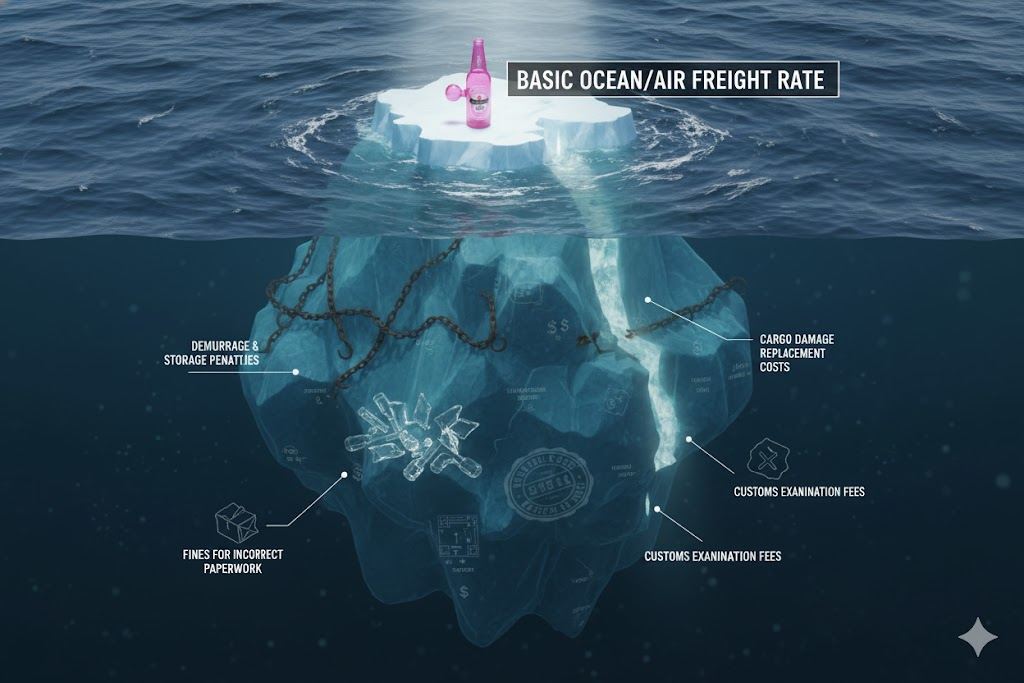
Both air and sea freight invoices contain line items that do not appear in the initial quote. Buyers who budget only the headline freight rate get surprised. The most common additions:
| Surcharge | When It Applies | Typical Amount |
|---|---|---|
| Peak Season Surcharge (PSS) | Sea freight, August–October (pre-holiday rush) | $200–$500 per TEU |
| General Rate Increase (GRI) | Sea freight, typically April and October | $300–$600 per TEU |
| Security Surcharge (SCS) | Air freight, post-9/11 regulatory cost recovery | $0.05–$0.10 per kg |
| Warehouse Handling (destination) | Both, if goods sit at terminal >3 free days | $15–$40 per day per CBM |
| Demurrage / Detention | Sea freight, if container not returned within free days | $75–$150 per day per container |
| ISF Filing Fee (US imports) | Sea freight only, mandatory 10+2 filing | $25–$50 |
| AMS/ACI Filing | Air and sea to US/Canada | $25–$35 |
| Currency Adjustment Factor (CAF) | Sea freight, fluctuates with USD/EUR | 5–15% of freight |
For a first-time buyer, these surcharges can add 15-30% to the headline freight cost. Always ask your freight forwarder for an all-in quote that includes surcharges, not just the base rate. A quote that says “$65/CBM” without specifying whether BAF, THC, and documentation are included is not a real price — it is a starting point.
Decision Framework: Which Mode for Which Order
Experienced buyers do not pick one mode and stick with it. They match the mode to the order profile. The following framework works for glass pipe imports specifically:
| Order Profile | Recommended Mode | Reasoning |
|---|---|---|
| Sample shipment (5–20 pieces) | Air express (DHL/FedEx) | Speed matters; absolute cost is low ($50–$150) |
| Urgent restock (<500 units, retail deadline) | Air freight | Revenue at risk exceeds freight premium |
| Routine restock (500–3,000 units, no deadline) | Sea LCL | Lowest per-unit cost for partial-container volumes |
| Large order (3,000–15,000 units) | Sea FCL 20ft | Per-unit cost drops to $0.10–$0.20 |
| Full containerload (15,000+ units) | Sea FCL 40ft | Lowest possible per-unit cost; plan 30-day lead time |
| New product launch (planned) | Sea freight (first order) + air (top-up if demand surprises) | Hybrid approach: base stock by sea, quick reaction by air |
| Trade show samples / display pieces | Air express or hand-carry | Must arrive before show opens; no alternative |
One pattern worth noting: the hybrid approach is increasingly common among experienced buyers. They place a large base order by sea (covering 80% of expected demand) and keep a small air-freight reserve budget for emergency top-ups when demand exceeds forecast. This balances the cost efficiency of sea freight with the responsiveness of air freight, without committing to either mode exclusively.
Freight Quotes With Real Landed Numbers
Elfglass prepares cartons, pallets, and export documentation for both air and sea shipments, and works with your forwarder on Incoterms from EXW to DDP. Ask us for a packing plan before you book freight.
MOQ from 100 pieces | BSCI / WRAP / ISO 9001 | NDA before every project
Incoterms and Who Pays for What
The shipping mode decision intersects with Incoterms — Incoterms the seller’s responsibility ends and the buyer’s begins. The two most common Incoterms for glass pipe imports:
FOB (Free on Board): The seller delivers goods to the port and clears them for export. The buyer arranges and pays for the main freight, insurance, and all destination costs. FOB gives the buyer control over freight forwarding — you choose the forwarder, negotiate the rate, and track the shipment directly. This is the preferred term for buyers who ship regularly and have established freight relationships.
CIF (Cost, Insurance, and Freight): The seller arranges and pays for freight and insurance to the destination port. The buyer handles import customs and onward delivery. CIF is simpler for the buyer but offers less control — the seller’s forwarder may not prioritize speed or cost efficiency since it is the seller’s account. CIF is common for first-time or small buyers who lack their own freight forwarding relationships.
For air freight, the equivalent terms are often quoted as “airport to airport” with similar dynamics. The key point: the Incoterm determines who negotiates the freight rate, and whoever negotiates typically gets the better deal because they are the repeat customer of the forwarder.
Practical Tips for First-Time Shippers
If this is your first glass pipe import, the single most impactful decision is choosing a reliable freight forwarder — not the cheapest one, but one that specializes in China-to-your-destination trade lanes and handles glass/fragile goods regularly. A forwarder who has never shipped glass will not know to flag the breakage-risk surcharge, will not recommend the right carton specifications, and will not know that HS 7017.10 requires specific customs documentation.
Second, always insure glass shipments. The cost is trivial (0.3-0.5% of goods value) but the asymmetry is enormous. A single broken carton in a sea shipment can cost $500-1,000 in goods; the insurance premium for the entire shipment might be $5. There is no rational reason to skip it.
Third, build transit time into your reorder cycle. If sea freight takes 30 days door-to-door, and you need 2 weeks of safety stock, you should be placing reorder conversations 6 weeks before you expect to run out. Buyers who discover shipping lead times after placing an order — rather than before — are the ones who end up paying air freight premiums out of panic.
Learn more about our order fulfillment and shipping process.
Learn more about request a shipping quote from Elfglass.
Planning your first glass pipe shipment? Elfglass ships FOB and CIF to 40+ countries, with carton packing optimized for glass breakage prevention. Request a shipping quote — we will quote both air and sea options side by side so you can compare.
For related reading, see our wholesale glass pipe lead time planning guide for a detailed breakdown.
For related reading, see our pre-shipment inspection checklist for glass pipes for a detailed breakdown.
Ready to Start Your Custom Glass Pipe Project?
Get a free quote within 24 hours. MOQ from 100 pieces. NDA-protected design consultation.
About the Author
Ava Zeng has spent over 16 years managing international logistics at Elfglass, coordinating shipments of glass pipes to 40+ countries. She writes from direct experience with freight forwarders, customs brokers, and the real cost structures behind every shipping invoice.
Frequently Asked Questions
Is air freight worth it for glass pipes?
Air freight makes sense when the revenue gained from faster delivery exceeds the shipping cost premium — typically for urgent restocks under 500 units, sample shipments, or trade show materials. For routine orders above 500 units with no deadline pressure, sea freight saves 50-70% on per-unit shipping cost.
How much does it cost to ship glass pipes from China to the US?
For a typical 2,000-unit hand pipe order (180 kg, 0.42 CBM): sea LCL costs approximately $0.42 per unit, air freight approximately $1.03 per unit, and sea FCL (if filling a 20ft container) approximately $0.16 per unit. These figures include origin/destination charges, customs duty, and insurance.
What is the breakage rate for glass pipes during shipping?
With proper carton packing and palletizing, sea freight breakage runs 0.2-0.5%. Air freight breakage is higher at 1-3% due to rougher handling and pressure changes. Always insure glass shipments — the premium is 0.3-0.5% of goods value but covers the full replacement cost of breakage.
Should I use FOB or CIF for my glass pipe order?
FOB gives you control over freight forwarding and typically better rates if you ship regularly. CIF is simpler for first-time buyers who lack their own freight relationships. In both cases, the Incoterm determines who negotiates the freight rate — and the repeat customer (the party shipping more often) usually gets the better deal.
How far in advance should I plan my glass pipe shipment?
For sea freight, plan 6-8 weeks ahead: 1-2 weeks for production, 1 week for origin logistics, 4-5 weeks for ocean transit and customs clearance. For air freight, 2-3 weeks is sufficient. Buyers who plan around sea freight lead times and use air only for emergencies achieve the lowest total logistics cost.
