

The hidden costs of shipping are one of the most dangerous traps for new importers. You’re staring at two quotes, and Supplier B’s shipping rate is so low it feels like an easy win. Every instinct tells you to take the cheaper deal—a saving of over a thousand dollars is hard to ignore. But this is the exact moment where seasoned importers pause. They know that in the world of logistics, a quote that seems too good to be true almost always is. That “cheap” shipping rate isn’t a discount; it’s a warning sign for massive, unexpected shipping costs that can transform that initial saving into your most expensive mistake of the year. 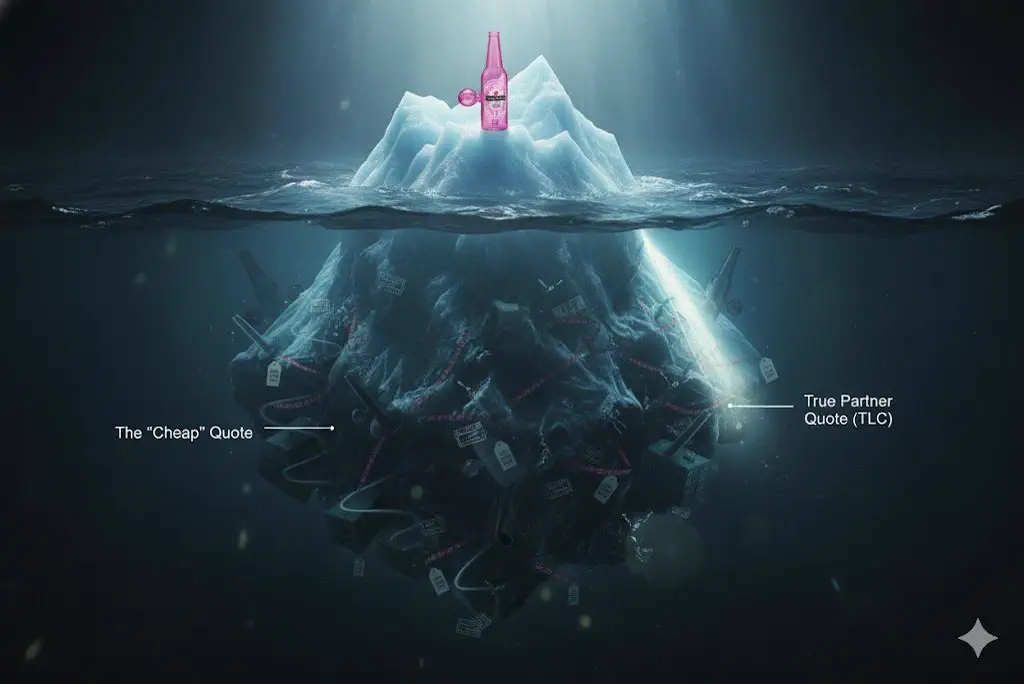
The Devil in the Details: Why Total Landed Cost Matters
The fundamental mistake many businesses make is comparing shipping quotes instead of comparing the Total Landed Cost (TLC). The initial quote is just the tip of the iceberg; the TLC is the true, all-inclusive cost to get your product from the factory to your warehouse, and it accounts for all potential hidden costs of shipping. Budget operators design quotes to be temptingly incomplete. A true logistics partner designs theirs to be transparent and final. Here’s a look at what that difference means in practice:
| Feature | The “Cheap” Quote | The True Partner Quote (TLC) |
| Freight Cost | Included (Often artificially low) | Included (Based on reliable carriers) |
| Origin Fees | Included | Included |
| Insurance | Minimal liability only (Worthless) | Comprehensive cargo insurance |
| Customs Brokerage | Omitted or uses inexperienced agents | Included with expert documentation |
| Destination Port Fees | NOT INCLUDED | INCLUDED (DTHC, etc.) |
| Duties & Taxes | Buyer’s problem | Clearly estimated or included |
| Contingency Support | Non-existent | Proactive communication included |
| Final Price | Artificially Low | Accurate & Reliable |
The Iceberg: What Lies Beneath the Surface of Your Quote
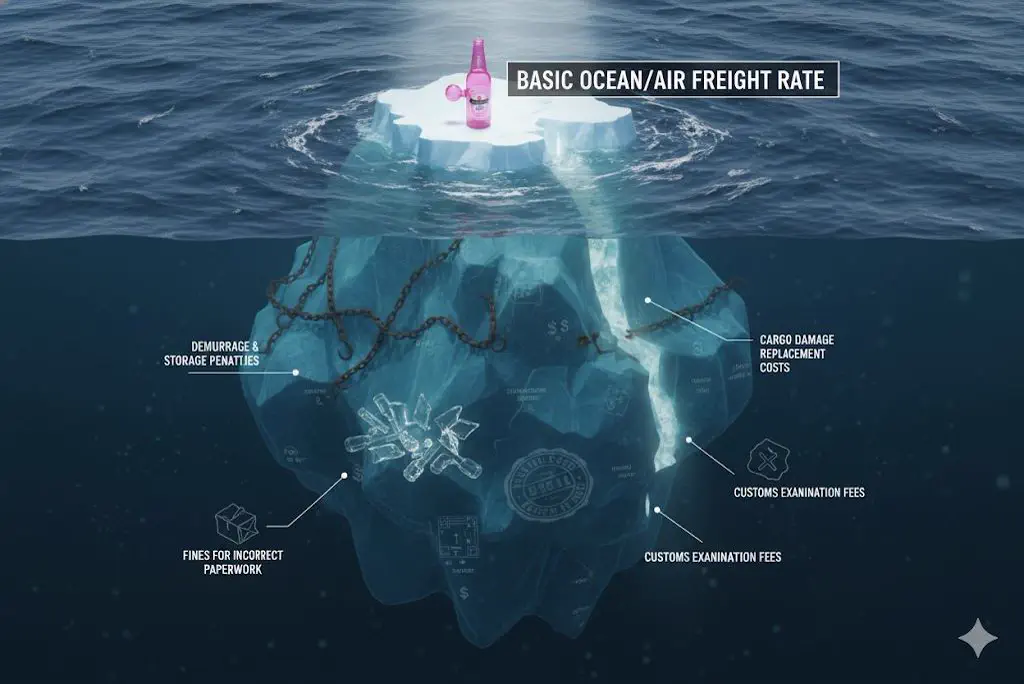
Think of your shipping costs as an iceberg. The cheap quote is the small, visible tip, while the real expenses hide just below the water. Above the Water (The Quote You See): Basic Ocean/Air Freight Rate Below the Water (The Hidden Costs You Pay Later): Destination Terminal Handling Charges (DTHC) Customs Examination Fees Fines for Incorrect Paperwork Demurrage & Storage Penalties Cargo Damage Replacement Costs Port Security Surcharges A true partner shows you the whole iceberg from the start, explaining all the potential hidden costs of shipping so you can budget accurately. 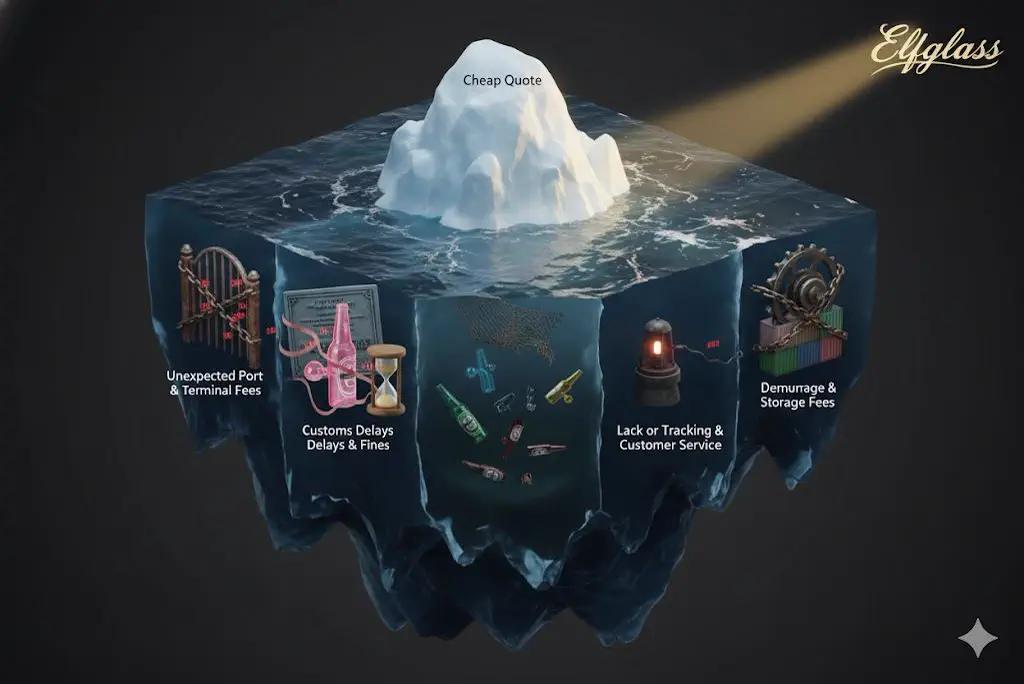
Uncovering the 5 Hidden Costs of Shipping
That massive, hidden part of the iceberg is where your profit margins go to die. Here are the five most common traps that spring from a deceptively low quote.
1. Unexpected Port & Terminal Fees
The most common “surprise.” Budget forwarders leave out Destination Terminal Handling Charges (DTHC) and other mandatory port fees. These aren’t optional—they are billed directly to you upon arrival, often at inflated rates. That $300 you “saved” can easily become a $900 mandatory fee.
2. Customs Delays & Fines
Proper customs clearance is a skill. Inexperienced agents often misclassify goods, triggering costly inspections and fines. Believe me, I’ve seen a simple typo on a customs form trap a six-figure shipment in port for three weeks, racking up thousands in penalties. This is one of the most painful hidden costs of shipping, and it’s entirely avoidable with a professional broker.
3. Lost or Damaged Cargo
To offer low prices, cheap carriers cut corners, partnering with rough handlers and offering only bare-minimum insurance. When your products arrive damaged—and they will more often—you’re left with a worthless claim and the full cost of replacement.
4. Lack of Tracking & Customer Service
When a problem occurs with a budget shipment, the operator often goes silent. Their business model doesn’t support a real customer service team. A professional partner has dedicated staff and tracking systems to inform you of issues before they become crises. This lack of support from cheap providers creates massive disruption, transforming minor hiccups into major operational failures.
5. Demurrage & Storage Fees
This is the financial trap that snaps shut when customs clearance is delayed. If your container isn’t picked up on time, the port starts charging daily penalty fees called demurrage, often $150-$300+ per day. A one-week delay can single-handedly wipe out your entire profit margin on a shipment.
Packaging and Freight Planned Around Your Route
From foam-insert and double-wall cartons to air or sea freight with clear Incoterms, we engineer packaging to cut breakage and quote landed cost honestly. Send us your destination and volume for a packing plan.
MOQ from 100 pieces | BSCI / WRAP / ISO 9001 | NDA before every project
A Value-Driven Philosophy: Partnership Over Price
At Elfglass, we refuse to play the cheap quote game. We’ve built our logistics philosophy on a simple principle: transparency wins trust. This belief shapes every timeline we commit to, as explored in our delivery speed philosophy. We partner exclusively with vetted, reliable freight forwarders. This means our initial quote is honest and accounts for the true hidden costs of shipping, because we are in the business of building long-term partners, not scoring a quick, deceptive sale. The same discipline runs through our MOQ 100 trial order program, where first-time buyers test both product and logistics at low risk. 
Build Your Own Total Landed Cost Worksheet
The only way to compare suppliers honestly is to reduce every quote to the same number: total landed cost. Build this worksheet once and force every forwarder and supplier to fill in every row. A quote that leaves a row blank is, by definition, incomplete — and the missing row is exactly where the surprise fee lives.
| Cost Component | What It Covers | How to Get the Number |
|---|---|---|
| Product (EXW / FOB) | Factory unit price × quantity | Supplier quote |
| Origin charges | Export docs and terminal handling at origin | Forwarder itemization |
| Freight (ocean / air) | Carrier line-haul to destination port | Forwarder rate sheet |
| Insurance | Cargo cover at full declared value | Insurer or forwarder |
| Duties and taxes | Tariff by HS code plus VAT / GST | Customs broker estimate |
| Customs brokerage | Clearance fee and entry filing | Named broker’s quote |
| Destination port fees (DTHC) | Terminal handling at the arrival port | Forwarder itemization |
| Inland drayage | Port-to-warehouse trucking | Drayage carrier |
| Demurrage / storage contingency | Buffer for clearance or pickup delays | Daily rate × estimated risk days |
Add the rows into a single figure and compare that across suppliers — never the freight line alone. Two quotes that look $1,000 apart on freight routinely invert once destination fees, duties, and insurance are entered honestly.
Red Flags When Reading a Freight Quote
Budget operators do not hide their traps; they simply leave them off the page. Learn to read the omissions. Any one of these signals that the number in front of you is not a total landed cost.
- Destination fees (DTHC) not itemized, or explicitly marked “not included.”
- Duties and taxes dismissed as “buyer’s problem” with no estimate offered.
- Insurance quoted at carrier-minimum liability rather than full declared value.
- No named customs broker, or an unnamed “in-house agent” with no references.
- An ocean or air rate dramatically below market — the margin is recovered later in accessorials.
- A single lump-sum “all-in” figure with no line-item breakdown behind it.
- Free-time and demurrage terms left unstated.
Ask for the itemized version before you compare anything. A transparent partner produces it in a day; a budget operator will hesitate, and that hesitation is the whole answer.
Stop Comparing Quotes. Start Comparing Partners.
It’s time to shift your mindset. Stop asking, “Who has the lowest shipping quote?” and start asking, “Who can provide the most transparent and risk-free shipping solution?” True value isn’t found in a cheap quote; it’s found in the peace of mind that comes from eliminating the devastating hidden costs of shipping. Ready to see the difference? [Request a fully transparent, all-inclusive quote from Elfglass] and start making decisions with confidence.
Frequently Asked Questions
What is total landed cost, and why is it important?
Total landed cost (TLC) is the complete and final cost of getting a product to your warehouse, including product price, shipping quote, and all ancillary costs like duties, taxes, and insurance. It reflects the true cost of inventory, exposing hidden shipping costs that cheap quotes leave out.
Should I use my supplier’s freight forwarder or find my own?
Using your own trusted freight partner almost always results in a lower total landed cost and greater peace of mind, because direct control over logistics is key to navigating supply chain volatility and avoiding scams.
How can I protect myself from unexpected shipping charges?
Demand a fully itemized quote that outlines every potential charge, and ask your logistics provider to quote the total landed cost rather than just the freight rate.
Get a Quote for Your Next Order
Building your wholesale lineup? with shipping costs quoted transparently before you commit? Explore our wholesale water pipe collections for MOQ, tiered pricing, and factory-direct lead times. Send us your product spec and target quantity — contact our factory team or message us on WhatsApp, and we will reply with pricing and lead times within 24 hours.
About the Author
Ava Zeng is the founder of Elfglass, a Shenzhen-based borosilicate glass pipe manufacturer serving B2B brands worldwide. Every guide on this site is grounded in her production-floor experience— the annealing lines, QC checkpoints, and export orders behind each claim.
Before you commit to a supplier, read her founder’s story and trust promise, and the guide to vetting a reliable glass pipe manufacturer— the same red-flag checklist Elfglass applies to its own suppliers.
Hidden-cost identification follows the logistics cost-analysis method, where landed-cost calculations reveal fees invisible at the quote stage.
Ready to Source Custom Glass Pipes?
Get a free quote within 24 hours. MOQ from 100 pieces. NDA-protected design consultation.
