

Friends, let’s have an honest conversation.
If you’re wondering how to forecast demand as a smoke shop owner, you know it can feel like a high-stakes gamble where you’re betting your entire cash flow.
We’ve been in this business a long time.
We’ve seen the nightmare from both sides: the owner in May, staring at a warehouse full of dusty, holiday-themed stock they can’t move.
And we’ve seen the other, equally painful nightmare: the glaring “Sold Out” sign on your hottest products on April 19th.
Both of these scenarios lead to the exact same place: real, hard-lost profit and a massive amount of stress.
At Elfglass, we don’t believe in guessing.
We believe in planning.
As your manufacturing partner, your success is our success.
So let’s stop guessing and start building a system that actually makes you money.
Identifying Your Peak Seasons: The Smoke Shop Sales Calendar
First, we need to be on the same page.
Your smoke shop inventory plan can’t be a flat line.
For our industry, it’s a predictable series of peaks and valleys.
Knowing them is the first step to mastering seasonal inventory planning.
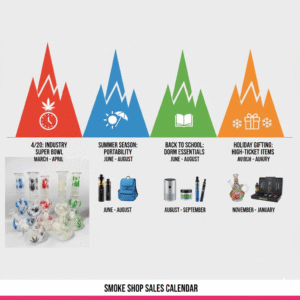
H3: The Industry’s “Black Friday”: 4/20
This isn’t just a holiday; it’s our industry’s Super Bowl.
The sales rush doesn’t just happen on one day—it starts building in late March and hits a frenzy.
Knowing how to forecast demand for 4/20 is the most critical financial decision you’ll make all year.
Customers are stocking up, and your inventory must be at its absolute deepest.
H3: The Summer Season (June – August)
Festivals, vacations, and outdoor activities change customer behavior.
What do they need?
Portability. You’ll see a significant spike in vapes, durable silicone pieces, travel cases, and smell-proof bags.
H3: Back to School (August – September)
Don’t sleep on this mini-season, especially if you’re located in or near a college town.
You’ll see an influx of students looking to outfit their dorms and apartments.
H3: The Holiday Season (November – January)
From “Danksgiving” through New Year’s, this is your Q4 sprint.
The keyword for this entire period is: Gifting.
High-ticket items, premium glass art, and sophisticated vaporizers become your A-list products.
How to Forecast Demand: 3 Foundational Methods
You don’t need a complex algorithm.
The most effective demand forecasting methods start with the goldmine of data you’re already sitting on.
H3: 1. Analyze Your Historical Sales Data
This is the most important, powerful piece of advice we can give you for how to forecast demand.
Stop guessing what might sell and start looking at what has sold.
- Look at the Same Period: To plan for this 4/20, pull your sales data from last year.
- Look at Velocity: Don’t just look at total revenue. Which specific SKUs sold out? How many units of your top 10 products did you move per week?
- Factor in Growth: If your business is on a growth trajectory, your baseline forecast for this year should be at least 20% over last year’s numbers.
H3: 2. Monitor Market Trends
Historical data can’t predict a brand-new trend.
This is where you must be plugged into the industry.
Read trade publications, see what influencers are promoting, and check out reliable sources like Retail Dive for broader consumer shifts.
H3: 3. Factor in Your Marketing Plans
This sounds simple, but it’s the variable most people forget.
Are you planning a massive BOGO sale?
If so, your marketing plan is your forecast.
You must plan your inventory to service the demand you are actively creating.
Building a Resilient Inventory: It’s More Than Just Ordering More
We aren’t aiming for a big inventory. We’re aiming for a smart one.
This is where the art of inventory management for retail becomes your strategic weapon.
H3: Calculate Your “Lead Time”
This is the single most critical number in your business.
It’s the key to understanding how to forecast demand successfully.
The formula is simple: Production Time + Shipping Time = Total Lead Time
For international manufacturing, this can be 60 to 120 days.
If your 4/20 peak starts in April and your lead time is 90 days, you must be finalizing your order no later than January.
H3: Set Your “Safety Stock”
Think of “Safety Stock” as your shop’s insurance policy.
It’s a small, extra inventory buffer you hold to protect you from unexpected demand spikes or supply chain delays.
A simple way to start is by holding an extra 1-2 weeks’ worth of sales for your A-list items.
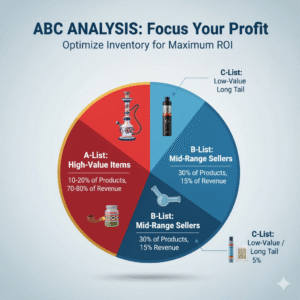
H3: Use ABC Analysis
Not all inventory is created equal.
ABC analysis is how you focus your cash and attention where it matters.
- A-List: Your top 10-20% of products that generate ~80% of your revenue. You must never stock out of these.
- B-List: Your steady, middle-ground sellers.
- C-List: The bottom 50% of your products. It is okay to stock out of these occasionally.
This model frees up your cash from C-list items.
The Bridge: How Your Manufacturer is a Key Part of Your Inventory Strategy
At the end of the day, your forecasts and plans are only as good as your supply chain.
This is where your relationship with your manufacturer becomes your single biggest competitive advantage.
This is the Elfglass difference.
A true partner provides reliable and predictable lead times.
That turns your forecast from a “guess” into a “plan.”
A good partner has an extremely low defect rate.
Our commitment to quality means the 100 units you order are 100 units you can sell.
And finally, a strategic partner doesn’t just take orders.
We analyze your forecast with you.
We help you plan your production cycles far in advance, ensuring you are perfectly stocked for every peak season.
Frequently Asked Questions (FAQ)
Q1: What is “Safety Stock,” and how much should I keep?
A: Safety stock is the extra inventory buffer you hold to mitigate the risk of stockouts.
For a simpler approach, start by holding 10-20% of your average inventory for core (A-List) items, or enough to cover one to two weeks of sales, and adjust based on supplier reliability.
Q2: What is the best inventory management software for a small smoke shop?
A: For many small smoke shops, the inventory management features built into your Point-of-Sale (POS) system (like Shopify POS or Square) are the best place to start.
As you grow, you might consider dedicated inventory apps that integrate with your e-commerce and POS platforms.
Q3: How far in advance should I place my orders for the 4/20 holiday?
A: This depends entirely on your manufacturer’s “Total Lead Time” (Production + Shipping).
For international manufacturing, this can be 60-120 days. To be safe, you should confirm your 4/20 orders with your supplier no later than January.
Conclusion: Stop Guessing, Start Planning
You no longer need to run your business on gut feelings.
You now have a framework for how to forecast demand by making data-driven decisions.
By analyzing your history, understanding your calendar, and building a resilient inventory system, you can turn your operations into a profit-driving machine.
We believe that mastering inventory is the key to unlocking maximum profitability and sustainable growth.
Planning your inventory for the next big season? Don’t do it alone. Partner with a manufacturer who understands your business cycle.
