

Your order is finally complete, and you breathe a sigh of relief.
But soon, a new anxiety creeps in.
The real challenge of international shipping for glassware begins.
This process, a vast ocean separating the factory from your warehouse, often feels like a “black box,” full of unknown delays, hidden fees, and complex paperwork that can derail even the most carefully planned product launch.
The reality is, supply chain disruptions are no longer a rare event.
They’re a painful, and increasingly common, part of business.
For a brand founder or purchasing manager importing glassware from China, the challenges feel overwhelming.
You’re not just managing fluctuating shipping costs; you’re trying to navigate complex customs regulations, predict timelines, and avoid the dreaded customs hold that can wipe out your profit margin.
This guide will turn on the light.
We’ll illuminate every step of your cargo’s journey home, transforming international logistics from an intimidating obstacle into a manageable, strategic part of your business.
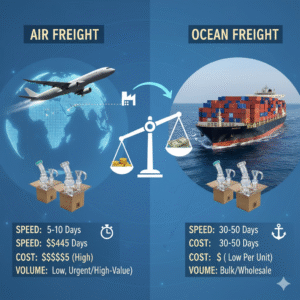
Air Freight vs. Ocean Freight: Choosing Your Best Path
Your first major decision is how to ship your goods.
This choice hinges on three factors: Speed, Cost, and Volume.
There is no single “right” answer; the best choice depends entirely on your current business need.
Your choice will define the cost and speed of your international shipping for glassware.
Most businesses will use a mix.
For example, they might air freight the first 10% of their order to get a new product to market and photograph it, while the remaining 90% comes on the “slow boat” to protect their margins.
Here is a direct comparison to help you decide.
Comparison: Air Freight vs. Ocean Freight for Glassware
| Feature | Air Freight | Ocean Freight |
| Average Transit Time | Very Fast (5-10 days) | Slow (30-50 days, door-to-door) |
| Cost | Extremely High (Often 5-10x ocean freight) | Low (Per unit / cubic meter) |
| Key Benefit | Speed to market & inventory agility | Lowest cost-per-unit & scalability |
| Main Drawback | Prohibitive cost for bulk items | Long lead times require advance planning |
Air Freight: When Speed is Everything
Air freight is your “panic button” and your strategic-launch tool.
It’s fast, secure, and reliable. But that speed comes at a significant premium.
Its pricing is based on “chargeable weight” (a calculation of both size and actual weight), which means it’s wildly expensive for large, dense orders.
Use air freight for:
- Urgent sample shipments for a key client.
- That last-minute restock needed before a major holiday or trade show.
- Your first small batch of a new, high-value glass pipe design to test the market now.
Ocean Freight: The Backbone of Your Bulk Business
This is the workhorse of global trade.
Ocean freight is how you move large quantities of glassware cost-effectively.
You’re booking space in a 20-foot or 40-foot container (either a Full Container Load, FCL, or Less-than-Container Load, LCL).
While slower, the cost-per-unit is dramatically lower, making it the only viable option for most wholesale orders.
This is your go-to for stocking your warehouse, and it requires what most new businesses struggle with: advance planning.
De-Risking Your Timeline: The Ocean Freight Journey Step-by-Step
When your supplier quotes you “30 days” for transit, they are often only referring to the time the ship is on the water.
This is dangerously misleading.
The full journey, from the factory floor to your warehouse door, is much longer.
Understanding each step helps you set realistic expectations and plan your inventory.
Here is a typical door-to-door timeline for importing from China to the US:
A Typical Ocean Freight Timeline
Step 1: Factory to Port (in China)
- (Time: 1-5 Days)
- Your goods are loaded onto a truck and transported from the factory to the port of origin (e.g., Shanghai, Shenzhen, Tianjin).
Step 2: Export Customs & Loading (at Origin Port)
- (Time: 3-7 Days)
- This is a critical “black box” phase. Your container must clear China’s export customs, be processed at the terminal, and be physically loaded onto the correct vessel. Delays are common during peak season or holidays.
Step 3: Ocean Transit (The “On the Water” Part)
- (Time: 15-30 Days)
- This is the leg most people think of. The time varies greatly:
- To US West Coast (e.g., Los Angeles): 15-20 days
- To US East Coast (e.g., New York): 25-30+ days (via Panama Canal)
Step 4: Unloading & US Customs (at Destination Port)
- (Time: 5-10 Days)
- The ship arrives, but your goods aren’t ready. The container must be unloaded, moved to the terminal, and—most importantly—clear US Customs. This is where a random exam or a documentation error can cause a major delay.
Step 5: Port to Your Warehouse (Final Mile)
- (Time: 3-7 Days)
- Once cleared, your container is picked up by a truck (or train) for the final journey to your warehouse.
Total Estimated Timeline: 27 – 59 Days (Average 35-45 Days)
A quick note on this: a 5-day delay at customs, which sounds small, can feel like an eternity when your launch date is looming and your cash is tied up.
Believe me, I’ve seen a simple typo on a form hold a 40-foot container hostage at the port for a week.
Always, always plan a 1-2 week buffer in your timeline.
Decoding Your Quote: The Real Costs of International Shipping for Glassware
An international freight quote can be a full page of acronyms and fees.
It’s confusing, and it’s where many hidden costs live.
When you’re comparing shipping costs from China, make sure you’re comparing “apples to apples.”
Many of these costs are tied to your supplier terms.
Before you agree, make sure you’re [Decoding Supplier Lingo (FOB, EXW…)] so you know what you’re responsible for.
Here are the main charges you need to understand:
- Main Freight Cost: This is the base rate for moving the container from Port A to Port B.
- Fuel Surcharges (BAF/FAF): A variable fee that carriers add to cover fluctuating fuel prices. This can change weekly.
- Port Fees (THC): Terminal Handling Charges. This is the cost for the port to load and unload your container from the ship.
- Customs Brokerage Fees: The fee you pay a licensed expert (a customs broker) to file your paperwork and ensure you’re compliant. This is not optional; it’s a necessary cost of doing business.
- Duties and Taxes: This is the big one. This is not shipping cost; it’s the tax you pay the US government to import your product. It’s calculated as a percentage of your goods’ value. This fee will not be on your freight quote and must be paid separately.
The Art of Customs: Avoiding the “Stuck at the Border” Nightmare
Customs clearance represents the single biggest risk of delay and unexpected costs ininternational shipping for glassware.
Your cargo doesn’t move until US Customs and Border Protection (CBP) gives it the green light.
The cornerstone of successful customs clearance?
Getting your HS (Harmonized System) code right.
This single 6- to 10-digit code tells customs exactly what your product is (e.g., “Glass pipes”) and determines your duty rate.
Using the wrong one, even by accident, is the fastest way to get a fine, an exam, or a delay that lasts for weeks.
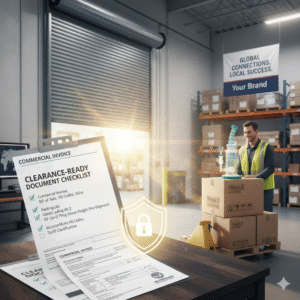
To ensure smooth customs clearance for glass pipes, you need a “Clearance-Ready” document set. Any inconsistency is a red flag.
Proper documentation is key, but so is how your items are packed. Poor packing can also lead to delays or damage, a topic we cover in our [Packaging for Profit] guide.
Your “Clearance-Ready” Document Checklist:
- Commercial Invoice: The bill of sale from the factory. It must list the buyer, seller, product descriptions, HS codes, quantities, and value.
- Packing List: Details the contents, weight, and dimensions of each carton. This must match the commercial invoice.
- Bill of Lading (B/L) or Air Waybill (AWB): This is the contract with the shipping carrier. It’s the “ticket” for your goods.
- ISF (10+2) Filing: For US-bound ocean freight only. This is a security filing that must be submitted by your customs broker before the ship even leaves China. A late filing results in an automatic $5,000 penalty.
For more information, the official U.S. Customs and Border Protection (CBP) website is a valuable, if dense, resource.
The Bridge: How a Good Partner Simplifies Everything
You don’t have to become a logistics expert overnight.
The complexity of this process is precisely why experienced partners are so valuable.
An experienced glassware manufacturer, like Elfglass, acts as your logistics quarterback.
We have long-standing relationships with reliable freight forwarders and customs specialists.
We’ve shipped thousands of orders and know the process inside and out for international shipping for glassware.
Instead of you trying to find a broker, a freight forwarder, and a trucking company, we handle it.
- We provide all the correct, accurate documentation.
- We ensure your products are classified with the correct HS codes.
- We work with our partners to get you a single, transparent, all-inclusive quote.
- We manage the process so you can focus on building your brand, not on tracking a container.
Our role is to make this complex process simple and seamless for you.
Conclusion: From Anxious to Empowered
International shipping for glassware is no longer a scary, unknown “black box.”
You now have a clear map of the journey, from the factory gate in China to your warehouse door.
You have a realistic timeline.
You understand the mysterious costs on your quote.
Most importantly, you have a checklist of the documents that determine whether your shipment clears customs smoothly or gets stuck.
Armed with this knowledge, you can plan your inventory, budget accurately, and set product launch dates with confidence.
You can make informed decisions—like choosing ocean freight for your bulk order and saving air freight for a true emergency—that support your business goals.
Frequently Asked Questions (FAQ)
Q: What documents are needed for customs clearance in the US?
A: For ocean freight, you’ll primarily need the Bill of Lading (B/L), Commercial Invoice, and Packing List.
Additionally, your customs broker must file an ISF (Importer Security Filing) 10+2 before the goods leave the origin port in China.
Having accurate HS codes for your products on all documents is crucial to avoid delays and penalties.
Q: Should I buy shipping insurance?
A: We strongly recommend it.
International shipping involves many variables and risks, such as damage, loss, or theft.
For a relatively small cost, cargo insurance protects your investment and provides financial peace of mind.
This is especially important when shipping fragile items like glassware. Your freight forwarder can add this to your shipment for a small fee.
Q: Can Elfglass handle the entire shipping process for me?
A: Yes, we can facilitate the entire process for you.
While we are a manufacturer, we have long-standing partnerships with reliable freight forwarders.
We can provide you with a transparent, all-inclusive quote (including shipping) and manage the complex logistics, from ensuring correct documentation to coordinating final delivery, making the entire process seamless for you.
Take the Next Step
Don’t let logistics be the roadblock to your brand’s success. Work with a partner who understands the entire journey.
Contact us for a quote that includes transparent shipping options.
