
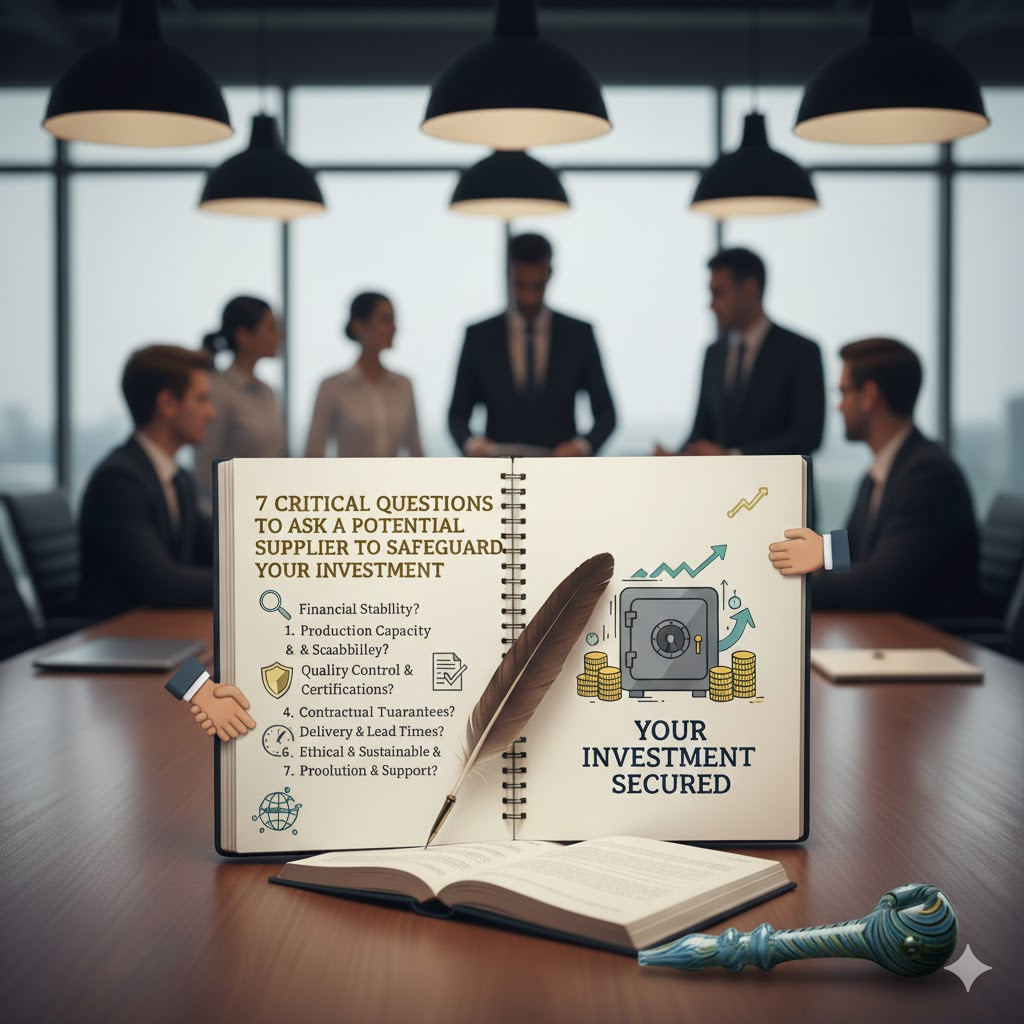
You’re a brand founder or procurement manager, and you’ve reached the final stage: a video call with a short-listed potential supplier.
You’ve covered the basics like pricing and lead times, but then comes that dreaded awkward silence.
You know you should dig deeper, but you don’t know what questions to ask a potential supplier will truly reveal whether this supplier is worth your trust.
The key to a successful partnership lies in mastering the art of the supplier interview.
This guide provides the strategic “interview script”—the 7 critical questions to ask a potential supplier—that will transform you from a passive buyer into an informed evaluator.
Use this vetting suppliers checklist to distinguish between genuine capability and sales theater, and secure your investment.

Beyond Price: The Quality of Your Questions Determines the Quality of Your Partnership
When most buyers open with, “What’s your price?”, suppliers immediately categorize them as a commodity buyer rather than a strategic partner.
This transactional setup results in generic answers, hidden issues, and your project being treated like just another order number.
Professional procurement specialists understand that the quality of your questions directly determines the quality of the information you receive, and more importantly, it signals to suppliers whether you’re worth their best efforts.
When you ask shallow questions, you get shallow partnerships.
The seven questions to ask a potential supplier in this script are designed to flip the dynamic.
They demonstrate that you understand manufacturing complexity and supply chain nuances, compelling suppliers to respond with transparency, detailed explanations, and often their most experienced team members.

Your 7-Point Supplier Evaluation Interview Script: Key Questions to Ask a Potential Supplier
Use this framework to systematically assess your potential partner’s capabilities, reliability, and commitment to transparency.
This script is ideal for anyone looking to understand how to vet a manufacturer effectively.
The Questions That Reveal Capability and Process
| # | Critical Question to Ask | What to Listen For (The Gold Standard) | Red Flags to Watch Out For |
| Q1 | “Can you walk me through your Quality Control process in detail?” | A multi-stage process: Incoming Material Inspection (IQC), In-Process Monitoring (IPQC), and Finished Goods Inspection (FQC), with clear checkpoints at each stage. Bonus points for mentioning statistical tools like SPC (Statistical Process Control). | Generic assurances like “We have good QC.” Inability to describe when inspections occur or who performs them. |
| Q2 | “Who will be the primary contact for this project? Can I communicate with them directly?” | A dedicated, technically competent project manager or engineer who has the authority to discuss technical specifications and timeline adjustments without constantly deferring to others. | Being told you must communicate only through a general sales representative who lacks technical knowledge. |
| Q3 | Questions to ask a potential supplier about Product Complexity: Have you previously produced a product with similar complexity to our design? | Specific, relevant examples (case studies, production images, or a detailed breakdown of how they solved a similar technical challenge). | Vague claims about “extensive capabilities” without offering concrete evidence. Reluctance to show any portfolio. |
The Questions That Test Reliability and Risk Management
| # | Critical Question to Ask | What to Listen For (The Gold Standard) | Red Flags to Watch Out For |
| Q4 | “What is your process for handling production delays or quality issues?” | A documented contingency plan with specific steps: immediate notification, root cause analysis, corrective action plan (CAPA), and clear escalation timelines. They should offer a past example of a challenge they successfully overcame. | Blaming external factors, making vague promises like “we’ll work it out,” or expressing shock that issues could even occur. |
| Q5 | “Questions to Ask a Potential Supplier about Material Sourcing: Where do you source your raw materials from, and can you provide related certificates?” | Full supply chain transparency. Detailed records of their key material suppliers and a willingness to provide Certificates of Compliance (COC) or origin documentation. They should be able to trace a material lot back to its source. | Evasive answers about material sourcing; purchasing through multiple intermediaries without clear documentation. |
| Q6 | “How do you protect a client’s design intellectual property?” | Specific security measures: Signed NDAs, secure file transfer systems, restricted access to design files within the factory, and employee confidentiality training. | Simply saying, “Don’t worry,” or failing to mention any specific security protocols for documents or servers. |
| Q7 | “Could you provide the contact information for one or two existing partner brands for reference?” | While confidentiality often prevents direct contact, strong suppliers will offer alternative verification methods: third-party audit reports, detailed case studies demonstrating a long-term relationship, or verifiable industry certifications. | An absolute refusal with no alternative means of verifying their long-term credibility or client satisfaction. |
Reading Between the Lines: What Tone and Body Language Reveal
The most revealing moment in supplier evaluation isn’t when they provide a perfect answer—it’s how they react when challenged with detailed questions about their operations.
Professional suppliers demonstrate confidence through immediate, detailed responses without hesitation or defensive language.
They view tough questions as opportunities to showcase their pride in their systems.
Believe me, I’ve learned this the hard way on a frozen morning trying to fix a botched shipment; a defensive supplier is a crisis waiting to happen.
Watch for suppliers who pivot conversations back to pricing or timeline discussions when pressed on quality control or IP protection.
This deflection indicates discomfort with operational transparency and suggests they are competing primarily on cost, not capability.
Conversely, suppliers who offer spontaneous examples, suggest a virtual facility tour, or offer additional technical discussions are demonstrating the proactive partnership approach essential for complex manufacturing relationships.
This approach transforms supplier evaluation from a guessing game into a systematic assessment where transparency becomes the currency of trust, and only suppliers confident in their capabilities will remain engaged in the conversation.
From Passive Buyer to Strategic Partner
These seven questions fundamentally transform your position from someone hoping suppliers will treat you well to someone who commands respect through informed inquiry.
When you demonstrate sophisticated understanding of manufacturing processes, quality systems, and supply chain management, suppliers recognize they’re dealing with a serious buyer who won’t accept superficial answers or empty promises.
This shift in dynamic attracts higher-quality suppliers while filtering out opportunistic vendors.
Professional suppliers actually prefer working with buyers who ask tough questions because it creates clear expectations, reduces miscommunication, and demonstrates a shared commitment to project success.
By mastering these strategic questions, you’re not just evaluating suppliers; you’re positioning yourself as the type of client that top-tier manufacturers prioritize when capacity is constrained.

Next Steps: A Quick Guide to Vetting Flow
| Step | Action | Outcome |
| 1. Preliminary Research | Review their website, check for Forbes article on due diligence, and check their trade show history. | Shortlist 3-5 potential partners. |
| 2. Ask the 7 Questions | Use this script in a video conference. Observe their manner as much as their answer. | Identify true partners and eliminate risky vendors. |
| 3. Request a Sample | Order a paid sample that reflects the complexity of your actual product. | Verify their stated quality standards in a tangible product. |
| 4. Place Initial Order | Start with a smaller pilot order to test their production-level performance, communication, and delivery speed. | Full-scale verification of the partnership. |
Frequently Asked Questions (FAQ)
Q: Should I ask these questions via email or video conference?
A: A video conference is highly recommended.
While email is useful for initial logistics, a video call allows you to assess their confidence, transparency, and non-verbal cues.
For complex topics like Quality Control, a live discussion will be much more revealing than written text. This is a crucial step for interviewing a factory.
Q: What kind of responses would be considered a “bad answer” to these questions?
A: Bad answers are those that are vague, defensive, or completely lack detail.
For example, responding to a QC question with only “We have good QC” instead of detailing a multi-stage process, or avoiding the IP protection question with a simple “Don’t worry,” are major red flags.
Push for specific, actionable processes.
Q: Is it necessary for me to visit the factory in person?
A: It depends on the size of your order and the complexity of the product.
While not always necessary for the first order, a physical audit is invaluable for large-scale or long-term partnerships.
For initial vetting, requesting a comprehensive video tour or a third-party audit report can be a good substitute.
ACTION CALL: Ready to ask the tough questions? We’re ready to answer them. Schedule a call with an Elfglass expert and experience a truly transparent partnership.
