
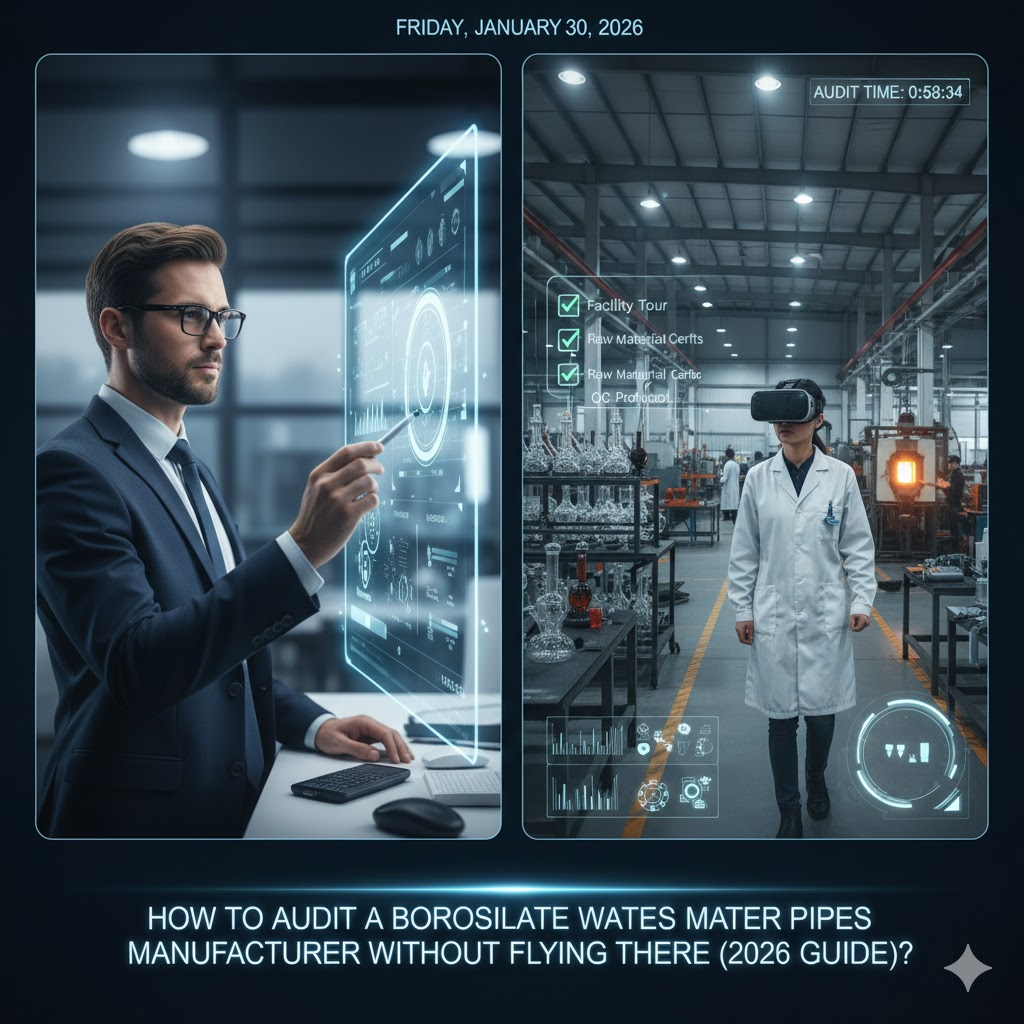
A strictly visual Remote Audit creates a dangerous blind spot: a high-definition webcam cannot detect internal stress in heavy-wall borosilicate.
Failing to verify physical annealing standards invites fatal thermal shock breakage once inventory reaches distribution, destroying margins and dealer trust instantly.
In the 2026 sourcing landscape, finding a reliable borosilicate water pipes manufacturer requires more than a Zoom call; it requires a forensic understanding of regional capabilities and material science.
We replace digital assumptions with structural mandates. This guide enforces ASTM C336 annealing cycles and Dewar Seal integrity checks unseen by the camera lens.
We benchmark production against AQL 2.5 quality control and verified ±0.2mm wall thickness tolerances, ensuring your “Heavy Duty” glass isn’t actually a ticking time bomb.
Phase 1: Identifying the Manufacturing Hub (Hebei vs. Shenzhen)
Before you audit a specific factory, you must audit the region.
China’s glass industry is specialized by geography. Understanding the difference between Hebei (The Volume Engine) and Shenzhen (The Design Hub) is the first step in aligning your supplier with your business model.
Hebei: The Global Volume King Hebei is not just a location; it is the primary ecosystem for the water pipe industry’s “Golden 4” inventory pillars.
The region hosts the world’s highest density of skilled lampworking artisans specialized in mass-producing Borosilicate 3.3.
-
The “Toyota Camry” Strategy: This concentration allows us to mass-produce the Classic Beaker and Straight Tube at a cost basis that supports healthy wholesale margins.
-
Supply Chain Integration: We integrate raw material production directly with processing, eliminating logistics bloat. This efficiency enables us to scale “Standard Models” (50 pcs MOQ) rapidly while maintaining strict material exclusion policies.
-
Capacity Specs: Elfglass operates 8 dedicated lines in this region with an annual capacity of 1.5 million units. This volume guarantees consistency for large distributors.
Shenzhen: The Innovation & Design Hub Shenzhen functions as a global engine for hardware innovation.
If Hebei is the muscle, Shenzhen is the brain. This hub bridges the gap between Western aesthetics and Eastern production speed.
-
Closing the “Lost in Translation” Gap: Most Western designers run into a wall when working with commodity factories. Shenzhen-based teams, like our 12-person R&D unit, define themselves as technical partners. We interpret the “soul” of the design—how it hits, how it clears—before tooling begins.
-
24-Hour Sketch-to-Model: Speed is the currency here. We utilize rapid prototyping to convert napkin sketches into technical 3D models within 24 hours. This proves whether “unrealistic” ideas can exist in physical glass without committing to expensive molding costs.
Strategic Audit Point: If a supplier claims to be a “high-end design boutique” but offers dirt-cheap prices on standard beakers, they are likely a trader outsourcing to a budget Hebei workshop. Real manufacturers have a clear regional identity.
Phase 2: The “Hybrid” Risk (The Blind Spots of Digital Verification)
Research indicates that hybrid verification models delegate up to 70% of assessments to digital channels.
This creates a critical blind spot for glass manufacturing.
The “Spot Weld” Trap A high-resolution camera cannot feel the difference between a cheap “Spot Weld” and a structural “Dewar Seal” (Double Wall Weld).
On a video feed, a brittle joint looks identical to a reinforced one.
-
The Risk: Spot welds are single points of contact that snap under minor pressure (like inserting a banger).
-
The Audit: You must physically inspect the “Elephant Joints” (Bistable Joints) to confirm the 50% extra glass reinforcement actually exists.
The Invisible Killer: Internal Stress Internal glass stress is the invisible killer of heavy wall tubing. It leads to fatal thermal shock once the product reaches the end-user, yet it displays no visual symptoms on a webcam.
-
The Standard: We mandate strict adherence to ASTM C336 annealing standards.
-
The Verification: We physically audit kiln temperature curves to ensure 9mm “Tank” series tubes undergo full 8-12 hour annealing cycles—twice as long as standard glass.
Phase 3: The Remote Audit Checklist (Technical Interrogation)
To truly audit a borosilicate water pipes manufacturer remotely, you need to ask questions that traders cannot answer.
1. Wall Thickness Verification (The “Heft” Test) We hold a strict Wall Thickness Tolerance of ±0.2mm. A 9mm “Heavy Duty” Beaker uses nearly double the raw material of a standard 5mm tube.
-
The Check: Ask the supplier to weigh a standard 12-inch beaker live on video.
-
The Benchmark: A real 9mm beaker should weigh significantly more than a 5mm one. If the weight is light, they are selling you standard glass at a premium price.
2. Material Purity (Soft Glass Exclusion) Hebei’s volume focus can sometimes lead to material substitution. Some factories mix in “Soft Glass” (Soda-Lime) to cut costs.
-
The Check: Ask for a “Boiling Water Test” video. Real Borosilicate 3.3 can withstand boiling water poured directly into a room-temperature tube. Soft glass will shatter.
3. QC Protocols (AQL 2.5) Mass production runs must operate under AQL 2.5 Level II protocols.
-
The Check: Ask to see their “Defect Segregation” area (The Red Bin). A real factory floor generates scrap. If you don’t see a bin full of broken glass, they are likely hiding defects or packing them into your order.
Turn Sketches Into Best-Sellers Without Compromise
Transform your drawings into market-ready products with 24-hour modeling and rapid 15-day lead times.
We safeguard your inventory using certified Borosilicate 3.3 glass and military-grade IP protection.
Turn Sketches Into Best-Sellers Without Compromise

Final Thoughts on Manufacturer Audits
Reliance on standard video audits often masks the fatal difference between a cosmetic replica and a structural asset.
Partnering with a borosilicate water pipes manufacturer who mandates ASTM C336 annealing and verifies “Dewar Seal” integrity protects your reputation from spontaneous inventory failure.
Your long-term growth depends on delivering “Tank” durability to your dealers, not just securing the lowest FOB price.
Eliminate the guesswork by weighing the evidence yourself.
We recommend ordering a targeted sample kit to physically verify the 9mm wall thickness and joint stability before committing to a container.
Frequently Asked Questions
How do you prevent joint breakage, the #1 issue with imported glass?
We strictly prohibit weak “Spot Welds.” Instead, we utilize Dewar Seals (Double Wall Welds) or reinforced “Bistable Joints.” These methods add 50% more glass mass to the critical stress point where the joint meets the beaker body.
What is the actual lead time for production?
Plan for 30-45 days.
While some factories rush this, we refuse to shortcut the annealing process.
We adhere to ASTM C336 standards to eliminate internal stress.
This is critical for our thicker glass, such as the 9mm “Tank” series. Rushing annealing creates “ticking time bombs.”
What is your breakage policy?
We protect shipments using Elf-Guard Packaging, which mandates individual Air Column Bags for every water pipe.
If breakage still occurs, send us a photo validation within 3 days of delivery for an immediate credit or replacement.
How do I verify the wall thickness claims?
We hold a strict Wall Thickness Tolerance of ±0.2mm.
We encourage you to weigh the products or use calipers immediately upon receipt.
“Heft” is a primary selling point for the 9mm series, so we ensure the glass is actually there.
Can I custom brand these glass pipes?
Yes. We execute branding via High-Temp Baked Decals (fired at 580°C for permanence), sandblasting, or Electroplating.
Custom logo orders require a Minimum Order Quantity (MOQ) of 100 pieces.
