
The biggest mistake new smoke shop owners make when buying glass pipes in bulk is chasing the lowest per-unit price. A $3.50 spoon pipe that arrives with a 12% breakage rate costs more than a $4.20 pipe with a 2% breakage rate — once you factor in refunds, replacement shipping, and the customer who never returns.
Bulk purchasing is not just about quantity discounts. It is about understanding which SKUs move fast enough to justify the capital tie-up, how to structure orders so your best-sellers never go out of stock, and when to say no to a tempting MOQ deal that would bury you in slow-moving inventory.
Understanding Bulk Pricing Tiers
Most Chinese glass pipe factories publish tiered pricing based on order volume. Here is a typical structure for standard borosilicate hand pipes:
| Quantity | Unit Price | Discount vs base |
|---|---|---|
| 50–99 pcs | $4.80 | Base |
| 100–299 pcs | $4.20 | 12.5% |
| 300–499 pcs | $3.80 | 20.8% |
| 500+ pcs | $3.50 | 27.1% |
The jump from 50 to 100 units saves you $60 on a single SKU. But the jump from 300 to 500 units requires committing to 200 additional pieces — and if those extra 200 sit on your shelf for six months, the effective cost per unit rises sharply.
The Breakage Rate Reality
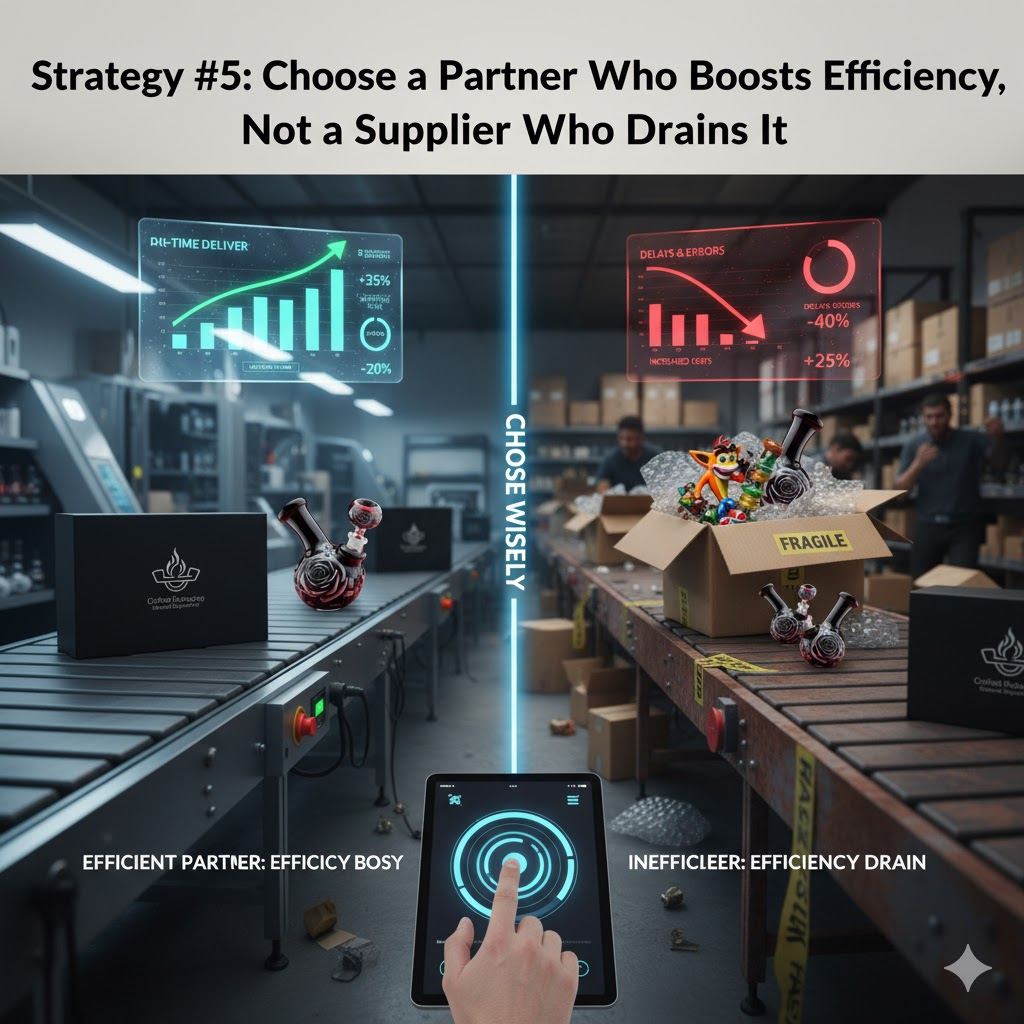
Glass pipes are fragile. Even with proper packaging, some percentage will arrive cracked or chipped. The industry average breakage rate for sea-freight shipments is 3–5%. Air freight drops this to 1–2%, but at triple the shipping cost.
Here is the math most buyers skip:
- Supplier A: $3.50/unit, 12% breakage → effective cost = $3.50 / 0.88 = $3.98 per sellable unit
- Supplier B: $4.20/unit, 2% breakage → effective cost = $4.20 / 0.98 = $4.29 per sellable unit
Supplier A appears cheaper on paper. But the 12% breakage rate means you must also process 12 refund requests, ship 12 replacements (often at your own cost), and deal with 12 disappointed customers. The administrative cost alone can exceed the $0.31 per-unit savings.
Quick answer: When comparing bulk quotes, calculate the effective cost per sellable unit: divide the quoted price by (1 − breakage rate). Then add estimated refund processing costs ($5–$10 per incident) to get the true landed cost.
Which SKUs to Buy in Bulk
Not every glass pipe deserves a bulk order. Use this framework to decide:
Always bulk-buy: Classic shapes (spoon pipes, straight tubes, beaker bongs) in clear borosilicate. These are your bread-and-butter SKUs with consistent year-round demand. Order 200–500 units at a time.
Bulk-buy selectively: Popular colors (blue, green, purple fumed) in proven shapes. Order 100–200 units, but only after you have sold through at least 50 units of that color-shape combination.
Never bulk-buy: Novelty shapes, seasonal designs, or untested colors. Order 25–50 units as a test. If they sell through in 30 days, then consider a larger reorder.
The 80/20 rule applies: roughly 20% of your SKUs will generate 80% of your revenue. Identify those 20% early and keep them deeply stocked. Everything else should be ordered conservatively.
Bulk Pricing That Rewards Volume
Elfglass offers tiered bulk pricing on proven borosilicate shapes, with COE 3.3 certified glass and pre-shipment inspection on every container. Send us your target SKUs and quantities for a bulk quote.
MOQ from 100 pieces | BSCI / WRAP / ISO 9001 | NDA before every project
Negotiating Better Bulk Terms
Once you know which SKUs to buy in volume, you can negotiate from a position of strength. Here are three tactics that work:
1. Bundle multiple SKUs into one container. Instead of ordering 500 spoons from Factory A and 300 beakers from Factory B, consolidate both orders with a single factory that produces both shapes. You save on freight, simplify customs paperwork, and gain leverage for a volume discount.
2. Commit to a quarterly blanket order. Tell the supplier: “I will order 1,000 units per quarter across five SKUs.” This gives them production predictability, which they reward with better pricing. Most factories will drop prices by 5–8% for blanket commitments.
3. Ask for free samples of new designs. When you place a 500-unit order, request 5–10 free samples of the supplier’s newest shapes. This costs the factory almost nothing (marginal material cost) but gives you fresh inventory to test without additional capital outlay.
Need Help Planning Your First Bulk Order?
Elfglass offers curated bulk packages for new retailers — 100 units across 5 proven SKUs with mixed shapes and colors. Request a quote to see our current bulk pricing.
Five Mistakes That Kill Bulk Profitability
We have seen buyers lose thousands on bulk orders that looked great on paper. Here are the traps to avoid:
1. Buying too many SKUs at once. Ordering 50 units each of 20 different shapes ties up $10,000 in inventory that may take 12 months to sell through. Better to order 200 units of 5 proven shapes.
2. Ignoring joint sizes. Glass pipes come in 10mm, 14mm, and 18mm joint sizes. If you order 500 bowls but your water pipes use 14mm joints and the bowls are 18mm, you have 500 unusable pieces. Always confirm joint compatibility before placing bulk orders.
3. Forgetting about replacement parts. Bowls break. Downstems crack. If you sell 500 water pipes but only stock 50 replacement bowls, you will run out within weeks. Order replacement parts at 10–15% of your main product quantity.
4. Not checking COE consistency. Borosilicate glass comes in COE 3.3 (high-quality, thermal-shock resistant) and lower grades. Mixing COEs in the same batch can cause stress fractures during normal use. Ask your supplier to certify COE 3.3 for all bulk orders. Learn more in our borosilicate verification guide.
5. Skipping pre-shipment inspection. Never release the 70% balance payment without a pre-shipment inspection. Hire a third-party inspector or request detailed photos of random samples from the production batch. Catching defects before shipment saves you the cost of return freight — which often exceeds the product value.
| Mistake | Cost impact | Prevention |
|---|---|---|
| Too many SKUs | Capital tied up 6–12 months | Focus on top 5–10 proven shapes |
| Wrong joint sizes | 100% loss on incompatible pieces | Measure existing inventory first |
| No replacement parts | Lost repeat sales, unhappy customers | Order bowls/downstems at 10–15% ratio |
| Mixed COE glass | Stress fractures, returns, reputation damage | Require COE 3.3 certification |
| No pre-shipment inspection | Defects discovered after payment released | Hire third-party inspector or request photos |
Bulk Order Cadence: A Reordering Calendar by SKU Type
Knowing which SKUs to buy in bulk is half the job; knowing when to reorder each one is the other half. The cadence below ties order quantity to a reorder trigger, so your best-sellers never stock out and your test items never become dead stock. Every quantity restates the framework above — the addition is the timing discipline.
| SKU Class | Order Quantity | Reorder Trigger | Why |
|---|---|---|---|
| Bread-and-butter classics (spoon, straight tube, beaker, clear boro) | 200–500 units | When on-hand drops to roughly 4–6 weeks of sell-through | Consistent year-round demand justifies the capital tie-up |
| Popular colors in proven shapes (blue, green, purple fumed) | 100–200 units | Only after 50+ units of that color-shape have sold through | Proven demand, but narrower than the classics |
| Novelty, seasonal, or untested colors | 25–50 units (test) | 30-day sell-through gate before any larger reorder | Tests demand without burying you in slow movers |
| Replacement parts (bowls, downstems) | 10–15% of main-piece quantity | Reorder alongside the mains; never let them run out | They break often and drive the repeat visit |
| Blanket-commitment SKUs | ~1,000 units/quarter across ~5 SKUs | Scheduled, not reactive | Production predictability earns a 5–8% discount |
Cash Flow and Capital Tie-Up: Sizing a Bulk Order You Can Absorb
The discount is real, but so is the capital it locks up. A 27.1% saving at the 500+ tier only pays if those units turn — 200 extra pieces sitting on a shelf for six months raise the effective cost per unit and starve the SKUs that actually move. Size the order against your cash cycle, not against the price break.
- Commit against sell-through velocity, not against the discount. The bigger tier is only cheaper if the extra units sell within the season; otherwise the tie-up cost exceeds the per-unit saving.
- Match the order to your payment cycle. The 30% deposit leaves up front and the 70% balance is due against shipping documents — make sure the first units can sell before that balance clears.
- Use the 80/20 to free cash. Roughly 20% of SKUs drive ~80% of revenue. Keep those deep and deliberately under-fund the C-list rather than spreading capital thin across 20 shapes.
- Watch the dead-stock trap. 50 units each of 20 shapes can tie up capital for 6–12 months; 200 units of 5 proven shapes turns. Depth in winners beats breadth in also-rans.
- Trade cash predictability for the blanket discount deliberately. A quarterly commitment earns 5–8%, but only commit what you can realistically sell through inside the quarter.
- Count the carrying cost the unit price hides. Storage space, insurance, handling, and shrinkage on a large bulk order are real costs that the per-unit discount does not show on the quote.
Frequently Asked Questions
What is the minimum order quantity for bulk glass pipes?
Most Chinese factories set MOQs between 50 and 100 units per SKU for standard shapes. Some suppliers offer mixed-SKU packages starting at 100 total units (e.g., 20 units each of 5 different shapes). For custom designs or private-label orders, MOQs typically start at 300–500 units.
How much should I expect to pay per unit for bulk glass pipes?
Standard borosilicate hand pipes range from $3.50 to $6.00 per unit depending on complexity and order volume. Simple spoon pipes at 500+ units cost $3.50–$4.00 each. Intricate percolator bongs at 100-unit quantities cost $12–$25 each. Custom designs with logo etching add $1–$3 per unit.
What breakage rate is acceptable for bulk glass pipe orders?
An industry-standard breakage rate is 3–5% for sea freight and 1–2% for air freight. Anything above 8% indicates poor packaging or low-quality glass. Reputable suppliers will replace broken pieces or credit your next order if the breakage rate exceeds their stated guarantee.
Should I buy from one factory or multiple suppliers?
For your first 6–12 months, stick with one reliable factory to simplify quality control, communication, and shipping. Once you reach $50,000+ annual volume, diversify across two factories to reduce supply chain risk. Never put all your inventory with a single supplier.
How do I verify glass quality before placing a bulk order?
Order samples first. Test them for thermal shock resistance (heat with a torch, then cool rapidly), check for bubbles or imperfections in the glass, and verify the weight feels substantial. Request COE 3.3 certification from the supplier. For large orders, hire a third-party inspection service like SGS or Bureau Veritas to audit a random sample from the production batch.
Ready to Start Your Custom Glass Pipe Project?
Get a free quote within 24 hours. MOQ from 100 pieces. NDA-protected design consultation.
About the Author

Ava Zeng is the founder of Elfglass and has spent 16 years managing B2B glass pipe sourcing, production oversight, and international trade compliance. She has processed over 800 wholesale orders and works directly with factories in Hebei and Guangdong to ensure payment terms, quality standards, and shipping timelines meet the needs of retail buyers across North America, Europe, and Oceania.
Ready to Place Your First Bulk Order?
Elfglass offers curated 100-unit starter packs across 5 proven SKUs. Request a quote today and compare our bulk pricing.
