
Every spec sheet from a serious glass factory carries a number most buyers scroll straight past: COE 3.3. It looks like a model code or an internal batch reference. It is neither. It is the single most consequential durability figure in glass, and it quietly separates a pipe that survives a hot rinse, a cold counter and years of use from one that cracks the first winter it meets a kettle.
COE is the coefficient of thermal expansion, and the 3.3 is not a grade or a quality tier — it is a measured physical property, roughly 3.3 millionths of a metre of movement per metre of glass per degree. Everything a buyer actually cares about in glass durability traces back to that one number: whether the piece survives thermal shock, whether two parts can be welded together at all, and how cleanly it anneals. Understanding it turns material selection from trusting a supplier’s adjective into reading a specification.
This guide explains what COE measures, where 3.3 comes from, how borosilicate compares with soda-lime glass in hard numbers, why mismatched COE ruins a joint, and how to specify glass so you get what you pay for. For how the material pairs with the forming process, our hand-blown versus machine-made guide covers the other half of the decision.
To specify COE 3.3 glass, ask for borosilicate glass 3.3 — a glass whose mean linear coefficient of thermal expansion is about 3.3 × 10⁻⁶ per kelvin, called “33 COE” in glassblowing shorthand. It expands roughly a third as much as soda-lime glass (about 9.0 × 10⁻⁶/K), so it resists thermal shock and is the standard for lab glassware and quality pipes. Require every component to be the same COE, because glasses of different COE cannot be welded without cracking.
Key Takeaways
- COE is the coefficient of thermal expansion; “3.3” is a measured property, not a quality grade.
- Borosilicate 3.3 expands about 3.3 × 10⁻⁶/K; soda-lime about 9.0 × 10⁻⁶/K — roughly three times more.
- Lower COE means better thermal-shock resistance, so the glass survives hot-to-cold without cracking.
- Glassblowing shorthand multiplies by 10⁷, so boro 3.3 is “33 COE” and soft glass is “104 COE.”
- Glasses of different COE cannot be fused — mismatched expansion cracks the joint.
- Specify “borosilicate glass 3.3 (ISO 3585)” and require single-COE construction.
Table of Contents
What COE Actually Measures
COE is the coefficient of thermal expansion, and it measures one thing: how much a material grows when it heats and shrinks when it cools. Every solid does this, and glass is no exception. Because a pipe is heated at one end while the rest stays cool, the amount the glass moves per degree decides how much internal stress that temperature difference creates. As the physics of thermal expansion describes it, the linear coefficient is the fractional change in length per degree of temperature change.
It is written in units of per kelvin (or per degree Celsius — the increment is identical), and for glass the numbers are small enough that they are conventionally expressed in millionths. A COE of 3.3 × 10⁻⁶/K means a one-metre rod of that glass lengthens by 3.3 micrometres for every degree it warms. Tiny per degree — but across a 200-degree swing through a thick glass wall, those micrometres add up into real, uneven, crack-opening forces. That is the entire story of glass durability told in one number.
Where the Number 3.3 Comes From
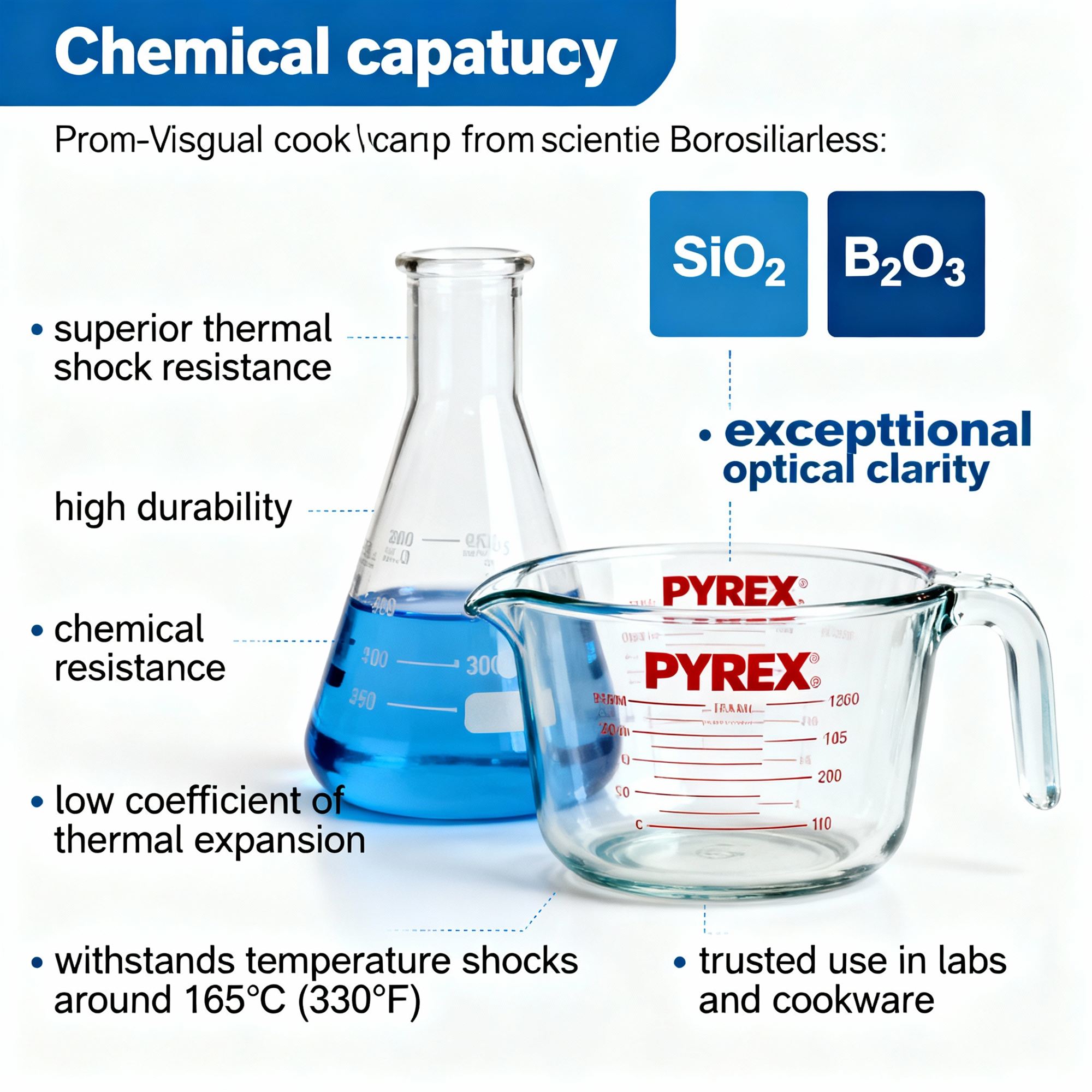
The 3.3 is not a marketing tier; it is the measured linear COE of a specific family of glass: borosilicate 3.3, the low-expansion borosilicate made famous by laboratory glassware and heat-proof cookware. Its mean coefficient of linear thermal expansion, measured roughly between 20 and 300 degrees C, is about 3.3 × 10⁻⁶/K — which is exactly how it got its name. Borosilicate glass earns that low figure from its chemistry: a high silica content with boron trioxide added, which reduces how much the network expands as it heats.
In glassblowing shorthand you will see the same glass called 33 COE. That is not a different material — artists multiply the linear coefficient by 10⁷ rather than 10⁻⁶, so 3.3 becomes 33. When a pipe supplier says boro 3.3 and a lampworker says 33 COE, they mean identical glass. The parallel soft-glass number is 104 COE (about 10.4 × 10⁻⁶/K), the soda-lime family used for colorful Italian rod. Keeping the two conventions straight prevents a very common and very expensive specification mix-up.
Borosilicate 3.3 vs Soda-Lime: The Numbers
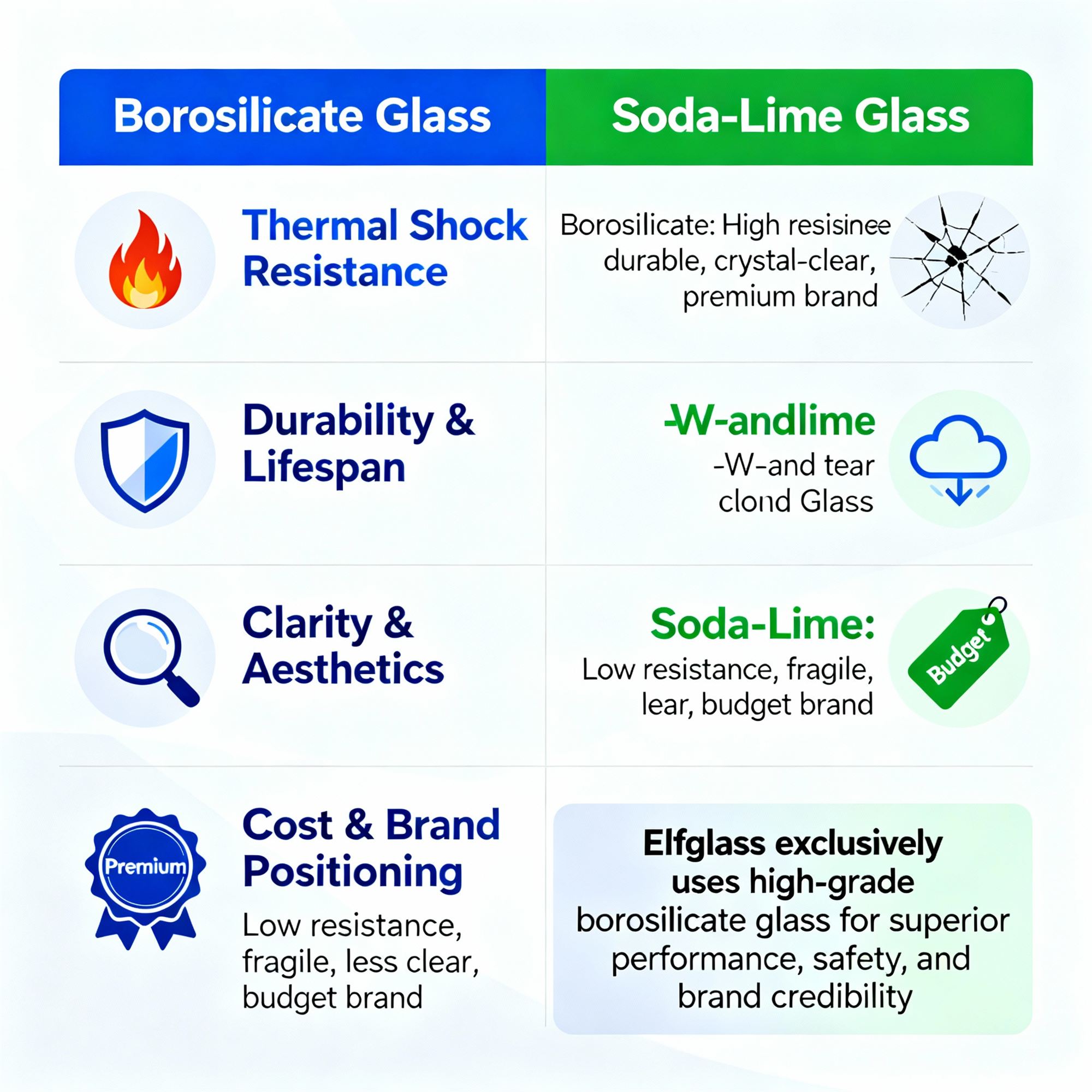
The comparison that matters to a buyer is borosilicate against soda-lime, because those are the two families a pipe is realistically made from. Soda-lime is the ordinary glass of windows, bottles and most inexpensive smoking glass; borosilicate is the durable, heat-resistant glass of labs and quality pipes. Reference tables such as Engineering ToolBox’s linear expansion data put ordinary plate glass at about 9.0 × 10⁻⁶/°C and Pyrex-type borosilicate near 4.0 × 10⁻⁶/°C, with the low-expansion borosilicate 3.3 used for pipe and lab glass sitting at the bottom of that range.
| Property | Borosilicate 3.3 | Soda-Lime Glass |
|---|---|---|
| Linear COE (×10⁻⁶/K) | ~3.3 | ~9.0 |
| Glassblowing COE number | 33 COE | ~90–104 COE |
| Thermal-shock resistance | High — survives rapid hot/cold | Low — cracks on sudden change |
| Chemical durability | High — resists water, acids, leaching | Lower — can haze and leach over time |
| Working temperature | Higher; harder to melt and form | Lower; easier and cheaper to work |
| Typical use | Lab glass, cookware, quality pipes | Windows, bottles, inexpensive pipes |
The headline is the first row: soda-lime glass moves about three times as much per degree as borosilicate 3.3. That ratio is the reason a borosilicate beaker goes from a burner to a wet bench without a sound while a soda-lime jar shatters on the same treatment. On a pipe it is the difference between a piece you can rinse under hot water and set on a cold granite counter, and one you cannot.
Sourcing Borosilicate 3.3 Glass Pipes?
Elfglass builds pipes from low-expansion borosilicate 3.3 — the material rated for thermal shock and daily use, not the cheaper soda-lime that cracks under it. Every design is specified to a single COE so joints anneal clean and stress-free. Send your product list and get a quote within 12 hours.
MOQ from 100 pieces | BSCI / WRAP / ISO 9001 | NDA before every project
Why COE Decides Thermal Shock
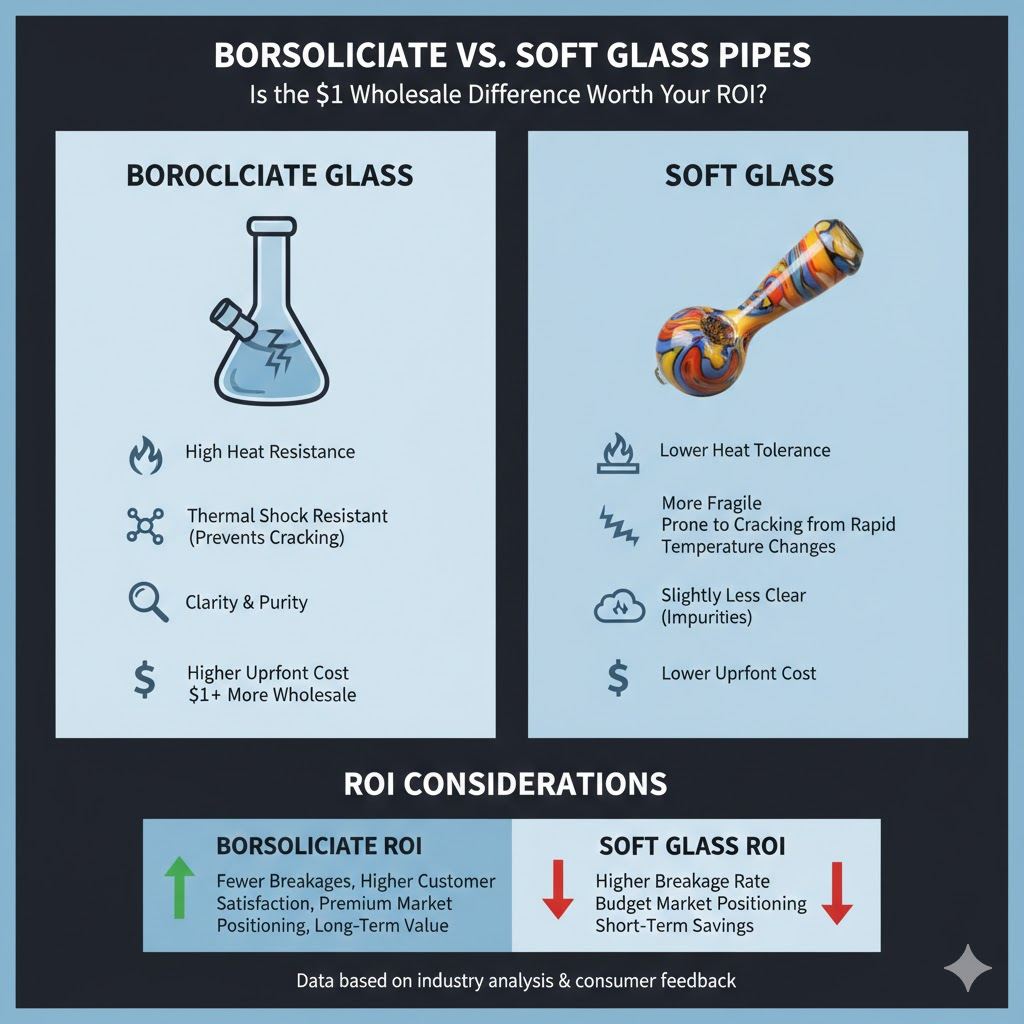
Thermal shock is the failure mode COE controls, and it is what actually breaks glass in ordinary use. When one part of a piece heats or cools faster than another — hot water into a cold bowl, a flame on one joint while the rest stays at room temperature — the hot region wants to expand while the cold region holds it back. That fight is stress. If the stress exceeds the glass’s strength, a crack runs. Thermal shock resistance is therefore not about how strong the glass is at rest; it is about how little it tries to move per degree.
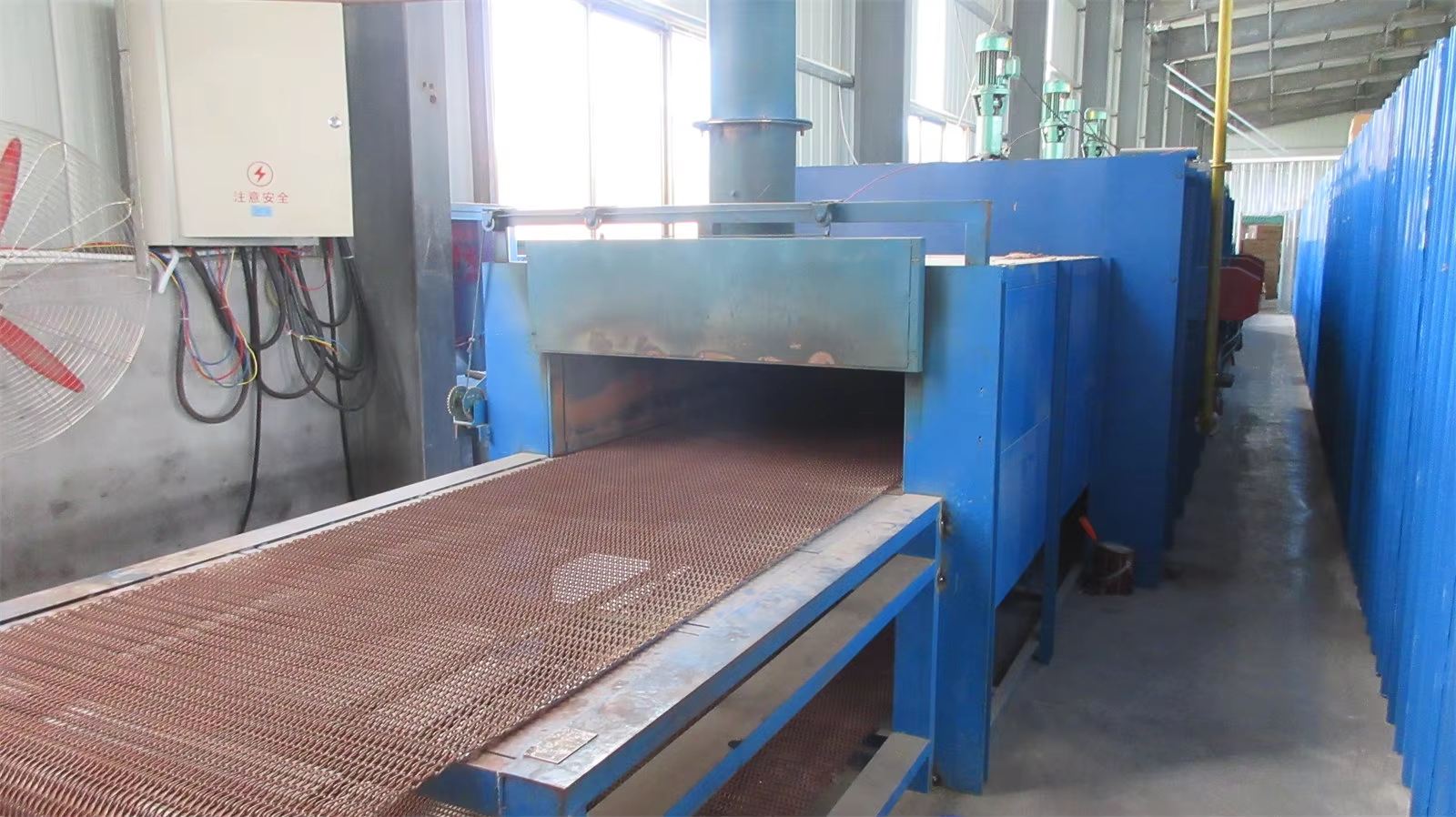
Because the stress from a temperature difference scales with the coefficient of expansion, a glass that expands a third as much generates roughly a third of the stress for the same shock. Borosilicate 3.3 can absorb a temperature differential well over a hundred degrees that would instantly fracture soda-lime. The same principle governs annealing: after forming, a piece is held near its annealing point and cooled slowly so the temperature gradient — and the stress it creates — never crosses the cracking threshold. Low-COE glass is more forgiving here, but it still has to be annealed properly, or it ships with locked-in stress that fails weeks later on a customer’s counter. Our glass pipe drop test standards guide covers the mechanical side of the same durability question.
COE Matching: Why You Can’t Weld 33 to 104
Here is the fact that separates a real glass factory from a reseller relabeling cheap stock: glasses of different COE cannot be permanently joined. A pipe is built by welding parts together in a flame — a joint to a tube, a bowl to a wall, a percolator into a chamber. If those parts share a COE, they expand and contract together and the joint cools stress-free. If one part is 33 COE borosilicate and another is 104 COE soft glass, they move at different rates as the joint cools, and the boundary locks in stress that cracks the piece in the annealer — or, worse, survives it and fails in the customer’s hands a month later.
This is why a legitimate manufacturer builds an entire piece within one COE family, and why boro 3.3 is welded only to boro 3.3. It is also a useful buyer’s test: ask what glass each component is. A piece advertised as borosilicate but assembled with mixed or unspecified colored parts is a red flag, because colored soft glass and clear borosilicate are usually different COE. A supplier who genuinely understands annealing and COE matching answers this instantly; one who does not will change the subject. Our wholesale glass pipe quality control guide shows how to systematize these material checks before you release the balance payment.
How to Specify Glass as a Buyer
Pulled together, material selection is a specification, not a vibe. You do not need to become a glass chemist; you need to name the property and require proof. Ask for borosilicate glass 3.3 — the low-expansion borosilicate whose properties are standardized under ISO 3585 — and require that every component of the piece sits in the same COE family. Ask how the piece is annealed, and ask what glass any color work is made from and whether it is COE-compatible with the body.
| What to Specify | Ask For | Why It Protects You |
|---|---|---|
| Material family | “Borosilicate glass 3.3 (ISO 3585)” | Names the durable glass instead of an adjective |
| COE consistency | All components in one COE family | Prevents stress cracks at mixed-material joints |
| Annealing | Controlled anneal with a slow, even cool | Releases stress so pieces do not fail later |
| Color / compat glass | COE-matched to the body glass | Color work that cracks is a mixed-COE fault |
| Verification | Material documentation or glass supplier named | Proof over promises before you pay the balance |
Specify glass this way and COE 3.3 stops being a number on a spec sheet you scroll past and becomes the durability guarantee you actually bought. A pipe made from real borosilicate 3.3, built to a single COE and annealed properly, is a product that survives hot rinses, cold counters and years of use — and a reputation that survives alongside it.
Ready to source glass specified to a real material standard? Request a quote telling us the piece, and we will confirm the borosilicate 3.3 specification, COE-matched construction and annealing in writing — quote within 12 hours, samples in 1 to 3 days, MOQ from 100 pieces, all under NDA.
What does COE 3.3 mean in glass?
COE stands for coefficient of thermal expansion. The 3.3 means the glass expands by about 3.3 millionths of its length per degree Kelvin, measured roughly between 20 and 300 degrees C. It is the defining property of low-expansion borosilicate glass, which is why the material is called borosilicate 3.3. In glassblowing shorthand the same glass is 33 COE, because artists multiply the figure by ten to the seventh instead of ten to the sixth.
Is COE 3.3 glass better than regular glass for pipes?
For heat and durability, yes. Borosilicate 3.3 expands about a third as much as soda-lime glass, so it resists thermal shock, tolerates hot-to-cold changes, and is more chemically durable. Soda-lime glass is cheaper and easier to work but cracks under sudden temperature change and can haze over time. This is why laboratory glassware, heat-proof cookware and quality pipes use borosilicate.
What is the difference between 33 COE and 104 COE glass?
They are two different glass families. 33 COE is borosilicate 3.3, expanding about 3.3 times ten to the minus six per Kelvin. 104 COE is soda-lime soft glass, expanding about 10.4 times ten to the minus six, and it is the colorful glass used in lampworking and Italian rod. They expand at very different rates and cannot be fused together without the joint cracking from residual stress.
Can you mix different COE glass in one pipe?
No. Joining glasses of different COE creates stress at the join as the piece cools, because the two parts contract at different rates. The piece cracks in the annealer or, if it survives, fails later in use. A reputable manufacturer builds an entire pipe within one COE family, and for pipes that is almost always borosilicate 3.3.
How do I verify a supplier uses real borosilicate 3.3?
Ask for the material specification in writing: borosilicate glass 3.3, ideally referenced to ISO 3585, which standardizes its properties. Ask what glass every component is, including any color work, and confirm it is all one COE family. Ask how the piece is annealed. A supplier who understands COE matching answers instantly; hesitation is a red flag.
Ready to Start Your Custom Glass Pipe Project?
Get a free quote within 24 hours. MOQ from 100 pieces. NDA-protected design consultation.
