
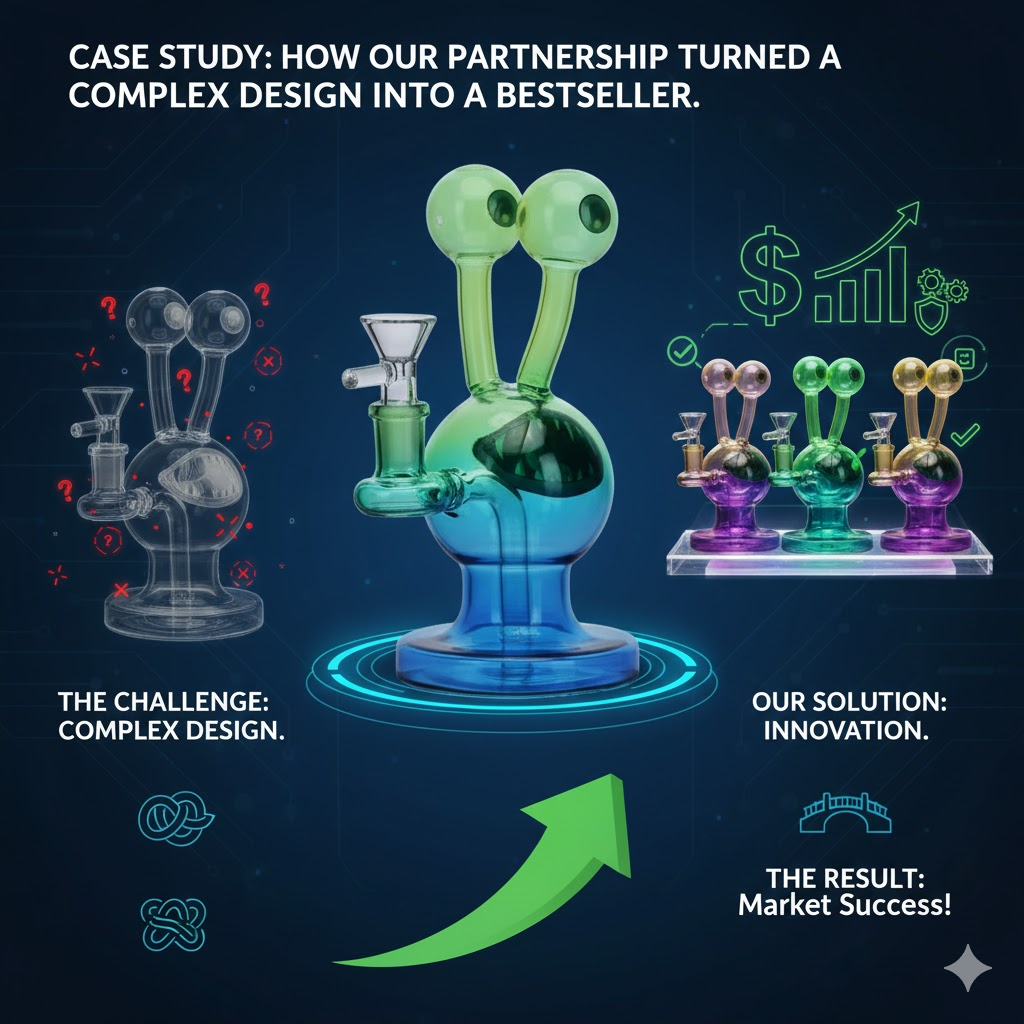
We call him “Smart.”
That’s not his real name—we protect our clients’ identities strictly—but it fits him.
He is a CEO with a sharp eye for market gaps and a design vision that refuses to compromise.
Two years ago, Smart came to us with a problem.
He had a design for a multi-chamber recycler rig that was visually stunning.
It was architectural, aggressive, and elegant.
It was also, according to the three factories he had visited previously, “impossible.”
One factory told him the internal uptake tubes would crack during cooling.
Another produced a sample where the vortex function didn’t spin—it just splashed water into the mouthpiece.
The third quoted him a mold fee so high it was essentially a polite way of saying “Go away.”
Smart was ready to scrap the project.
He was afraid his best idea would never see the light of day.
This is the story of how we didn’t just say “Yes,” but how we used advanced physics, empathy, and grit to turn that complex glass pipe design into the hero product of his catalog.
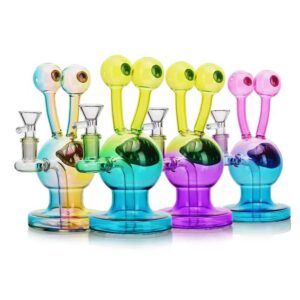
The Challenge: Why Others Said “No”
The design featured a “floating” internal drain system suspended inside a heavy beaker base. Visually, it looked like magic.
Manufacturing-wise, it was a nightmare.
The specific technical hurdles were:
-
Thermal Shock Risk: The connection points between the thick base (9mm) and the delicate internal tubes (4mm) created a massive thermal gradient. During the cooling process, these different thicknesses contract at different rates. Without precise intervention, the internal welds would snap before the piece even left the kiln.
-
Fluid Dynamics Failure: The recycler relied on a precise vacuum balance to create a tornado effect (vortex). If the uptake tubes were even 1mm too wide, the air velocity would drop, and the water would stall instead of spin.
Other factories refused it because it disrupted their standard “blow-and-go” production line.
It required thinking, not just blowing. They wanted easy volume; Smart needed precision engineering.
The Elfglass Approach: Empathy Before Engineering
When Smart sent us the blueprints, we didn’t look at the geometry first.
We practiced our core philosophy: Empathy Before Engineering.
We asked him: “What is the experience you want the smoker to have?”
He told us, “I want them to feel like they are holding a machine, not a vase. And when they inhale, I want the water to move violently, but the hit to feel effortless.”
We understood then that the complexity wasn’t just for show. It was the soul of the product. Rejecting the complexity meant rejecting the brand’s identity.
A Note from the Factory Floor:
“To be honest, when our engineering lead first saw the blueprints for the internal chambers, the room went silent.
We knew this wasn’t just ‘hard’—it was a risk that could break a hundred prototypes before we got one right.
You could feel the hesitation in the air.
But that silence didn’t last long; it was quickly broken by the sound of Ava grabbing a marker and drawing a new mold concept on the whiteboard.
‘We don’t run,’ she said. ‘We figure it out.'”
The Solution: How We Engineered the Breakthrough
We didn’t just guess.
We applied science to solve this complex glass pipe design.
Here is exactly how we solved the “impossible.”
Step 1: The Digital Twin (CFD Simulation)
Before melting a single gram of glass, we created a Digital Twin of the pipe.
Using Computational Fluid Dynamics (CFD) software, we simulated the airflow.
-
The Findings: The simulation showed that the original drain tube angle was too steep, creating turbulence that killed the vortex. (See more on avoiding flaws in 5 Common Design Flaws).
-
The Fix: We adjusted the uptake-to-drain ratio in the 3D model, optimizing the restriction point to increase velocity based on Bernoulli’s principle. We proved the “chug” would work digitally before we made it physically.
Step 2: The Tooling Innovation (Graphite Steam Cushion)
Hand-blowing the internal chambers resulted in slight variations that ruined the function.
We needed machine-level precision.
We milled a custom Wet Graphite Mold.
By keeping the graphite porous and wet, we utilized the Leidenfrost Effect—creating a microscopic cushion of steam between the mold and the hot glass.
-
The Result: The glass was shaped by steam pressure, not the mold itself. This allowed us to hold a 0.01mm tolerance on the internal tubes while keeping the surface fire-polished and pristine.
Step 3: Surgical Annealing
The breakage issue was solved in the kiln.
Standard annealing schedules rush the cooling process to save money.
For this piece, we developed a custom Annealing Schedule:
-
Soak Phase: We held the pieces at exactly $565^\circ C$ ($1050^\circ F$) for 4 hours (double the industry standard) to allow the thick base and thin tubes to reach thermal equilibrium.
-
Strain Point: We cooled slowly to the strain point of $515^\circ C$ to ensure no residual stress was locked into the welds.
-
Verification: Every single unit was checked under a Polariscope. If we saw the “rainbow” of stress lines, it was rejected.
The Result: A Bestseller is Born
Six weeks after our first meeting, we shipped the “Golden Sample” to Smart in California.
This was the culmination of recognizing the Importance of Prototyping.
He filled it with water. He took a pull.
The water spun into a perfect, violent vortex. No splashback. No drag. Just function.
The Market Impact:
-
Launch: The product launched as the flagship of his “Scientific Collection.”
-
Sales: The first batch sold out in 3 weeks.
-
Durability: Despite the complex internal welds, the return rate for breakage was near zero—lower than his standard beaker bongs.
Conclusion: Challenge Us
Complexity is not a barrier; it’s a filter.
It filters out the vendors who just want your money and leaves the partners who want to build your legacy.
If you have a complex glass pipe design that scares other factories, or a sketch you’ve hidden away because you think it’s “too much,” bring it to Elfglass.
We don’t run from challenges; we build them.
Have a design that others say is ‘too hard’ to make?
Let’s turn your complexity into your competitive advantage.
Frequently Asked Questions (FAQ)
Q1: Do you charge extra for engineering complex designs?
A1: We include basic Design for Manufacturing (DFM) support in our partnership.
For highly complex projects requiring specialized graphite molds or extensive R&D, we provide a transparent quote upfront.
We view this as an investment in a long-term bestseller, not just a one-off fee.
Q2: What if my design actually IS impossible to manufacture?
A2: If physics simply won’t allow it, we won’t lie to you.
However, we will never just say “No.”
We will provide “Option B” and “Option C”—modifications that preserve 90% of your aesthetic while ensuring 100% manufacturability and durability.
Q3: How do you protect the IP of a bestseller like this?
A3: We sign a strict NDA before seeing your design.
Furthermore, for unique molds, we establish an exclusive ownership agreement.
Your bestseller remains yours alone; we will never sell your custom design to another client.
(External Resource: For a deeper look into the physics of glass shaping, refer to this article on Complex Geometry in Glass Blowing by the Corning Museum of Glass.)
