
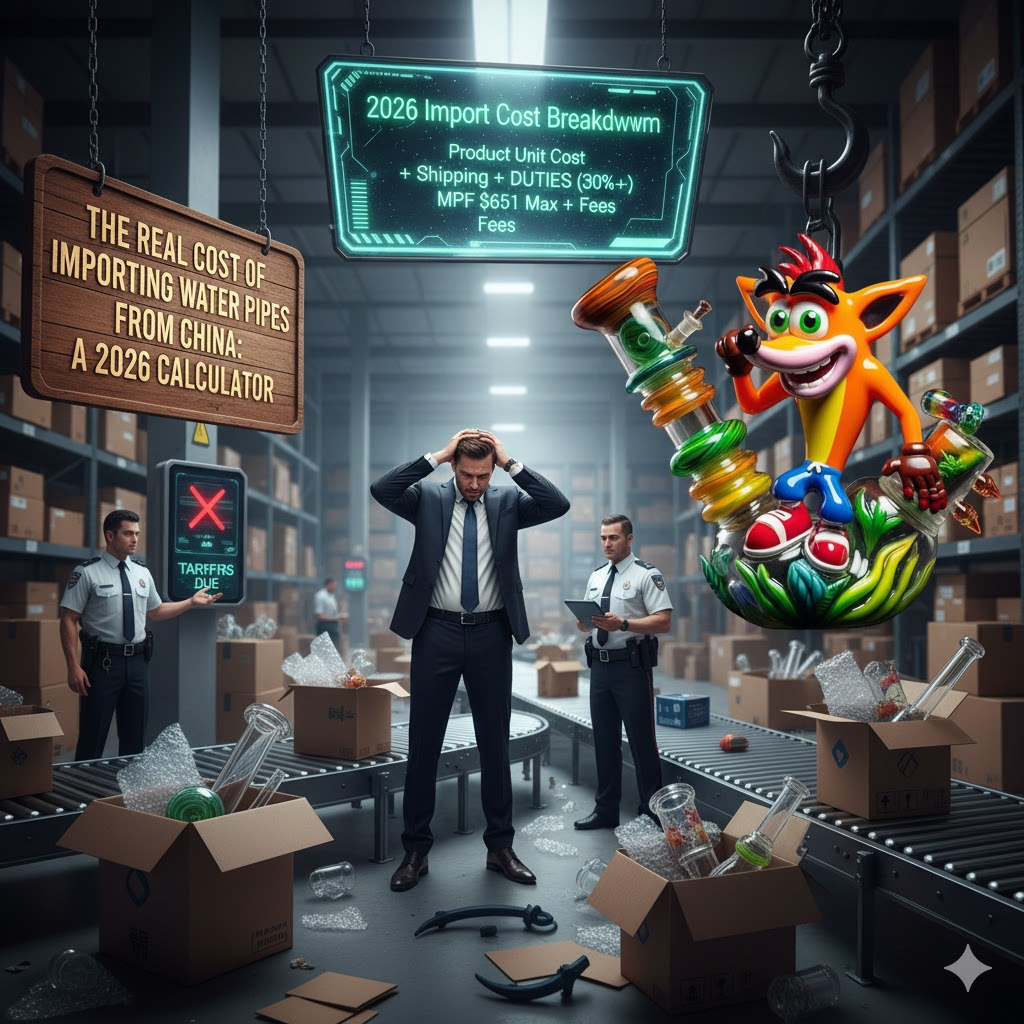
Performing a precise analysis on the cost of importing water pipes from China reveals that logistics often consume more capital than the borosilicate glass itself.
Novice importers frequently fixate on the FOB invoice, ignoring that unoptimized packaging and “dead air” can inflate landed costs by 50%.
A single missed ISF filing deadline triggers a mandatory $5,000 penalty, instantly erasing the margins of a standard beaker container load.
This guide audits the true expense of importing, from the 2.5% duty rate under HS Code 9614.00.00 to strategic CBM optimization.
We demonstrate how nesting accessories inside 9mm thick beakers and utilizing Elf-Guard Packaging transforms volumetric weight liabilities into profitable inventory.
The “Invisible” Costs Checklist (Guideline: Port Fees, ISF Filing, Duty)
Beyond the invoice price, regulatory and terminal fees usually add 20-50% to your landed cost. Missing the 24-hour ISF deadline triggers an automatic $5,000 penalty.
| Fee Category | Estimated Cost | The Insider Note |
|---|---|---|
| ISF (10+2) Filing | $30 – $150 | Must file 24h pre-loading or face $5k fines. |
| Duty (HS 9614.00.00) | 2.5% Base Rate | Specific to smoking pipes. |
| Terminal (THC) | $500 – $1,200 | Arrival port fee. Not included in FOB. |
| Merchandise Processing | Min ~$31 / Max ~$614 | Capped per entry (0.3464% rate). |
Regulatory Compliance (ISF Filing & HS Codes)
The most common error new importers make is treating customs compliance as an afterthought.
The US Customs and Border Protection (CBP) enforces the Importer Security Filing (ISF) strictly.
You must submit this data 24 hours before the cargo is loaded on the vessel in China.
If you miss this window, the penalty is $5,000 per violation, regardless of the shipment value. This makes compliance timing just as critical as your product quality.
- ISF (10+2) Deadline: Mandatory 24 hours prior to vessel loading.
- Standard HS Code: 9614.00.00 (Smoking Pipes) attracts a 2.5% duty rate.
- Alternative HS Code: 7013.99.00 (Glassware) is sometimes used but risks reclassification.
- Customs Bonds: Continuous bonds (~$500/year) are cheaper for volume importers than single entry bonds ($50-$100 each).
Port Handling & Terminal Surcharges
FOB quotes only cover costs up to the export port.
Once the vessel arrives in the US, the importer assumes liability for a series of unbundled operational fees.
These are billed by the terminal operators and the government, not your supplier.
If your customs broker clears the goods slowly, “Demurrage” fees kick in after the free time expires, charging you hundreds of dollars daily for storage.
- Terminal Handling Charges (THC): Fees for moving containers at the US port ($500–$1,200).
- Harbor Maintenance Fee (HMF): 0.125% of the entered cargo value.
- Merchandise Processing Fee (MPF): 0.3464% of value, capped at roughly $614 per entry.
- Demurrage Risk: Storage penalties accrue immediately if clearance exceeds the port’s “free days.”
Sea vs. Air Freight Math: The 500 Beaker Case Study
Shipping water pipes by air usually costs more than the glass itself. Sea freight reduces logistics spend by up to 80%, making it the only viable option for bulk orders.
The Logistics Math: Volume Weight vs. Actual Weight
Novice importers often look at the scale weight of a borosilicate tube and assume shipping will be cheap.
This is a fatal calculation error.
Logistics carriers do not charge based on how heavy a bong is; they charge based on how much space it steals in the cargo hold.
We wrap every Elfglass unit in mandatory Elf-Guard Air Columns inside 5-layer reinforced master cartons.
While this virtually eliminates breakage, it increases the “Dimensional Weight” (Length x Width x Height).
For a standard beaker, the “volumetric cost” via air freight almost always exceeds the manufacturing cost of the item itself.
You end up paying more to move the product than you did to make it, destroying your profit margin before the goods even land.
Case Study: Shipping 500 Standard Beakers
Let’s look at the hard numbers for a standard wholesale order: 500 units of 12-inch, 9mm thick Beaker Bongs.
- The Air Freight Trap: Shipping this volume by air usually costs 3-4x the production value of the glass. You are effectively burning capital on jet fuel. This method is only viable for emergency samples, never for inventory.
- The Sea Freight Solution: Shipping via LCL (Less than Container Load) drops the per-unit shipping cost dramatically, often to under $1-$2 per piece depending on current rates. You trade speed (30-45 days transit) for profitability.
- Elfglass Optimization: We refuse to ship “air.” We mitigate high CBM costs by nesting smaller items—like bowls, downstems, or ash catchers—inside the empty space of the beaker boxes. This maximizes Container Utilization and increases your revenue per cubic meter.
The “Volume Trap” (Guideline: Loose packaging kills margins)
Freight carriers charges by volume, not just weight. Unoptimized packaging forces you to pay for “dead air,” inflating landed costs by up to 30%.
| Variable | Standard “Loose” Pack | Elfglass Optimized Pack |
|---|---|---|
| Packing Material | Bulky Styrofoam Blocks | Elf-Guard™ Air Columns |
| Space Utilization | Low (40% Dead Air) | High (Nested Accessories) |
| Freight Calculation | Volumetric Weight (Expensive) | Near Actual Weight (Efficient) |
The Hidden Mathematics of “Shipping Air”
Freight carriers do not care about the actual weight of glass pipes—they care about how much space you occupy on the vessel.
They charge based on the greater of the actual weight or Volumetric Weight (L x W x H / 5000).
Shipping bulky, light boxes full of traditional styrofoam is financially disastrous for importers.
- The “Loose Pack” Penalty: Standard packing methods create significant “dead zones” between products. Without optimization, up to 40% of your shipping invoice pays strictly for empty space.
- Margin Erosion: For low-density items like water pipes, unoptimized per-unit freight costs often exceed the manufacturing cost if CBM (Cubic Meter) is not aggressively managed.
Strategic CBM Optimization & The “Nesting” Technique
To restore margins, we attack packaging volume with specific internal specifications designed for high-volume wholesalers.
- The Nesting Protocol: We utilize the hollow space inside large beakers to pack smaller accessories (bowls, downstems, ash catchers). This allows you to ship the smaller high-margin items effectively for free.
- Elf-Guard™ Air Columns: We replaced bulky foam with mandatory Air Column Bags. These inflate to the exact shape of the glass, reducing external packaging volume by 25% while offering superior impact protection.
- Master Carton Logic: We use 5-layer corrugated cardboard sized specifically to eliminate internal gaps, ensuring every cubic centimeter pays for itself in product value.
Turn Sketches Into High-Margin Glass Fast

Final Thoughts
Your true profit margin is defined at the port of entry, not just on the factory invoice.
Relying on “loose pack” shipments invites financial disaster through wasted cargo space and strict customs penalties.
Secure your bottom line by leveraging our “Nesting Protocol” to ensure every shipping dollar moves high-value 9mm glass rather than empty air.
Stop estimating logistics liabilities and start validating the actual landed math.
Contact our team today for a custom “CBM Audit” on your next wholesale order to see the exact freight savings.
We will prove how optimized Sea Freight turns heavy borosilicate glass into your most profitable asset.
Frequently Asked Questions
What is the correct HS Code for borosilicate water pipes?
For borosilicate water pipes, the standard Harmonized System (HS) code is 9614.00.00 (Smoking pipes).
Some importers use the alternative code 7013.99.00 (Glassware for indoor decoration), but this carries risk.
We recommend verifying with your customs broker, as misclassification often triggers audits or results in incorrect duty calculations.
How do I accurately calculate the landed cost per unit?
Do not mistake the FOB (Free on Board) price for your final cost.
To find your true margin, use this formula: (Product Cost + Sea/Air Freight + Customs Duties + Insurance + Port Fees) divided by the total unit quantity.
Tariffs (specifically Section 301) and logistics often add 30-50% to the initial factory invoice.
We also optimize CBM (Cubic Meter) by nesting smaller items inside larger boxes to lower your per-unit freight cost.
What are the hidden fees when importing glass from China?
Beyond basic freight, budget for three specific port charges: the Merchandise Processing Fee (MPF), Harbor Maintenance Fee (HMF) for sea freight, and the ISF Filing fee (Security Filing).
Also, glass cargo frequently triggers physical exams by Customs.
Inspection fees vary but can range from several hundred to over a thousand dollars if X-ray or tailgate exams escalate to an intensive search.
Do I need a customs bond for importing glassware?
Yes. U.S. Customs and Border Protection (CBP) requires a Customs Bond for any commercial shipment valued over $2,500.
You can purchase a “Single Entry Bond” for one-off shipments.
If you plan multiple shipments annually (3 or more), a “Continuous Bond” (typically $400-$500/year) is cheaper and speeds up clearance processes.
What happens if the glass arrives broken?
We mitigate this by using mandatory “Elf-Guard” air column bags and 5-layer corrugated master cartons reinforced for impact resistance.
However, if a tube acts arrive broken, we provide a credit or replacement.
You must submit a photo of the damage within 3 days of delivery to validate the claim.
