

Shifting wholesale dab rigs inventory trends toward volume-based hardware is an immediate response to the 2026 concentrate market saturation. If you sell through licensed retail channels, our guide to stocking glass for licensed dispensaries covers assortment planning.
Retailers clinging to low-velocity “heady glass” models risk capital stagnation, as daily consumers now demand functional, replaceable tools over collectible art.
To succeed, you must analyze the “60/40 Split” liquidity model against the Elfglass “Golden 4” technical matrix.
Whether you are sourcing wholesale dab rigs with 10mm joints or verifying Borosilicate 3.3 integrity, this data helps buyers align stock levels with modern extraction economics.

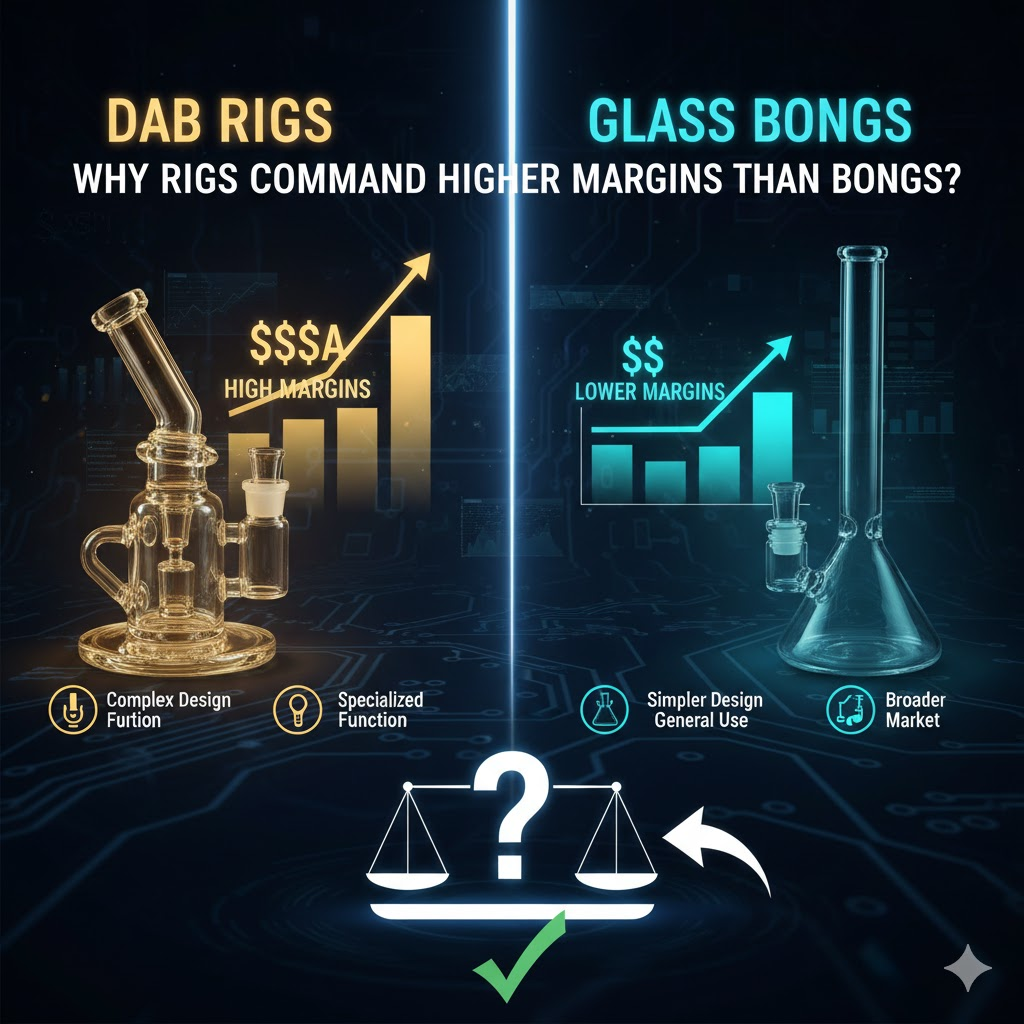
The “Legal State” Effect: Cheap Wax = High Rig Turnover
Legalization oversaturates the oil market, creating daily consumers who need functional, replaceable hardware.
Retailers must pivot from high-end art glass to volume-based technical rigs.
The Economics of Abundance
As cannabis markets mature, the price per gram of concentrates drops significantly due to supply saturation.
This price crash changes consumer behavior instantly.
Dabbing shifts from a “special occasion” activity to a daily routine, often replacing flower consumption.
These new daily users do not buy expensive, fragile art pieces for their morning commute; they demand affordable, functional “daily drivers.”
This economic mechanism increases hardware velocity.
Wholesale units under $50 become the primary volume movers.
Retailers stocking based on old “heady glass” models will sit on stagnant inventory, while those stocking durability-focused production glass capture the daily user market.
Meeting the Technical Demand: 10mm Joints and Mini Rigs
Modern consumers, specifically the “Flavor Chaser” demographic, reject large bongs for dabbing.
Excessive air volume dilutes terpenes.
To secure B2B profitability in this sector, inventory must align with the engineering standards defined by the Elfglass “Golden 4” strategy.
- Mini Rig Standard: Rigs must stand under 6 inches. Low air volume preserves flavor intensity.
- Joint Sizing: We use 10mm Female joints to create airflow restriction (vacuum), unlike the 14mm standard used for flower bongs.
- Material Integrity: High Borosilicate Glass 3.3 (Lab-Grade) is required to withstand the thermal shock of frequent torch heating. Soft glass (Soda-Lime) will crack under this usage.
- Recycler Function: Designs use vortex drains to cool vapor mechanically rather than through heavy water filtration, preventing “stale” hits.
The 60/40 Split (Guideline: Ideal starting inventory)
Allocate 60% of capital to high-velocity staples for liquidity and 40% to high-margin specialty glass for profit maximization.
| Strategy Segment | Allocation | Elfglass “Golden 4” Target | Key Metric |
|---|---|---|---|
| Core (Cash Flow) | 60% | Mini Rigs & Nectar Collectors | >6 Inventory Turns/Year |
| Growth (Margin) | 40% | Recyclers & E-Rig Attachments | 3x Higher Margin |
The Safe-Bet Heuristic: Balancing Velocity and Margin
Many shops fail because they treat all inventory identically.
The 60/40 split applies standard ABC analysis to separate bills-payers from profit-drivers.
You allocate the majority of your budget to “A-Level” stock that guarantees liquidity.
These items do not need to command the highest markup, but they must move quickly to prevent cash from stagnating on the shelf.
- The 60% Foundation (Cash Flow): Dedicate this portion to high-turnover SKUs. You need consistent revenue streams with rapid inventory cycles that exceed 6 turns per year.
- The 40% Speculation (Profit Drivers): Invest the remainder in higher-ticket items. These move slower but distinguish your shop from competitors and maximize per-unit margin.
- Risk Mitigation: This ratio prevents the accumulation of “dead stock” obsolescence while ensuring enough core inventory exists to meet daily walk-in demand.
Applying the Elfglass “Golden 4” Matrix
We map our specific manufacturing categories directly to this financial split.
Using the “Golden 4” strategy ensures you stock the correct borosilicate profiles for both volume and margin goals.
- The 60% Core (Mini Rigs & Nectar Collectors): Stock “Flavor King” Mini Rigs (<6 inches) and portable Nectar Collectors. These are volume drivers. We use 10mm joints specifically because dabbers demand airflow restriction for efficient vaporization, unlike the 14mm standard used for flower.
- The 40% Upgrade (Recyclers & E-Rig Tops): Allocate the margin-heavy budget here. Complex Recyclers (Klein, Torus) demand higher retail prices. Aftermarket E-Rig attachments are critical; they offer 3x higher margins than the electronic devices they attach to.
- The Upsell Bridge: Regardless of the split, every unit requires mandatory add-ons. Full-weld Quartz Bangers and Spinner Caps increase the average ticket size across both categories.
Wholesale Supply Built for Smoke-Shop Sell-Through
Elfglass helps you forecast demand, build a high-turnover catalog, and reorder on a rhythm that keeps best-sellers in stock without dead inventory. Share your shop profile and we will map a sourcing plan.
MOQ from 100 pieces | BSCI / WRAP / ISO 9001 | NDA before every project
A Worked 500-Unit Opening Order
The 60/40 split is a capital allocation, not a unit count, and the difference matters when you actually place the order. Because core cash-flow pieces carry a lower unit cost than specialty margin pieces, 60% of your capital buys far more than 60% of your units. Here is how a 500-unit opening order shakes out.
| Segment | Capital Share | Indicative Units | Target |
|---|---|---|---|
| Core: mini rigs and nectar collectors | 60% | ~325 | 6+ inventory turns per year |
| Specialty: recyclers and e-rig tops | 40% | ~125 | 3x higher per-unit margin |
| Attach: bangers, caps, terp pearls | From margin | ~1.5x rig count | Basket-size builder |
Treat the unit numbers as indicative and reweight them to your actual cost points — if your specialty recyclers are unusually expensive, 40% of capital may buy only 90 units. The discipline is the split, not the exact counts: keep the majority of your money in stock that turns, and let the specialty shelf earn margin without trapping your liquidity.
Re-Balancing the Ratio After 90 Days
An opening ratio is a hypothesis, not a law. The shops that stay liquid are the ones that revisit it on a fixed cadence instead of letting the first guess harden into dead stock. At day 90, run this loop:
- Run ABC analysis on real sell-through. Rank every SKU by units turned, not by margin. The items that actually moved become your new “A” stock regardless of where you originally placed them.
- Shift capital toward what turns. Increase reorder depth on the fast movers first; they fund everything else. This is the liquidity engine doing its job.
- Deal with the slow specialty early. A recycler that has not moved in 90 days is a markdown or a bundle candidate now — waiting only converts it into next season’s dead stock.
- Check the attach rate. If bangers and caps are not selling alongside rigs, the problem is placement or staff prompting, not the product. Reposition them at the register before you cut the order.
- Adjust for season. Portable nectar collectors spike around summer festival season; heavier recyclers gift better in the holidays. Reweight the mix a quarter ahead of the demand, not after it.
- Reorder core in smaller, more frequent batches. Frequent shallow reorders keep cash moving and let you react to a shape that suddenly takes off, instead of committing everything in one buy.
Done on a quarterly rhythm, this loop turns a static inventory guess into a compounding advantage: your fast movers never run dry, your margin pieces never go stale, and your capital stays working instead of sitting on a shelf.
Final Thoughts
Legal markets drive daily concentrate use, and these consumers immediately reject fragile soft glass that fails under thermal shock.
Stocking lab-grade Borosilicate 3.3—properly annealed at 1050°F—is the only way to eliminate breakage returns and validate your shop’s technical authority.
Focus your liquidity on durability; a rig that survives the torch builds the trust necessary for high-ticket upsells.
Stop guessing on air volume mechanics and verify the Elfglass “Flavor King” standard yourself.
Request our 2026 “Golden 4” Catalog or schedule a sample review to stress-test our welds against your current inventory.
Your market share depends on precision, so let’s align your production specs with the data.
Bring Your Custom Glass Vision to Life
Frequently Asked Questions
Are wholesale dab rigs more popular than bongs?
No. In terms of raw unit count, flower consumption still dominates.
However, wholesale dab rigs track with the vaporizer niche, showing significantly higher year-over-year growth.
Think of bongs as cash flow and rigs as your growth engine.
What are the inventory trends for wholesale dab rigs in 2026?
The “stack it high” strategy is dead. Successful shops are focusing on curated, high-margin functional glass—specifically recyclers and specialized mini rigs.
Should a new shop stock more bongs or rigs?
Stock bongs for volume, but rigs for margin. Since flower accounts for roughly 60% of sales in mature markets, standard bongs ensure consistent turnover.
Rigs should represent a smaller (20-30%) but premium section of your inventory.
The rigorous concentrate connoisseur doesn’t just buy a rig; they buy the entire “Upsell Ecosystem”—quartz bangers, spinner caps, and wholesale terp pearls.
That basket size is often where the real profit margin lives.
Why do many high-end mini rigs use 10mm joints instead of 14mm?
It comes down to airflow mechanics.
While 14mm joints provide the open airflow needed to clear a large chamber of flower smoke, dabbing requires the opposite.
A 10mm joint creates restriction.
This tighter pull creates a vacuum causing concentrates to vaporize efficiently at lower temperatures.
If you use a large joint on a mini rig, you introduce too much air, which cools the banger too fast and ruins the terpene profile.
Get a Quote for Your Next Order
Balancing flower and concentrate inventory? Send us your product spec and target quantity — contact our factory team or message us on WhatsApp, and we will reply with pricing and lead times within 24 hours.
About the Author
Ava Zeng is the founder of Elfglass, a Shenzhen-based borosilicate glass pipe manufacturer serving B2B brands worldwide. Every guide on this site is grounded in her production-floor experience— the annealing lines, QC checkpoints, and export orders behind each claim.
Before you commit to a supplier, read her founder’s story and trust promise, and the guide to vetting a reliable glass pipe manufacturer— the same red-flag checklist Elfglass applies to its own suppliers.
Inventory ratios between flower and concentrate reflect shifting consumer preferences, where dab and vape formats have gained share in legal markets.
Ready to Source Custom Glass Pipes?
Get a free quote within 24 hours. MOQ from 100 pieces. NDA-protected design consultation.
