
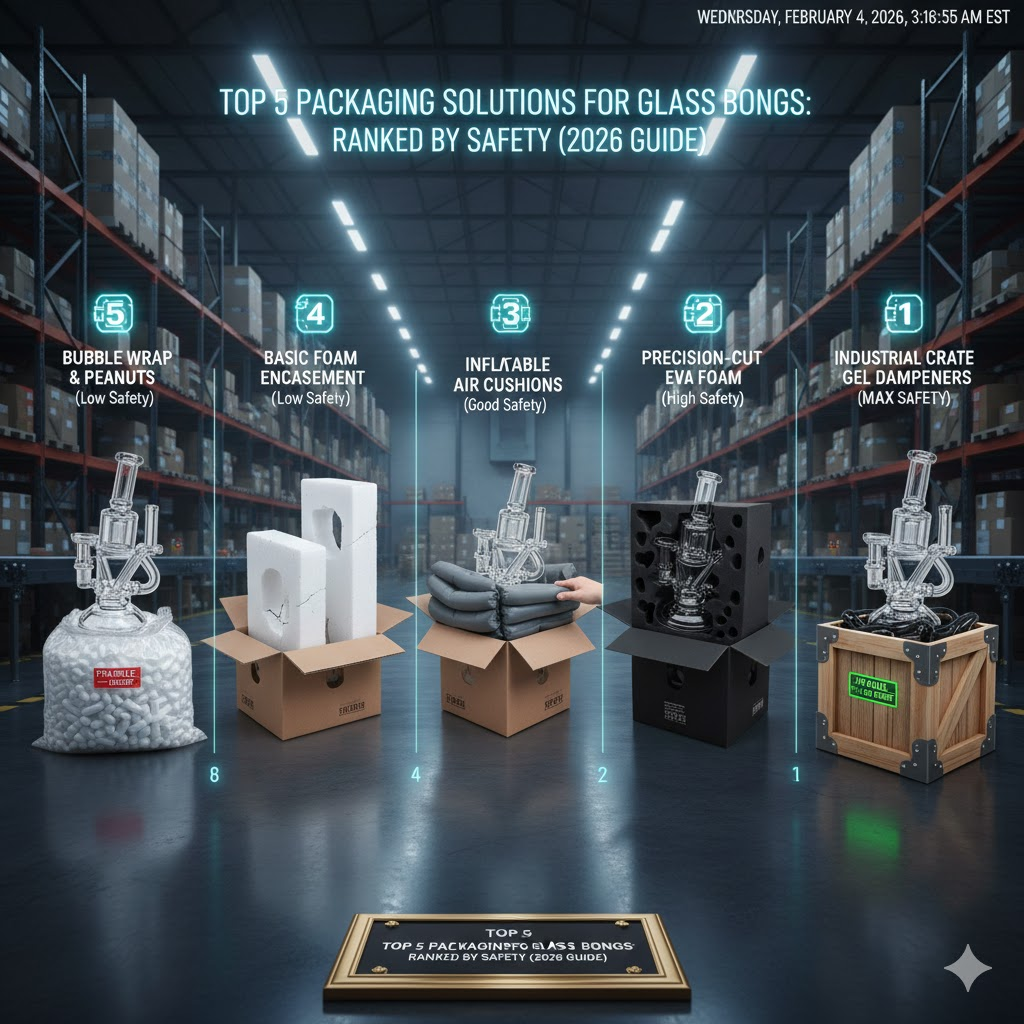
Implementing the Best Glass Packaging Methods for international shipments is the only safeguard against the industry’s volatile breakage rates.
While generic bubble wrap reduces initial volume, it frequently fails under logistic stress, forcing brands to absorb the heavy financial cost of replacement credits and destroyed inventory.
For B2B importers, packaging is not just trash; it is an insurance policy.
This analysis ranks the top 5 solutions against the proprietary Elf-Guard Air Column system.
We evaluate impact resistance for heavy-duty 9mm models and CBM optimization to ensure your supply chain balances unboxing safety with profit protection.
The “Breakage Tax”: Why Packaging Defines Margins
Before ranking the methods, we must understand the cost of failure.
When importing water pipes from China, carrier liability is virtually non-existent.
-
The “Checkerboarding” Effect: Loose packaging allows glass to vibrate against the box wall.
-
The “Dead Air” Cost: Bulky packaging increases CBM (Cubic Meters), raising your shipping cost per unit.
We ranked the following methods based on Shock Absorption, CBM Efficiency, and Cost.
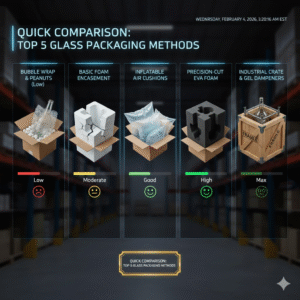
Quick Comparison: Top 5 Glass Packaging Methods
| Rank | Packaging Method | Safety Score | CBM Efficiency | Verdict |
| #1 | Air Column Bags (Elf-Guard) | ⭐⭐⭐⭐⭐ | High | The B2B Standard |
| #2 | Die-Cut PE Foam | ⭐⭐⭐⭐ | Low (Bulky) | The Premium Choice |
| #3 | EPS Styrofoam | ⭐⭐⭐ | Medium | The “Messy” Option |
| #4 | Honeycomb Paper | ⭐⭐ | High | The Eco-Gamble |
| #5 | Bubble Wrap | ⭐ | Variable | Avoid at All Costs |
1. Air Column Bags (The “Elf-Guard” Standard)
-
Best For: High-volume wholesale, heavy-duty 9mm beakers.
This is the technology behind our proprietary Elf-Guard system.
Unlike static padding, air columns utilize independent, inflatable chambers that wrap 360 degrees around the borosilicate glass.
-
The Suspension Physics: The glass effectively “floats” in a cushion of air. Even if the outer carton is crushed, the air pressure absorbs the impact before it touches the rig.
-
Multi-Chamber Reliability: If one column is punctured, the others remain inflated, maintaining protection (unlike bubble wrap which fails completely).
-
Cost Efficiency: Ships flat to the factory, reducing storage costs, and inflates on demand.
2. Die-Cut PE Foam (The “Unboxing” King)
-
Best For: High-end retail brands ($200+ MSRP), Gift Sets.
Polyethylene (PE) Foam is laser-cut to the exact geometry of the bong. It offers a “Apple-like” unboxing experience where every accessory has a dedicated slot.
-
Pros: Extreme luxury feel; zero movement inside the box.
-
Cons: Very expensive mold fees ($1000+); extremely bulky, which increases Landed Costs due to high CBM usage.
3. EPS Styrofoam Blocks (The Old Standard)
-
Best For: Cheap entry-level glass.
Expanded Polystyrene (Styrofoam) is the traditional white, crumbly block.
-
The Problem: It creates a mess (“snow”) when unpacked, annoying customers. Structurally, it is rigid but brittle. Under heavy impact, Styrofoam cracks, transferring the shock directly to the glass joint.
4. Honeycomb Paper (The Eco-Trap)
-
Best For: Small hand pipes, spoons.
While sustainable, paper lacks the compressive strength to protect heavy 9mm borosilicate glass.
-
The Risk: Paper compresses during transit. A 12-inch beaker wrapped in paper will eventually loosen, leading to “rattle” and eventual breakage against the box wall.
5. Standard Bubble Wrap (The Profit Killer)
-
Best For: Nothing in international shipping.
Relying on hand-wrapped bubble wrap is the #1 red flag of a Trader vs Factory. It relies entirely on the packer’s skill.
-
Human Error: Inconsistent wrapping thickness creates weak points, usually around the neck or base.
-
Compression: Bubbles pop under the weight of stacked pallets.
Case Study: Elfglass (Implementing the Air Column Standard)
To understand how the #1 ranked solution works in practice, we examine Elfglass, a manufacturer that has standardized the Air Column method.
Verdict
Elfglass functions as a pure-play OEM/ODM manufacturer, utilizing ASTM C336 annealing standards to deliver laboratory-grade borosilicate hardware.
How They Use Packaging as Insurance
Elfglass refuses retail sales to end-users, focusing strictly on B2B safety.
-
Preparation: Every 9mm “Tank” unit is inspected for Wall Thickness.
-
Inflation: The “Elf-Guard” air bag is inflated to specific PSI, locking the 10mm joint in place.
-
Carton: The unit is placed in a 5-layer corrugated carton, ensuring no contact with the outer walls.
📊 Elfglass At a Glance:
-
Core Strength: Zero-Breakage Guarantee via Air Column Technology.
-
Material: High Borosilicate Glass 3.3.
-
Breakage Policy: Credit or replace within 3 days of delivery.
Scale Your Brand With Precision Manufacturing
Eliminate quality risks with lab-grade Borosilicate products delivered market-ready in just 15 days. We act as your technical partner to turn complex designs into profitable, durable inventory.
The Hidden Cost: CBM Optimization & “Dead Air”
Selecting the right glass packaging methods isn’t just about safety; it’s about shipping math.
The Volume Trap
Die-Cut Foam is safe, but it is huge. A foam box for a 12-inch beaker might measure 20x10x10 inches. An Air Column box for the same item measures 14x6x6 inches.
-
The Result: You can fit 40% more inventory in a container using Air Columns compared to Foam.
-
The Profit: Lower freight cost per unit = Higher Net Margin.
Nesting Strategy
We further optimize CBM by nesting smaller items (bowls, downstems) inside the hollow space of the larger beakers within the packaging, ensuring you never pay to ship “dead air.”
Final Thoughts on Packaging Selection
While standard bubble wrap offers lower upfront costs, only the Elf-Guard Air Column system guarantees your inventory survives from the factory floor to the retail shelf.
Prioritizing impact resistance over shipping volume prevents costly breakage claims that erode your wholesale margins.
Authentic dealer trust relies on consistent, intact unboxing experiences.
Do not rely on assumptions; validate our zero-breakage standards with a tangible trial.
Order a Sample Kit Today
Test the structural integrity and packaging resilience firsthand within 7 to 15 days. Contact our logistics specialists today to review your specific CBM requirements.
Scale Your Brand With Precision Manufacturing

Frequently Asked Questions
What is the safest glass packaging method?
Air Column Bags (like Elf-Guard) are the safest for B2B shipping.
They provide 360-degree suspension and independent air chambers that prevent failure even if punctured.
Why is Bubble Wrap bad for bongs?
Bubble wrap compresses and pops under heavy pallet weight.
It also relies on human wrapping skill, leading to inconsistent protection around fragile joints.
Does packaging affect import duty?
Indirectly, yes. Packaging affects the Landed Cost by changing the volume (CBM).
While duty is based on value, shipping cost is based on volume. Bulky foam increases your freight bill significantly.
Can I use Die-Cut Foam for wholesale?
Yes, but be prepared for higher shipping costs.
We recommend Die-Cut Foam only for “high-ticket” items (>$100 wholesale) where the premium unboxing experience justifies the extra freight cost.
What is the Elf-Guard breakage guarantee?
We maintain a breakage rate below 1%.
If any unit arrives broken using our Air Column system, we provide a direct credit or free replacement in your next order.
