
The duty rate is the first number buyers look up and the last one that decides the budget. On a formal ocean entry into the United States, two fees most buyers have never heard of — the merchandise processing fee at 0.3464 percent and the harbor maintenance fee at 0.125 percent — arrive on every entry whether the duty itself computes to 3 percent or zero.
Duty calculation is not hidden knowledge. It is a formula, a classification code, and a customs value definition that changes by market. This guide gives you all three, then runs two complete worked calculations — one US landing, one UK landing — on the same shipment so you can copy the method for any country.
We export glass pipes worldwide from Elfglass, the factory behind this site, and the buyers who land costs cleanly all start here: with the formula, not with a blog rate table. Pair this guide with our total import cost breakdown and the China sourcing process guide.
Glass pipe import duties equal the duty rate × customs value. The US assesses duty on FOB value; the EU and UK assess on CIF value, then add import VAT — 20 percent in the UK — on top. US formal entries also carry MPF of 0.3464 percent and HMF of 0.125 percent regardless of the duty rate.
Key Takeaways
- Duty = duty rate × customs value. Every country differs on the rate and on what counts as the value.
- The US computes duty on FOB value; the EU and UK compute on CIF value — freight changes your tax base.
- US formal ocean entries add MPF 0.3464% and HMF 0.125% on top of duty.
- The UK adds 20% import VAT on goods + duty + transport; EU member states set their own VAT rates.
- Your HS code drives the rate — get it from your broker, and get it in writing.
Table of Contents
The Duty Formula That Works in Every Country
Every market computes duty with the same skeleton: duty rate × customs value. The differences live in two places — the rate your product classifies under, and the value the customs authority lets you use as the base. The value definition is the one that surprises buyers, because it changes the arithmetic before you ever reach a rate.
| Component | United States | EU / UK |
|---|---|---|
| Customs value | FOB transaction value | CIF — goods plus freight plus insurance |
| Duty | Rate × FOB value | Rate × CIF value |
| Border fees | MPF 0.3464% + HMF 0.125% (formal ocean entries) | Generally none |
| Import VAT / GST | None at the border | UK 20% VAT; EU rate per member state; AU 10% GST |
The practical consequence: the same $10,000 shipment costs more to import into the UK than into the US before the duty rate even enters the comparison, because the UK taxes your freight too. Buyers comparing markets on duty rates alone reach the wrong conclusion every time.
Find Your HS Code Then Your Rate
Glass smoking products do not share one classification. Depending on construction and destination practice, they are typically declared under the glassware or smoking-implement headings of the Harmonized System — and a digit of difference in that code can move the duty rate by whole percentage points. The classification is a judgment your customs broker confirms, and a competent factory sends its recommended code with the commercial documents.

With the code in hand, look the rate up in the destination tariff database: the national tariff schedules publish product-level rates that no summary article can substitute for. Rates also change through trade policy, so check the current schedule per shipment — never reuse a rate from last year without confirming it still applies.
The Fees That Hug the Duty
US formal entries carry two statutory charges alongside duty. The merchandise processing fee is set in federal regulation at 0.3464 percent of customs value, and the harbor maintenance fee adds 0.125 percent on ocean shipments. They are small percentages that never go away — a $10,000 entry pays about $47 in fees before the duty calculation even starts.
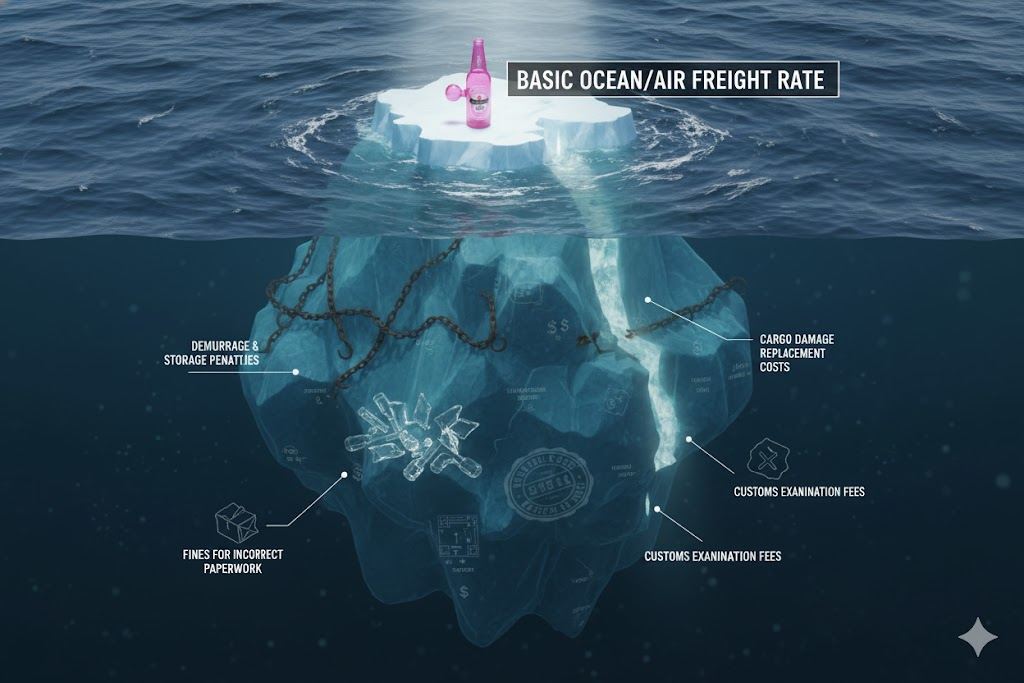
Other markets add their own handling charges at the port or through the broker: clearance fees, terminal handling, and storage. None of them are duty, and all of them land in the same budget. Our hidden shipping costs guide lists the repeat offenders.
Ship-Ready Compliance Documentation
Elfglass supplies the material declarations, certifications, and export paperwork your customs broker needs for the US, UK, EU, Canada, and Australia. Ask us which documents accompany your order before you buy.
MOQ from 100 pieces | BSCI / WRAP / ISO 9001 | NDA before every project
VAT and GST Are Not Duty
The most expensive confusion in import planning is treating VAT as part of duty. Duty is a cost — you never see it again. UK import VAT at 20 percent applies to the goods value plus duty plus transport, but registered businesses typically reclaim it as input tax. The same logic applies across the EU, where each member state sets its rate and the EU maintains the common VAT framework.
So the honest comparison looks like this: the UK charges a bigger number at the border, and part of that number comes back through your VAT return. Cash flow planning needs the border number; profitability planning needs the post-reclaim number. Track both as separate lines, and never let a quote comparison blur them together.
Two Worked Calculations US vs UK
Same shipment in both examples: $10,000 of glass pipes, $1,500 ocean freight, $100 insurance, and an illustrative 3 percent duty rate — the real rate depends on your HS code and destination. Every figure below exists to demonstrate the arithmetic.

US landing — duty on FOB value:
| Line | Basis | Amount |
|---|---|---|
| Goods invoice (FOB) | Commercial invoice | $10,000.00 |
| Duty | $10,000 × 3% | $300.00 |
| MPF | $10,000 × 0.3464% | $34.64 |
| HMF | $10,000 × 0.125% | $12.50 |
| Total to customs | — | $347.14 |
UK landing — duty and VAT on CIF value:
| Line | Basis | Amount |
|---|---|---|
| Goods invoice | Commercial invoice | $10,000.00 |
| Freight + insurance | To UK port | $1,600.00 |
| CIF customs value | Goods + freight + insurance | $11,600.00 |
| Duty | $11,600 × 3% | $348.00 |
| Import VAT | 20% × ($11,600 + $348) | $2,389.60 |
| Total collected | — | $2,737.60 |
Same goods, same ocean, and the UK border number is nearly eight times the US number — because VAT sits on top of everything including duty. Run the VAT reclaim through your accountant and the effective gap narrows sharply, which is exactly why the two worked tables belong in the same article.
Red Flags in Duty Planning
Four practices turn a routine clearance into a five-figure problem:
- Undervaluing invoices. Customs authorities benchmark declared values against market data. Penalties, delayed cargo, and seized goods cost multiples of any duty saved.
- Accepting a guessed HS code. A code copied from an old shipment or a forum post shifts the rate and voids the paper trail when audited. Get the code from your broker in writing.
- Budgeting duty but not fees. MPF, HMF, clearance, and terminal handling are small lines that repeat on every entry — and they add up over a year of reorders.
- Blurring VAT into cost of goods. Reclaimable VAT inflates your landed cost on paper and hides your real margin. Track it separately from day one.

Conclusion
Import duty is arithmetic, not folklore: rate × customs value, with the value defined as FOB in the US and CIF in the EU and UK, plus statutory fees and reclaimable VAT layered on top. The two worked calculations above are templates — substitute your invoice, freight, and broker-confirmed rate, and any country becomes calculable in minutes.
Risk reminders before your next shipment:
- Confirm the HS code and current rate per shipment — schedules and trade policy change.
- Never undervalue an invoice; the downside is asymmetric and brutal.
- Keep duty, fees, and VAT as separate budget lines, and reclaim what is reclaimable.
- Price retail from the full border number plus freight, not from the factory quote.
Want the numbers before you commit? Start with a 100-piece trial order — the smallest shipment that still proves the economics. Request a quote and we will send the itemized documents your broker will ask for.
How are glass pipe import duties calculated?
Duty equals the duty rate multiplied by customs value. The United States assesses duty on FOB value; the EU and UK assess on CIF value. The rate depends on the HS code.
What fees apply beyond duty when importing into the US?
Formal ocean entries carry a 0.3464 percent merchandise processing fee and a 0.125 percent harbor maintenance fee, both on customs value.
Do I pay VAT on glass pipes imported into the UK?
Yes. Import VAT at 20 percent applies to the goods value plus duty plus transport costs to the UK.
Where do I find the exact duty rate for my shipment?
In the destination country tariff database, looked up by HS code. Your broker confirms the code; a competent factory sends it with the quote.
What is the most expensive duty-planning mistake?
Undervaluing invoices. Customs authorities audit against market data, and penalties plus seized goods cost far more than the duty you saved.
Ready to Start Your Custom Glass Pipe Project?
Get a free quote within 24 hours. MOQ from 100 pieces. NDA-protected design consultation.
