
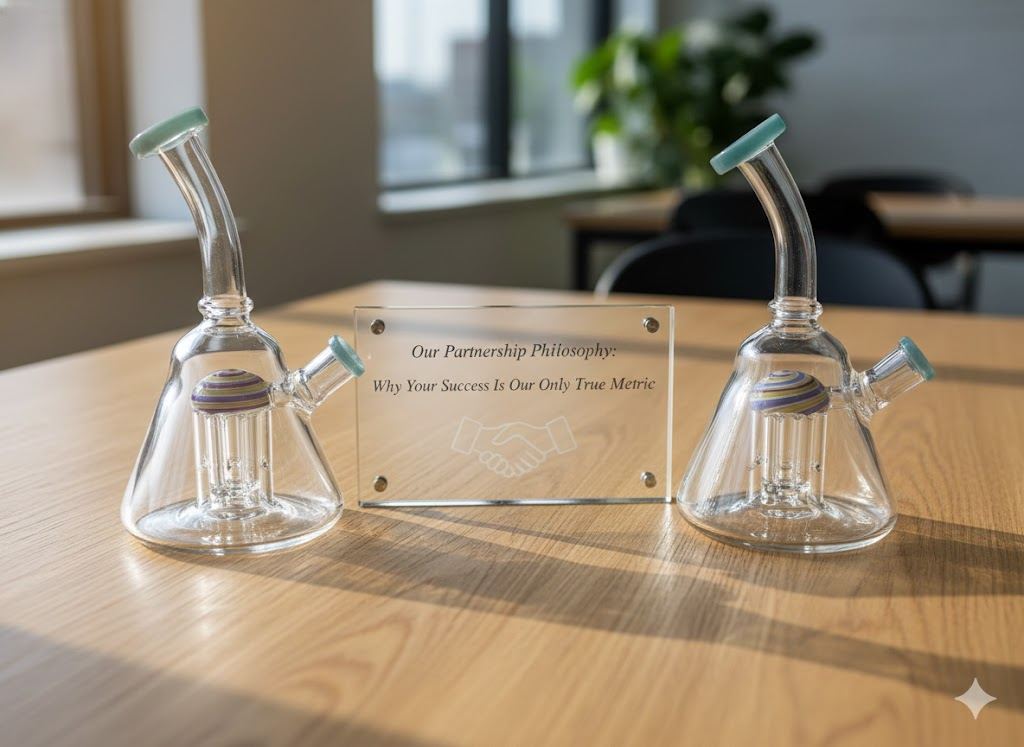
What is the goal of a glass pipe manufacturing partner?
If you ask this question in an industrial park in Hebei or a trade office in Shenzhen, you will likely get the same answer: “To produce products and ship orders.”
On the surface, this answer seems logical.
But I believe it is fundamentally flawed.
In fact, I believe this “shipping-first” mindset is the reason so many brilliant smoking accessories brands stagnate, stumble, or fail within their first three years.
Read more about the sixteen years of glass pipe manufacturing evolution at Elfglass.
At Elfglass, we have a different answer.
We do not exist to ship orders. We exist to build brands.
This isn’t just a semantic difference; it is a complete reversal of the traditional business model.
It is a philosophy born from my own “baptism by fire” in this industry watching incredible designs die because the factory didn’t care about anything beyond the bill of lading.
This manifesto explains why we operate differently, and why we believe your success is the only true metric for a glass pipe manufacturing partner.
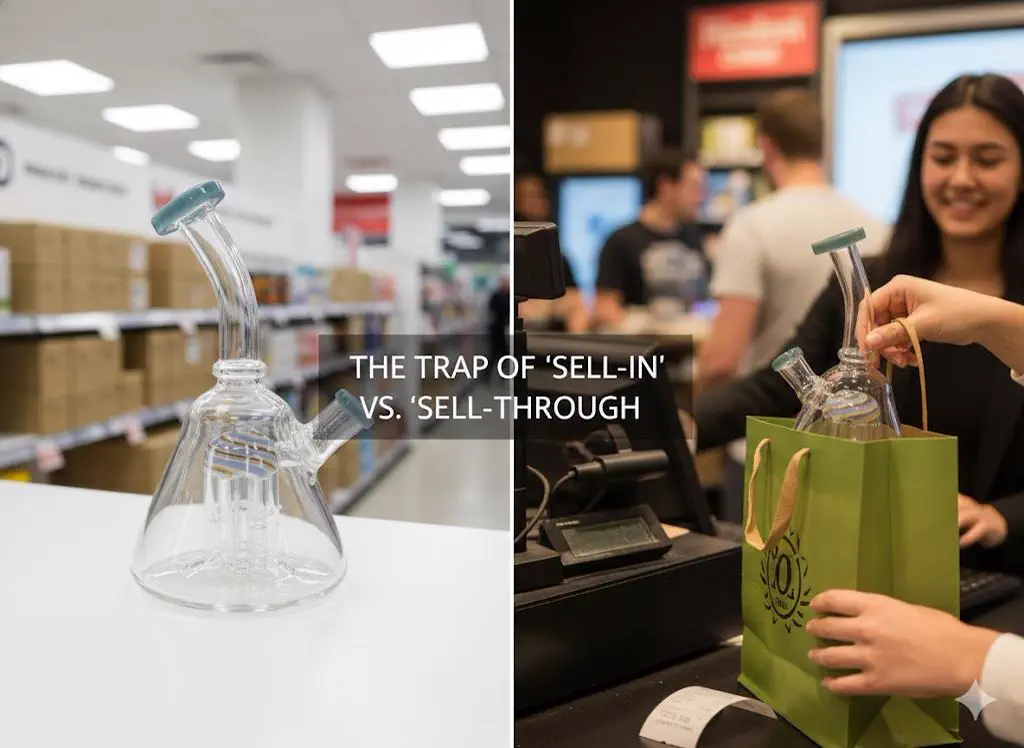
The Trap of “Sell-In” vs. “Sell-Through”
In the world of retail and distribution, there are two ways to measure sales, and they represent two very different relationships.
-
Sell-In (The Transactional Trap): This is the volume of product a factory sells to you. For a traditional manufacturer, “Sell-In” is the finish line. Once the container doors are sealed, they mark the project as a “Success.” They have been paid. But for you, the risk has just begun. You are now sitting on inventory that hasn’t proven itself.
-
Sell-Through (The Partnership Reality): This is the volume of product you sell to your end customer. This is the moment the consumer picks up your glass pipe, feels the weight, admires the curve, and decides, “I need this.”
Here is the hard truth: A factory can be “successful” based on Sell-In while its client is failing based on Sell-Through.
A factory can ship you 10,000 units of a water pipe that looks okay on a spec sheet but feels cheap in the hand.
At Elfglass, as your chosen glass pipe manufacturing partner, we refuse to profit from your inventory burden.
We realized early on that if your product doesn’t sell through if it doesn’t fly off the shelf you won’t come back.
Therefore, we must be as obsessed with your Sell-Through rate as you are.
The “Keiretsu” Approach: Learning from the Best
We are not the first to realize that the “us vs. them” dynamic of buyer and supplier is toxic.
In a landmark study by the Harvard Business Review, researchers analyzed why Toyota and Honda consistently outperformed their competitors.
They found that while US car companies treated suppliers as interchangeable vendors, the Japanese giants built “Keiretsu” close-knit networks of deep, long-term partnerships.
They shared innovation. They solved problems together.
We are bringing this “Keiretsu” spirit to the glass industry.
We view ourselves as your Technical Partner and Spiritual Pillar.
We are not on the opposite side of the negotiating table; we are on the same side of the drawing board.
Start a Conversation With a Real Factory Partner
You get a named contact, honest lead times, and an NDA before any OEM project. Tell us what you are building and we will reply within 12 hours with straight answers, not a sales script.
MOQ from 100 pieces | BSCI / WRAP / ISO 9001 | NDA before every project
How This Philosophy Changes the Way We Work
Saying “we care” is easy. Proving it requires a change in operations.
Here is how our obsession with your success manifests in our daily work:
1. Why We “Empathy Before Engineering” We don’t start with blueprints; we start with feelings.
Why? Because emotion is what drives Sell-Through.
A consumer buys a piece because of how it feels.
If we blindly manufacture a drawing without understanding the emotion behind it, we create a soulless product.
By understanding your vision first, we ensure the final product connects with your customers.
2. Why We Are Unafraid to Say “No” A transactional supplier will say “Yes” to everything to get the order.
-
“Can you make the glass thinner to save $0.50?” -> Yes.
-
“Can we skip the annealing process to ship faster?” -> Yes.
These “Yeses” are trapdoors. Because we are invested in your long-term growth, we have the courage to say: “No. We won’t do that, because it will hurt your brand.”
We protect you from compromises that would kill your Sell-Through rate.
3. Why Transparency is our Currency In a true partnership, there are no “black boxes.”
Whether it’s discussing the realities of wholesale glass pipes sourcing or breaking down the cost of a custom mold, we believe you deserve the full picture.
If we see a potential risk in your supply chain like a looming tariff or a raw material shortage we tell you immediately.
We don’t hide bad news, because we know that unpleasant truth is better than a pleasant lie.
Transactional Factory vs. Partnership Factory
The difference between these two operating models shows up in a dozen small, concrete behaviors long before it shows up in your sell-through numbers. Here is the side-by-side we hold ourselves to.
| Dimension | Transactional Factory | Partnership Factory (Elfglass) |
|---|---|---|
| Success metric | Sell-in — the container shipped | Sell-through — your product sells |
| Design feedback | Says yes to everything to win the order | Flags risk early, offers alternatives |
| Pricing | Opaque; changes late in the process | Transparent, tiered, put in writing |
| During a delay | Goes quiet until you chase them | Tells you early and re-plans with you |
| After shipment | The relationship effectively ends | Reorder and retail-feedback loop continues |
| How they see you | A PO number | A brand they help grow |
Read down the left column and you will recognize suppliers you have already worked with. Read down the right column and you will see the operating commitments we are willing to be measured against — not aspirations, but the actual behaviors that separate a vendor from a partner.
How We Work on Sell-Through, Not Just Sell-In
Claiming to care about your sell-through is worthless unless it changes what we do on a Tuesday morning. Concretely, it changes these things:
- We ask about your customer first. Before we talk quantity, we want to know who buys from you, at what price point, and on what shelf — because that determines the wall thickness, finish, and weight that will actually move.
- We watch reorder signals. Which SKUs come back fastest and which sit tells us more about a design than any spec sheet. We track that pattern across your orders and raise it with you.
- We share what we see across the market. Anonymized, of course — but if a finish or a size is suddenly moving for retail partners in your segment, you hear it from us before you have to discover it the hard way.
- We tune the product to your market’s sweet spot. Wall thickness, color, joint size, and price ladder are all levers, and we adjust them to fit the customer you are actually selling to rather than a generic one.
- We treat an underperformer as a shared problem. When a design does not sell through, we do not shrug and point at the sell-in we already banked. We iterate — adjust the piece, reposition it, or in some cases advise you to discontinue it and put the shelf space behind something that earns it.
This is what the Keiretsu spirit looks like in practice at a glass factory. It is slower at the start of a relationship and dramatically faster over the life of one, because the trust compounds and the second, third, and fourth orders take a fraction of the effort the first one did. We would rather build that compounding partnership with a founder who is here in three years than bank a single large sell-in from someone who never reorders.
An Invitation to Build a Legacy
We are not looking for “orders.” We are looking for Founders.
We are looking for the visionaries who understand that building a brand is a marathon, not a sprint. We are looking for partners who want to build a product line that defines the market.
If you are tired of suppliers who celebrate when the ship leaves the port, come talk to us. Let’s build a partnership where the champagne only pops when your product sells out.
Your vision is safe here.
Frequently Asked Questions
What is the difference between sell-in and sell-through?
Sell-in is the volume a factory sells to you, and for a traditional manufacturer it is the finish line. Sell-through is what your customers actually buy from you, which is what a true manufacturing partner optimizes for.
What is the Keiretsu approach in glass manufacturing?
Inspired by a Harvard Business Review study of why Toyota and Honda outperformed US car companies, the Keiretsu approach treats suppliers as long-term partners rather than interchangeable vendors, aligning incentives across the whole chain.
How does this philosophy change the way Elfglass works?
Elfglass starts with empathy before engineering: instead of starting with blueprints, we start with the end consumer’s feelings, because emotion is what drives sell-through at retail.
Get a Quote for Your Next Order
Need documentation you can verify? with a partner who puts the partnership terms in writing? Explore our wholesale hand pipe ranges — or send your product spec and target quantity to our factory team or message us on WhatsApp, and we will reply with pricing and lead times within 24 hours.
About the Author
Ava Zeng is the founder of Elfglass, a Shenzhen-based borosilicate glass pipe manufacturer serving B2B brands worldwide. Every guide on this site is grounded in her production-floor experience— the annealing lines, QC checkpoints, and export orders behind each claim.
Before you commit to a supplier, read her founder’s story and trust promise, and the guide to vetting a reliable glass pipe manufacturer— the same red-flag checklist Elfglass applies to its own suppliers.
Ready to Source Custom Glass Pipes?
Get a free quote within 24 hours. MOQ from 100 pieces. NDA-protected design consultation.
