
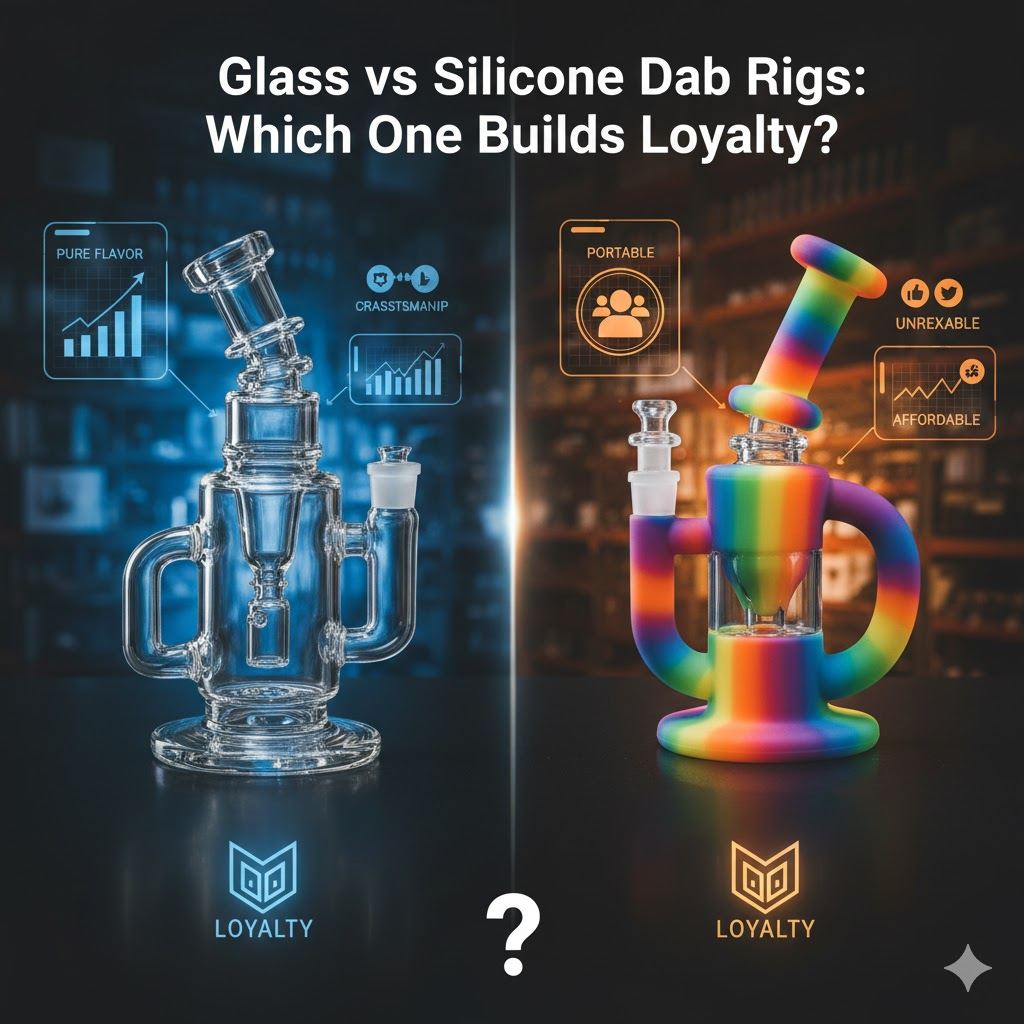
The glass vs silicone dab rigs inventory mix determines whether you secure temporary festival sales or long-term brand loyalty. For more context, see this silicone sleeves on glass pipes.
While silicone offers unbreakable utility, its porous surface acts as a terpene trap, creating “ghost flavors” that prevent the high-fidelity experience required to upsell premium quartz spacer ecosystems. Before expanding into quartz accessories, read our wholesale quartz bangers guide.
According to Harvard Business Review, acquiring a new customer is exponentially more expensive than retaining an existing one.
Selling a product that degrades in quality over time (like silicone) hurts retention.
This guide benchmarks the retention value of Lab-Grade Borosilicate 3.3 against Platinum-Cured Silicone.
We analyze ASTM C336 annealing standards to help you balance durable volume movers with the high-margin glass architecture demanded by hash rosin connoisseurs.
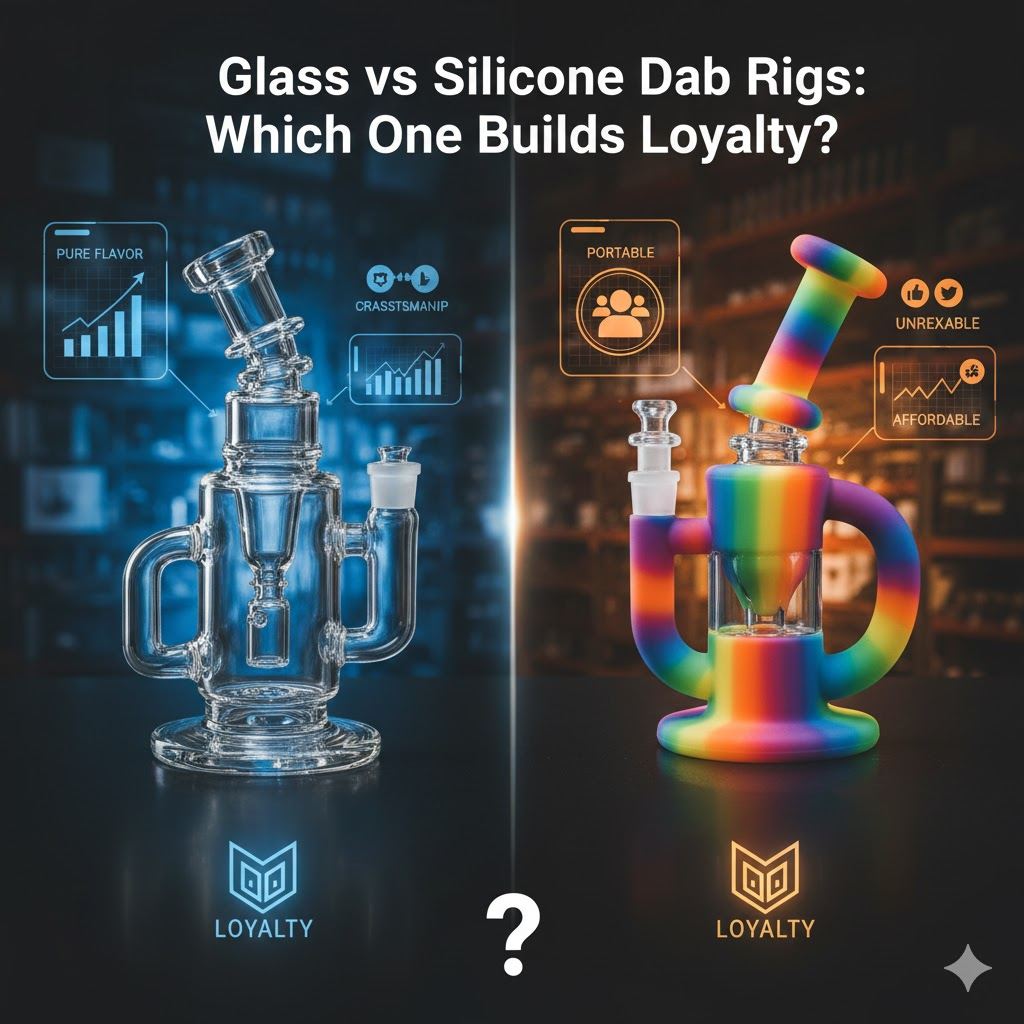
The Essential Shapes: Why Glass Wins on Function
Profitable inventory relies on three core geometries: Mini Rigs for flavor chasing, Recyclers for higher margin tiers, and Fab Eggs for advanced filtration density.
| Architecture | Core Mechanic | B2B Strategy | Target Profile |
|---|---|---|---|
| Mini Rig | Low Air Volume | Volume Mover (Daily Driver) | Hash Rosin Connoisseurs |
| Recycler | Vortex Flow | High Margin ($40+ Wholesale) | Professional/Upgraders |
| Fab Egg | Swiss Diffusion | Visual Premium | Function Enthusiasts |
The Mini Rig (Flavor Purity)
Big glass kills flavor, but porous material kills it faster. In the glass vs silicone dab rigs debate, the Glass Mini Rig is the undisputed leader for flavor chasers.
We engineer these rigs specifically to minimize the contact between air and vapor.
While silicone absorbs terpenes over time, creating a permanent “stale” taste, our Borosilicate 3.3 remains chemically inert.
We strictly fit Mini Rigs with 10mm female joints to create a vacuum, providing the necessary restriction that flexible silicone joints often fail to maintain.
-
Height: Under 6 inches (Standard)
-
Joint Spec: 10mm Female (Precision Grind)
-
Material: Lab-Grade Borosilicate 3.3
The Fab Egg (Advanced Filtration)
The Fab Egg combines the Swiss Perc’s diffusion with a recycling body.
This design is nearly impossible to replicate effectively in silicone because the internal “egg” structure requires rigid structural integrity to function as a percolator.
We use Grade A Borosilicate tubing and an annealing cycle of 1050°F to ensure these complex internal connections survive daily thermal shock.
The Hidden Cost of Silicone: Returns and Repeat Purchases
The “ghost flavor” problem is not a tasting note, it is a return driver. Once silicone absorbs terpenes, every dab tastes like the last strain that touched it, and the customer who notices will not buy a replacement from you; they will buy from a competitor who stocks glass. Borosilicate is chemically inert, which is why connoisseurs treat a glass rig as a long-term purchase and why their next order is a second rig rather than a refund.
That repeat-purchase pattern changes what you stock. If a customer’s first glass rig lasts for years, your revenue comes from the next rig they add: a recycler, a fab egg, a travel mini. The material decision is really a lifetime-value decision, and the borosilicate glass grades deep dive walks through how soda-lime and 3.3 glass differ under torch heat and cleaning solvents.
Stock the Glass Pipes Your Customers Actually Buy
Elfglass produces the full wholesale catalog, from hand pipes and sherlocks to dab rigs, percolator bongs, and accessories, in proven best-selling specs. Tell us your market and we will recommend a catalog mix with pricing.
MOQ from 100 pieces | BSCI / WRAP / ISO 9001 | NDA before every project
Verifying the Glass Before You Order: Annealing and Certifications
Not every rig labeled “glass” is annealed, and the difference shows up in your breakage rate. Annealing follows ASTM C336 at roughly 1050°F for borosilicate, releasing internal stress so the piece survives torch heat. Unannealed or soft-glass pieces pass the same visual inspection, then shatter on the first heavy heat cycle, a return you eat rather than the factory.
When you compare factories, ask for the audits rather than the brochure: BSCI, WRAP, or ISO 9001 documentation, a plant visit or video walkthrough, and a sample order before your MOQ of 100 units. The Shenzhen vs. Hebei glass factories comparison explains why production location matters for QC consistency and shipping economics.
Cleaning and Care: The Test That Decides the Material
Hand both materials to a customer and the difference appears in the first cleaning. Silicone parts need warm soapy water and careful drying, and even then the absorbed terpenes remain; glass goes into an isopropyl alcohol soak, rinses clean, and comes back neutral. For a shop, that means silicone units look tired after months of display handling, while glass pieces can be restored to showroom condition.
Offer the cleaning test in your store and the material choice sells itself. The 2026 dab rig styles overview shows which shapes currently carry the display traffic, and every one of them is available in borosilicate rather than porous polymer.
Glass vs Silicone: Side-by-Side Buyer’s Table
The arguments above are scattered across function, returns, and cleaning. Condensed into one comparison, the material decision becomes a shelf decision you can hand to a buyer or a store manager. Every row restates a difference already covered in this guide — it is the side-by-side framing that makes it usable at the point of purchase.
| Attribute | Borosilicate 3.3 Glass | Platinum-Cured Silicone |
|---|---|---|
| Terpene retention | Chemically inert — tastes the extract as intended | Porous — absorbs terpenes, builds permanent ghost flavor |
| Cleaning | Isopropyl soak rinses back to neutral | Warm soapy water; absorbed residue stays |
| Joint stability | Precision-ground 10mm holds the vacuum | Flexible joints often fail to maintain restriction |
| Thermal shock | Annealed at 1050°F (ASTM C336) survives torch heat | Not torch-rated; entry-level and festival use only |
| Display aging | Restores to showroom condition | Looks tired after months of handling |
| Percolator complexity | Recyclers and fab eggs possible | Rigid internal structures impossible to replicate |
| Customer LTV role | Long-term purchase; drives the next rig | One-off entry sale |
Total Cost of Ownership: A Worked Comparison
Sticker price favors silicone; ownership favors glass. The table below is a template, not a quote — substitute your own numbers, but keep the time horizon, because the divergence only shows up across the second and third purchase, not the first.
| Horizon | Silicone Path | Glass Path |
|---|---|---|
| First purchase | Low entry price | Higher entry price |
| Within year one | Ghost flavor appears; customer seeks a replacement elsewhere | Rig still neutral after repeated ISO cleanings |
| Next transaction | Replacement sale goes to a competitor who stocks glass | Same customer adds a second rig — recycler or fab egg |
| Net for your shop | One low-margin sale, then churn | One higher sale, then a repeat-margin relationship |
That last row is the whole decision. Silicone wins the festival table and the impulse buy; glass wins the customer who comes back. Stocking glass is not the more expensive choice — it is the choice that keeps the second and third sale in your shop instead of a competitor’s, which is exactly the retention economics the customer-acquisition cost argument at the top of this guide describes.
Final Thoughts on Glass vs Silicone Dab Rigs
Silicone captures the entry-level sale, but chemically inert Borosilicate 3.3 creates the recurring revenue.
Serious connoisseurs abandon porous materials immediately once they detect the “ghost flavor” of degrading silicone.
Do not risk your shop’s reputation on soft glass import batches.
Request a sample kit today to test our joint precision and thermal shock resistance against your current supply.
Premium Wholesale Rigs: Precision Meets Profitability
Frequently Asked Questions
Is a glass rig better than silicone for dabbing?
Yes, for flavor preservation. Silicone is naturally porous and eventually absorbs terpenes, creating a permanent residu or “ghost flavor” that alters the taste of future dabs.
High Borosilicate 3.3 glass remains chemically inert and non-porous, ensuring the user tastes the extract exactly as intended.
While silicone serves the entry-level or festival market, glass is the standard for connoisseurs.
Why do many high-end dab rigs use 10mm joints instead of 14mm?
While 14mm flows well for flower smoke, 10mm is superior for concentrates because it creates restriction.
This tighter pull generates a vacuum, helping to vaporize oil at lower temperatures.
Low-temp vaporization preserves delicate terpenes that high heat destroys.
For this reason, 10mm is our standard for Mini Rigs and flavor-focused setups.
What is the specific benefit of a Recycler design?
Recyclers use the movement of water rather than the volume of water to cool vapor.
Too much water filtration strips away flavor. By cycling water through external tubes (a vortex function), the rig cools the smoke mechanically without trapping flavor compounds.
It also prevents splashback, keeping water out of the mouthpiece during heavy pulls.
Why is Borosilicate 3.3 glass critical for oil rigs?
Standard “soft glass” (Soda-Lime) cannot withstand the localized heat of a butane torch and often cracks due to thermal shock.
Borosilicate 3.3 is laboratory-grade material used in scientific beakers.
It resists thermal shock greater than 170°C. We also anneal our glass at 1050°F (565°C) for 8-12 hours to remove internal stress, ensuring the rig doesn’t shatter during normal use.
Why are smaller “Mini Rigs” recommended for dabbing?
Less air volume equals better flavor retention.
Large rigs allow vapor to expand and mix with too much air, causing oxidation and stale flavor before it reaches the user.
Mini rigs (typically under 6 inches) keep the vapor path compact, delivering a potent, flavor-rich hit preferred by hash rosin connoisseurs.
Get a Quote for Your Next Order
Choosing glass or silicone dab rigs for your store? Send us your product spec and target quantity — contact our factory team or message us on WhatsApp, and we will reply with pricing and lead times within 24 hours.
About the Author
Ava Zeng is the founder of Elfglass, a Shenzhen-based borosilicate glass pipe manufacturer serving B2B brands worldwide. Every guide on this site is grounded in her production-floor experience— the annealing lines, QC checkpoints, and export orders behind each claim.
Before you commit to a supplier, read her founder’s story and trust promise, and the guide to vetting a reliable glass pipe manufacturer— the same red-flag checklist Elfglass applies to its own suppliers.
Ready to Source Custom Glass Pipes?
Get a free quote within 24 hours. MOQ from 100 pieces. NDA-protected design consultation.
