
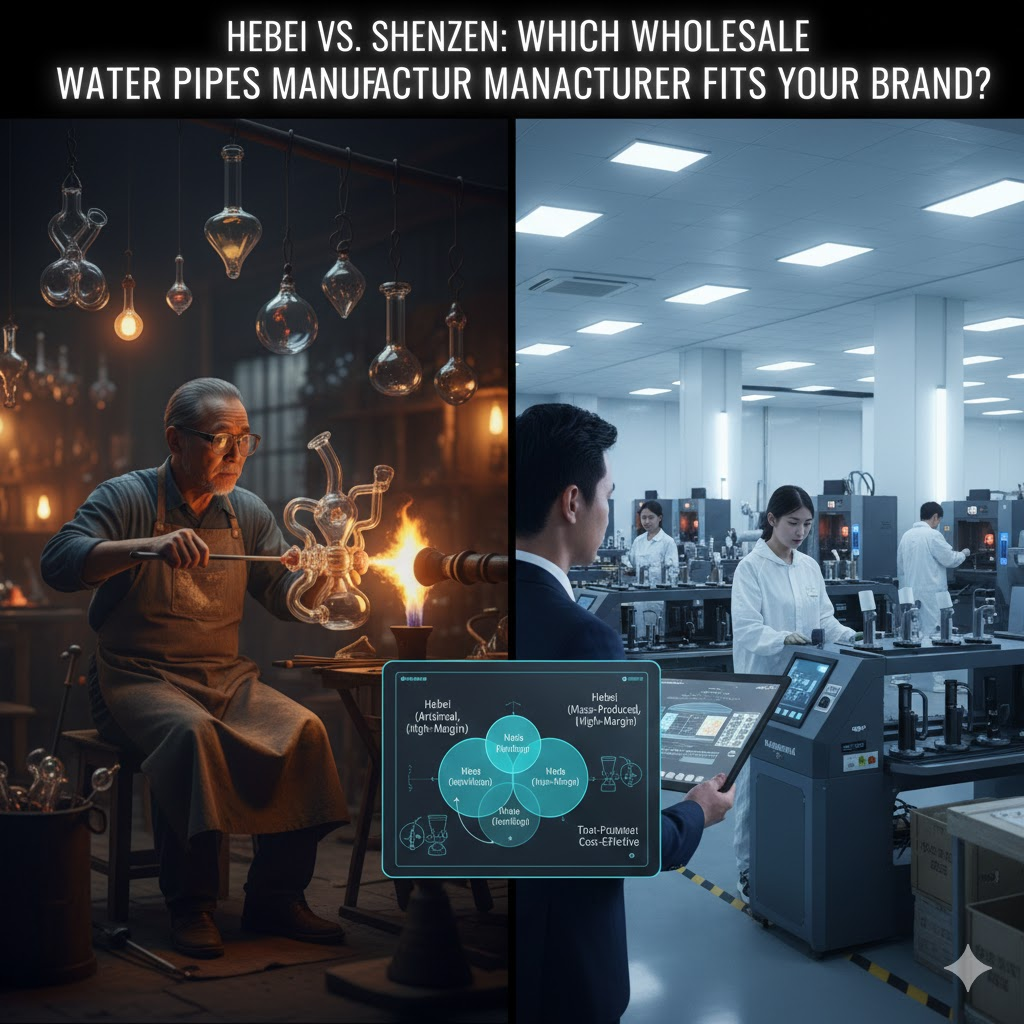
For importers, the geography of Chinese glass manufacturing is not just a map—it is a menu of trade-offs.
The sourcing decision between Hebei (the volume engine) and Shenzhen (the innovation hub) forces a critical strategic choice between raw cost velocity and structural integrity.
While Hebei offers unmatched pricing for standard beakers, its reliance on rapid spot welding often leads to transit breakage that erodes profit margins.
Conversely, Shenzhen offers precision but at a premium. Misjudging this regional distinction risks paying premium prices for generic inventory or, worse, building a brand on glass that shatters under thermal shock.
This comprehensive analysis benchmarks wholesale water pipes manufacturers against the High Borosilicate 3.3 standard.
We evaluate suppliers on Dewar Seal joint strength, ASTM C336 annealing protocols, and the hidden risks of the “Hybrid Supply Chain” to help you secure heavy-duty inventory that eliminates warranty headaches.
Hebei: The Volume King (The “Toyota Camry” of Glass)
Hebei province, particularly the cluster around Hejian and Cangzhou, serves as the global heartbeat for high-volume borosilicate production.
For wholesale water pipes manufacturers, this region is the undisputed “Volume King,” churning out millions of units annually that stock the shelves of smoke shops worldwide.
The Economics of Scale: Domination of the ‘Classic Beaker’
For wholesalers and head shop chains, the classic beaker is the bread and butter.
In terms of sales velocity, the standard 10-inch to 18-inch beaker functions like the Toyota Camry of bongs—it is reliable, standard, and ubiquitous.
Hebei manufacturers leverage three key advantages to dominate this sector:
-
Proximity to Raw Materials: The region sits atop major silica and gas supply lines, reducing material overhead.
-
Piece-Rate Labor Models: Workers are often paid by the unit, incentivizing massive throughput speed over meticulous detail.
-
Geometric Simplicity: Factories here are optimized for straight tubes and simple beaker bases, avoiding the time-consuming complexity of intricate percolators.
This allows Hebei factories to offer FOB prices that Shenzhen simply cannot match on basic SKUs.
If your business model relies purely on price-fighting in the entry-level market, Hebei is the logical source.
The Hidden Cost: Quality Control and Technical Risks
However, the “Piece-Rate” culture creates a conflict of interest.
When a glassblower is paid by the piece, they are financially penalized for spending extra time on Quality Control. This leads to two systemic risks:
-
The “Spot Weld” Shortcut: To attach the joint to the beaker base quickly, workers often use a “Spot Weld”—a single, thin point of contact. While visually acceptable, this joint lacks structural reinforcement and frequently snaps during shipping or when a user presses down on a quartz banger. At Elfglass, we reject this method in favor of Dewar Seals (Double Wall Welds), but this technique is rare in volume-focused Hebei workshops.
-
Material Substitution (The Soft Glass Trap): To shave cents off the dollar, some lines may introduce Soft Glass (Soda-Lime) into the mix. Unlike Borosilicate 3.3, soft glass has a high Coefficient of Expansion (COE). If a customer cleans a soft glass tube with hot tap water, the rapid temperature change can cause immediate, catastrophic failure.

Shenzhen: The Design Hub (The “Silicon Valley” Approach)
Shenzhen represents the transition from manual labor to scientific precision.
As China’s technology capital, the glass blowing culture here is heavily influenced by the adjacent electronics and medical device industries.
Wholesale water pipes manufacturers in this hub optimize specifically for durability, complex percolation, and brand-ready consistency.
Precision Engineering Meets Glassblowing
We adhere to a “Silicon Valley” approach that moves beyond traditional, purely manual methods.
In Shenzhen, the priority shifts from raw output speed to standardized QC protocols.
-
Engineering-Grade Tolerances: While hand-blown glass naturally varies, Shenzhen factories (including Elfglass) target a Wall Thickness Tolerance of ±0.2mm. This ensures that the 500th unit in your order feels exactly the same weight and balance as the first sample.
-
Complex Filtration: This is the home of the Recycler and the Fab Egg. The skilled labor force here specializes in internal plumbing—Matrix, Stereo Matrix, and Honeycomb percolators—that requires extended bench time to perfect.
Material Standard: Exclusively Borosilicate 3.3
Comparable to medical-grade Pyrex, this material is non-negotiable for high-performance water pipes.
It eliminates the risk of “Thermal Shock,” allowing end-users to clean their pieces with boiling water or use butane torches without fear of cracking.
Advanced Fabrication: Why We Use “Dewar Seals”
Durability is engineered directly into the structure.
We verify that all heavy-duty joints utilize reinforced “Bistable Joints” or Dewar Seals.
This process involves fusing the inner and outer glass walls into a single, robust connection point, adding approximately 50% more material to the highest-stress area of the rig.
The “Hybrid” Risk: Shenzhen Facade, Hebei Reality
The most insidious trap in the glass supply chain isn’t buying low-quality goods—it’s paying “Design Hub” premiums for standard workshop production.
This is known as the “Hybrid Supply Chain.”
The Deceptive Showroom Model
We often see trading companies establish glossy, high-tech showrooms in Shenzhen or Shanghai to project an image of precision engineering.
They hire English-speaking sales staff and produce slick marketing videos.
This allows them to command higher unit prices based on the perception of being a premium manufacturer.
The Outsourcing Reality
The logistical reality is often quite different. In many “Hybrid” scenarios, the trading company does not own a single kiln.
Once you place an order, it is quietly sub-contracted to remote family workshops in Hebei where labor costs are lower.
The Danger to Your Brand:
-
Loss of QC Control: The trader cannot monitor the annealing schedule of a factory they don’t own.
-
Process Blind Spots: Outsourced workshops often skip the mandatory 8-12 hour ASTM C336 annealing cycle to rush shipments. This leaves internal stress in the glass, creating “ticking time bombs” that shatter months later.
-
IP Leakage: When molds are moved between unauthorized subcontractors, your custom designs often leak to competitors.
At Elfglass, we eliminate this risk by maintaining vertical integration.
We control the raw material, the kiln schedule, and the final QC, ensuring you get exactly what you paid for.
Comparative Analysis: Which Source Fits Your Strategy?
To help you decide, we have benchmarked the two regions across critical B2B metrics.
| Feature | Hebei Manufacturers | Shenzhen Manufacturers (Elfglass) |
| Primary Advantage | Low Cost / High Volume | Precision / Complexity / Durability |
| Best For | Entry-Level Beakers ($10-$15 retail) | Brand-Name Rigs / Recyclers ($50+ retail) |
| Joint Technology | Often Spot Welds (Weak) | Dewar Seals / Bistable (Reinforced) |
| Glass Material | Risk of Soda-Lime mix | 100% Lab-Grade Boro 3.3 |
| QC Standard | Speed-Focused | AQL 2.5 Level II |
| Lead Time | Fast for Standard Shapes | Slower Start (QC Heavy), Consistent Output |
Strategic Recommendation:
-
Choose Hebei if your business model is strictly high-volume, low-margin cash-and-carry, and you have a high tolerance for breakage returns (typically 5-10%).
-
Choose Shenzhen (Elfglass) if you are building a Brand. If your customers demand function, warranty support, and safety, the lower breakage rates and higher perceived value of Shenzhen glass yield a higher long-term ROI.
How to Audit Your Manufacturer (Remote Checklist)
If you cannot visit China personally, how do you verify if a supplier is a real wholesale water pipes manufacturer or a hybrid trader?
Use this remote audit checklist:
-
The “Live Video” Challenge: Do not accept pre-recorded tours. Ask for a live video call. Ask the sales rep to walk from the showroom to the annealing kiln immediately. A trader will make excuses; a factory will walk through the door.
-
The Caliper Test: Ask them to measure the wall thickness of a random unit on the production line live on camera. If it deviates more than 0.5mm from the spec, their QC is loose.
-
The “Reject Bin” Check: Ask to see the scrap bin. A factory floor without broken glass is a lie. Real manufacturing generates scrap; if you don’t see it, they might be packing defects into your box.
Realize Your Vision With Precision Glass Manufacturing
Secure your inventory with scientifically annealed Borosilicate 3.3 glass that minimizes breakage and maximizes ROI.
From rapid 24-hour modeling to military-grade IP protection, we bridge the gap between sketch and reality.
Realize Your Vision With Precision Glass Manufacturing

Final Thoughts on Manufacturer Selection
Sourcing based solely on the lowest sticker price often creates a hidden liability through warranty claims and fractured brand trust.
By strictly enforcing High Borosilicate 3.3 material standards and reinforced Dewar Seals, we eliminate the structural failures inherent in generic “volume” glass.
True margin protection comes from securing inventory that survives the journey from our kiln to your customer’s hands.
We ensure you understand exactly where your margin goes: into the glass itself, not the showroom rent or the “dead air” of broken shipments.
Do not rely on glossy showroom promises; validate the engineering tolerance with your own hands.
We recommend requesting a specific sample of our 9mm “Tank” series to physically test the difference in weight, weld strength, and annealing quality.
