
Minimum order quantity. Three words that can make or break a purchasing decision. If you are a B2B buyer exploring wholesale glass pipes for the first time, the word “MOQ” probably feels like a wall between you and the product you need. You see suppliers listing 500, 1,000, even 5,000 pieces per SKU on Alibaba, and you wonder whether your small brand or startup shop can even get a foot in the door. The ICC’s Incoterms® rules standardize how responsibility and risk split between buyer and seller in international trade (Incoterms rules).
Here is what most generic sourcing guides will not tell you: in the borosilicate glass pipe industry, MOQs are far more negotiable than buyers assume. A 100-piece trial order is not just possible—it is often the smartest way to start. This guide walks you through exactly how to negotiate MOQ wholesale terms with a glass pipe supplier, why factories set minimums in the first place, and what strategies actually move the number in your favor.
What MOQ Actually Means in Glass Pipe Manufacturing
MOQ stands for Minimum Order Quantity—the lowest number of units a factory will produce in a single run. But in glass pipe manufacturing, MOQ is not an arbitrary number pulled from thin air. It is tied directly to the physical and economic realities of working with borosilicate glass.
Every glass pipe design—whether it is a simple hand pipe or a complex recycler dab rig—requires its own production setup. That means preparing or fabricating the mold, calibrating the furnace to the right temperature for the specific glass thickness, setting up the annealing cycle to relieve internal stresses, and running quality checks on the first pieces off the line. All of that happens before a single sellable unit is complete.
When a supplier tells you their MOQ is 100 per design, what they are really saying is: “We need to produce at least 100 units of this specific SKU to make the setup time, labor, and material costs worthwhile.” Order fewer, and the per-unit cost balloons to a point where neither party benefits.
This is why minimum order quantity glass pipes discussions always come back to one concept: the production run. The economics of glass blowing reward batch consistency. That is not a limitation designed to frustrate buyers—it is the physics and math of the craft.
Why Factories Set Minimums (And What It Costs Them Below That Number)
To negotiate effectively, you need to understand what happens on the factory floor when an order falls below the MOQ threshold. Here is the cost structure that drives the minimum:
| Cost Component | What It Covers | Why It Drives MOQ |
|---|---|---|
| Mold preparation | Custom mold fabrication or setup for each unique design | Fixed cost regardless of order size; amortized across all units |
| Furnace calibration | Temperature adjustment for borosilicate glass (requires ~1,600°C) | Each new design may need a separate furnace run |
| Annealing cycle | Controlled cooling to prevent stress fractures | Batch process—runs most efficiently with full kiln loads |
| QC setup | First-article inspection, measurement tools, leak tests | Inspection protocol must be established per design |
| Labor allocation | Skilled glass blowers assigned to one design | Switching designs mid-shift reduces throughput |
When you ask a supplier to produce 30 units of a custom hand pipe, they still incur every one of those setup costs. The difference is that those costs get divided by 30 instead of 100 or 500. The per-unit price for a 30-piece run could be two to three times higher than the 100-piece price. That is not the supplier being difficult—that is manufacturing arithmetic.
Understanding this gives you real leverage when you sit down to negotiate. You are not asking the factory to absorb a loss. You are having a conversation about how to structure the order so that both sides reach a viable number. For a deeper look at why 100 pieces has emerged as a practical threshold in this industry, read our breakdown of wholesale glass pipes MOQ 100 trial orders.
5 Strategies to Negotiate MOQ with a Glass Pipe Supplier
Now for the part you actually came for. These are the strategies that work when you need to negotiate MOQ wholesale terms with a borosilicate glass pipe manufacturer. They are drawn from real conversations on our production floor, not from a generic sourcing blog.
1. Start With a Trial Order at the Stated MOQ
The single most effective negotiation tactic is also the simplest: accept the stated MOQ for your first order and use it as a proving ground. When a factory sets their MOQ at 100 per SKU, they are already signaling that they are willing to work with smaller buyers. Many large factories demand 500 or 1,000. A 100-piece minimum is itself a sign of flexibility.
Place that trial order. Sell through the product. Collect data on which designs move fastest, which colors your customers prefer, and what your actual reorder cadence looks like. Then come back to the supplier with real sales data and a proposal for a larger second order. Suppliers remember buyers who follow through. That track record is your strongest negotiation chip for lower MOQs on future designs or for mixing SKUs more freely.
If you are exploring wholesale hand pipes for your first order, this approach works especially well. Hand pipes have lower per-unit costs than water pipes or dab rigs, so a 100-piece trial represents a manageable investment while you test the market.
2. Consolidate SKUs Within a Product Family
Instead of ordering five completely different designs at 100 pieces each (500 total), ask whether the supplier can consolidate your order within a single product family. For example, if you want spoon pipes in three colorways and a Sherlock pipe in two, some factories will count those toward a shared production run if the base form factor is similar.
This works because the mold preparation and furnace calibration overlap across similar pieces. The supplier still gets a meaningful batch size, and you get variety without hitting 500 units. The key is to have this conversation early—before the production schedule is locked.
3. Commit to a Volume Schedule
If your concern is cash flow rather than market uncertainty, propose a volume commitment spread across multiple deliveries. Instead of 500 pieces in one shipment, negotiate 100 pieces per month over five months. The factory gets the same total volume. You get smaller, more manageable shipments with lower upfront capital requirements.
This approach works well when you are sourcing water pipes from China and need to manage both production costs and international shipping. Smaller, more frequent shipments can also reduce your warehousing burden and give you room to adjust based on what sells.
4. Pay a Small-Batch Surcharge
Some suppliers will lower the MOQ if you accept a modest per-unit surcharge to cover their additional setup cost. This is a fair trade. You get the flexibility to test a new design with 50 or 60 pieces instead of 100. The supplier covers their incremental cost. If the design sells well, you transition to the standard MOQ at the standard price.
Not every factory offers this option, but it is worth asking. Frame it as a partnership investment rather than a demand. The supplier needs to know you are serious about scaling past the trial quantity.
5. Build the Relationship Before the Order
This one is underrated. Before you send a purchase order, invest time in understanding the supplier’s capabilities, visiting their facility (or doing a virtual tour), and having a transparent conversation about your business stage and growth plans. Factories that understand your trajectory are more willing to accommodate a lower MOQ because they see the long-term potential.
At Elfglass, we sign an NDA before any project begins and respond to quote inquiries within 12 hours. These are not just process details—they signal that we take every buyer relationship seriously, whether the first order is 100 pieces or 1,000. When a buyer shares their roadmap with us, we can plan production runs more efficiently, which creates room for flexibility on MOQ. Before you accept any quotation, review the ten red flags that appear in glass pipe quotes.
When 100 Units Is the Right Starting Point
There is a reason the 100-piece MOQ has become a standard in the glass pipe wholesale world. It sits at the intersection of several practical considerations:
- Production efficiency: 100 pieces is enough to justify the mold setup, furnace time, and annealing cycle without excessive waste.
- Buyer risk: For most independent brands and smoke shops, 100 pieces represents a testable quantity. You can gauge customer response without committing to a warehouse full of inventory.
- Shipping economics: 100 glass pipes fit comfortably into a single carton or a small pallet, keeping freight costs proportional to order value.
- Quality validation: A 100-piece run gives the factory enough units to establish a consistent quality baseline. If there is a design flaw, it surfaces early—before you have ordered 2,000 pieces.
At Elfglass, our MOQ is 100 pieces per design. Sampling takes 1 to 3 days, and production runs 7 to 12 days for orders at that level. That means from first inquiry to shipment, you are looking at roughly two to three weeks—fast enough to iterate on designs and respond to market trends.
The 100-piece threshold also makes financial sense when you factor in the full cost of importing. Beyond the product cost, you are paying for freight, duties, and insurance. Spreading those fixed import costs across 100 units (rather than 30 or 50) gives you a healthier per-unit landed cost.
Transparent Tiered Pricing and Flexible MOQ
Elfglass publishes volume tiers, explains every cost driver, and works with first-time buyers on realistic minimums and safe payment terms. Tell us your target quantity and we will quote a tier that protects your margin.
MOQ from 100 pieces | BSCI / WRAP / ISO 9001 | NDA before every project
What If You Cannot Hit the MOQ? Realistic Alternatives
Sometimes the MOQ is still too high for where you are in your business. That is okay. Here is what you can do:
Mix across product categories. Instead of ordering 100 pieces of a single dab rig design, ask whether the supplier allows you to split the MOQ across related items—for example, 50 dab rigs and 50 hand pipes. Not every factory permits this, but many will consider it if the total order value meets a certain threshold.
Choose from existing catalog designs. Custom designs carry higher MOQs because the mold is built from scratch. If the supplier has stock molds or existing designs, they may offer lower minimums since the setup cost is already amortized. This is a practical way to start if you are not ready for a fully custom OEM run.
Ask about sample orders. Before committing to 100 pieces, many buyers want to hold the product first. At Elfglass, we provide samples within 1 to 3 days specifically for this reason. A sample order lets you validate quality, test packaging, and photograph the product for your store before placing the full trial order.
Be honest about your stage. Suppliers respond better to transparency than to vague promises. If you are a new brand planning your first product launch, say so. Share your projected timeline and growth targets. A good wholesale glass pipes sourcing guide should help you map out a realistic path from sample to trial order to recurring volume—and a good supplier will work with you at each stage.
How to Evaluate Whether a Supplier’s MOQ Is Reasonable
Not all MOQs are created equal. When you are comparing suppliers, look beyond the number itself and evaluate the context:
- Is the MOQ per design or per order? A 100-per-design MOQ is very different from a 100-per-order MOQ. The former means you can order multiple designs at 100 each; the latter means you must put all your units into a single SKU.
- Does the MOQ change for repeat orders? Some factories lower the MOQ once you have established a relationship and proven your purchasing consistency.
- What certifications does the factory hold? A factory with BSCI, WRAP, and ISO 9001 certifications has invested in compliance infrastructure. That investment signals professionalism and stability—and often correlates with more reasonable, transparent MOQ policies.
- How quickly do they respond? A supplier who returns your quote within 12 hours is demonstrating the kind of operational discipline that translates to reliable production scheduling and MOQ flexibility.
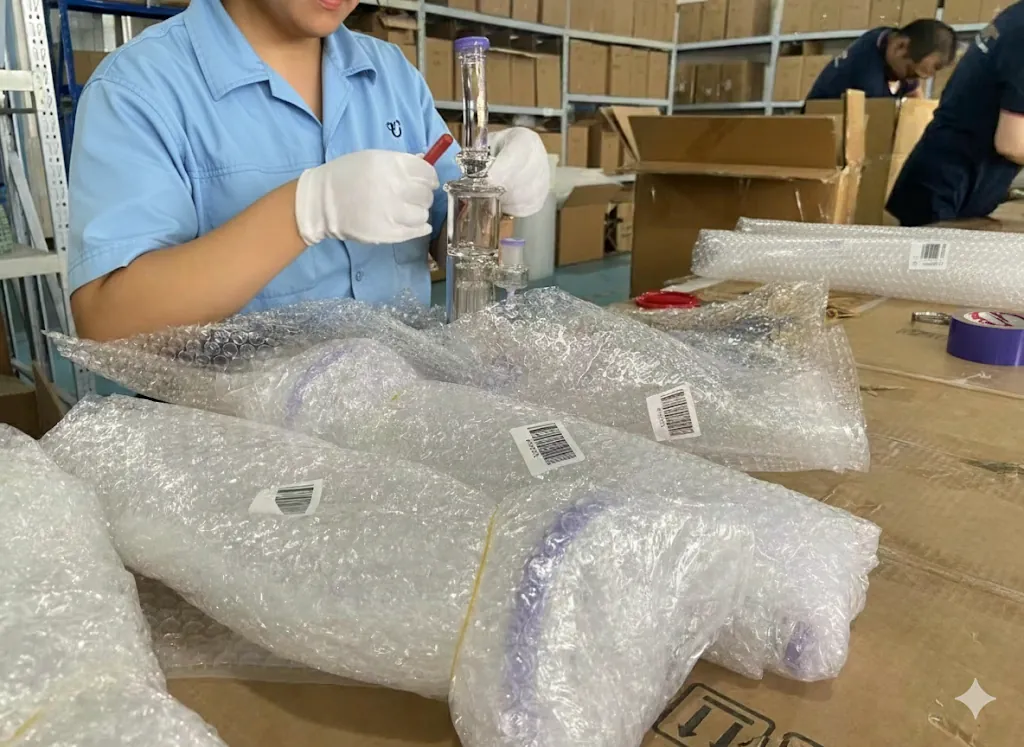
At Elfglass, we hold all three certifications (BSCI, WRAP, ISO 9001), maintain a 1,000 sqm production facility in Shenzhen with a team of 20 skilled workers, and produce up to 10,000 pieces per month. Our MOQ is 100 per design because we believe in meeting buyers where they are. Whether you are launching a new brand or expanding an existing product line, we structure our production runs to support your growth rather than gatekeep it.
The Negotiation Mindset: Partnership Over Adversarial Bargaining
The most successful MOQ negotiations do not feel like negotiations at all. They feel like two businesses solving a problem together. When you approach a glass pipe supplier with genuine interest in a long-term partnership, the conversation shifts from “Can you lower your MOQ?” to “How can we structure this order so it works for both of us?”
That shift matters. Suppliers who view you as a partner will proactively suggest alternatives—consolidated SKUs, phased deliveries, sample-first workflows. Suppliers who view you as a one-time transaction will quote their standard MOQ and move on to the next inquiry.
Bring your real numbers to the table. Tell the supplier what your budget allows, what your market can absorb, and what your reorder timeline looks like. The more information the factory has, the more creatively they can structure the order. And remember: a supplier who agrees to every MOQ request without pushback is not necessarily being flexible. They may be a trading company marking up factory prices, or they may not understand their own production constraints. A factory that explains why their MOQ exists—and then works with you to find a workable solution—is the partner you want.
Wrapping Up: 100 Pieces Is a Starting Line, Not a Barrier
MOQ does not have to be a dealbreaker. In the borosilicate glass pipe industry, a 100-piece minimum per design is already one of the more accessible entry points for B2B buyers. The strategies above—trial orders, SKU consolidation, volume scheduling, small-batch surcharges, and relationship building—are all proven ways to make that number work for your business.
The goal is not to push a supplier below their sustainable cost floor. The goal is to find a manufacturing partner who understands your stage, respects your constraints, and has the production expertise to deliver quality glass pipes at an order size that makes sense for both sides.
If you are ready to explore what a 100-piece trial order looks like for your brand, reach out to the Elfglass team. We will respond within 12 hours with a clear quote, an honest assessment of what is feasible, and no pressure to commit beyond what your business can support.
Frequently Asked Questions
What is MOQ in wholesale glass pipe sourcing?
MOQ (Minimum Order Quantity) is the lowest number of units a glass pipe factory will produce in a single order. In borosilicate glass pipe manufacturing, MOQs typically range from 100 to 500 pieces per design, depending on the complexity of the piece and the factory’s production setup.
Can MOQ be negotiated with glass pipe suppliers?
Yes, MOQ can often be negotiated, especially when you commit to a volume schedule, consolidate SKUs within a product family, or agree to a small-batch surcharge. Suppliers are more willing to flex when they see a clear path to repeat business.
How do I lower my MOQ with a Chinese glass pipe supplier?
Focus on building a transparent relationship, sharing your growth plan, and proposing structured commitments like phased deliveries. Offer to pay a modest surcharge for smaller batches, and demonstrate that you are a serious buyer by ordering samples first and following through on trial orders.
What happens if I order below the stated MOQ?
Most factories will either decline the order or apply a per-unit surcharge to cover their setup costs. Producing below MOQ means the fixed costs of mold preparation, furnace calibration, and QC setup are spread across fewer units, raising the per-piece price significantly.
Is a 100-piece MOQ realistic for a new glass pipe brand?
Yes. A 100-piece MOQ per design is one of the most common and achievable starting points for new brands in the glass pipe market. It balances production efficiency for the factory with manageable risk and investment for the buyer, especially for product categories like hand pipes and accessories.
About the Author
Ava Zeng is the founder of Elfglass, a Shenzhen-based borosilicate glass pipe manufacturer serving B2B brands worldwide. Every guide on this guide is grounded in her production-floor experience— the annealing lines, QC checkpoints, and export orders behind each claim.
Before you commit to a supplier, read her founder’s story and trust promise, and the guide to vetting a reliable glass pipe manufacturer— the same red-flag checklist Elfglass applies to its own suppliers.
MOQ flexibility is one of the levers described in minimum order quantity economics, where factory utilization rates determine how much volume can bend.
Ready to Source Custom Glass Pipes?
Get a free quote within 24 hours. MOQ from 100 pieces. NDA-protected design consultation.
