
Your Glass Pipe Design Is Worth Protecting — Here Is How
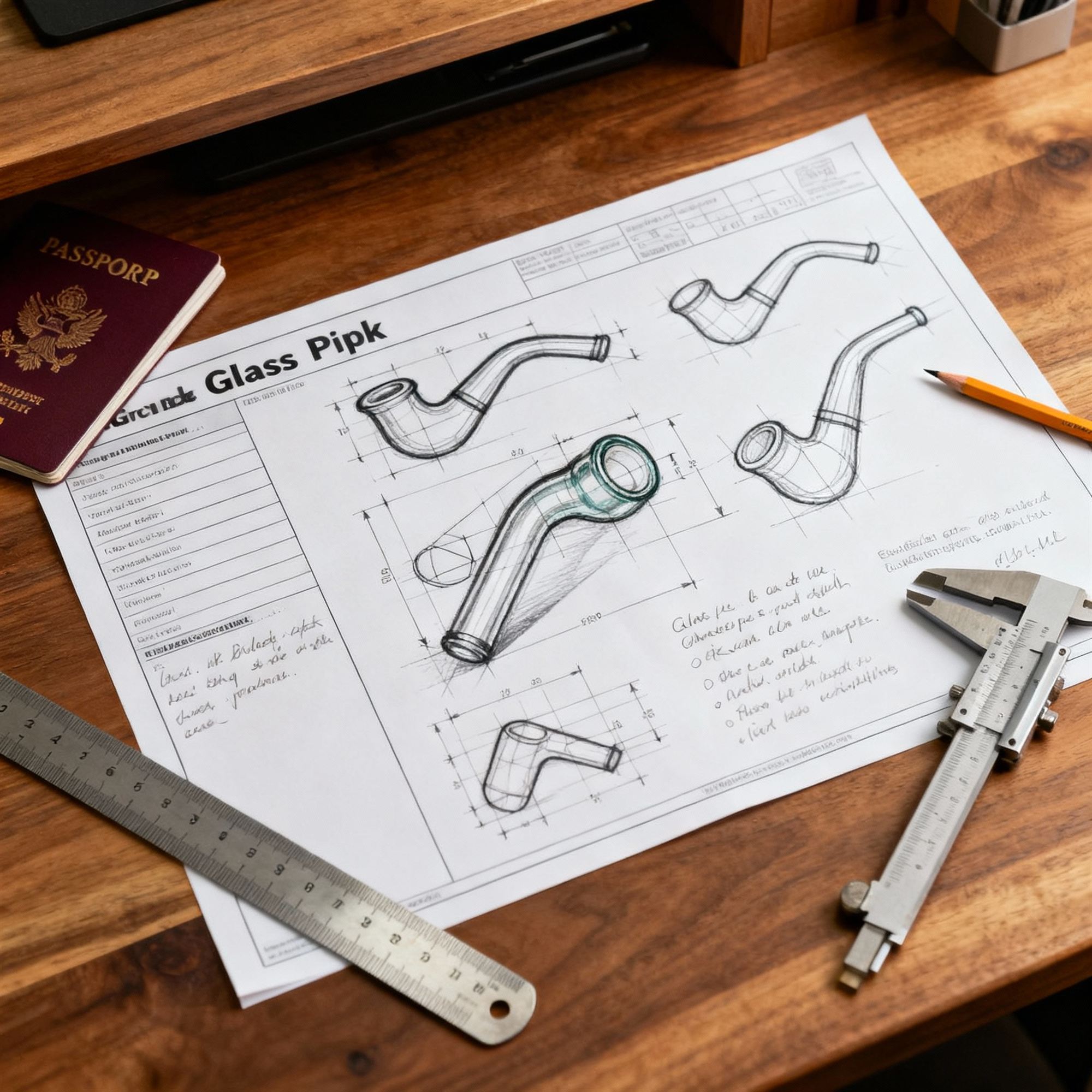
A smoke shop brand in Colorado spent 14 months developing a distinctive hand pipe shape — an ergonomic grip with a proprietary percolator pattern that produced visibly smoother hits. They commissioned molds at $2,800, tested 6 prototypes, and finally had a product that differentiated them from every other pipe on the shelf. Then they discovered that their Chinese supplier was selling the identical design to three other US buyers under a different SKU.
This is not a rare story. In the glass pipe industry, design theft between buyers — facilitated by suppliers who treat every custom design as a catalog addition — is a persistent problem. The legal frameworks for protecting glass pipe designs exist, but most buyers do not know they exist, and most suppliers do not volunteer the information. This article covers the specific intellectual property tools available to glass pipe buyers, how to use them at each stage of the sourcing relationship, and what to do when you discover your design has been copied.
What Can Actually Be Protected in a Glass Pipe Design
Not everything about a glass pipe is protectable. Understanding what qualifies — and what does not — prevents wasted legal spend and false confidence. The three forms of IP protection relevant to glass pipe designs:
| Protection Type | What It Covers | Duration | Cost (Approximate) |
|---|---|---|---|
| Design patent (US) | The ornamental appearance of a functional item — the unique visual shape of the pipe | 15 years from grant | $2,000–$5,000 (attorney + USPTO fees) |
| Utility patent (US) | A novel functional mechanism — e.g., a new percolator diffusion pattern that measurably improves filtration | 20 years from filing | $8,000–$15,000 (attorney + USPTO fees) |
| Trade dress | The overall visual impression of a product line that consumers associate with your brand — no registration required but harder to enforce | Indefinite (as long as used) | Enforcement costs only |
For most glass pipe brands, USPTO design patent guide. They protect the way a pipe looks — its silhouette, surface pattern, and ornamental features — without requiring you to prove functional novelty. The threshold is lower than a utility patent, the cost is manageable, and the protection is clear: nobody else can make, sell, or import a pipe that looks substantially the same as your patented design.
Utility patents are relevant only if you have invented a genuinely new functional feature — a new percolator geometry, a novel airflow mechanism, or a proprietary glass treatment. These are rare in the glass pipe space and expensive to obtain. Most product differentiation comes from design, not function, which makes design patents the right tool for most buyers.
The Mold Ownership Question: Where Design Protection Really Starts
Before you file any patent, address the contractual question that determines whether your design ever reaches a competitor’s catalog: who owns the molds.
In glass pipe manufacturing, the mold is the physical embodiment of your design. Whoever controls the mold controls production. Many buyers assume that because they paid for the mold, they own it. This assumption is wrong in many jurisdictions — particularly in China, where the factory may claim that the mold is their tooling and the buyer merely paid a “mold fee” for its use.
The fix is contractual. Your purchase order or supply agreement must explicitly state:
| Clause | What It Says | Why It Matters |
|---|---|---|
| Mold ownership | “All molds, tooling, and patterns created for or paid for by Buyer remain the exclusive property of Buyer” | Establishes legal ownership independent of physical possession |
| Mold exclusivity | “Supplier shall not use Buyer’s molds to produce goods for any third party” | Prevents the factory from running your design for other buyers |
| Mold location and access | “Molds shall be stored at Supplier’s facility, labeled with Buyer’s asset tags, and made available for inspection or removal upon 30 days’ notice” | Ensures you can retrieve your molds if you switch suppliers |
| Design confidentiality | “Supplier shall not disclose, photograph, display, or reproduce Buyer’s designs for any purpose other than fulfilling Buyer’s orders” | Prevents the factory from showing your design at trade shows or in their catalog |
| Penalty for breach | “Violation of mold exclusivity or design confidentiality shall result in liquidated damages of $[X] per incident plus immediate return of all molds” | Creates a financial deterrent, not just a contractual obligation |
These five clauses cost nothing to include in a contract but provide the foundation for legal enforcement if your design is copied. Buyers who skip the contract and rely on trust are the ones who discover their design in a competitor’s catalog 18 months later — with no legal basis to object.
Your Designs Stay Yours: NDA Before Every Project
Elfglass signs an NDA before any OEM conversation and clarifies mold ownership in writing up front. Send us your concept and we will put the protection terms in your quote.
MOQ from 100 pieces | BSCI / WRAP / ISO 9001 | NDA before every project
Design Patents in Practice: Filing Strategy for Glass Pipe Brands
If you have a distinctive pipe design worth protecting, here is the practical filing strategy:
Step 1: Document the Design Before Disclosure
Before showing your design to any supplier, create a dated record. Professional CAD drawings or high-resolution photographs from 6 angles (top, bottom, left, right, front, back) with a dated notarized statement. This establishes prior art — evidence that you created the design before anyone else. In the US, design patent protection requires the design to be novel; prior art documentation is your evidence of novelty date.
Step 2: File a US Design Patent Application
A design patent application requires: drawings (or photographs) showing the design from all views, a brief description, and filing fees ($1,000-$2,000 including attorney preparation). The USPTO examination typically takes 12-24 months. Once granted, you have the right to exclude others from making, using, or selling a substantially similar design in the US.
Step 3: Consider International Filing
US design patents only protect within the United States. If your market includes the EU, UK, or other jurisdictions, consider:
| Jurisdiction | Protection Type | Key Feature |
|---|---|---|
| European Union | Registered Community Design (RCD) | Single registration covers all 27 EU member states; 3-month grace period for disclosure |
| United Kingdom | UK Registered Design | Post-Brexit equivalent to RCD; separate application required |
| China | Chinese Design Patent | Essential if your supplier is in China — provides basis for customs seizure of infringing exports |
| International | WIPO Hague System | Single international application designating multiple countries; cost-effective for 3+ jurisdictions |
The Chinese design patent is particularly important for glass pipe buyers who source from China. Without a Chinese design patent, you have no legal basis to prevent your supplier from making your design for other buyers — Chinese law does not recognize US design patents as enforceable within China. A Chinese design patent costs approximately $500-1,500 and takes 4-6 months to grant. It also provides the basis for Chinese customs to seize infringing exports — a powerful tool if you discover another buyer importing your design from your supplier.
What to Do When You Discover Your Design Has Been Copied
Despite contracts and patents, design copying still happens. When it does, the response should be measured and strategic:
Step 1: Document the infringement. Purchase the infringing product (through a third party if possible, to avoid tipping off the competitor). Photograph it alongside your original design. Note the seller, the source, and the date. This evidence is the foundation of any legal action.
Step 2: Review your IP portfolio. Do you have a design patent? A signed mold ownership agreement? A confidentiality clause? Your enforcement options depend entirely on what legal rights you hold. If you have none of these, your options are limited — which is why the preventive steps above matter.
Step 3: Send a cease-and-desist letter. If you have a design patent or contractual rights, a letter from an IP attorney typically resolves the issue without litigation. Most suppliers and competitors will stop selling an infringing design when confronted with credible legal evidence — the cost of defending a patent infringement lawsuit far exceeds the revenue from one copied design.
Step 4: File a customs recordation. In the US, you can record your design patent with US Customs and Border Protection (CBP). If infringing goods are imported, CBP can seize them at the border. This requires a valid US patent and a recordation fee of approximately $190 per IP right. It is one of the most cost-effective enforcement tools available.
Practical Design Protection Checklist for Glass Pipe Buyers
| Stage | Action | Timing |
|---|---|---|
| Before design is finalized | Document with dated photographs/CAD drawings | Before sharing with any supplier |
| Before mold is commissioned | Sign supply agreement with mold ownership + exclusivity + confidentiality clauses | Before paying mold fee |
| After design is finalized | File US design patent application | Within 12 months of first public disclosure (or before disclosure for international filings) |
| If sourcing from China | File Chinese design patent | Before first production run |
| Ongoing | Monitor competitor catalogs and Alibaba/1688 listings for copies | Quarterly |
| If infringement found | Document → review IP portfolio → cease-and-desist → customs recordation | Immediately upon discovery |
Learn more about our custom design and manufacturing process.
Learn more about discuss your custom design project with Elfglass.
Protecting your glass pipe design starts with the right manufacturing partner. Elfglass signs mold ownership agreements, design confidentiality NDAs, and exclusivity commitments with every custom-order buyer. Discuss your custom design project — we will walk you through the IP protection framework before production begins.
For related reading, see our writing a clear inquiry to your glass pipe factory for a detailed breakdown.
For related reading, see our glass pipe surface finish options for a detailed breakdown.
Ready to Start Your Custom Glass Pipe Project?
Get a free quote within 24 hours. MOQ from 100 pieces. NDA-protected design consultation.
About the Author
Ava Zeng has spent over 16 years at Elfglass managing custom design projects and OEM partnerships. She has navigated mold ownership disputes, design patent filings, and cross-border IP enforcement — and developed the contractual frameworks that protect buyers’ designs from factory-floor copying.
Frequently Asked Questions
Can I patent a glass pipe design?
Yes. In the US, a design patent protects the ornamental appearance of a glass pipe for 15 years. The application requires drawings from multiple views and costs approximately $2,000-$5,000 including attorney fees. The design must be novel — you cannot patent a shape that already exists in the market.
Does my US design patent protect me in China?
No. US patents are only enforceable within the United States. If your supplier is in China, you need a separate Chinese design patent to prevent them from making your design for other buyers. Chinese design patents cost approximately $500-1,500 and take 4-6 months to grant. They also enable Chinese customs to seize infringing exports.
What if my supplier copies my design without a patent?
Without a patent or contractual protection, your options are limited. You may have trade dress rights if the design is strongly associated with your brand, but enforcement is expensive and uncertain. This is why preventive measures — mold ownership contracts, confidentiality agreements, and design patent filings — should be in place before production begins.
How do I ensure my supplier does not sell my design to other buyers?
Three layers of protection: (1) A supply agreement with mold exclusivity and design confidentiality clauses, including liquidated damages for breach. (2) A design patent in the relevant jurisdictions (US + China if sourcing from China). (3) Ongoing monitoring of competitor catalogs and online marketplaces for copies. No single measure is sufficient — the combination creates enforceable protection.
How much does it cost to protect a glass pipe design internationally?
Budget approximately $3,000-$8,000 for comprehensive protection: US design patent ($2,000-$5,000), Chinese design patent ($500-$1,500), and EU Registered Community Design ($500-$1,500). If you need protection in 3+ countries, the Hague System can reduce filing costs. Add $500-$1,000 for attorney review of supply agreements. This investment protects designs that may generate tens of thousands in annual revenue.
