
Every wholesale glass pipe buyer has heard the horror stories: a supplier looks perfect on Alibaba, the price is right, the samples pass inspection, and then the full order arrives with cracked joints, mismatched colors, and wall thicknesses that would not hold up to a single drop test. The common thread in every one of these disasters is the same: the buyer skipped manufacturer verification.
Key Takeaways
- Business license verification is the floor, not the ceiling. Check registration, scope, and expiration through official government databases.
- Factory audits reveal production reality. A supplier who refuses an audit is hiding capacity constraints, subcontracting, or quality gaps.
- Sample evaluation must include destructive testing. Visual inspection alone misses wall thickness variance, annealing quality, and joint alignment.
- Reference checks with existing buyers uncover patterns that no certificate can show.
- Payment structure is your last line of defense. Never release full payment before shipment inspection passes.
Step 1: Verify the Business License
The first action is pulling the supplier’s business license from China’s National Enterprise Credit Information Publicity System (NECIPS). This free government database shows the company’s registered name, legal representative, registered capital, business scope, and operating status. If the supplier’s scope lists “retail” or “consulting” but not “manufacturing,” you are dealing with a trading company, not a factory.
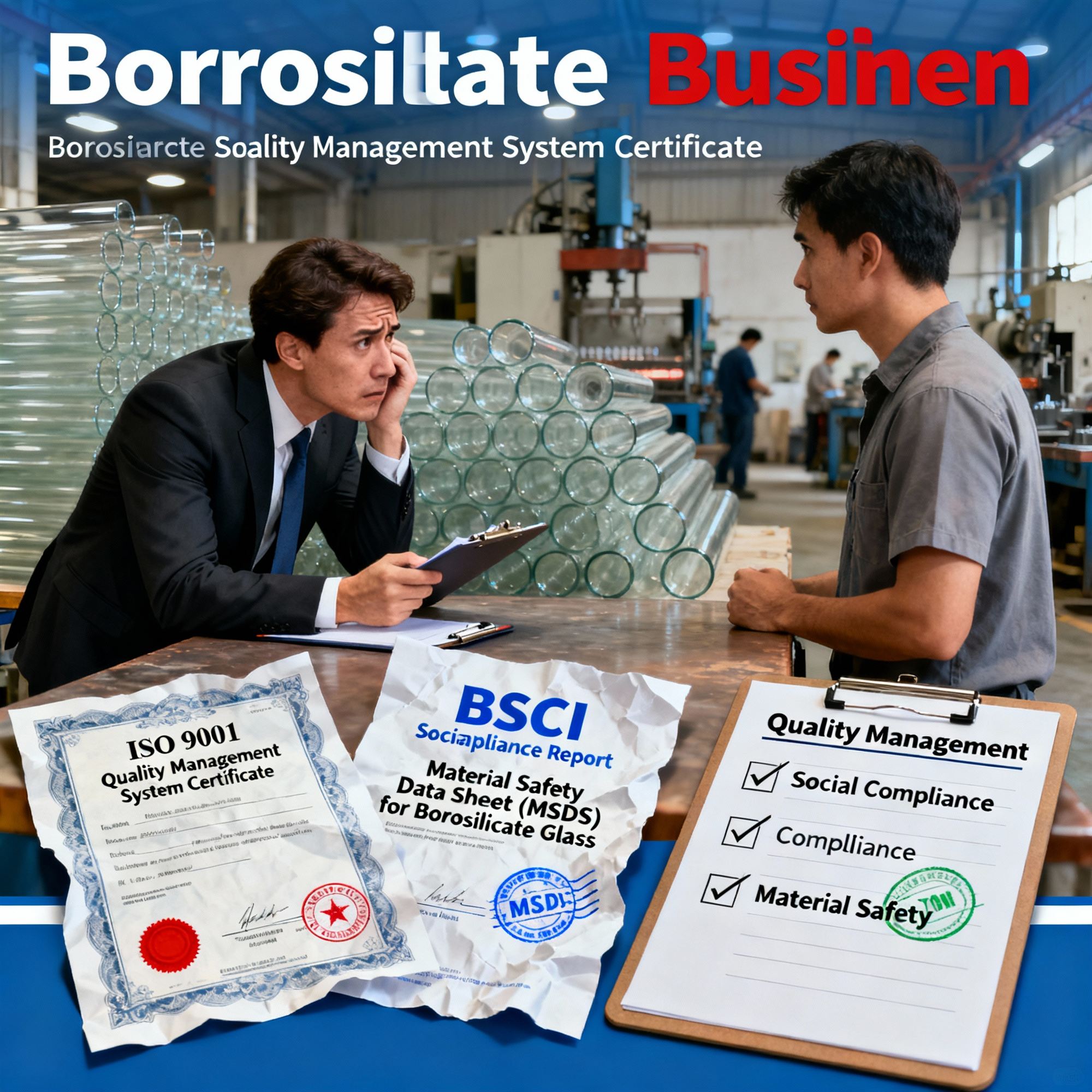
Cross-check the registered address against satellite imagery. A legitimate glass factory sits in an industrial zone with loading docks and kiln infrastructure. If the address maps to a high-rise office suite, the “manufacturer” is a middleman. Verify the ISO 9001 quality management standard certification claimed by the supplier through the issuing body’s public registry.

Step 2: Request a Factory Audit
A factory audit is not optional. It is the single most important step in separating real manufacturers from trading companies and fly-by-night operations. There are three types of audits to consider:
- Desktop audit: The supplier submits documents remotely. Low cost but low confidence. Useful as a first screen only.
- Third-party on-site audit: Firms like SGS, Bureau Veritas, or QIMA send an inspector to the factory. Cost ranges from $300 to $800 per man-day. The report covers production capacity, QC processes, equipment condition, and workforce size.
- Buyer-conducted audit: You or your local agent visit the factory personally. This is the gold standard because you see everything the supplier does not want you to see: the scrap pile, the rework station, the subcontracting workshop next door.
During the audit, check that the kiln temperature controllers match the borosilicate annealing profile (typically 560 degrees C for 3-5 hours). Verify that QC stations have calibrated measurement tools. Count the number of active production lines and compare to the supplier’s claimed monthly output.
Step 3: Evaluate Production Samples
Never approve a supplier based on catalog photos or video calls alone. Request 3-5 production samples of your exact specification and run the following tests:
| Test | Method | Pass Criteria |
|---|---|---|
| Wall thickness | Ultrasonic gauge at 5 points | Within +/- 0.3mm of spec |
| Joint fit | Mate with standard 14mm/18mm bowl | No wobble, no gap at seal |
| Thermal shock | Boil water, pour, wait 60 seconds, cold rinse | No cracks or crazing |
| Weight consistency | Digital scale, 10-unit sample | Coefficient of variation under 5% |
| Visual inspection | Bubble, streak, devitrification check | Zero visible defects at arm’s length |
If the supplier refuses to send samples or charges an unreasonable sample fee (over $50 per piece for standard items), treat this as a red flag. Legitimate manufacturers understand that sampling is the cost of doing business with new wholesale buyers.
Step 4: Check References and Track Record
Ask the supplier for contact information of at least two current wholesale buyers in your target market. Call them. Ask specifically about on-time delivery rate, defect rate on arrival, responsiveness to claims, and whether they would reorder. A supplier with no references or only domestic Chinese clients is untested in export compliance and international logistics.
Also check the supplier’s Alibaba supplier verification program history, including transaction volume, buyer reviews, and years on the platform. Cross-reference with any negative reports on trade forums or B2B complaint boards.
Step 5: Structure Payment to Protect Yourself
Your payment structure is the final verification gate. The standard B2B terms for a new supplier relationship are 30% deposit, 70% balance paid after pre-shipment inspection passes. Never pay 100% upfront. Never agree to full balance before goods are inspected. If the supplier demands full payment before shipment, they have already decided what your order is worth to them, and it is not quality.
Use Trade Assurance or escrow services for your first two to three orders. This gives you a dispute resolution path if the goods arrive non-conforming. After you have built trust over multiple successful orders, you can negotiate more flexible terms like net-30 or open account.
Need Help Vetting Your Next Glass Pipe Supplier?
Let Our Factory Transparency Work for You
Elfglass welcomes buyer audits at any stage. We provide full documentation packages including business licenses, ISO certificates, and third-party audit reports. Explore our custom glass pipe manufacturing services
Frequently Asked Questions
What documents should a legitimate glass pipe manufacturer provide?
A legitimate glass pipe manufacturer should provide a current business license, ISO 9001 or equivalent quality management certificate, MSDS for raw materials, and a factory audit report from a recognized third party such as SGS or Bureau Veritas. They should also supply references from at least two current wholesale buyers.
How do I check if a glass pipe factory actually exists?
Start by searching the Chinese National Enterprise Credit Information Publicity System for the company registration. Cross-reference the address with satellite imagery and request a live video tour. Verify their Alibaba or Made-in-China storefront has been active for at least two years with transaction history.
Can I trust a glass pipe supplier who refuses a factory audit?
No. A supplier who refuses third-party or buyer-conducted factory audits is hiding something. Legitimate manufacturers welcome audits because they demonstrate transparency. If a factory claims scheduling conflicts, propose a random-date clause in your purchase contract.
What red flags indicate a glass pipe manufacturer is a trading company?
Red flags include a factory address that maps to an office building rather than an industrial zone, inability to show production equipment during video calls, no in-house QC staff, and quotes that are significantly below market rate with vague specifications.
Ready to Start Your Next Glass Pipe Project?
Whether you need help verifying a new supplier, setting up quality control, or scaling your wholesale orders, the Elfglass team is ready to support your business. contact our team today and let us show you what a transparent, quality-focused manufacturing partner looks like.
About the Author
Ava Zeng is the founder of Elfglass, a borosilicate glass pipe manufacturer based in Cangzhou, China. With over 12 years of hands-on experience in glass manufacturing and international B2B trade, Ava has helped hundreds of smoke shops, head shops, and distributors across North America, Europe, and Australia build profitable glass product lines. She oversees every OEM project from design brief to final shipment, and writes from the factory floor rather than the marketing department.
