
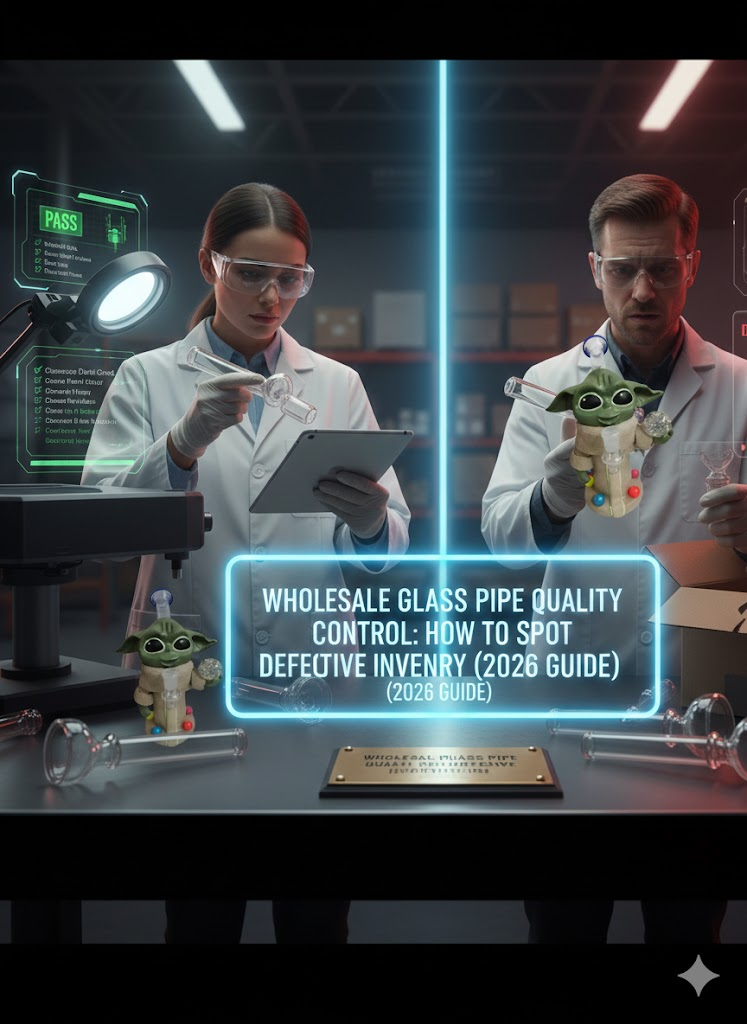
Strict wholesale glass pipe quality control (QC) protocols are the only defense against a warehouse full of shattered inventory.
While generic hand pipes may offer lower FOB pricing on paper, neglecting critical physical inspections leads to immediate retail breakage, negative reviews, and costly warranty claims.
Buyers relying on visual inspections through compressed Alibaba photos or generic supplier videos often miss the structural instability inherent in cheap “soft glass” imports.
A pipe might look beautiful on a screen, but if it rolls off a display counter or cracks during its first cleaning, your wholesale margin is instantly destroyed.
This comprehensive guide defines the specific inspection metrics for Borosilicate 3.3 verification, internal stress detection, and the critical “Anti-Roll” flat-bottom engineering.
We benchmark production output against ASTM C336 annealing standards to ensure your stock minimizes returns and maximizes shelf life.
The “Anti-Roll” QC Check: Engineering for Retail Survival
The most common cause of hand pipe breakage doesn’t happen during shipping; it happens on the retail display counter or the end-user’s coffee table.
The Defect: The “Round Bottom” Flaw Cheap, mass-produced spoons are often blown quickly as perfect teardrops.
When placed on a flat surface, their center of gravity is unstable.
A slight vibration or bump causes the pipe to roll over, dropping the bowl’s contents or, worse, rolling completely off the table and shattering.
The Elfglass Standard: The “Flat-Bottom” Base Proper wholesale glass pipe quality control requires a physical “Anti-Roll” check.
-
The Test: Place the Spoon pipe on a completely flat, hard surface (like a glass display case). Nudge the mouthpiece gently with one finger.
-
The Result: A defective pipe will roll onto its side. A properly engineered pipe will wobble slightly but immediately self-correct and remain upright.
-
The Engineering: During manufacturing, our artisans use a graphite paddle to stamp a precise flat plane on the bottom of the bowl while the glass is still semi-molten. This stabilizes the unit, drastically reducing in-store shrinkage for head shops and frustration for the end-user.
Visual Inspection: Spotting the “Invisible” Defects
Before a product is packed into our Elf-Guard Air Columns, it must pass an AQL 2.5 Level II visual inspection.
Here is what you must look for when auditing a supplier’s sample:
1. Seed Bubbles (Air Trapped in Glass)
-
The Defect: Tiny air bubbles trapped within the wall of the glass.
-
The Danger: In soft glass or poorly melted borosilicate, these bubbles expand and contract at different rates than the surrounding glass when heated. This creates micro-fractures that eventually cause the pipe to burst.
-
The QC Check: Hold the pipe up to a strong LED light. If you see clusters of pinhole bubbles, reject the batch.
2. Draft Hole Precision (The Clog vs. Snap-Through Test)
-
The Defect: Cheap pipes often have draft holes (the hole at the bottom of the bowl) that are either too narrow or too wide.
-
The Danger: If it’s under 2mm, the pipe will clog with resin after two uses. If it’s over 5mm, burning ash will snap through the pipe and burn the user’s throat.
-
The QC Check: We engineer and verify every draft hole to a strict 3mm-4mm tolerance. This width maintains optimal airflow while physically blocking ash pullback.
3. Uneven Wall Thickness
-
The Defect: One side of the bowl is 5mm thick, while the opposite side is stretched to a fragile 1.5mm.
-
The Danger: Uneven walls heat unevenly. The thin side will shatter when exposed to a direct butane lighter flame.
-
The QC Check: Use digital calipers to measure the thickness around the carb hole (the weakest point). We maintain a tolerance of ±0.2mm on all heavy-wall pipes.
Material & Annealing Verification: The Science of Durability
The most dangerous defects in glass blowing are invisible to the naked eye.
This is where technical wholesale glass pipe quality control separates real manufacturers from trading companies.
The Soft Glass Trap (Soda-Lime vs. Borosilicate 3.3) Many competitors cut costs by utilizing “Soft Glass” (Soda-Lime) sourced from India or Mexico.
-
The QC Test (Thermal Shock): If you take a room-temperature soft glass pipe and drop it into boiling water (a common cleaning method), it will crack instantly.
-
The Elfglass Standard: We strictly use High Borosilicate Glass 3.3. It survives repeated heat cycles and boiling water. You are choosing between inventory that lasts a week and inventory that lasts years.
The Polarized Light Test (Annealing Verification) Manufacturing creates internal stress within the glass. If a factory rushes the cooling cycle, that stress remains locked inside.
-
The Defect: “Shelf-Shatter.” A pipe that looks perfect but spontaneously cracks two months later sitting on a shelf.
-
The QC Check: By placing the glass between two polarized polarizing filters (a Polariscope), internal stress shows up as bright, rainbow-colored bands.
-
The Solution: We strictly adhere to ASTM C336 annealing protocols. Our pipes undergo a programmed cooling cycle at 1050°F (565°C) to neutralize all internal stress points.
Applying QC Standards to the “Golden 4” Hand Pipe Shapes
Different shapes require different wholesale glass pipe quality control focal points.
If you are stocking the “Golden 4” to cover 90% of consumer demand, here is how you audit each specific SKU:
#1 The Spoon (Daily Driver – 80% Volume)
-
Role: High Rotation, standard daily use.
-
Specific QC Focus: The “Anti-Roll” flat bottom is mandatory. Additionally, the carb hole placement must be ergonomic (usually left-side) and fire-polished to ensure it isn’t sharp to the touch.
#2 The Chillum (Point-of-Sale Impulse Buy)
-
Role: Volume add-on, counter jar ready ($5-$10 retail).
-
Specific QC Focus: Draft hole precision is everything here. Because the travel path is so short, a draft hole exceeding 4mm will result in a terrible user experience (inhaling ash). We verify every chillum with gauge pins.
#3 The Sherlock (The Aesthetic Premium)
-
Role: Aesthetic upgrade, premium pricing for collectors.
-
Specific QC Focus: The Sherlock’s “S” curve is a major stress point. If the glass is bent too quickly during production without proper wall thickness preservation, the neck will snap. We mandate heavy-wall tubing (>5mm) for the curved stem and verify it under polarized light. Furthermore, the fuming (silver/gold) must be evenly distributed to ensure the “color-changing” effect blooms beautifully as resin builds.
#4 The Hammer Bubbler (Hybrid Upsell)
-
Role: High Average Order Value (AOV), portable water filtration.
-
Specific QC Focus: Internal weld integrity. A bubbler features an internal downstem attached to the outer wall. Cheap factories use weak “Spot Welds” here. We use reinforced Dewar Seals to ensure the internal percolator does not snap off if the unit is tapped against an ashtray.
Final Thoughts: Don’t Pay for Broken Promises
Sourcing cheap “soft glass” imports might save you a few cents on the initial invoice, but it creates massive long-term liability through high breakage rates and lost customer trust.
Effective wholesale glass pipe quality control is not an afterthought; it is the foundation of your brand’s profitability.
Our Borosilicate 3.3 standard withstands thermal shock and physical impact, ensuring your inventory survives from our Shenzhen factory to your retail counter.
A precision-engineered flat bottom and strict ASTM C336 annealing is the difference between a high-rotation staple and a shattered return.
Verify the Quality Yourself Stop guessing on durability and test the “Anti-Roll” stability and wall thickness yourself with a curated Sample Kit.
We provide “Golden Samples” before mass production to align with your specific fuming and branding requirements.
Turn Creative Dreams Into Precision Glass Reality Bypass the communication chasm with our dedicated 12-person R&D team that delivers technical 3D models in just 24 hours.
Scale your inventory with scientifically annealed Borosilicate 3.3 glass that reduces breakage and maximizes your B2B ROI.
Turn Creative Dreams Into Precision Glass Reality

Frequently Asked Questions
What is the “Anti-Roll” check for spoon pipes?
The “Anti-Roll” check is a physical test where a spoon pipe is placed on a flat surface and gently nudged.
A well-engineered pipe features a pressed flat bottom on the bowl, allowing it to self-correct and stay upright.
Defective, round-bottom pipes will roll over, significantly increasing the risk of dropping and breaking in retail settings.
How do you spot internal stress in a glass pipe?
Internal stress is invisible to the naked eye but acts as a ticking time bomb for breakage.
Professional manufacturers use a Polariscope (two polarized light filters).
When viewed through this tool, stressed glass displays bright rainbow bands.
We eliminate this stress using strict ASTM C336 annealing cycles in our kilns at 1050°F.
What is the ideal draft hole size for a hand pipe?
Through extensive R&D, we mandate a draft hole tolerance of 3mm to 4mm.
If the hole is smaller than 3mm, the pipe will quickly clog with resin.
If it is larger than 4mm, it creates a “snap-through” effect, allowing burning ash to enter the user’s mouth.
How can I tell the difference between Borosilicate and Soft Glass?
Soft Glass (Soda-Lime) is generally heavier but much more brittle, and it cannot handle rapid temperature changes.
If you submerge a room-temperature soft glass pipe in boiling water, it will crack (Thermal Shock).
Borosilicate 3.3 (which we use exclusively) expands at a much lower rate and will survive extreme heat changes, making it far superior for smoking accessories.
What is an acceptable defect rate for wholesale glass pipes?
In high-volume B2B sourcing, perfection is a myth due to the organic nature of glassblowing, but defects should be strictly managed.
We operate under AQL 2.5 Level II standards, meaning our acceptable major defect rate is under 2.5%.
Anything higher suggests the factory lacks proper Quality Control segregation (the “Red Bin” protocol).
