
I still remember the first time a buyer told me that our sample arrived before he expected it. He said he almost did not recognize the package when it showed up on his desk because he had mentally prepared himself to wait another two weeks. That moment stayed with me. It was not about logistics. It was about the weight of expectation and what happens when someone decides to carry that weight for you instead of making you carry it alone.
At Elfglass, we have built our entire sampling process around a single conviction: when a factory treats your timeline as sacred, it treats your business as sacred. This is not a marketing slogan. It is the operating principle behind every sample we cut, inspect, and ship within one to three days of receiving a request.
When Speed Becomes Respect for Buyers
There is a philosophy we practice at Elfglass that I have carried since the day I founded this company in 2010. I call it Speed is Sacred Respect. The idea is simple but difficult to execute consistently. Every buyer who contacts us is working under pressure. Their pressure might be a trade show date, a retailer who has promised shelf space, a seasonal demand window, or simply the quiet anxiety of having invested money and waiting to see whether the product matches the vision. None of that pressure is unreasonable. All of it is real.
When we receive a sampling request, I want my team to understand that the person on the other end is not being impatient. They are being vulnerable. They have told their investors, their retail partners, or themselves that this product will exist and will be good. Our job is to confirm that belief as quickly as possible or to give them honest feedback early enough to adjust. That is what fast sampling means to me. It is not about moving fast for its own sake. It is about moving fast because someone is waiting, and waiting without information is a particular kind of suffering that I remember from my own early years in this industry. A 1–3 day sample window follows the rapid prototyping principle, where short feedback loops catch design errors before tooling money is committed.
The Hidden Cost of Waiting Weeks
Let me be direct about what happens when sampling takes four, five, or six weeks, which is the norm at many large glass factories. The buyer sends a design. The factory queues it behind production orders already running. Three weeks pass before anyone picks up the request. Then the sample is made, inspected, packed, and shipped. Another week for international delivery. By the time the buyer holds the sample, a month or more has elapsed. In that month, a trade show date has moved closer. A retailer has asked twice for an update. A competitor has launched a similar piece. The window of opportunity has narrowed, and nobody in the supply chain had a conversation about it.
The cost of slow sampling is not abstract. It is measured in missed launch windows, in retailer confidence that erodes with every delayed email, in extended time-to-revenue that strains cash flow for small brands. I have watched buyers lose entire seasonal campaigns because their supplier treated sampling as a low-priority afterthought. The sample itself might have been perfect. The timing was not. And in wholesale glass, timing is not separate from quality. A perfect pipe that arrives after the market has moved is not a perfect pipe. It is a lesson.

Small Factory Floor Means Zero Queue
People sometimes ask me how we manage one to three day sampling when larger factories need weeks. The answer is structural, not magical. Our factory is 1,000 square meters. We have twenty employees. Everyone knows everyone. When a sampling request comes in, I can walk to the workbench where it will be made and speak directly to the person making it. There are no scheduling layers. There is no queue of fifty orders ahead of your sample. There is no department that needs to approve the request before another department begins sourcing materials.
This is the small factory advantage in its purest form. Our monthly capacity is 10,000 pieces, which means we are never so overloaded that sampling becomes an inconvenience. We produce water pipes, hand pipes, dab rigs, and accessories for OEM and ODM wholesale clients, and our MOQ is 100 pieces per design. That scale, which some might consider modest, is precisely what allows us to treat every sampling request as urgent. When you work with a factory running 100,000 pieces a month, your sample is one of ten thousand priorities. When you work with us, your sample is one of perhaps five things happening that week. The difference in attention is not subtle.
Inspect Real Production Glass Before You Commit
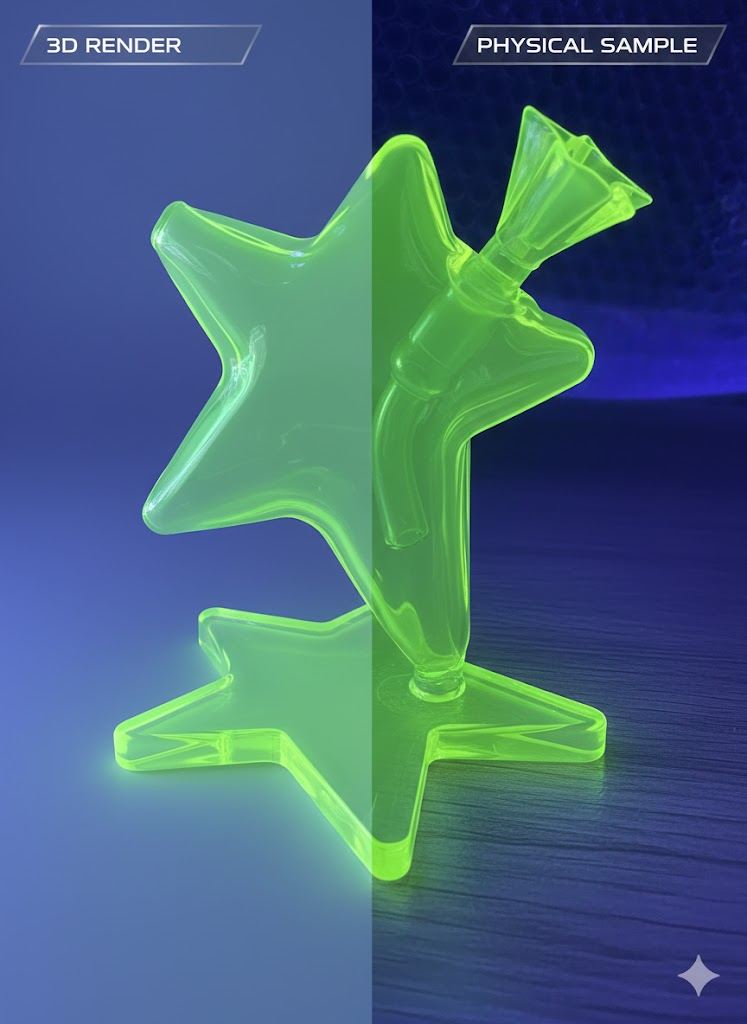
We ship COE 3.3 borosilicate samples in 1 to 3 days and back every order with a documented QC process and inspection report. Request a sample kit and judge the wall thickness, color, and finish yourself.
MOQ from 100 pieces | BSCI / WRAP / ISO 9001 | NDA before every project
What Fast Sampling Validates Before Production
Speed without accuracy is just expensive haste. When we say one to three days, we mean one to three days to produce a sample that accurately represents what your full order of 100 or more pieces will look like. The sample validates glass thickness, joint angles, percolator function, color consistency, and overall form. It is the physical contract between what you imagined and what we will manufacture. Getting this wrong at the sampling stage means getting it wrong across an entire production run, and that is a cost neither of us can afford.
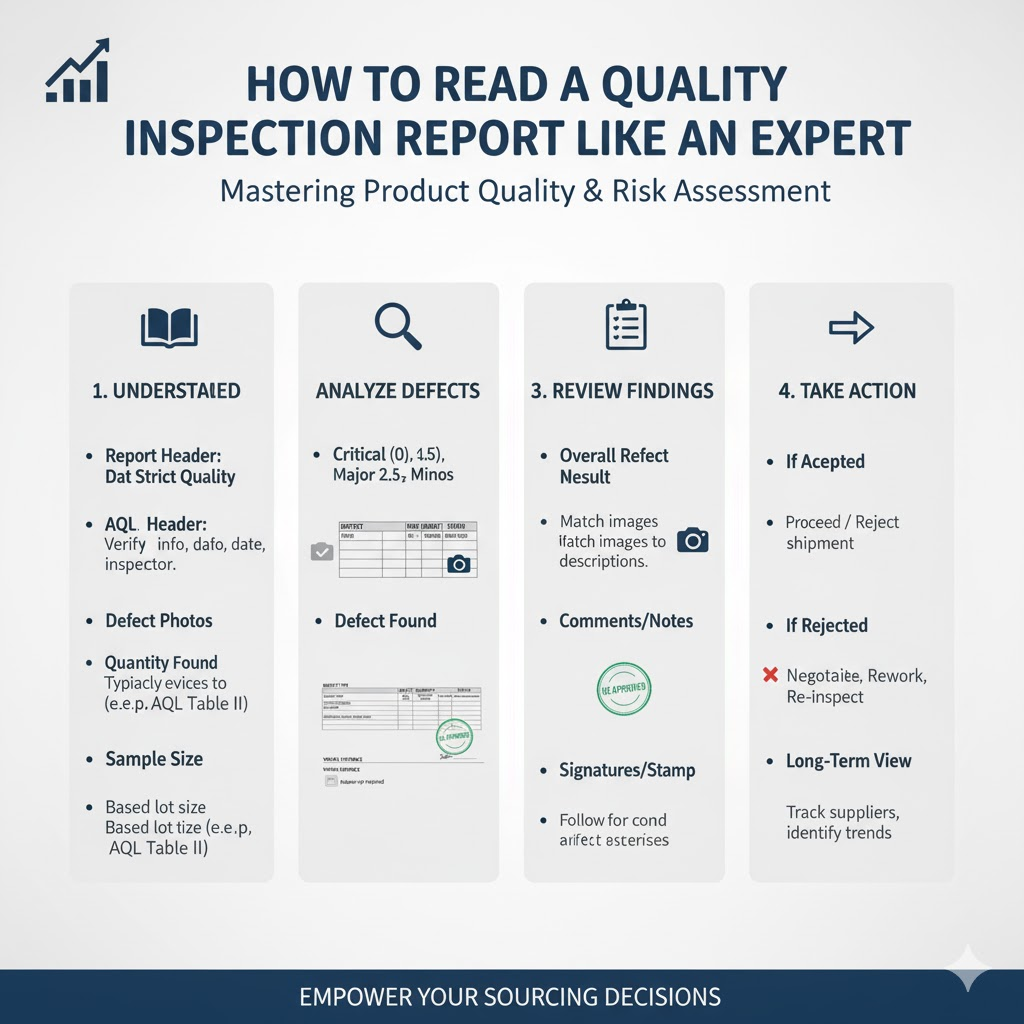
This is why our sampling process includes careful inspection before the piece leaves the factory. We check tolerances, we test fit and function, and we photograph the sample from multiple angles so you can evaluate it before it even arrives at your door. For buyers sourcing wholesale water pipes or custom dab rigs, this step is critical. A water pipe with a slightly misaligned downstem might still function, but it will not meet the standard you promised your customers. The sample catches that before a hundred units ship.
The Empathy Behind Every Sample Shipped
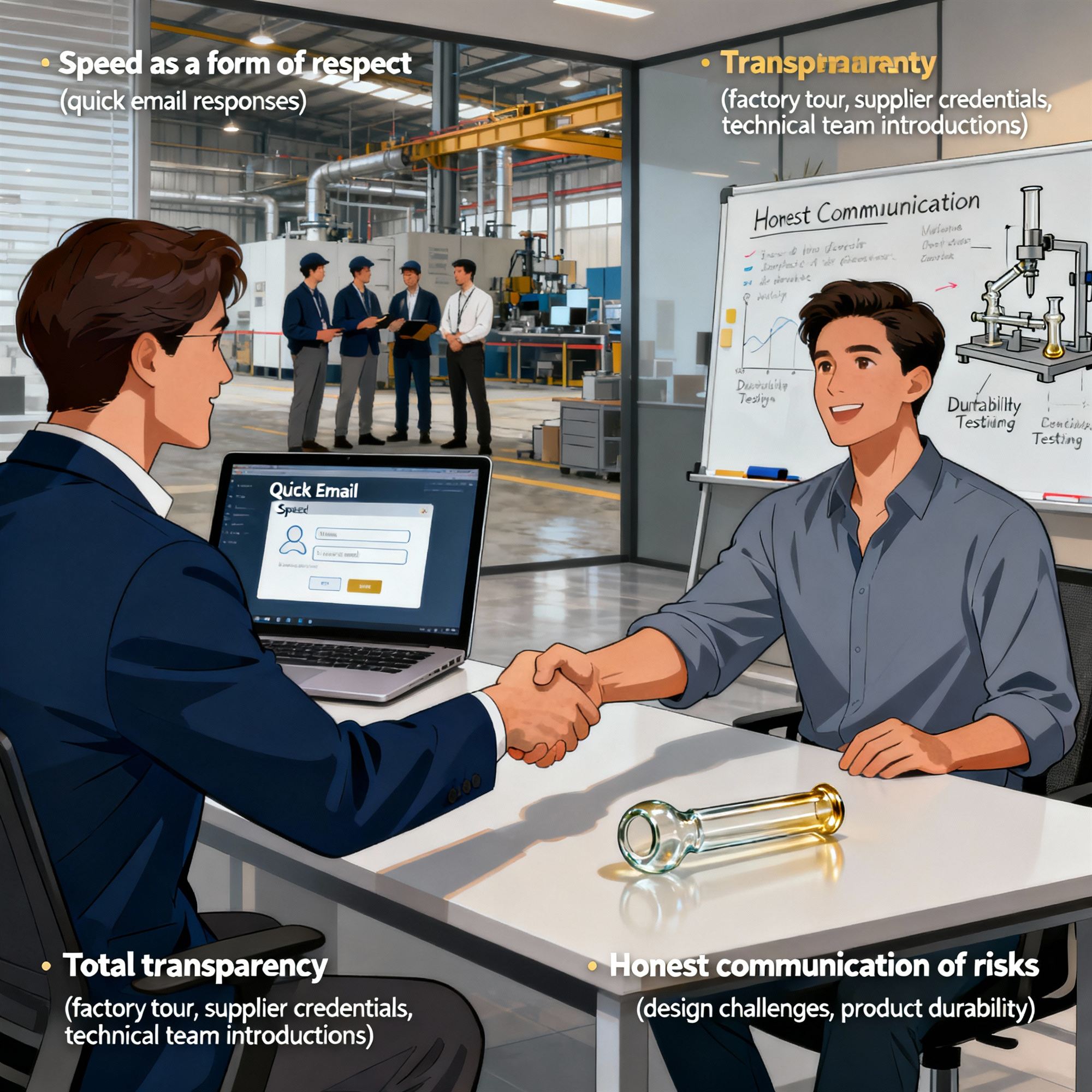
I have said many times that what kills a great idea is never the technology, but the communication gap and a lack of empathy. In sampling, empathy looks like this. We understand that you checked your tracking number this morning. We understand that you have a meeting next Tuesday where you need to show something physical to your team. We understand that if we cannot send you a sample quickly, you will find someone who can, and you will be right to do so. This is not pressure. This is respect for the reality of your position.
Our certifications, BSCI, WRAP, and ISO 9001, exist to give you confidence in our systems. But systems alone do not make a supplier responsive. What makes a supplier responsive is the willingness to see the human on the other side of the order. When our team stays late to finish a sample so it catches the next day’s courier pickup, that is not because our quality manual requires it. That is because someone in our office understood that the person waiting for that sample has been refreshing their email all afternoon. That kind of empathy cannot be certified. It can only be practiced.
Your Launch Timeline Deserves Sacred Treatment
If you are reading this, you are probably evaluating suppliers for a product launch that matters to you. I want you to consider what it means to work with a factory that views your timeline not as a constraint to manage but as a commitment to honor. One to three day sampling is not our fastest possible speed. It is our standard speed. It is what happens when a team of twenty people in a 1,000 square meter factory decides that every request deserves immediate attention.
Production takes seven to twelve days for orders of 100 pieces and above. That timeline is built on the same foundation as our sampling. Clear communication, no unnecessary layers, and the understanding that your launch date is not a suggestion. If you would like to discuss a sampling request or simply learn more about how we work, I invite you to reach out directly. I read every inquiry myself, and I respond with the same urgency I would want if I were in your position.
For a detailed comparison, see our guide on first OEM project timeline.
Frequently Asked Questions About Fast Glass Pipe Sampling
How fast can I receive a sample of my custom design?
For most custom glass pipe designs, we produce and ship samples within one to three business days of receiving your design specifications. Complex pieces with multiple percolators or unusual color work may require an additional day, but we will always communicate the exact timeline before we begin. Sample material checks align with the property framework in ISO 3585, the international standard for borosilicate glass, giving buyers measurable reference points for thermal and chemical resistance.
What does the sampling process validate before full production?
The sample confirms glass thickness, joint alignment, percolator function, color accuracy, and overall proportions. It serves as the physical reference for your full production run. Any adjustment identified at the sampling stage is incorporated before we begin manufacturing your order of 100 or more pieces, preventing costly corrections later.
Why can Elfglass sample faster than larger glass factories?
Our 1,000 square meter factory with twenty employees operates without the scheduling layers and production queues that slow down larger facilities. With a monthly capacity of 10,000 pieces, we always have the bandwidth to prioritize sampling requests immediately rather than placing them behind existing production orders.
Is there a minimum order quantity after sampling?
Our MOQ is 100 pieces per design or SKU. Once you approve the sample, we begin production within your agreed timeline. Production typically takes seven to twelve days for orders at or above the 100-piece minimum, depending on design complexity and current order volume.
What happens if the sample does not meet my expectations?
We treat sample feedback as a normal part of the development process, not a failure. If the sample reveals an issue with the design, material, or specification, we revise and produce a new sample within the same one to three day window. Our goal is to get the piece right before production begins, and that sometimes requires iteration.
About the Author
Ava Zeng is the founder of Elfglass, a Shenzhen-based borosilicate glass pipe manufacturer serving B2B brands worldwide. Every guide on this site is grounded in her production-floor experience— the annealing lines, QC checkpoints, and export orders behind each claim.
Before you commit to a supplier, read her founder’s story and trust promise, and the guide to vetting a reliable glass pipe manufacturer— the same red-flag checklist Elfglass applies to its own suppliers.
Ready to Source Custom Glass Pipes?
Get a free quote within 24 hours. MOQ from 100 pieces. NDA-protected design consultation.
