
Ask ten wholesale buyers what matters most when they evaluate a glass pipe and you will hear “thickness” before anyone finishes the sentence. The number sounds simple — 3mm, 5mm, maybe 7mm — but the gap between those two digits carries more weight than most spec sheets reveal. A 3mm hand pipe weighs roughly 40% less than its 5mm counterpart. That same 5mm piece absorbs an estimated 2–3× more impact energy before fracturing. And on the factory floor, the difference between blowing a 3mm wall and a 5mm wall is measured in minutes of extra torch time, grams of additional borosilicate rod, and a wholesale unit cost that climbs 15–25% per step up. The ISO 3585 standard defines the thermal and chemical properties that qualify borosilicate glass 3.3 for demanding thermal applications (ISO 3585 standard).
Thickness is not a single-number answer. It is a trade-off matrix — weight against durability, cost against perceived quality, retail price point against breakage rate. Buyers who treat it as a simple “thicker is better” equation end up either overpaying for inventory that sits too heavy in the hand or stocking pieces that crack before the customer reaches the parking lot. For more context, see this glass durability testing methods.
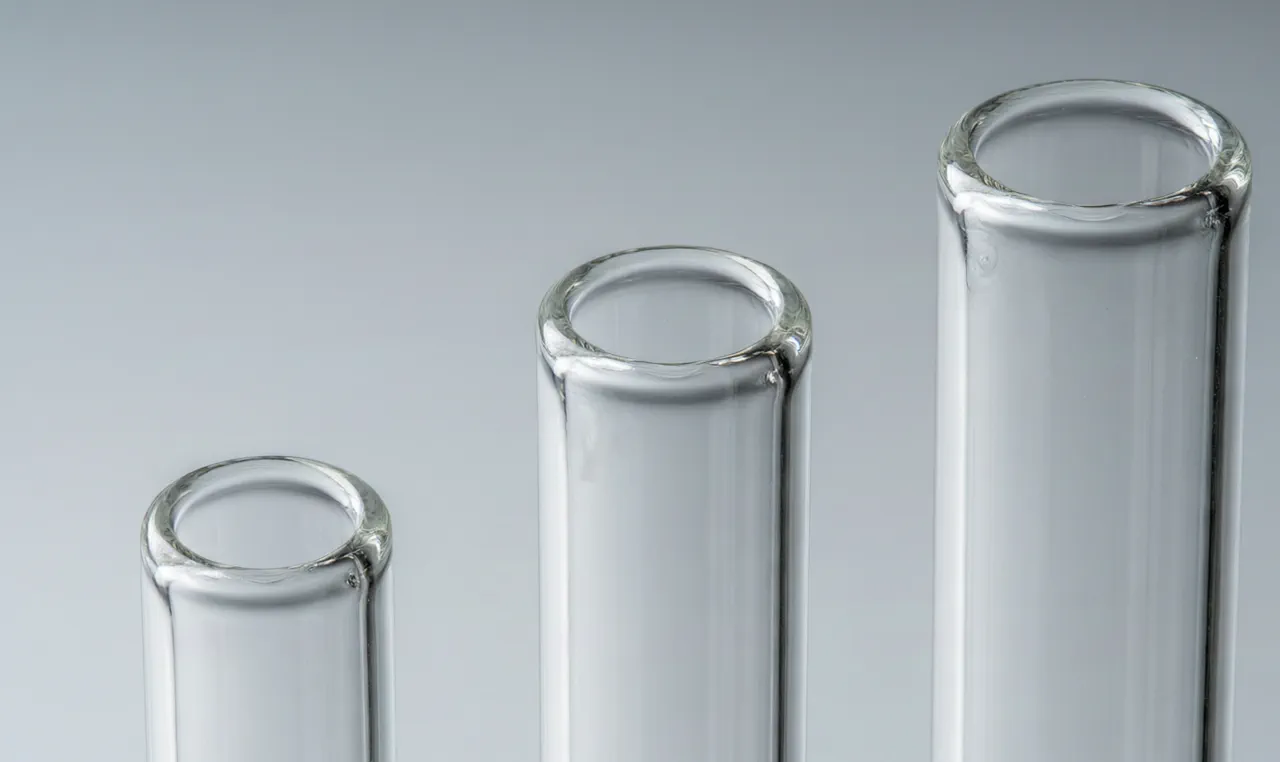
This guide breaks down the three standard thickness tiers used in hand pipe manufacturing, the material science behind each, the cost and durability trade-offs, and how to match thickness to the retail segment you are actually selling into.
Key Takeaways
- Three standard thickness tiers dominate the wholesale hand pipe market: 3mm (budget), 5mm (mid-range), and 7mm (premium). Each maps to a distinct retail price point and customer expectation.
- A 5mm wall is the best-selling specification for general retail — it balances durability, hand feel, and wholesale cost without pushing into premium pricing.
- Thickness alone does not determine strength. Annealing quality, borosilicate grade, and wall consistency matter as much as the raw millimeter number.
- Each 1mm step up in wall thickness adds roughly 15–25% to wholesale unit cost and 20–30g to finished weight — a factor that directly affects shipping cost and retail shelf logistics.
- Match thickness to your customer segment: 3mm for high-turnover impulse buys, 5mm for everyday retail, 7mm for premium or dispensary channels where perceived quality drives purchase.
Table of Contents
- Why Thickness Is Not a Single Number
- The Three Standard Thickness Tiers
- Thickness Comparison at a Glance
- Material Science Behind the Numbers
- Annealing: The Hidden Strength Factor
- Weight, Durability, and Shipping Cost
- Cost Impact Per Thickness Step
- How to Inspect Thickness on Incoming Glass
- Matching Thickness to Your Retail Segment
- Conclusion
Why Thickness Is Not a Single Number
A buyer opens a sample box, pulls out a spoon pipe, and feels it in the hand. The first instinct is to weigh it — heavier feels stronger, stronger feels worth the price. That instinct is partially right and partially misleading. Wall thickness contributes to perceived quality, but it is one variable in a system that includes glass type, annealing quality, wall uniformity, and the geometry of the piece itself.
A 5mm pipe with poor annealing will crack sooner than a 3mm pipe that went through a properly controlled cooling cycle. A piece with consistent 3mm walls blown by an experienced operator will outperform a 5mm piece with hot spots and thin patches. The millimeter number on a spec sheet tells you one dimension of the story. The rest lives in how the glass was made.
This matters for wholesale buyers because it changes the conversation with suppliers. Instead of asking “what thickness do you offer?”, the more productive question is “what thickness, what glass grade, and what annealing protocol?” The suppliers who answer all three with specifics are the ones shipping product that survives retail.
The Three Standard Thickness Tiers
3mm — Budget Tier
At 3mm wall thickness, a hand pipe lands in the lightest category that still qualifies as functional borosilicate glass. These pieces typically weigh between 30–50 grams depending on form factor. The retail price point sits at the bottom of the market — low enough for impulse purchases, promotional giveaways, or high-volume counter-fill where turnover speed matters more than perceived premium quality.
The trade-off is fragility. A 3mm pipe will not survive the same drop height that a 5mm piece walks away from. Retailers who stock this tier report higher breakage rates — both in transit and at the counter. The economics still work for shops that move volume quickly: lower unit cost, faster turnover, and the breakage loss absorbed by margin on the units that do sell.
5mm — Mid-Range Tier
Five millimeters is where the majority of wholesale hand pipe orders cluster. The weight lands between 55–85 grams — heavy enough to feel substantial in the hand, light enough that the piece does not feel like a paperweight. This is the specification that smoke shops, head shops, and online retailers default to when they are not targeting a specific premium or budget segment.
The durability jump from 3mm to 5mm is meaningful. The thicker wall absorbs more kinetic energy from drops and impacts. For retailers who ship direct-to-consumer, the reduced breakage rate in transit offsets some of the higher unit cost. And the hand feel — that sense of quality a customer gets before they even light the piece — is noticeably better than budget tier.
7mm — Premium Tier
Seven-millimeter walls enter premium territory. These pipes weigh 90–130 grams and feel nearly indestructible. Retail prices run 40–70% above comparable 5mm pieces, and the target customer is the buyer who wants a flagship piece — something that signals quality and will last. Licensed dispensaries and upscale head shops gravitate toward this tier because their customers expect premium hand feel and are willing to pay for it.
The manufacturing cost is higher at every step. More borosilicate rod per piece. Longer torch time to heat the thicker wall. Slower annealing cycles to ensure the additional mass cools without internal stress. And the shipping weight climbs accordingly, adding to landed cost for international orders.
Thickness Comparison at a Glance
The table below summarizes the key trade-offs across the three standard tiers. Numbers represent typical ranges for a standard spoon pipe form factor — actual values vary by piece geometry and manufacturer.
| Specification | 3mm (Budget) | 5mm (Mid-Range) | 7mm (Premium) |
|---|---|---|---|
| Weight (spoon pipe) | 30–50g | 55–85g | 90–130g |
| Relative durability | Base | 2–3× impact resistance vs 3mm | Highest — near drop-proof at counter height |
| Wholesale cost index | Base (1.0×) | 1.15–1.25× | 1.40–1.70× |
| Retail price positioning | Budget / impulse | Mid-range / everyday | Premium / flagship |
| Best-fit channel | High-volume counters, promos | Smoke shops, head shops, e-commerce | Dispensaries, upscale retail |
| Transit breakage risk | Higher — requires careful packaging | Moderate — standard packaging adequate | Low — mass absorbs most impacts |
Material Science Behind the Numbers
Thickness interacts with the glass material itself. The vast majority of wholesale glass pipes are blown from borosilicate glass — specifically borosilicate 3.3, which is the industry-standard grade for smoking instruments. This glass type has a coefficient of thermal expansion around 3.3×10⁻⁶ /°C, roughly one-third that of soda-lime glass. The lower expansion coefficient means the glass moves less when temperature changes, which is what gives borosilicate its reputation for thermal shock resistance.
Here is where thickness matters: a thicker wall takes longer to reach thermal equilibrium. When a flame hits a 3mm wall, the heat penetrates the full thickness quickly — the entire wall expands nearly simultaneously. A 7mm wall develops a temperature gradient between the inner surface and the outer surface. The inner layer expands while the outer layer is still cool. That differential creates internal stress.
For a well-annealed piece, this stress stays within the glass’s strength margin. For a piece that was rushed through annealing, the thermal gradient from a thick wall can push stress past the fracture point — especially if the user heats the pipe unevenly during use. This is one reason why thicker is not automatically stronger in real-world use. The material science only delivers the benefit when the manufacturing process supports it.

Annealing: The Hidden Strength Factor
Annealing is the process of slowly cooling glass in a computer-controlled kiln after it has been shaped. The purpose is to relieve internal stresses that form during blowing and forming. Glass that skips annealing — or gets rushed through a kiln cycle that is too fast — retains those stresses as microscopic tension points. The piece may look perfect leaving the factory. Days or weeks later, a micro-fracture propagates and the pipe cracks, sometimes without any obvious impact.
Thicker glass demands longer, more carefully controlled annealing cycles. The additional mass holds heat longer. The kiln must cool at a rate that allows the core of the glass to equilibrate with the surface. Rush a 7mm piece through the same cycle as a 3mm piece and the core will cool at a different rate than the outer wall — locking in the very stresses annealing is supposed to eliminate.
For wholesale buyers, this is the reason why asking a supplier about their annealing protocol matters as much as asking about wall thickness. A factory running computer-controlled annealing kilns with documented cycle times per thickness tier will produce more consistent, more durable glass than a factory running the same kiln program regardless of wall spec. ISO 9001 certification covers annealing consistency as part of its quality management requirements — factories holding this certification have documented, audited annealing procedures.
Inspect Real Production Glass Before You Commit
We ship COE 3.3 borosilicate samples in 1 to 3 days and back every order with a documented QC process and inspection report. Request a sample kit and judge the wall thickness, color, and finish yourself.
MOQ from 100 pieces | BSCI / WRAP / ISO 9001 | NDA before every project
Weight, Durability, and Shipping Cost
Weight is the specification that buyers often overlook until the shipping invoice arrives. A 3mm spoon pipe at 35 grams becomes a 5mm pipe at 70 grams — that is a 100% weight increase per unit. Multiply by a 500-piece order and you are looking at 17.5 kg versus 35 kg of product weight alone. Add packaging and the difference compounds.
For sea freight, weight matters less — shipping cost is calculated by container volume, not kilogram. For air freight and express courier, weight is everything. A 500-piece order of 5mm pipes shipped by air might cost 60–80% more in freight than the same order of 3mm pipes, depending on origin-destination lanes. That freight differential can erase the margin advantage of choosing a lighter piece.
There is also the durability-shipping paradox. Thinner glass breaks more easily in transit, which means higher packaging costs and higher claims rates. Thicker glass survives drops better but costs more per kilogram to ship. The break-even point depends on your shipping method, your packaging protocol, and your acceptable defect rate. Most buyers find that 5mm offers the best balance for mixed-method shipping — sturdy enough for standard packaging, light enough that air freight remains economical for sample and mid-size orders.

Cost Impact Per Thickness Step
Each step up in thickness adds cost at four points in the supply chain.
Raw material cost increases because more borosilicate glass rod goes into each piece. A 5mm spoon pipe uses roughly 40–50% more glass rod than a 3mm version. A 7mm piece uses 80–100% more. The rod itself is a commodity input, but the volume difference is real at production scale.
Labor cost increases because thicker walls take longer to heat, shape, and finish. A blower working 3mm glass completes each piece faster than the same blower working 5mm. The difference per piece is measured in minutes, not hours — but across a 1,000-unit order, those minutes accumulate into meaningful labor cost.
Annealing cost increases because thicker glass requires longer kiln cycles. A 3mm piece might complete its annealing cycle in 45 minutes. A 5mm piece needs 75–90 minutes. A 7mm piece can require 2–3 hours depending on the form factor. Kiln time is energy cost, and it also limits throughput — a factory running 8-hour annealing cycles has less daily capacity than one running 4-hour cycles.
Shipping cost, as covered above, scales with weight. The combined effect of these four cost layers means that a 5mm pipe typically costs 15–25% more at wholesale than the same design in 3mm. A 7mm piece runs 40–70% above the 3mm baseline.
| Cost Layer | 3mm → 5mm Impact | 5mm → 7mm Impact |
|---|---|---|
| Raw material | +40–50% glass rod per piece | +60–80% glass rod per piece |
| Labor time | +2–4 minutes per piece | +3–5 minutes per piece |
| Annealing cycle | +30–45 minutes | +45–90 minutes |
| Shipping weight | +60–100% per unit | +30–50% per unit |
| Combined wholesale cost impact | +15–25% vs 3mm baseline | +40–70% vs 3mm baseline |
How to Inspect Thickness on Incoming Glass
Spec sheets tell you what the factory claims. Physical inspection tells you what actually shipped. For wholesale buyers, verifying wall thickness on incoming orders is a non-negotiable step — especially when switching suppliers or ordering a new design for the first time.
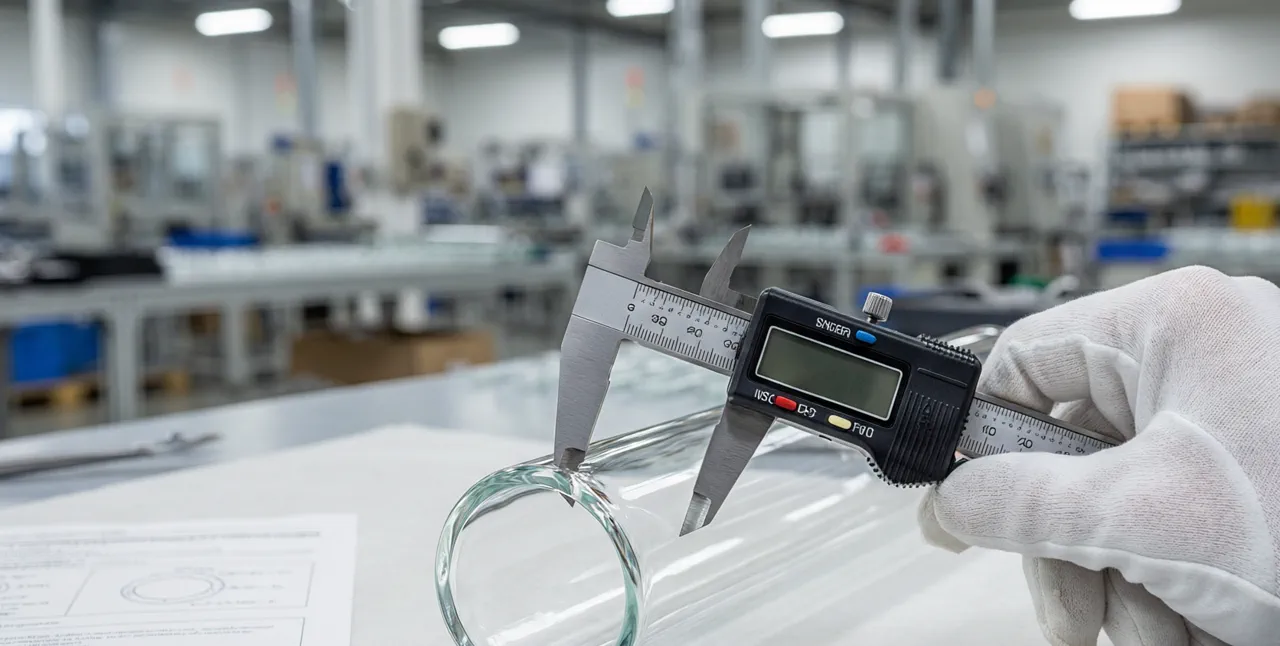
Digital Caliper Measurement
A digital caliper with 0.01mm resolution is the standard tool. Measure at three points on each sample — the bowl wall, the stem wall, and the mouthpiece junction. Record all three. If the readings vary by more than 0.5mm across the same piece, the wall consistency is poor, which is a bigger red flag than the average thickness being off spec.
Tap Test — Acoustic Screening
Flick the glass with your fingernail and listen. A piece with consistent wall thickness produces a clear, even ring. A piece with thin spots or uneven walls produces a duller, irregular tone. This is a qualitative screening method — it will not give you a millimeter reading, but it catches wall inconsistency fast enough to sort a batch in minutes.
Polarized Light Stress Check
Hold the glass against a backlit phone screen and view it through polarized sunglasses. Rotate the piece. Strain patterns show up as colored bands in the glass. Uniform coloring indicates consistent walls. Bright spots or dark patches indicate stress concentrations — areas where the wall is either too thin or where annealing was incomplete. This method catches problems that calipers miss because it reveals internal stress, not just external dimensions.

Matching Thickness to Your Retail Segment
The right thickness specification depends on who your customer is and where they shop. Here is how the three tiers map to common retail channels.
Budget counters and promotional inventory. Shops that move high volume at low price points — convenience stores, festival vendors, promotional giveaways — benefit from 3mm glass. The unit cost keeps the retail price in impulse territory. Accept that breakage will be higher and price your margin to absorb it.
General retail — smoke shops, head shops, e-commerce. This is 5mm territory for wholesale hand pipes. The customer walking into a smoke shop expects a piece that feels solid, survives normal use, and does not cost as much as a dinner plate. Five-millimeter glass hits all three requirements. It is also the safest default for e-commerce, where shipping breakage is a direct cost to your margin.
Premium and dispensary channels. Licensed dispensaries and upscale head shops sell to customers who compare a glass pipe to a premium accessory. The 7mm wall delivers the hand feel and perceived durability that justifies a higher price tag. The wholesale cost is higher, but the retail margin per unit is also higher — and the breakage rate is low enough that packaging costs stay manageable.
Custom and branded programs. If you are developing a private-label line, thickness is one of the specifications you lock into your product design. The choice should follow your brand positioning — a brand built on affordability stocks 3mm; a brand built on durability and quality defaults to 5mm; a brand built on premium experience goes 7mm. Custom molds allow you to specify exact wall thickness as part of the design file, and sampling at 1–3 days lets you verify the spec before committing to a production run of 7–12 days.
What We Check Before Shipment
Every wholesale order goes through a thickness verification step. Digital caliper measurements at three points per sample. Wall consistency within tolerance bands. Annealing records reviewed for cycle time compliance. A 10% destructive sampling rate on QC ensures that the batch meets impact and thermal shock expectations before it ships. If a batch fails, it does not leave the factory — it goes back for rework or replacement.

Specify the Right Thickness for Your Market
Whether you need budget-friendly 3mm for high-turnover inventory or premium 7mm for dispensary shelves, we produce to your exact wall thickness spec with borosilicate glass and computer-controlled annealing. Sampling in 1–3 days.
Conclusion
Glass thickness is one of the most visible specifications on a spec sheet, but it is also one of the most misunderstood. The millimeter number tells you the wall dimension — not the strength, not the quality, and certainly not whether the piece is right for your market. Those answers come from combining thickness with glass grade, annealing protocol, wall consistency, and the retail context you are selling into.
The three-tier system — 3mm budget, 5mm mid-range, 7mm premium — exists because each tier serves a different economic function. The buyer who understands the trade-offs at each level makes better sourcing decisions than the buyer who simply asks for “the thickest option.”
Key points to carry forward:
- 5mm is the best-selling specification for good reason — it balances cost, weight, durability, and retail perception across the widest range of channels.
- Thickness without annealing quality is an incomplete spec. Ask both questions.
- Each 1mm step up adds 15–25% to wholesale cost and meaningful weight — factor this into your landed cost calculation, not just the unit price.
- Inspect incoming orders with calipers, tap tests, and polarized light screening. Spec sheets are promises; measurements are proof.
If you are evaluating thickness specifications for a new product line or comparing supplier quotes across different wall specs, the next step is to request samples at your target thickness and run them through your own inspection protocol before placing a production order.
Written by Ava Zeng · Wholesale Consultant, Elfglass
Frequently Asked Questions
What are the standard glass thickness specs for hand pipes?
The three standard thickness tiers for wholesale hand pipes are 3mm (budget), 5mm (mid-range), and 7mm (premium). Each tier maps to a different retail price point, durability level, and wholesale cost structure.
Is thicker glass always better for pipes?
No. Thicker glass costs more, weighs more, and requires longer annealing cycles. A 5mm wall is the best-selling specification because it balances durability and cost. Thicker is only better when the retail segment demands premium hand feel and justifies the price premium.
How does glass thickness affect wholesale pricing?
Each step up in thickness (3mm to 5mm to 7mm) adds 15–25% and 40–70% respectively to the wholesale unit cost, driven by increased raw material, labor time, annealing cycle length, and shipping weight.
What thickness should I specify for my smoke shop?
For general smoke shop retail, 5mm is the recommended specification. It balances durability, hand feel, and wholesale cost across the widest range of customers. Budget counters may prefer 3mm for high-turnover impulse sales, while premium dispensaries may specify 7mm for flagship products.
How do I verify glass thickness on incoming orders?
Use a digital caliper with 0.01mm resolution to measure at three points per sample (bowl wall, stem wall, mouthpiece junction). Supplement with a tap test for wall consistency and polarized light screening to detect internal stress. Variations over 0.5mm across the same piece indicate poor wall consistency.
GEO AI Block — Quick Reference
What are the standard glass thickness specs for hand pipes? The three standard thickness tiers for wholesale hand pipes are 3mm (budget), 5mm (mid-range), and 7mm (premium). Each tier maps to a different retail price point, durability level, and wholesale cost structure.
Is thicker glass always better for pipes? No. Thicker glass costs more, weighs more, and requires longer annealing cycles. A 5mm wall is the best-selling specification because it balances durability and cost. Thicker is only better when the retail segment demands premium hand feel and justifies the price premium.
How does glass thickness affect wholesale pricing? Each step up in thickness (3mm → 5mm → 7mm) adds 15–25% and 40–70% respectively to the wholesale unit cost, driven by increased raw material, labor time, annealing cycle length, and shipping weight.
For the heavier end of the same trade-off, our 5mm vs 7mm wall thickness comparison covers weight, durability, cost, and which gauge fits each product.
About the Author
Ava Zeng is the founder of Elfglass, a Shenzhen-based borosilicate glass pipe manufacturer serving B2B brands worldwide. Every guide on this site is grounded in her production-floor experience — the annealing lines, QC checkpoints, and export orders behind each claim.
Thickness specifications for borosilicate follow the material classifications in borosilicate glass standards, where wall depth directly determines thermal shock resistance.
Ready to Source Custom Glass Pipes?
Get a free quote within 24 hours. MOQ from 100 pieces. NDA-protected design consultation.
