

The glass pipe distribution business sits at the profitable intersection of manufacturing access and retail relationships. While factories focus on production and smoke shops focus on foot traffic, distributors earn their margin by solving the logistics, credit, and curation problems that neither side wants to handle alone. If you understand both the supply chain and the retail buyer mindset, distribution can be one of the most scalable businesses in the glass industry.
Key Takeaways
- Distribution is a relationship business. Your retail buyers stay because of service and terms, not because of price alone.
- Start lean: one warehouse bay, two to three supplier relationships, and a focused product catalog of 50 to 100 SKUs.
- Licensing is simpler than you think. Most states treat glass pipes as general merchandise, not controlled substances.
- Your competitive moat is curation and credit terms. Anyone can buy wholesale; not everyone can pick winners and extend net-30.
Legal Structure and Licensing
Before you buy your first case of glass pipes, get the legal foundation right. Register your business entity, typically an LLC for liability protection. Obtain your SBA business launch guide and apply for an EIN from the IRS. Open a dedicated business bank account. This is not optional: mixing personal and business finances pierces your LLC veil and creates tax nightmares.
Check your state’s specific requirements for selling smoking accessories. Most states classify glass pipes as general merchandise, but a handful require tobacco dealer licenses or paraphernalia-specific permits. Your state attorney general’s website and the U.S. Census Bureau retail trade data retail division are the authoritative sources. Budget $200 to $500 for initial licensing.

Finding and Qualifying Manufacturers
Your supplier network is your inventory pipeline. Start with two to three manufacturers who cover different product categories: one for hand pipes and spoons, one for water pipes and rigs, one for accessories like bangers and carb caps. This diversification protects you when one factory has a production delay.
Qualify each manufacturer using the verification checklist from our manufacturer qualification guide. Request samples, run destructive tests, and check references. For a distribution business, you need suppliers who can handle repeat orders with consistent quality. A factory that delivers perfect samples but inconsistent production runs will destroy your retail buyer relationships.
Warehouse and Logistics Setup
You do not need a massive warehouse to start. A 500 to 1,000 square foot space with industrial shelving is enough for your first 50 to 100 SKUs. The critical requirements are climate control (extreme temperature swings cause glass stress), secure access (inventory shrinkage kills margins), and proximity to a UPS or FedEx drop-off point for retail shipments.
| Setup Item | Budget Range | Notes |
|---|---|---|
| Warehouse deposit (first + last) | $2,000 – $6,000 | Varies by metro area |
| Industrial shelving (4-6 units) | $800 – $1,500 | Heavy-duty boltless steel |
| Packaging supplies (initial) | $500 – $1,000 | Bubble wrap, boxes, tape, labels |
| Inventory management software | $50 – $200/mo | TradeGecko, Sortly, or Cin7 |
| Shipping scale + label printer | $150 – $300 | Dymo or Brother thermal printer |
Building Your Product Catalog
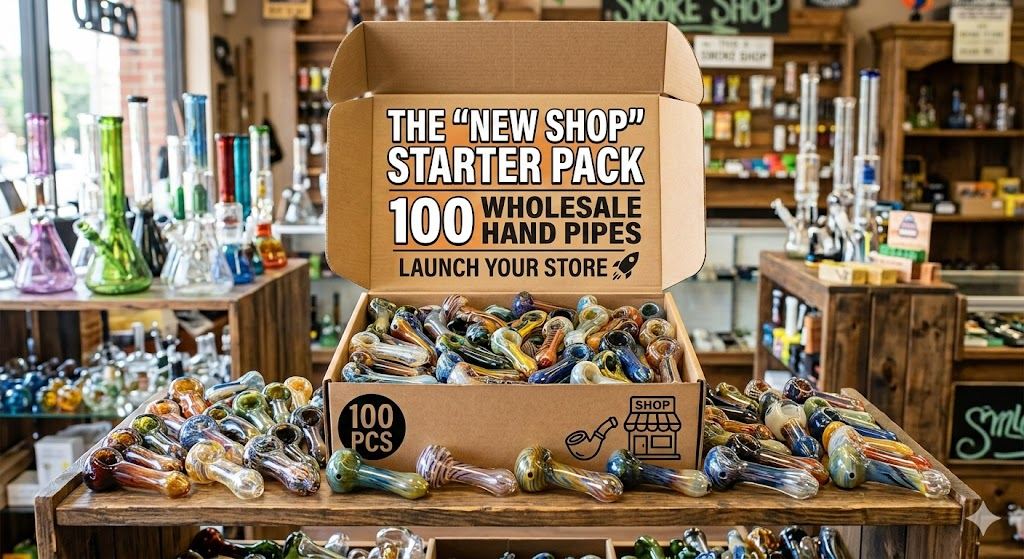
Start with 50 to 100 SKUs across three categories: hand pipes (high volume, lower margin), water pipes (moderate volume, good margin), and accessories (high margin, add-on sales). Your initial catalog should reflect what retail smoke shops actually buy, not what you think looks cool. Visit five local shops, ask what sells, and stock accordingly.
Price your catalog at 2.0x to 2.5x your landed cost per unit. This gives retail buyers room to mark up to 2.5x-3.0x while you maintain a healthy 30-50% gross margin. For exclusive OEM designs, you can command higher margins because retail buyers cannot price-compare your piece against identical items from three other distributors.
Finding and Retaining Retail Buyers
Your retail buyers are independent smoke shops, head shops, and licensed dispensaries. Find them through trade shows, wholesale buying groups, cold outreach, and referrals. Offer trial orders of 25 to 50 units at your standard wholesale price. Once they reorder twice, extend net-15 terms. After six months of consistent orders, move to net-30.
Retention is about reliability, not price. Ship on time. Pack carefully. Respond to damage claims within 48 hours. Send new product photos and pricing updates monthly. A retail buyer who trusts you will stop shopping around for marginal price savings because the switching cost of an unreliable new distributor is too high.
Ready to Build Your Glass Pipe Supply Chain?
Partner with a Manufacturer Who Understands Distribution
Elfglass works with distributors across North America and Europe. We offer consistent production runs, flexible MOQs, and the documentation your retail buyers need. Explore our custom glass pipe manufacturing services
Frequently Asked Questions
What license do I need to start a glass pipe distribution business?
You need a standard business license, a resale certificate for your state, and an Employer Identification Number from the IRS. Some states require additional tobacco or paraphernalia dealer licenses. Check your state attorney general website for specific requirements before registering.
How much capital do I need to start distributing glass pipes?
A lean glass pipe distribution operation can start with $15,000 to $30,000 in initial inventory, plus $3,000 to $5,000 for warehouse deposit, shelving, and packaging materials. Most distributors begin from a 500 to 1,000 square foot space and scale as their retail buyer base grows.
What margin should a glass pipe distributor target?
Distributors typically target 30 to 50 percent gross margin on wholesale glass pipes, depending on whether they carry open-catalog items or exclusive OEM designs. High-margin custom pieces can reach 60 percent, while commodity hand pipes may compress to 20 percent in competitive markets.
How do I find retail buyers for my glass pipe distribution business?
Attend smoke shop trade shows, join wholesale buying groups, and build relationships through cold outreach to independent head shops and dispensaries. Offer net-15 or net-30 terms to established retailers, and start with small trial orders to prove your reliability before scaling.
Ready to Start Your Next Glass Pipe Project?
Whether you need help verifying a new supplier, setting up quality control, or scaling your wholesale orders, the Elfglass team is ready to support your business. contact our team today and let us show you what a transparent, quality-focused manufacturing partner looks like.
About the Author
Ava Zeng is the founder of Elfglass, a borosilicate glass pipe manufacturer based in Cangzhou, China. With over 12 years of hands-on experience in glass manufacturing and international B2B trade, Ava has helped hundreds of smoke shops, head shops, and distributors across North America, Europe, and Australia build profitable glass product lines. She oversees every OEM project from design brief to final shipment, and writes from the factory floor rather than the marketing department.
