
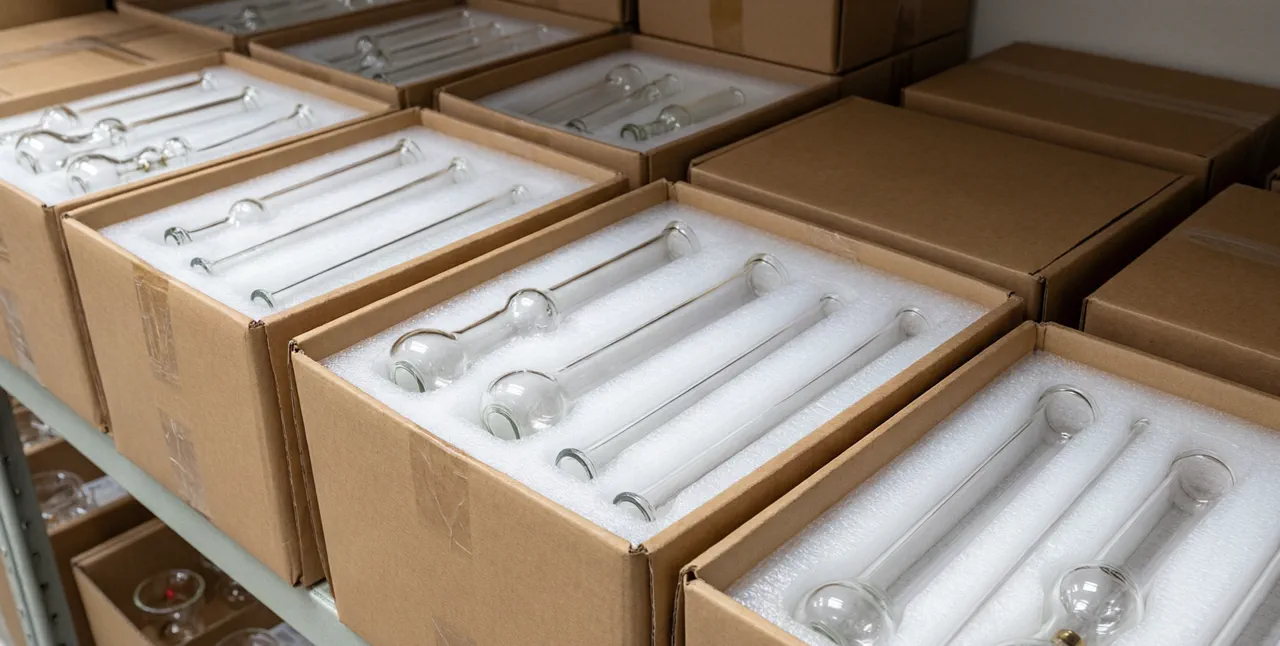
Walk into any smoke shop and scan the counter. Beneath the register, tucked beside the rolling papers and lighters, you will find a row of small glass tubes. No carburetor. No moving parts. Just a straight bore and a bowl end. These are chillums — and they move faster per square inch of display space than almost anything else on the shelf. Hand pipes like these are shaped at the torch using lampworking, a glass-forming technique in which solid glass rods are melted and shaped over a flame (lampworking reference).
For wholesale buyers, chillums and one-hitters represent an entry-level price point with repeat-purchase economics that outperform most other hand pipe categories. A shop can stock ten color variants in a footprint smaller than a single bong display, and the unit cost makes trial orders accessible even for new retailers. But sourcing them well requires understanding what separates a chillum that survives three months of daily use from one that cracks on the second week.
This guide covers what chillums and one-hitters actually are, why they work as counter-fill inventory, which material and spec choices matter for wholesale buyers, and how to evaluate a manufacturer before placing an order.
Key Takeaways
- A chillum is a straight-tube, no-carb pipe; “one-hitter” describes the single-dose usage pattern. All chillums function as one-hitters, but the terms are not perfectly interchangeable in retail.
- Borosilicate glass chillums cost more upfront than soft glass but resist thermal shock, reducing crack-related returns at retail.
- Wholesale MOQ starts at 100 pieces per design, with sampling in 1–3 days and production in 7–12 days for orders above 100 pieces.
- Custom branding — logo etching, sandblasting, printed sleeves — is available at MOQ quantities, with exclusive molds for custom designs.
- Counter-fill economics favor chillums: low unit cost, small display footprint, high turnover rate, and natural cross-sell with grinders and accessories.
What Are Chillums and One-Hitters
A chillum is a conical or straight-tube smoking pipe with no side-mounted carburetor hole. The user packs ground material into the wider end, lights it, and inhales through the narrow mouthpiece. There is no water filtration, no percolator, no secondary air path. Smoke travels one direction: from bowl to lip.
The word “chillum” comes from the Hindi chilam, a clay or stone pipe used by sadhus (Hindu ascetics) for centuries. Rastafarian traditions adopted a similar vessel for communal smoking ceremonies. The modern retail chillum keeps the straight-tube form but swaps clay for borosilicate glass, ceramic, or occasionally silicone.
“One-hitter” describes a usage pattern rather than a specific shape. Any pipe designed to hold a single loaded dose — enough for one inhalation — qualifies as a one-hitter. Spoon pipes with small bowls, bat-style pipes with a removable screen, and straight chillums all serve this function. In retail practice, however, most shops use “one-hitter” and “chillum” interchangeably because the straight-tube design dominates the category.
The distinction matters when you source. A buyer asking a manufacturer for “one-hitter pipes” may receive spoon-shaped pieces, while “chillum pipes” will pull straight tubes. Clarify the shape you want before requesting samples.

Why Smoke Shops Stock Chillums as Counter Fillers
Counter-fill inventory has one job: convert the three feet of space around a cash register into revenue. Chillums do this better than most categories for four reasons.
First, the price point. A wholesale chillum costs a fraction of what a bong or even a mid-range spoon pipe costs. Retail prices typically land in the impulse-buy zone — low enough that a customer grabbing a lighter or rolling papers adds one to the transaction without deliberation. For the shop owner, this means higher transaction frequency and faster inventory turns.
Second, SKU simplicity. A chillum has one shape. The variation comes from color, finish, and glass texture. A buyer can stock eight color variants — clear, amber, cobalt, green, pink, black, frosted, and a swirl option — from a single manufacturer with one order form. Compare that to stocking eight different bong styles, each with its own dimensions, joint sizes, and perc types.
Third, the disposable nature drives repeat purchases. A glass chillum is not a lifetime purchase. It breaks. Customers upgrade. They buy extras. A smoke shop that sells 20 chillums in January may sell 20 more in February — not because the market expanded, but because the product is consumed through use and accidental damage.
Fourth, cross-sell. A customer buying a chillum often needs a screen, a lighter, or a small grinder. These add-on items sit in the same counter display, and the combined basket value climbs quickly. Shops that pair chillums with a small branded display case report higher attach rates on accessories.
If you are building your initial hand pipe inventory, the wholesale hand pipes category page covers the full range of styles worth considering alongside chillums.
Types of Wholesale Chillums by Material
The material a chillum is made from determines its durability, heat resistance, customization potential, and wholesale cost. Here is how the four main material categories compare for retail stocking.
| Material | Durability | Cost | Customization |
|---|---|---|---|
| Borosilicate glass | High — thermal shock resistant | Mid-range | Etching, sandblasting, color tinting |
| Soft glass | Moderate — cracks under thermal stress | Low | Wide color range, fuming, murrine |
| Silicone-wrapped | High — shatterproof exterior | Low–mid | Color wraps, novelty shapes |
| Ceramic / stone | Moderate — brittle but heat-stable | Low (limited supply) | Glazing, traditional finishes |
Borosilicate glass is the default recommendation for retail stocking. It withstands the thermal cycling of repeated lighting and cooling without developing stress fractures. Soft glass is cheaper to buy wholesale but generates more returns when customers experience cracking. Silicone-wrapped chillums appeal to a novelty buyer and survive drops that would shatter bare glass, but they occupy a different retail segment — often sold alongside colorful, younger-skewing merchandise.
Ceramic and stone chillums carry historical authenticity but present sourcing challenges. Few manufacturers produce them at scale, and the supply chain is less predictable. Most wholesale buyers find better margins sticking with borosilicate glass for the core inventory and adding one or two silicone options for the novelty end of the display.
Glass Thickness and Durability Considerations
Wall thickness is the single most important specification for a wholesale chillum. A thin-walled chillum (under 3mm) feels lightweight and costs less in material, but it is vulnerable to both impact breaks and thermal stress cracks. A thick-walled piece (5mm and above) feels substantial in the hand, retains heat longer, and survives the kind of daily handling that retail customers put it through.
The trade-off is weight and cost. Thicker walls use more glass, which increases unit cost and shipping weight. For a chillum — a small, portable piece — most buyers find that 3mm to 4mm hits the right balance. This is thick enough to resist casual cracking without adding unnecessary bulk.
Thickness alone does not determine durability. Annealing quality matters equally. A properly annealed 3mm chillum will outlast a poorly annealed 5mm piece every time. Annealing is the controlled cooling process that relieves internal stress in the glass. Skip it or rush it, and microscopic stress points remain locked in the walls. The piece may survive factory QC, but it will crack within weeks of retail use — often during the first hot-lighter ignition.
When evaluating samples, ask the manufacturer about their annealing cycle. A factory running certified quality management (ISO 9001, for example) will have documented annealing parameters. If a supplier cannot explain their annealing process or hesitates when you ask, treat that as a red flag.
Stock the Glass Pipes Your Customers Actually Buy
Elfglass produces the full wholesale catalog, from hand pipes and sherlocks to dab rigs, percolator bongs, and accessories, in proven best-selling specs. Tell us your market and we will recommend a catalog mix with pricing.
MOQ from 100 pieces | BSCI / WRAP / ISO 9001 | NDA before every project
Customization and Private Label Options
Chillums are one of the easiest hand pipe styles to brand. The simple geometry — a straight tube with no complex percolator or joint — gives logo application methods a clean, unobstructed surface. The three most common branding techniques are etching, printing, and sandblasting, each with different cost and durability profiles. The guide to logo application methods covers the technical details of each process.
For private label buyers, the key question is whether to brand stock shapes or invest in a custom mold. Stock shapes with a logo etch are the fastest path: the manufacturer already produces the chillum, and adding your brand is a surface-level modification. Custom molds let you create a distinctive shape — a unique taper, a textured grip, a signature silhouette — but they require a mold fee and a longer lead time.
At Elfglass, custom molds are built exclusive to the client. The design never enters the stock catalog. MOQ for branded chillums starts at 100 pieces per design, which applies whether you are etching a logo on a stock shape or running a custom mold. Sampling takes 1–3 days, and production for orders above 100 pieces runs 7–12 days. The full OEM/ODM workflow, from initial design consultation through delivery, is documented on the process page.
Packaging customization is equally important for retail. Branded sleeves, hang-tab cards, and custom display boxes turn a generic glass tube into a shelf-ready product. A customer picking up a chillum in a printed sleeve with your shop’s logo perceives it as a curated item, not a commodity.
Ready to source wholesale chillums for your shop?
MOQ 100 pieces per design. Samples in 1–3 days. BSCI, WRAP, and ISO 9001 certified factory.
Sourcing Wholesale Chillums: MOQ, Pricing, and Lead Times
Sourcing chillums from a certified manufacturer follows the same commercial framework as any other glass pipe category. Here are the operational numbers that govern the process.
| Parameter | Detail |
|---|---|
| MOQ | 100 pieces per design / SKU |
| Sampling time | 1–3 days |
| Production lead time | 7–12 days (for 100+ pieces) |
| Payment terms | T/T — 30% deposit, 70% before shipment |
| Quote response | Within 12 hours |
| Certifications | BSCI, WRAP, ISO 9001 |
| NDA | Signed before project start |
| Custom molds | Exclusive to client |
The 100-piece MOQ per design is deliberately accessible. A new smoke shop can test three or four chillum styles — say, a clear borosilicate, a cobalt blue, a frosted finish, and a silicone-wrapped option — with a total order of 400 pieces. That is a manageable investment for a retailer validating which variants move fastest in their specific market.
Payment follows the standard T/T structure: 30% deposit when the order is placed, 70% balance cleared before the goods ship. This is the dominant payment model in glass pipe manufacturing and protects both sides — the factory has working capital to begin production, and the buyer retains leverage until the order is ready for dispatch.
Shipping adds another variable. Chillums are small and relatively light compared to bongs, which works in the buyer’s favor for air freight and express shipping on sample orders. For bulk production orders, sea freight becomes cost-effective, especially when combined with other hand pipe styles in the same shipment. Packaging method matters: individual bubble-wrap sleeves in a partitioned carton minimize breakage risk during transit.
Quality Checklist for Wholesale Buyers
Before committing to a bulk order, run each sample through this inspection sequence. These are the checkpoints that separate a reliable wholesale chillum from a return-generating liability.
Material verification. Confirm that the manufacturer is using borosilicate glass if that is what you ordered. Soft glass and borosilicate look similar to the untrained eye. Ask for a material certificate or, at minimum, request that the sample survive a basic thermal shock test — plunge it from room temperature into ice water. Proper borosilicate survives this. Soft glass often does not.
Visual inspection. Hold the chillum up to light. Look for bubbles trapped inside the glass wall, stress lines (thin cracks visible at certain angles), and uneven wall thickness. A well-made piece has consistent walls with no visible inclusions. Small surface variations are normal in hand-blown glass; internal bubbles or stress marks are not.
Annealing verification. This is the hardest checkpoint to assess visually, which is why it matters most. Ask the factory for their annealing cycle parameters — temperature, hold time, and cooling rate. A factory running ISO 9001 quality management will have these documented. If the annealing kiln temperature is off by even 20–30°C, the glass retains internal stress that will manifest as cracks during use.
Factory certifications. BSCI (Business Social Compliance Initiative), WRAP (Worldwide Responsible Accredited Production), and ISO 9001 each cover different aspects of factory operations. BSCI and WRAP address labor practices and social compliance — important for import compliance in markets like the USA and EU. ISO 9001 addresses quality management systems. Together, they signal that the factory operates under documented, audited processes rather than ad hoc methods.
Sample approval workflow. Order at least two samples before committing to bulk. Test one yourself. Give the other to a trusted retail customer for real-world feedback. If the sample passes both your inspection and a week of actual use without issues, the production run is likely to follow.
Chillums vs Other Hand Pipes: When to Stock Which
Chillums are not the only hand pipe worth stocking. A well-curated smoke shop counter offers a progression — an entry-level option, a mid-range step-up, and a premium piece for the enthusiast. Here is how chillums fit alongside other popular hand pipe styles.
| Style | Price Position | Best For | Key Consideration |
|---|---|---|---|
| Chillum / one-hitter | Entry | Impulse buys, first-time users, counter display | No carb — single-hit design limits session length |
| Spoon pipe | Mid-range | Everyday users who want a carb for longer sessions | More glass = higher unit cost and breakage risk |
| Sherlock pipe | Mid–premium | Customers who value aesthetics and a comfortable grip | Complex shape increases production cost |
| Steamroller | Entry–mid | Users who want a carb with a straight-tube form | Cylindrical shape is less ergonomic than a chillum |
Chillums and one-hitters are among the smallest hand pipes. For context on how these compact sizes compare to larger hand pipes in wholesale demand, see our hand pipe size guide.
The recommendation is straightforward: stock chillums as your entry-level option and layer two or three other styles above them. A customer who walks in for a $8 chillum may leave with a $25 spoon pipe if the display invites comparison. The chillum gets them to the counter; the upsell happens because the other styles are visible and within reach.
For shops just starting out, a mix of 60% chillums and 40% spoon pipes is a practical starting ratio. As you learn which styles your specific customers prefer, adjust the mix. The data will come quickly — chillum inventory turns fast enough that you will know within a month which colors and styles are moving.

Conclusion
Chillums and one-hitters occupy a unique position in wholesale hand pipe inventory. They are the simplest pipe to manufacture, the cheapest to buy, the smallest to display, and the fastest to turn over. For a smoke shop owner building or expanding a hand pipe section, they are the logical starting point — low risk, fast feedback, and a clear upgrade path into spoons, sherlocks, and beyond.
The sourcing fundamentals are simple: verify the material (borosilicate over soft glass for retail), confirm the annealing process, start with a 100-piece trial order per design, and add custom branding once you know which variants sell. The manufacturer’s certifications — BSCI, WRAP, ISO 9001 — are not just compliance checkboxes. They are evidence that the factory runs documented processes, which is what separates consistent quality from batch-to-batch roulette.
If you are ready to evaluate a chillum supplier or request samples, the next step is a direct conversation with the factory. A 12-hour quote response and 1–3 day sampling cycle means you can have branded samples in hand within a week.
Frequently Asked Questions
What is the difference between a chillum and a one-hitter?
A chillum is a straight-tube pipe with no carburetor hole. A one-hitter refers to any pipe designed for a single loaded dose. All chillums function as one-hitters, but not all one-hitters are chillums — spoon pipes with small bowls also qualify. In retail, the terms are often used interchangeably.
What is the typical MOQ for wholesale chillums?
Most glass pipe manufacturers set MOQ at 100 pieces per design or SKU. This allows retailers to test multiple colors and styles without a large upfront investment.
Are borosilicate glass chillums worth the extra cost over soft glass?
Yes, for retail stocking. Borosilicate glass resists thermal shock and lasts longer on the shelf and in daily use, which reduces crack-related return rates. Soft glass chillums cost less per unit but generate more warranty and replacement issues.
Can chillums be custom-branded for my smoke shop?
Yes. Manufacturers offer logo etching, printing, and sandblasting at MOQ quantities (typically 100 pieces per design). Custom molds for unique shapes are also available, with the mold kept exclusive to your brand.
How long does it take to receive a wholesale chillum order?
Sampling takes 1–3 days. Production for orders of 100 pieces or more typically takes 7–12 days, plus international shipping time depending on the method chosen (express, air, or sea freight).
About the Author
Ava Zeng is the founder of Elfglass, a Shenzhen-based borosilicate glass pipe manufacturer serving B2B brands worldwide. Every guide on this site is grounded in her production-floor experience— the annealing lines, QC checkpoints, and export orders behind each claim.
Before you commit to a supplier, read her founder’s story and trust promise, and the guide to vetting a reliable glass pipe manufacturer— the same red-flag checklist Elfglass applies to its own suppliers.
These pieces follow the form described in chillum references, a straight-bore design that has been produced commercially for decades.
Ready to Source Custom Glass Pipes?
Get a free quote within 24 hours. MOQ from 100 pieces. NDA-protected design consultation.
