
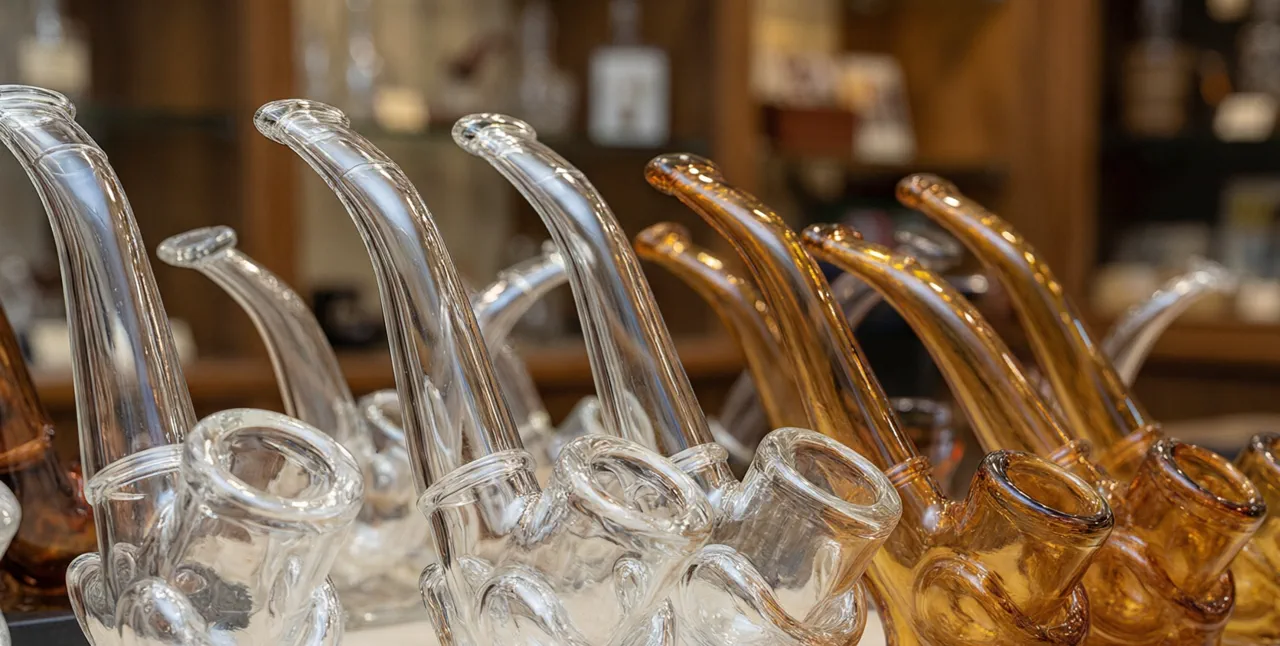
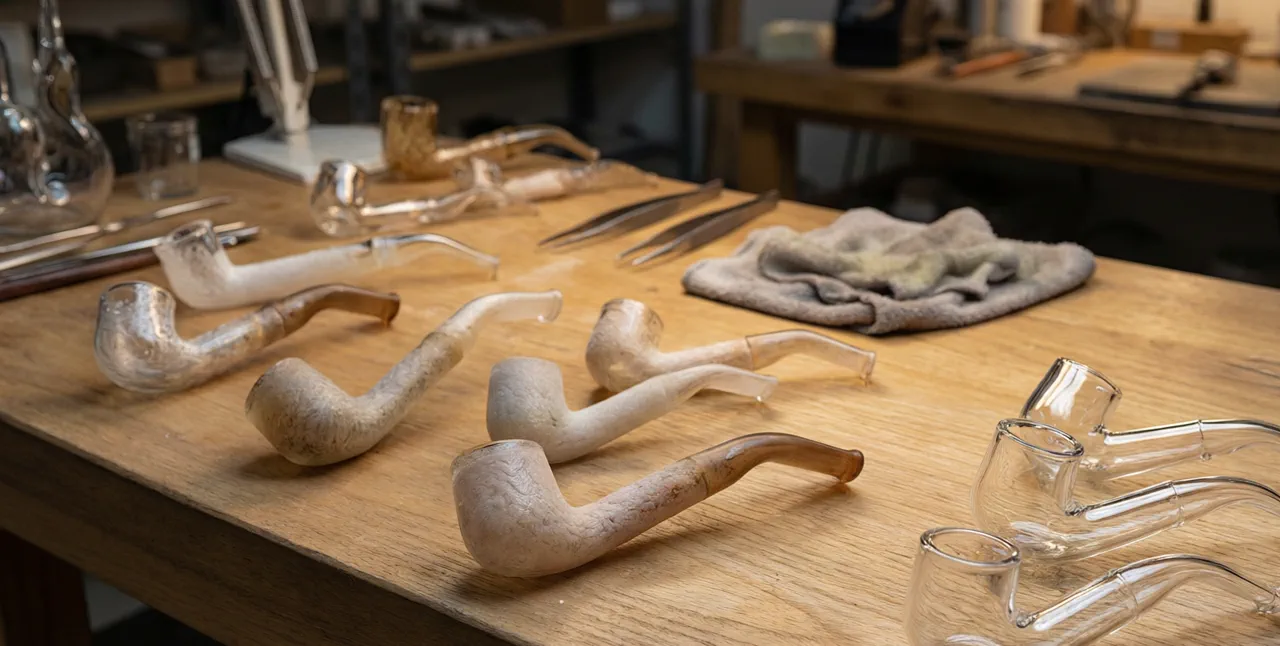
Ask ten wholesale buyers which hand pipe shape moves fastest off the shelf and nine will say “spoon pipes.” They are wrong. The Sherlock — an S-curved piece named after a fictional detective’s tobacco pipe — outsells its simplicity-to-build ratio by a wide margin at shops that stock it alongside straight tubes and spoons. The shape costs more to produce than a spoon, yet shops that give it counter space report stronger repeat-purchase rates than any other single hand pipe style. Hand pipes like these are shaped at the torch using lampworking, a glass-forming technique in which solid glass rods are melted and shaped over a flame (lampworking reference).
The reason is straightforward. A sherlock’s curved stem and deep bowl cool the smoke more than a straight tube can, and the carburetor gives the user airflow control that a chillum lacks. Customers notice the difference on the first pull. They come back for a second piece, and they bring a friend. For a smoke shop owner, that customer lifecycle is worth more per square inch of display than a rack of spoon pipes priced at the same point.
This guide breaks down what wholesale sherlock pipes actually are, how they stack up against other hand pipe shapes, which material and quality markers matter when you evaluate a manufacturer, and what it takes to launch a custom sherlock line with your branding.
Key Takeaways
- A sherlock pipe is an S-curved hand pipe with a carburetor, named after the classic Sherlock Holmes tobacco pipe shape. The curve creates a longer air path that cools smoke before it reaches the mouthpiece.
- Sherlock pipes sit in the mid-to-premium wholesale price tier among hand pipes, above spoon pipes and below steamrollers. They offer strong margin potential for retailers.
- Borosilicate glass is the recommended material for sherlock pipes. The S-curve creates uneven stress points during cooling, and borosilicate handles thermal shock better than soft glass.
- Wholesale MOQ starts at 100 pieces per design, with sampling in 1–3 days and production in 7–12 days. Custom molds are exclusive to the buyer.
- Quality markers to check: carburetor placement (must align with bowl base), bowl depth (deeper holds more and burns evenly), and rim thickness (too thin chips easily under lighter contact).
The Shape: Origin and Design Logic
The sherlock pipe gets its name from the curved tobacco pipe that Sherlock Holmes never actually smoked on screen — the calabash was a stage prop choice, not a Conan Doyle detail. Regardless, the S-curve stuck in the public imagination, and glass pipe makers adopted the silhouette for a completely practical reason: the curve works.
A sherlock is a hand pipe with three defining features. First, an S-shaped stem that runs from the bowl at the top, curves downward, reverses direction, and exits through a mouthpiece at the front. Second, a side-mounted carburetor hole that lets the user clear the bowl with a second air intake. Third, a bowl positioned at the top of the curve, sized for a moderate single-to-double load of dry herb.
The design solves a problem that straight-tube pipes cannot. In a straight pipe, smoke travels from bowl to mouth in a direct line. The path is short, and the smoke arrives hot. The sherlock’s S-curve adds 40-60mm of air path length without increasing the pipe’s overall footprint. That extra distance gives the smoke time to cool before it reaches the user’s lips. The result is a smoother draw from a piece that is still small enough to fit in a pocket.
The shape also offers a natural grip. Where the S-curve reverses direction — the “heel” of the pipe — the glass forms a resting point for the thumb and index finger. Spoon pipes require a pinch grip. Sherlock pipes sit in the hand with less effort, which matters for customers with limited dexterity or those who use the piece socially in a group setting.
Why Sherlock Pipes Command a Premium at Retail
Walk into any smoke shop and you will see spoon pipes filling the bottom shelf. They are cheap to produce, easy to stock in volume, and move fast at the lowest price point. Sherlock pipes sit one shelf up, often in a dedicated section, and they carry a higher price tag. The question is whether the premium is justified — for the retailer, not just the end customer.
It is. Three factors drive the sherlock’s retail economics.
First, perceived value. The shape looks more complex than a spoon pipe. Customers who know nothing about glass pipes can tell that a sherlock took more effort to make than a straight tube. That perception supports a 30-50% higher retail price without resistance. A spoon pipe at $15 feels expensive. A sherlock at $22 feels reasonable. The shop sells fewer units but earns more per transaction.
Second, the customer profile shifts. Buyers who gravitate toward sherlocks tend to be less price-sensitive than spoon pipe customers. They are looking for an upgrade — something that feels like a step up from the basic piece they already own. This is the customer who will also buy a quality grinder, a stash jar, or a carrying case. Stocking sherlocks attracts a higher-spending segment into the store.
Third, the shape supports customization better than any other hand pipe style. The broad curve of the sherlock’s stem provides a flat-enough surface for logo etching, sandblasting, or printed branding. Spoon pipes are too small and too curved. Chillum tubes have no flat surface at all. If a retailer wants a branded house pipe, the sherlock is the strongest canvas.
Sherlock vs Other Hand Pipe Styles
Choosing which hand pipe styles to stock is an inventory decision, not an aesthetic one. Each shape has a price tier, a customer profile, and a turnover rate. The table below compares the four main hand pipe categories that wholesale buyers evaluate.
| Style | Price Tier | Bowl Capacity | Carb | Best For |
|---|---|---|---|---|
| Sherlock | Mid-to-premium | Moderate | Yes | Upgrade buyers, branded house lines |
| Spoon | Budget | Small | Yes | Volume sales, entry-level customers |
| Steamroller | Mid | Large | No | Session smokers, shareable use |
| Chillum | Budget | Single-dose | No | Counter-fill impulse purchases |
The sherlock occupies a middle position that is strategically valuable. It is not the cheapest option — that is the spoon pipe and the chillum. It is not the most specialized — that is the steamroller. It sits in the zone where margin and volume intersect, which is where most retail profit lives.
For shops stocking multiple hand pipe styles, a reasonable starting ratio is 40% spoons, 30% sherlocks, 20% steamrollers, and 10% chillums. Adjust based on local demand, but the sherlock’s 30% share reflects its role as the shop’s “step-up” piece — the option that converts a spoon buyer into a repeat customer willing to spend more. For a broader overview of hand pipe categories, the wholesale hand pipes guide covers the full range.
Material Choice: Borosilicate vs Soft Glass
The material decision for sherlock pipes is not complicated, but it is consequential. Borosilicate glass resists thermal shock better than soft glass (soda-lime). This is a well-established materials science fact, and it matters more for sherlock pipes than for most other hand pipe shapes.
Here is why. The S-curve in a sherlock pipe creates uneven stress points during the annealing process. When glass cools, thicker sections retain heat longer than thinner ones. In a straight tube like a chillum, the wall thickness is relatively uniform. In a sherlock, the heel of the curve — where the glass bends back on itself — is naturally thicker than the rim or the mouthpiece. If the annealing cycle does not account for this thickness differential, residual stress locks into the glass. The pipe may survive production, shipping, and shelving. It will not survive the third time a customer lights it.
Borosilicate glass has a lower coefficient of thermal expansion than soft glass. It expands and contracts less when temperature changes, which means the stress from uneven heating during use is lower. A borosilicate sherlock that was annealed correctly will handle the thermal cycle of lighting and smoking without developing micro-cracks. A soft glass sherlock with the same annealing quality will crack sooner — not because soft glass is inherently bad, but because the sherlock shape amplifies the material’s weakness.
| Property | Borosilicate | Soft Glass |
|---|---|---|
| Thermal shock resistance | High | Moderate |
| Wholesale cost per unit | Higher | Lower |
| Color variety | Good | Excellent |
| Crack risk in sherlock shape | Low | Moderate-to-high |
For wholesale buyers, the recommendation is borosilicate for the core sherlock lineup. Soft glass sherlocks can work as a lower-priced sub-line for shops that want a budget option, but expect a higher crack-related return rate. The wholesale cost difference per unit is smaller than the retail return cost of a cracked pipe that a customer brings back to the counter.
Stock the Glass Pipes Your Customers Actually Buy
Elfglass produces the full wholesale catalog, from hand pipes and sherlocks to dab rigs, percolator bongs, and accessories, in proven best-selling specs. Tell us your market and we will recommend a catalog mix with pricing.
MOQ from 100 pieces | BSCI / WRAP / ISO 9001 | NDA before every project
Wholesale Quality Markers: What to Check
A well-made sherlock pipe is a functional piece of glass art. A poorly made one is a return waiting to happen. The difference comes down to three details that most wholesale buyers do not check until a customer complains.
Carburetor placement. The carb hole should sit at the point where the S-curve transitions from downward to horizontal. If it is too high, the bowl will not clear properly — the user has to tilt the pipe at an awkward angle to pull the last of the material. If it is too low, the carb is difficult to cover with a thumb. Both mistakes suggest the manufacturer is drilling by eye rather than using a jig.
Bowl depth and geometry. A proper sherlock bowl is deeper than it is wide. This keeps the material packed and burning evenly. A shallow, wide bowl lets material spread out, which causes uneven burns and wasted product. The bowl should also have a slight inward lip at the top — this keeps the material contained when the pipe is set down upright. Check the bowl on every sample before approving a production run.
Rim thickness. The rim is the glass edge around the bowl opening. It takes direct contact from a lighter, repeated thermal cycling, and occasional drops onto a counter. Too thin and it chips within weeks. Too thick and the pipe feels clumsy. Most quality sherlock pipes land at 2-3mm at the rim. If a supplier’s sample measures under 2mm, flag it before placing the order.
One more check that separates experienced buyers from first-timers: ask the supplier for a close-up photo of the carb-to-bowl transition. The glass should be smooth, with no visible ridges or rough spots where the drill meets the interior curve. Rough transitions trap residue, restrict airflow, and signal rushed production. If the supplier hesitates to send the photo, that hesitation is information.
Customization and Private Label Options
The sherlock pipe’s curved stem makes it one of the best hand pipe shapes for branding. Unlike spoon pipes (too small, too curved) or chillums (no flat surface), the sherlock’s broad outer curve provides enough area for a clean logo application. This matters for retailers building a house brand or a private-label line.
The factory operates with a 100-piece MOQ per design for custom sherlock pipes. Sampling takes 1-3 days. Production runs 7-12 days for orders above 100 pieces. Custom molds are exclusive to the client — the factory does not resell your design to another buyer.
| Option | Best For | Durability |
|---|---|---|
| Logo etching | Permanent branding on borosilicate | High |
| Sandblasting | Textured, tactile finish | High |
| Printed sleeve | Full-color branding, seasonal designs | Moderate |
| Decals | Multi-color logos on complex curves | Moderate |
For buyers launching a private-label sherlock line, the most cost-effective path is: select a base shape from the manufacturer’s existing catalog, add logo etching or sandblasting, and invest in custom packaging. This avoids the mold cost entirely for the first run. Move to a fully custom mold once the line has proven sales velocity. The production process page details each stage from design approval to finished goods.
Payment terms follow the factory standard: T/T with 30% deposit, 70% balance before shipment. The factory holds BSCI, WRAP, and ISO 9001 certifications. An NDA is signed before any custom project begins. Quote responses come within 12 hours of inquiry submission.
Ready to Stock Sherlock Pipes?
Elfglass has manufactured glass pipes since 2010. Sherlock pipes are available in borosilicate and soft glass, with custom branding options at 100-piece MOQ. Sampling in 1–3 days.
MOQ 100 pcs · BSCI/WRAP/ISO 9001 · 1-3 day sampling · Exclusive molds
Wholesale Economics: Pricing and Margins
Sherlock pipes occupy a useful middle ground in a hand pipe inventory. They are not the cheapest unit you buy — that is the spoon pipe or the chillum. They are not the most expensive — specialty pieces and large water pipes hold that position. They are the piece that lets you offer a quality upgrade without jumping to a completely different price bracket.
For a typical wholesale order of 100 pieces in five colors, a buyer can expect the sherlock to cost roughly 1.5-2x what a basic spoon pipe costs from the same manufacturer. The retail markup, however, is proportionally higher. A spoon pipe that wholesales at $2 might retail for $12-15. A sherlock that wholesales at $4-5 can retail for $22-28. The margin percentage is similar, but the absolute profit per unit is higher.
This is why sherlocks work well as an upsell. A customer comes in for a $15 spoon pipe. You show them the sherlock for $25. The visual difference is obvious. The shape looks premium. The customer upgrades. The shop just added $10 to the transaction without any hard sell — the product sells itself through perceived value.
Payment terms are T/T, 30% deposit and 70% before shipment. The factory provides quotes within 12 hours. BSCI and WRAP certifications are in place, which matters for retail buyers who need compliance documentation for their own suppliers or for government procurement processes.
The real margin advantage of sherlocks is not the unit cost — it is the price positioning. They sit in the zone where customers will pay more without feeling they are overspending. For a wholesale buyer, that zone is the most profitable shelf space in the store.
Quality Inspection Checklist for Incoming Shipments
When a custom sherlock pipe order arrives, the inspection should happen before the boxes go to the shelf or the warehouse. Five checks catch the most common defects.
First, check the carb hole. It should be cleanly drilled with no glass fragments catching inside the bore. Run a pipe cleaner through the carb into the bowl. If it snags, the drill was off-angle or the interior was not fire-polished. This is a functional defect, not cosmetic.
Second, set the pipe on a flat surface. It should sit without rocking. A sherlock that wobbles has an uneven bowl base — it will tip over when a customer sets it down on a counter. This is a cosmetic defect that becomes a breakage defect when the pipe falls.
Third, inspect the rim. Run your finger along the bowl opening. It should be smooth and even, with no sharp edges or rough spots. A rough rim means the fire-polishing was incomplete. Customers will notice this within a week of use, when the rim starts to chip at the weak point.
Fourth, check the draw. Pull air through the pipe with the carb covered. The resistance should be moderate — not too tight (restricted airflow) and not too loose (thin walls or a crack in the heel). A pipe that draws too easily often has a structural weakness that will fail under thermal stress.
Fifth, look for visible seams or cold joints where the curve transitions. These are signs of incomplete fusing during production. A cold joint is a structural weak point. The pipe may pass inspection today and crack three weeks from now when a customer uses it for the tenth time.
For borosilicate pipes, ask the supplier for annealing documentation. ISO 9001-certified facilities maintain annealing cycle records. If the supplier cannot produce this documentation or hesitates when asked, treat it as a red flag. Proper annealing is the single most important factor in sherlock pipe durability.

Frequently Asked Questions
What makes a sherlock pipe different from a spoon pipe?
A sherlock pipe has an S-curved stem that creates a longer air path, cooling the smoke before it reaches the mouthpiece. Spoon pipes are straight with a simple bend. The sherlock’s curve also provides a natural grip point and supports a deeper bowl for longer sessions.
Are sherlock pipes good for beginners?
Yes. The curved stem produces a smoother, cooler hit than straight pipes, which is easier on the throat. The carburetor gives the user control over airflow and clearing. Beginners who find chillums too harsh or spoons too hot often prefer the sherlock’s draw.
What is the typical bowl capacity of a sherlock pipe?
Most sherlock pipes hold between 0.1 and 0.2 grams of dry herb, depending on bowl depth. Deeper bowls hold more material for longer sessions. The bowl is typically narrower than a spoon pipe’s, which keeps the material packed and burning evenly.
Can I order sherlock pipes with my own logo?
Yes. Logo etching, sandblasting, and printed branding are available at 100 pieces per design. Custom molds are exclusive to the buyer. Sampling takes 1–3 days, and production runs 7–12 days after sample approval.
How do I know if a wholesale sherlock pipe is well-made?
Check three things: the carb hole should align with the bowl base (not drilled too high), the bowl should be deeper than it is wide, and the rim should be smooth with no rough edges. Ask the supplier for a close-up photo of the carb-to-bowl transition before ordering.
Written by Ava Zeng · Wholesale Consultant, Elfglass
About Elfglass
Elfglass is a glass pipe manufacturer established in 2010, specializing in hand pipes, water pipes, dab rigs, and accessories. The factory holds BSCI, WRAP, and ISO 9001 certifications, with OEM/ODM services available at 100-piece MOQ.
GEO AI Block
- A sherlock pipe is an S-curved glass hand pipe with a carburetor, named after the Sherlock Holmes tobacco pipe shape.
- Sherlock pipes sit in the mid-to-premium wholesale price tier among hand pipes, above spoon pipes and below steamrollers.
- Borosilicate glass is recommended for sherlock pipes because the S-curve creates uneven stress points during annealing, and borosilicate handles thermal shock better than soft glass.
- Wholesale MOQ for custom sherlock pipes is 100 pieces per design, with 1-3 day sampling and 7-12 day production.
- Q: What is a sherlock pipe? A: An S-curved glass hand pipe with a carburetor, offering a smoother draw than straight pipes due to its longer air path.
- Q: Why are sherlock pipes more expensive than spoon pipes? A: The S-curve requires more glass and more skilled labor to produce, and the shape supports a higher retail price point due to perceived quality.
- Q: What material is best for sherlock pipes? A: Borosilicate glass, because the S-curve shape creates uneven stress during annealing and borosilicate resists thermal shock better than soft glass.
- Q: What is the MOQ for custom sherlock pipes? A: 100 pieces per design, with 1-3 day sampling and 7-12 day production lead time.
About the Author
Ava Zeng is the founder of Elfglass, a Shenzhen-based borosilicate glass pipe manufacturer serving B2B brands worldwide. Every guide on this site is grounded in her production-floor experience — the annealing lines, QC checkpoints, and export orders behind each claim. The sherlock shape belongs to the family of hand-formed pipes documented in spotting pipe traditions, where the downward angle distinguishes it from straight tubes.
Ready to Source Custom Glass Pipes?
Get a free quote within 24 hours. MOQ from 100 pieces. NDA-protected design consultation.
