
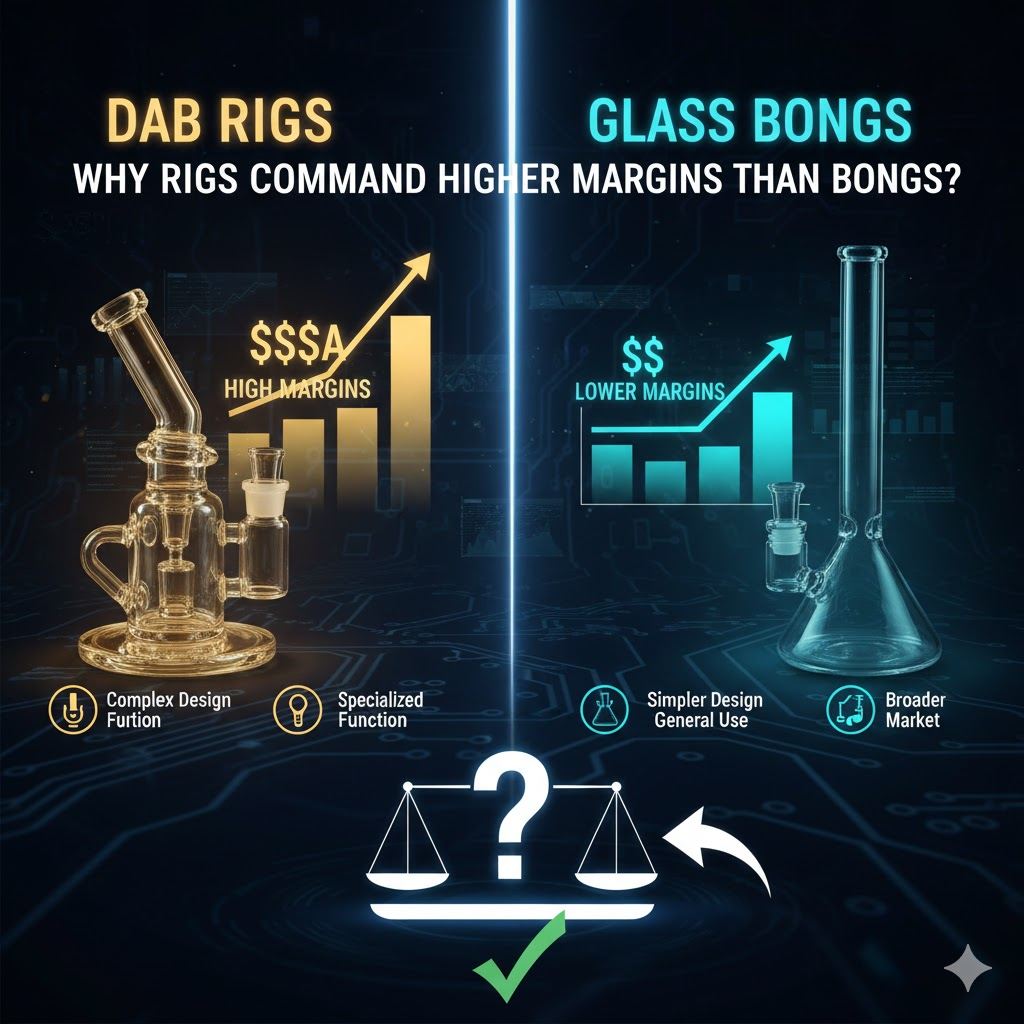
Wholesale dab rigs pricing depends on glass quality, joint precision, and function — engineered borosilicate 3.3 rigs consistently support retail margins above 200%. This guide explains what drives factory prices, how to avoid low-margin volume traps, and how to negotiate tiered wholesale deals.
Optimizing your profit strategy means distinguishing low-margin volume traps from high-yield industrial hardware.
While analyzing wholesale dab rigs prices, retailers find that engineered rigs consistently command 200% margins by serving the affluent concentrate market.
Relying solely on entry-level pipes leaves capital tied up in low-ticket inventory.
We price rigs for a living, and the tiers below are the ones we see in real purchase orders — not averages from a market report. Every price point in this guide is one our own wholesale quotes have covered, from entry-level spoons to premium recyclers. This report benchmarks the mechanics behind these higher valuations, specifically validating Borosilicate 3.3 durability against standard soda-lime.
The Economics of Wholesale Dab Rigs Prices
Unlike tobacco products which are heavily regulated and taxed, glass hardware is an unregulated, high-yield category.
Understanding the tiered structure of wholesale dab rigs prices is critical for maximizing floor space ROI.
According to Investopedia’s guide on pricing strategies, value-based pricing allows premium products to command higher margins based on perceived utility.
For dab rigs, that utility is “flavor preservation” and “durability.”
| Tier | Wholesale Cost | Target Retail | Margin Potential |
|---|---|---|---|
| Entry Level | $12 – $25 | $40 – $70 | Volume Driver (2x) |
| Mid-Tier (Boro) | $26 – $45 | $80 – $140 | Stability (3x) |
| Premium Recycler | $45+ | $150 – $300 | Profit Leader (4x+) |
Why Borosilicate 3.3 Justifies Higher Prices
Cheap imports use “soft glass” (Soda-Lime) which shatters under torch heat. We strictly use Lab-Grade Borosilicate 3.3.
-
Thermal Shock: Boro 3.3 withstands temp shifts >170°C.
-
Annealing: Our 12-hour cycle at 1050°F removes internal stress.
-
The Value: You pay slightly more upfront, but you eliminate the “breakage tax” of returns, securing a higher effective margin.

The “Function Video” Verification
Photos prove aesthetics; only video proves engineering.
We validate the vortex mechanics, drain speed, and zero-splashback promise on your specific batch before the final 70% balance payment.
Validating the “Vortex” Mechanic
Selling high-ticket items like Recyclers ($40+ wholesale cost) requires more than just a photo of the glass. Pairing them with premium dab accessories like terp pearls increases perceived value and justifies higher retail price points.
Complex designs such as Kleins, Torus, and Swiss Percs rely entirely on fluid dynamics. If the water doesn’t cycle correctly, the rig is dead inventory.
Static photography cannot convey function, so we use video evidence to prove three mechanical realities:
- The “Zero Splashback” Test: We confirm the internal tubing successfully cycles water for continuous cooling without splashing the user, a common failure point in cheaper soft-glass knockoffs.
- Proving the Vacuum: For 10mm Mini Rigs, the video demonstrates the necessary restriction and “chug.” This proves the piece creates the tight vacuum required for vaporizing lower-temp terpenes efficiently.
- Drain Efficacy: We verify that the drain system clears water fast enough to prevent stale smoke buildup in the main chamber.
The Pre-Balance “Stress-Test” Protocol
We strictly connect the “Function Video” to strict payment terms to protect your investment.
You should never wire a final balance based on a promise. Our protocol provides tangible proof of quality before cash changes hands.
- Batch Verification: We do not send stock footage. We record stress-test videos of your specific production batch after annealing is complete.
- Cash Flow Protection: This evidence is delivered before the 70% balance payment is due. You verify the function first; then you pay.
- Eliminating Risk: This step ensures you are paying for fully functional, annealed Borosilicate 3.3, filtering out any defective units before they leave the factory floor.
Turn Creative Sketches Into Profitable Reality
Transparent Tiered Pricing and Flexible MOQ
Elfglass publishes volume tiers, explains every cost driver, and works with first-time buyers on realistic minimums and safe payment terms. Tell us your target quantity and we will quote a tier that protects your margin.
MOQ from 100 pieces | BSCI / WRAP / ISO 9001 | NDA before every project
Building the Price Ladder: MOQ, Deposits, and Volume Tiers
A wholesale price is not a number, it is a structure. The ladder starts with the MOQ: at 100 units per design, the factory can hold a dedicated annealing and QC pass for your batch, which is what keeps per-unit cost predictable. The deposit frame is standard, 30% via T/T with the balance against shipping documents, and the volume tiers sit above the MOQ, where larger single-design quantities earn a lower per-unit rate because setup cost spreads across more pieces.
Ask for the ladder in writing before you compare quotes, because the tier boundaries are where pricing games happen. The wholesale starter kit bundles guide shows the same logic applied to mixed-SKU packages, where one order covers multiple price points.
The Function Video as a Pricing Lever
The function video does more than prove quality, it changes the negotiation. When a factory can show the finished rig cycling water before sealing, you are no longer buying an untested promise; you are buying a verified piece, and that verification has value in the quote. It also protects the price you agreed on: if a batch arrives damaged, the video settles the question of whether the glass shipped intact.
That is why the QC protocol belongs in the same conversation as the price. The dab rig QC protocol guide details the checks that run before a unit earns its video, so you know exactly what your per-unit price is paying for.
Reading a Dab Rig Quote: Line Items and Where Margin Hides
A wholesale price is only meaningful next to what it buys. Two quotes at different numbers can be the same rig, or the same number can be a far worse rig — the difference is in the line items. Use this anatomy to read any dab rig quote and to see where the 200%+ margin is actually earned or quietly lost.
| Quote Line Item | What It Tells You | Margin Implication |
|---|---|---|
| Glass grade (Boro 3.3 vs soda-lime) | Whether the rig survives torch heat | Soft glass carries a breakage tax of returns that erodes the premium margin |
| Wall thickness (4mm standard / 5–7mm heavy-duty) | Durability and perceived heft | Heavy-duty supports a higher retail tier and a stronger hand-feel |
| Joint precision (10mm ground, gauge-checked) | Whether the vacuum holds | A leaky joint produces returns, not margin |
| Annealing cycle (12-hour at 1050°F, ASTM C336) | Internal stress removed before packing | A skipped anneal becomes a self-shatter claim months later |
| Function-video verification | Proof the vortex, drain, and zero-splashback work on your batch | A verified rig defends the premium price and settles damage disputes |
| MOQ tier (100 units/design) | Whether setup cost spreads predictably | Tier boundaries are where pricing games hide — get them in writing |
| Deposit and balance terms (30% T/T, 70% vs documents) | Your cash risk and when you verify before paying | Pay the balance after the batch video, never before |
| Packaging (Elf-Guard, breakage under 2%) | Condition on arrival | Breakage above the guarantee is a cost, not a discount |
Negotiating the Price Ladder Without Sacrificing Quality
Price pressure in this category tempts suppliers to cut where the customer cannot see — the glass grade and the anneal. Negotiate hard on the ladder, but never let the discount come out of the material. These tactics move the number while protecting the margin the engineered rig is supposed to earn.
- Get the price ladder in writing before comparing quotes. The tier boundaries are where the games happen; a written ladder turns an ambiguous quote into a comparable one.
- Trade volume for a lower per-unit rate, never for thinner glass or a shorter anneal. A discount funded by the material is a return waiting to happen.
- Use mixed-SKU baskets to reach a tier threshold. One order across several designs can hit a volume rate without overcommitting to a single rig.
- Anchor the function video as a value item. You are paying for a verified piece — and that verification protects the agreed price if a batch arrives damaged.
- Confirm the MOQ still funds a dedicated annealing and QC pass. That dedicated pass is what keeps per-unit cost predictable and quality consistent across the batch.
- Time the balance to the verification. Negotiate the 70% to fall due after you have seen the batch video, not before the rigs are proven.
- Never let “cheaper” mean soda-lime. The 200%+ margin on engineered Borosilicate 3.3 is the entire point of the category; defend the grade first and the price second.
Final Thoughts on Pricing Strategy
Relying on generic soft glass invites disastrous return rates.
True ROI demands Lab-Grade Borosilicate 3.3 hardware.
Your long-term profitability depends on selling distinct, engineered durability.
Never settle for static catalog photos. Demand video verification of vortex mechanics.
Frequently Asked Questions
What are the standard wholesale price tiers for dab rigs?
Market data separates inventory into three profit centers.
Entry-level units ($12–$25 wholesale) drive volume turnover.
Mid-tier borosilicate rigs ($26–$45) balance durability with cost.
Premium recyclers start at $40+ wholesale, targeting enthusiasts who pay for function.
Most retailers apply a 2x to 2.5x keystone markup, with mid-tier glass offering the best stability against breakage returns.
How do glass margins compare to traditional tobacco products?
Tobacco is a low-margin volume trap.
Cigarettes often yield 4–6% margins due to state taxes and federal regulations.
Glass hardware is an unregulated, high-yield category.
Retailers report gross profit margins on glass pipes and dab rigs ranging from 35% to over 200%.
Your tobacco sales get customers in the door, but the glass sales pay the rent.
Why is Borosilicate 3.3 considered mandatory for dab rigs?
Standard “soft glass” (Soda-Lime) expands rapidly when heated, causing it to shatter under the thermal shock of a butane torch.
We strictly use Lab-Grade Borosilicate 3.3 (ASTM C336 standard), which withstands sudden temperature shifts over 170°C.
Critically, the material alone isn’t enough; we run a 12-hour annealing process at 1050°F (565°C) to remove internal stress and prevent the rig from cracking spontaneously.
Does the shift to electronic rigs impact glass inventory?
It creates a massive “Upgrade Market.”
Electronic bases (like Puffco or Carta) come with basic glass.
Consumers demand better function, driving sales for custom borosilicate tops (recyclers) that fit these existing batteries.
For wholesalers, these attachments function like high-margin aftermarket parts.
The profit margin on a replacement glass top is typically 3x higher than on the electronic device itself.
What distinguishes a ‘Recycler’ from a standard rig?
It comes down to flavor preservation. Standard rigs often hold stagnant smoke.
A recycler uses a continuous water loop (vortex function) to cool vapor instantly without requiring high water volume.
This prevents splashback mechanically and preserves terpenes that are otherwise lost in heavy filtration.
Flavor chasers specifically request these for high-end rosin use.
Get a Quote for Your Next Order
Planning dab rig pricing for wholesale buyers? Send us your product spec and target quantity — contact our factory team or message us on WhatsApp, and we will reply with pricing and lead times within 24 hours.
About the Author
Ava Zeng is the founder of Elfglass, a Shenzhen-based borosilicate glass pipe manufacturer serving B2B brands worldwide. She built Elfglass’s pricing and QC standards from the factory floor up — function videos before balance payments, 12-hour annealing cycles, and the Borosilicate 3.3 specs that justify premium wholesale tiers.
Before you commit to a wholesale price tier, read her founder’s story and trust promise, and the guide to vetting a reliable glass pipe manufacturer — the same red-flag checklist Elfglass applies to its own suppliers.
For more context, see this glass pipe pricing tiers and dealer discounts.
Ready to Source Custom Glass Pipes?
Get a free quote within 24 hours. MOQ from 100 pieces. NDA-protected design consultation.
