
Key Takeaways
- Custom percolator designs are constrained by the physics of borosilicate glass—wall thickness, minimum drill diameters, and structural integrity set hard limits on what can be manufactured.
- Complex percolator geometries (multi-chamber, spiral, tree-style) require more skilled labor hours and increase the risk of breakage during annealing, which drives up unit cost.
- A custom percolator design must account for airflow resistance—too many diffusion holes or too-small channels create a draw that is unpleasantly tight for end users.
- The MOQ for custom percolator designs at Elfglass is 100 pieces per SKU, with a 1-3 day sampling window before production begins.
- Brands should provide detailed CAD drawings or dimensioned sketches when requesting custom percolator quotes—vague descriptions lead to inaccurate pricing and rejected samples.
Percolators are one of the most visible differentiators in the wholesale water pipe market. A bong with a distinctive percolator—a spiral diffuser, a multi-chamber cascade, a tree-style array—immediately stands out on a retail shelf and commands a higher price point than a standard straight-tube piece. Water filtration here follows the basic water-pipe principle—smoke drawn through water before reaching the user—which is documented in standard references (water pipe design reference).
For brands looking to differentiate their catalog, custom percolator designs offer a clear path to uniqueness. But not every design that looks good on paper can be manufactured in borosilicate glass. The material has physical constraints—minimum wall thickness, drill diameter limits, thermal stress tolerances—that define a feasibility boundary between what is possible and what will shatter in the annealer. For more context, see this glass manufacturing limits.
If you are evaluating a custom percolator design for your next product line, understanding these feasibility limits helps you avoid costly sampling failures and ensures your design reaches production without compromise. This guide covers the technical constraints, the cost implications, and how to communicate your design intent to a manufacturer so the first sample matches your vision.
What Makes a Percolator “Custom”?
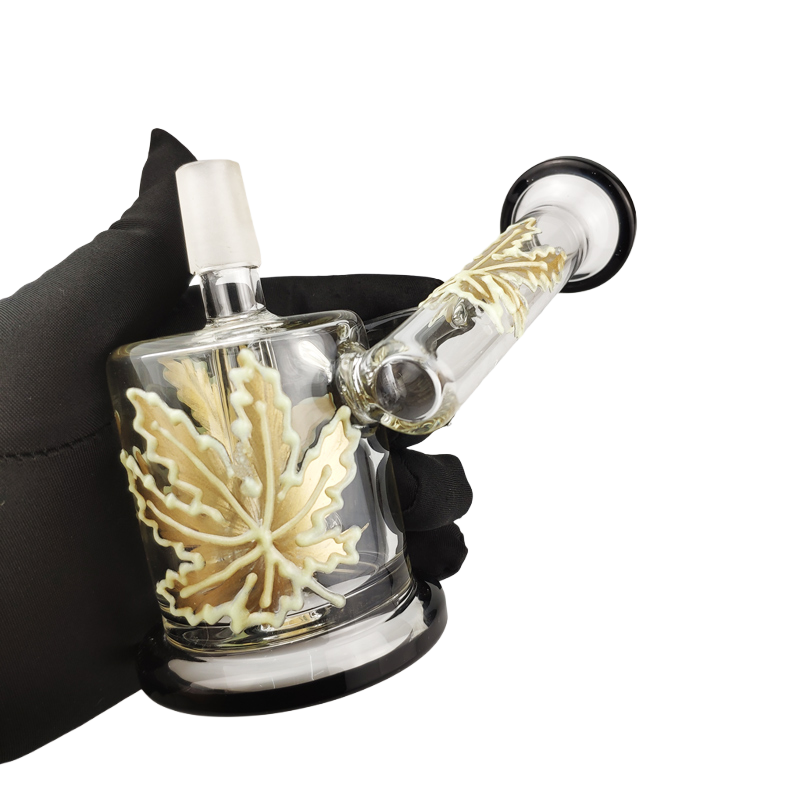
In wholesale manufacturing, a percolator is considered “custom” when it deviates from the factory’s standard catalog shapes. Standard percolators include basic honeycomb discs, simple showerhead arrays, and single-chamber tree percs—designs the factory produces regularly and can quote from existing tooling.
A custom percolator introduces one or more of the following deviations:
- Novel geometry: A spiral diffuser, a cascading multi-tier design, or an asymmetric chamber layout that does not match any existing mold.
- Unique hole patterns: Non-standard drill counts, diameters, or arrangements that require custom jig setup.
- Integrated features: A percolator that incorporates ice catchers, splash guards, or secondary chambers as part of its structure.
- Proprietary branding: A percolator shape that is exclusive to your brand and cannot be sold to other buyers.
Any of these deviations requires the factory to create new tooling, adjust blowing jigs, or train artisans on a new process. That is where the feasibility questions begin.
The Physics of Borosilicate Glass: Hard Constraints
Borosilicate glass is the standard material for quality water pipes because of its thermal shock resistance and clarity. But it is not infinitely malleable. Several physical properties set hard boundaries on custom percolator design:
Wall thickness. The minimum practical wall thickness for a functional percolator is approximately 2–3mm. Thinner walls are prone to cracking during the cooling phase and cannot withstand the mechanical stress of daily use. A design that calls for sub-2mm walls in any load-bearing section will fail in production.
Drill diameter. Diffusion holes drilled into a percolator disc have a minimum practical diameter of about 1mm. Holes smaller than this clog easily with resin and are difficult to drill cleanly without chipping the surrounding glass. Maximum hole diameter is limited by structural integrity—holes that remove too much material from a disc weaken it to the point of failure.
Thermal stress. During the blowing and annealing process, uneven wall thickness creates differential cooling rates, which generate internal stress. A percolator with thick sections adjacent to thin sections is highly likely to crack in the annealer. Good design distributes mass evenly.
Joint strength. Where the percolator connects to the main tube or chamber, the joint must be strong enough to survive handling and cleaning. A joint that is too small relative to the percolator mass will snap under minimal torque.
| Constraint | Minimum / Maximum | Failure Mode if Violated |
|---|---|---|
| Wall thickness | ~2–3mm minimum | Cracking during annealing or use |
| Drill hole diameter | ~1mm minimum, ~5mm maximum (disc) | Clogging (too small) or structural weakness (too large) |
| Mass distribution | Even thickness throughout | Thermal stress cracks in annealer |
| Joint size | Proportional to percolator mass | Snap-off at connection point |
| Overall dimensions | Limited by furnace and annealer size | Cannot fit in production equipment |
These are not negotiable limits. They are dictated by the material itself. A design that violates any of them will not reach production—no matter how appealing it looks in a CAD rendering.
Airflow Resistance: The User Experience Constraint
Beyond the physics of glass, there is a second constraint that determines whether a custom percolator design succeeds: airflow resistance. A percolator works by forcing smoke through a series of small holes or slits, which breaks the smoke into finer bubbles and increases surface area for filtration. But each hole adds resistance to the draw.
A design with too many diffusion holes—or holes that are too small—creates a draw that feels uncomfortably tight. Users must pull harder to get smoke through the piece, which defeats the purpose of smooth filtration. Conversely, a design with too few or too-large holes provides insufficient diffusion and feels like smoking through a straight tube.
The sweet spot depends on the percolator type. A honeycomb disc with 30–50 holes of 1.5–2mm diameter typically provides a balanced draw. A tree perc with 6–8 arms of similar hole count works well. A spiral diffuser needs careful calculation of channel width and pitch to maintain acceptable resistance.
When designing a custom percolator, always prototype the airflow. A manufacturer with experience in percolator design can advise on hole counts and diameters based on the intended chamber volume and target user profile.
Percolator Types and Their Feasibility Profiles
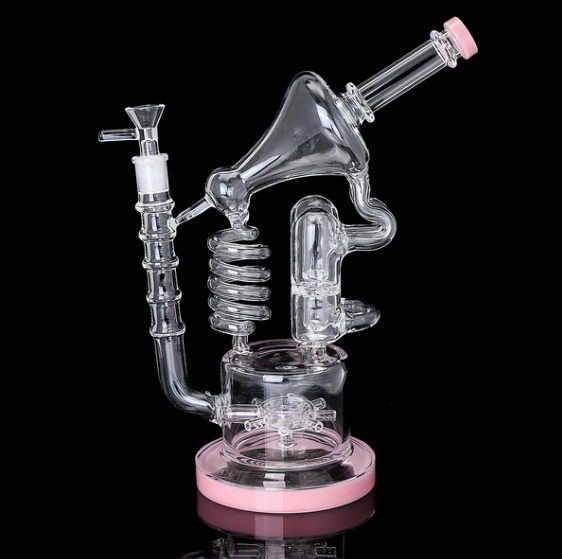
Different percolator types present different manufacturing challenges. Here is a feasibility assessment of the most common custom designs:
| Percolator Type | Feasibility | Key Constraints |
|---|---|---|
| Honeycomb disc | High | Standard design; easy to customize hole count and diameter. Low risk. |
| Tree perc | High | Multiple arms require even spacing and consistent wall thickness. Moderate complexity. |
| Spiral / helix diffuser | Moderate | Requires precise channel geometry. Tight spirals increase resistance. Higher skill requirement. |
| Multi-chamber cascade | Moderate to Low | Each chamber adds a blow-and-seal step. Risk of trapped air pockets. High labor cost. |
| Matrix / mesh perc | Low | Very fine drilling pattern. High breakage risk during production. Not recommended for high-volume orders. |
| Showerhead | High | Simple slit pattern around a dome. Easy to customize. Low risk. |
Honeycomb and tree percs are the safest bets for custom designs—they are well-understood geometries that factories produce regularly. Spiral and multi-chamber designs are feasible but carry higher risk and cost. Matrix percs are generally not recommended for production runs due to the high breakage rate.
For a comprehensive comparison of percolator types and their performance characteristics, see the percolator types comparison guide.
Cost Implications of Custom Percolator Complexity
Every deviation from a standard percolator design adds cost. Here is how complexity translates to pricing:
New tooling. A custom percolator requires new blowing jigs or molds. The tooling cost is amortized across the production run, so it matters more at lower quantities. At a 100-piece MOQ, the tooling cost per unit is significant. At 500 pieces, it becomes negligible.
Labor time. Complex percolators take longer to blow and finish. A standard honeycomb disc might add 2 minutes to the blowing cycle. A multi-chamber cascade could add 10–15 minutes. At a factory with 20 employees and a monthly capacity of 10,000 pieces, labor time directly affects throughput and unit cost.
Breakage rate. More complex designs have higher breakage rates during annealing and finishing. A 10% breakage rate on a standard perc might rise to 25–30% on a complex custom design. The wasted material and labor are factored into the unit price.
Sampling iterations. Custom percolators often require multiple sampling rounds to dial in the airflow and aesthetics. Each iteration costs time and material. Brands should budget for 2–3 sampling cycles before approving production.
The practical takeaway: a custom percolator design will cost more than a standard one, but the premium is justified if the design differentiates your product on the shelf. The key is to understand the cost drivers upfront and design within feasible parameters to minimize unnecessary expense.
How to Communicate Your Custom Percolator Design to a Manufacturer
The quality of your initial design brief determines how accurately the factory can quote and sample your custom percolator. Here is what to include:
CAD drawings or dimensioned sketches. Provide exact dimensions for the percolator—diameter, height, wall thickness, hole diameters, hole spacing, and joint sizes. A sketch with approximate measurements is better than nothing, but CAD files produce the most accurate quotes.
Airflow requirements. Specify the intended draw resistance. Do you want a loose, easy pull or a tighter, more filtered draw? This guides the factory’s recommendation on hole count and diameter.
Reference images. If your design is inspired by an existing percolator type, include photos or links. This gives the factory a visual reference for the general style, even if the specifics differ.
Material and finish specs. Confirm that the percolator will be made from borosilicate glass and specify any color or finish requirements (clear, colored, fumed, etc.).
MOQ and timeline expectations. State your target order quantity and desired delivery date. This helps the factory assess whether the design is viable at your scale and schedule.
For a template and detailed guidance on writing effective design briefs, see the guide to writing a glass pipe design brief.
Designing a Custom Percolator?
Elfglass reviews your custom percolator against borosilicate wall, airflow and diffusion limits before cutting a single piece, so your design is feasible and functional. Send your percolator sketch and get a quote within 12 hours.
MOQ from 100 pieces | BSCI / WRAP / ISO 9001 | NDA before every project
What Buyers Should Verify Before Ordering Custom Percolators
Before committing to a production run of custom percolator pieces, verify the following:
Physical sample approval. Never approve production based on CAD renderings alone. Require a physical sample that you can hold, inspect, and test for airflow. Check for even wall thickness, clean drill holes, and secure joints.
Breakage rate disclosure. Ask the factory what breakage rate they expect for your design during production. A transparent factory will provide an estimate based on similar past projects.
Exclusivity confirmation. If your percolator design is proprietary, confirm in writing that the factory will not produce the same design for other buyers. This should be covered in your NDA and purchase agreement.
Quality control standards. Define what constitutes an acceptable piece vs. a reject. Specify tolerance ranges for dimensions, hole alignment, and finish quality. This prevents disputes during QC inspection.
At Elfglass, we welcome custom percolator inquiries and work closely with brands to ensure designs are feasible before quoting. Our 1-3 day sampling turnaround means you can iterate quickly and reach production with confidence. Contact our team to discuss your custom percolator project.
Bottom Line: Design Within the Boundaries
Custom percolator designs are a powerful way to differentiate your water pipe catalog. But the boundaries of what is manufacturable are defined by the physics of borosilicate glass, not by the limits of imagination. Understanding those boundaries—wall thickness, drill diameters, thermal stress, airflow resistance—allows you to design ambitiously while staying within the realm of the possible.
The most successful custom percolator projects are those where the brand and the manufacturer collaborate early, iterating on the design until it balances aesthetics, function, and manufacturability. Start with a clear brief, expect sampling iterations, and approve only after holding a physical sample in your hands.
Ready to explore custom percolator options for your next collection? Visit our wholesale water pipes catalog or review our OEM process to get started.
Frequently Asked Questions
What is the minimum wall thickness for a custom percolator?
The minimum practical wall thickness for a borosilicate glass percolator is approximately 2–3mm. Thinner walls are prone to cracking during annealing and cannot withstand the mechanical stress of daily use.
Can any percolator design be manufactured?
No. Designs must respect the physical constraints of borosilicate glass—wall thickness, drill diameter limits, thermal stress tolerances, and airflow resistance. A design that violates these constraints will fail in production.
How much does a custom percolator cost compared to a standard one?
Custom percolators cost more due to new tooling, additional labor time, and higher breakage rates. The premium varies by complexity but typically ranges from 20% to 50% above standard percolator pricing at equivalent volumes.
What is the MOQ for custom percolator designs?
At Elfglass, the MOQ for custom percolator designs is 100 pieces per SKU. This allows the factory to amortize tooling costs while keeping the initial commitment manageable for emerging brands.
How long does it take to sample a custom percolator?
Elfglass offers a 1-3 day sampling turnaround for custom percolator designs. Multiple sampling iterations may be needed to dial in airflow and aesthetics before production approval.
About the Author
Ava Zeng is the founder of Elfglass, a Shenzhen-based borosilicate glass pipe manufacturer serving B2B brands worldwide. Every guide on this site is grounded in her production-floor experience— the annealing lines, QC checkpoints, and export orders behind each claim.
Before you commit to a supplier, read her founder’s story and trust promise, and the guide to vetting a reliable glass pipe manufacturer— the same red-flag checklist Elfglass applies to its own suppliers.
Ready to Source Custom Glass Pipes?
Get a free quote within 24 hours. MOQ from 100 pieces. NDA-protected design consultation.
